Vladimir Putin
Last updated: May 29, 2026
Vladimir Putin has been the central figure in Russia’s management of the South Caucasus for over two decades. His administration brokered the November 9, 2020 ceasefire that ended the 44-Day War, deployed Russian peacekeepers to Nagorno Karabakh (Artsakh), and positioned Russia as the indispensable mediator between Armenia and Azerbaijan. That architecture has since collapsed: Russia failed to prevent the Lachin Corridor blockade , took no action during Azerbaijan’s September 2023 offensive that resulted in the ethnic cleansing of Artsakh’s entire Armenian population, and watched as Armenia systematically withdrew from Russian-led security and economic structures.
The Ukraine War , which Putin launched in February 2022, fundamentally altered Russia’s capacity and willingness to act in the South Caucasus. With military resources committed to Ukraine and diplomatic isolation from the West deepening, Moscow’s ability to enforce its South Caucasus commitments diminished sharply. Putin’s personal relationships with Aliyev and Pashinyan — and his apparent willingness to tolerate Azerbaijan’s territorial advances — have become a template for how great-power guarantees can unravel when the guarantor’s interests diverge from the guaranteed party’s needs.
Groong covers Putin’s role in South Caucasus affairs through direct analysis of Russian policy, tracking of the peace process mediation formats, and assessment of what Russian withdrawal from its traditional mediating role means for the durability of any future Armenia-Azerbaijan settlement.
Groong episodes that include this tag
Below are all Groong episodes tagged with Vladimir Putin.
William Bairamian, Arthur Khachikyan: Artsakh Under Blockade - Day 31 [EP199]
Posted on Wednesday, Jan 11, 2023 | Category: Artsakh, Politics, Armenia, Nagorno Karabakh, Russia, Diaspora, Artsakh Blockade, Turkey, Azerbaijan, NATO, Ukraine, Georgia, Economy, European Union, China, Genocide, Middle East | Series: cog, video
Guests:
- William Bairamian , founder and editor of The Armenite. He has written extensively on Armenian politics, culture, and society. He received degrees in international affairs from Columbia University and UCLA.
- Arthur Khachikyan , International Relations expert from Stanford University, specializing in Intervention. He currently teaches at the Russian Armenian University in Yerevan.
âThis is a repeat of Srebrenica. To gradually strangle and force the people to leave.â -Arthur Khachikyan
Topic:
More than 120,000 people remain trapped in the Republic of Artsakh (or Nagorno-Karabakh)
Read MoreWilliam Bairamian, Arthur Khachikyan: Artsakh Under Blockade - Day 31 [EP199]
Posted on Wednesday, Jan 11, 2023 | Category: Artsakh, Politics, Armenia, Nagorno Karabakh, Russia, Diaspora, Artsakh Blockade, Turkey, Azerbaijan, NATO, Ukraine, Georgia, Economy, European Union, China, Genocide, Middle EastGuests:
- William Bairamian , founder and editor of The Armenite. He has written extensively on Armenian politics, culture, and society. He received degrees in international affairs from Columbia University and UCLA.
- Arthur Khachikyan , International Relations expert from Stanford University, specializing in Intervention. He currently teaches at the Russian Armenian University in Yerevan.
âThis is a repeat of Srebrenica. To gradually strangle and force the people to leave.â -Arthur Khachikyan
Topic:
More than 120,000 people remain trapped in the Republic of Artsakh (or Nagorno-Karabakh)
Read MoreReflections on Artsakh Blockade | Is Russia Pressuring Armenia to join Union State | Bill to Control Internet during Martial Law | Highlights and Lowlights of 2022 | Predictions for 2023 [EP197]
Posted on Tuesday, Jan 3, 2023 | Category: Armenia, Politics, Artsakh, Nagorno Karabakh, Azerbaijan, Russia, Ukraine, Artsakh Blockade, Lebanon, Syria, Turkey, European Union, Genocide, Israel, Economy, Georgia, Human Rights | Series: wir
Guest:
Topic:
- Hovikâs Reflections from the Artsakh Blockade Interviews
- Is Russia Pressuring Armenia to join a âUnion Stateâ?
- Government Bill to Control the Internet During Martial Law
- Highlights and Lowlights from Armenian News in 2022
- Predictions for 2023
Episode 197 | Recorded: January 3, 2023
Reflections on Artsakh Blockade | Is Russia Pressuring Armenia to join Union State | Bill to Control Internet during Martial Law | Highlights and Lowlights of 2022 | Predictions for 2023 [EP197]
Posted on Tuesday, Jan 3, 2023 | Category: Armenia, Politics, Artsakh, Nagorno Karabakh, Azerbaijan, Russia, Ukraine, Artsakh Blockade, Lebanon, Syria, Turkey, European Union, Genocide, Israel, Economy, Georgia, Human RightsGuest:
Topic:
- Hovikâs Reflections from the Artsakh Blockade Interviews
- Is Russia Pressuring Armenia to join a âUnion Stateâ?
- Government Bill to Control the Internet During Martial Law
- Highlights and Lowlights from Armenian News in 2022
- Predictions for 2023
Episode 197 | Recorded: January 3, 2023
Karen Vrtanesyan: Artsakh Under Blockade - Day 19 [EP196]
Posted on Friday, Dec 30, 2022 | Category: Artsakh, Politics, Armenia, Azerbaijan, Russia, Turkey, Artsakh Blockade, Nagorno Karabakh, Ukraine, Iran, Israel, NATO, Syria | Series: cog, video
Guest:
- Karen Vrtanesyan , expert on military and warfare strategies with a focus on Armenia and its neighboring region. Co-founder of the website razm.info.
“This is not a humanitarian crisis. This is a political crisis, a crisis of statehood. -Karen Vrtanesyan”
Topic:
This interview is a continuation of the collaboration between Groong and 168 Hours aiming to bring you more English-language coverage on the developments of this very serious humanitarian crisis in progress.
Links:
- 168 Hours: https://168.am
- Groong: https://podcasts.groong.org
Episode 196 | Recorded: December 30, 2022
Karen Vrtanesyan: Artsakh Under Blockade - Day 19 [EP196]
Posted on Friday, Dec 30, 2022 | Category: Artsakh, Politics, Armenia, Azerbaijan, Russia, Turkey, Artsakh Blockade, Nagorno Karabakh, Ukraine, Iran, Israel, NATO, SyriaGuest:
- Karen Vrtanesyan , expert on military and warfare strategies with a focus on Armenia and its neighboring region. Co-founder of the website razm.info.
“This is not a humanitarian crisis. This is a political crisis, a crisis of statehood. -Karen Vrtanesyan”
Topic:
This interview is a continuation of the collaboration between Groong and 168 Hours aiming to bring you more English-language coverage on the developments of this very serious humanitarian crisis in progress.
Links:
- 168 Hours: https://168.am
- Groong: https://podcasts.groong.org
Episode 196 | Recorded: December 30, 2022
Edgar Elbakyan: Artsakh Under Blockade: Day 13 [EP192]
Posted on Saturday, Dec 24, 2022 | Category: Artsakh, Politics, Armenia, Azerbaijan, Russia, Turkey, Artsakh Blockade, Nagorno Karabakh, Iran, Genocide, Human Rights, Georgia, Israel, Ukraine | Series: cog, video
Guest:
- Edgar Elbakyan , a political scientist and social thinker based in Yerevan, Armenia. He is a co-founder of the Armenian Project non-profit organization, which contributes to enhancing Armenian national civil society.
“The problem is not resources or power, the problem is how you put forward your goals”
Topic:
The blockade of Artsakh is now 13 days old. More than 120,000 people remain trapped in the Republic of Artsakh (or Nagorno-Karabakh). Supermarket shelves are empty. Essential medicine is running out.
On Friday, December 23, thatâs yesterday, a meeting between
Read MoreEdgar Elbakyan: Artsakh Under Blockade: Day 13 [EP192]
Posted on Saturday, Dec 24, 2022 | Category: Artsakh, Politics, Armenia, Azerbaijan, Russia, Turkey, Artsakh Blockade, Nagorno Karabakh, Iran, Genocide, Human Rights, Georgia, Israel, UkraineGuest:
- Edgar Elbakyan , a political scientist and social thinker based in Yerevan, Armenia. He is a co-founder of the Armenian Project non-profit organization, which contributes to enhancing Armenian national civil society.
“The problem is not resources or power, the problem is how you put forward your goals”
Topic:
The blockade of Artsakh is now 13 days old. More than 120,000 people remain trapped in the Republic of Artsakh (or Nagorno-Karabakh). Supermarket shelves are empty. Essential medicine is running out.
On Friday, December 23, thatâs yesterday, a meeting between
Read MoreTevan Poghosyan: Artsakh Under Blockade: Day 9 [EP188]
Posted on Wednesday, Dec 21, 2022 | Category: Artsakh, Politics, Armenia, Azerbaijan, Russia, Turkey, Artsakh Blockade, Nagorno Karabakh, Iran, Ukraine, China, Human Rights | Series: cog, video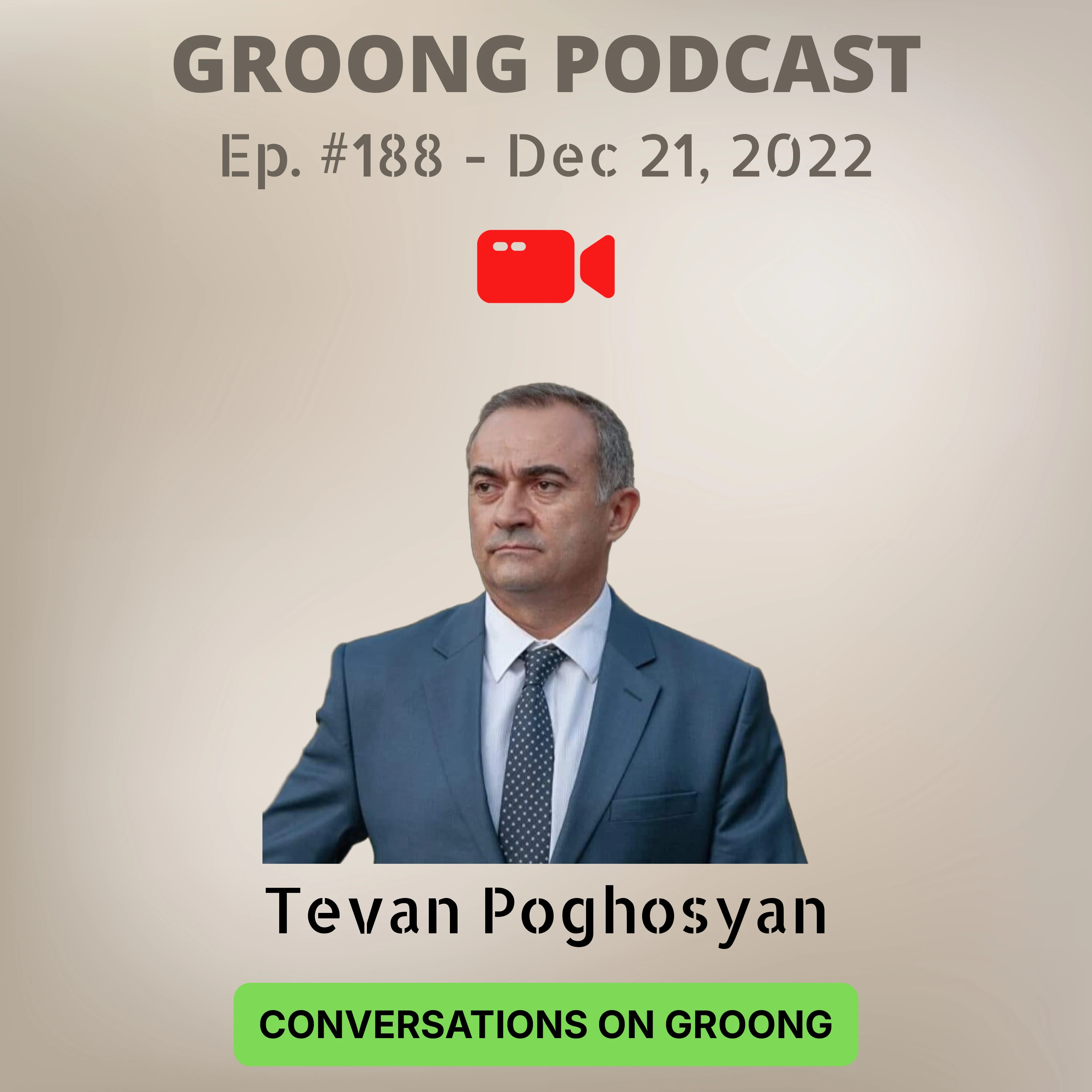
âPashinyan, why don’t you go and shake Artak Beglaryanâs hand, like you did in Shushi in 2019â - Tevan Poghosyan
Guest:
- Tevan Poghosyan , is president of the International Center for Human Development in Yerevan. Mr. Poghosyan was an MP in the National Assembly between 2012 and 2017 from the Heritage party. From 1997 to 1999 he served as the Nagorno-Karabakh Public Affairs Office Director in Washington, D.C.
Topic:
This is Day 9 of the blockade of Artsakh by Azerbaijan. This interview is a continuation of the collaboration between Groong and 168 Hours aiming to bring you more
Read More