Ukraine War
Last updated: June 11, 2026
The Russian Invasion and Its Timing
Russia’s full-scale invasion of Ukraine in February 2022 marked a strategic turning point whose consequences continue to reshape the South Caucasus. When Russia invaded Ukraine, it unleashed a war that would absorb Russian military capacity, provoke Western sanctions, and fundamentally alter Moscow’s ability to function as a regional hegemon. The Russia-Ukraine conflict, rather than remaining a European problem, became the primary lens through which Armenia had to recalculate its own security and geopolitical position. The Russian invasion of Ukraine came at the worst possible moment for Armenia—just as Yerevan was still reeling from the 2020 44-Day War , while Russian peacekeepers were deployed in Artsakh (Nagorno Karabakh ), and while Armenia remained dependent on Moscow for security guarantees that were about to become far less credible.
Russia’s Constrained Capacity and the Credibility Crisis
The Ukraine war stretched Russian military capacity to near-breaking point, diminished Moscow’s leverage as a security guarantor in the South Caucasus, and accelerated the credibility crisis of the CSTO — the collective security alliance that Armenia had relied on since 1992. Russia’s preoccupation with Ukraine meant that Russia could not effectively deter Azerbaijan, could not rapidly resupply Armenian forces, and could not credibly threaten to intervene on Armenia’s behalf. The Russia-Ukraine conflict became a test of whether Russia’s security commitments to smaller states meant anything at all. The answers that emerged were sobering for states depending on Russian protection.
Beyond military constraints, the Ukraine war fundamentally altered Russia’s relationship with Azerbaijan . As Western sanctions isolated Russia from global energy markets, Azerbaijan became strategically indispensable: the country re-packaged Russian energy and resold it to Europeans who were formally sanctioning Russia, providing Moscow with a crucial workaround to maintain revenue flows. Additionally, Azerbaijan emerged as a vital land communication corridor between Russia and Iran and the broader Middle East—a route of growing importance as Russia faced isolation from Europe. These economic and logistical dependencies meant that Russia could not afford to pressure or punish Azerbaijan, even as Azerbaijan threatened Armenia. The Russia-Ukraine conflict thus inverted Russia’s incentives in the South Caucasus: rather than deterring Azerbaijani aggression, Russia had reasons to accommodate Azerbaijani interests.
Direct Impact on Armenia’s Security
For Armenia, the Ukraine War’s most direct and catastrophic consequence was the removal of Russia as an available security backstop at the moment Armenia needed one most. The September 2023 Azerbaijani offensive—which resulted in the ethnic cleansing of the entire Armenian population of Artsakh—occurred against a backdrop of Russian military preoccupation with Ukraine and diplomatic isolation from the West. The Russian peacekeeping force deployed in Artsakh under the November 2020 ceasefire could not prevent the 2023 operation. Russia’s attention was elsewhere; the Armenian population of Artsakh—120,000 people who had expected protection from the ceasefire agreement—were ultimately on their own. The war also disrupted Russian arms supplies to Armenia, cut off technology transfers, and made Moscow an unreliable partner for defense procurement. The Russia-Ukraine conflict thus forced Armenia to rapidly diversify its security partnerships and pursue weapons from France, India, and other sources—a process that would have taken far longer without the urgency imposed by Russian unavailability.
The Western Pivot
The Ukraine war shifted the strategic calculations for Armenia’s Western alignment. As Pashinyan and Civil Contract reassessed Armenia’s position in a world where Russia could not be trusted, the pivot toward France, the EU, India, and the United States became not just geopolitically logical but strategically imperative. The war in Ukraine provided political cover to justify Armenia’s reorientation—it was not ideological choice but strategic necessity. Western governments, for their part, saw in Armenia an opportunity to build leverage in the South Caucasus and to bind a historically Russian-aligned state closer to the Euro-Atlantic orbit. The Ukraine war thus became the catalyst for Armenia’s geopolitical realignment, though the realignment would remain incomplete and contested, particularly as Armenia continued to depend on Russian energy, trade, and historical ties.
Groong’s Coverage and Analysis
Groong covers the Ukraine War not as a standalone topic but as a variable that shapes every calculation in Armenian foreign policy. Episodes in this category examine how Russia’s military capacity, diplomatic constraints, and weakened regional position affect Russian behavior in the South Caucasus, whether the Russia-Ukraine conflict has fundamentally altered Armenia’s security environment, the viability of different negotiating formats for the Armenia-Azerbaijan peace process , and the broader restructuring of European and Eurasian security that the war has accelerated. The conflict illuminates the reality that regional powers face new constraints in projecting influence, and that smaller states must continuously adapt their security strategies to changing circumstances beyond their control.
Groong episodes that include this tag
Below are all Groong episodes tagged with Ukraine War.
Benyamin Poghosyan - Trump Ultimatum to Putin, Corridor Pressures, DC Summit, Kitchen Sink | Ep 457, Aug 3, 2025 [EP457]
Posted on Tuesday, Aug 5, 2025 | Category: Armenia, Politics, Poll, Artsakh, Nagorno Karabakh, Azerbaijan, Iran, Ukraine, Russia, India, China, Armenian Genocide, NATO | Series: wir, video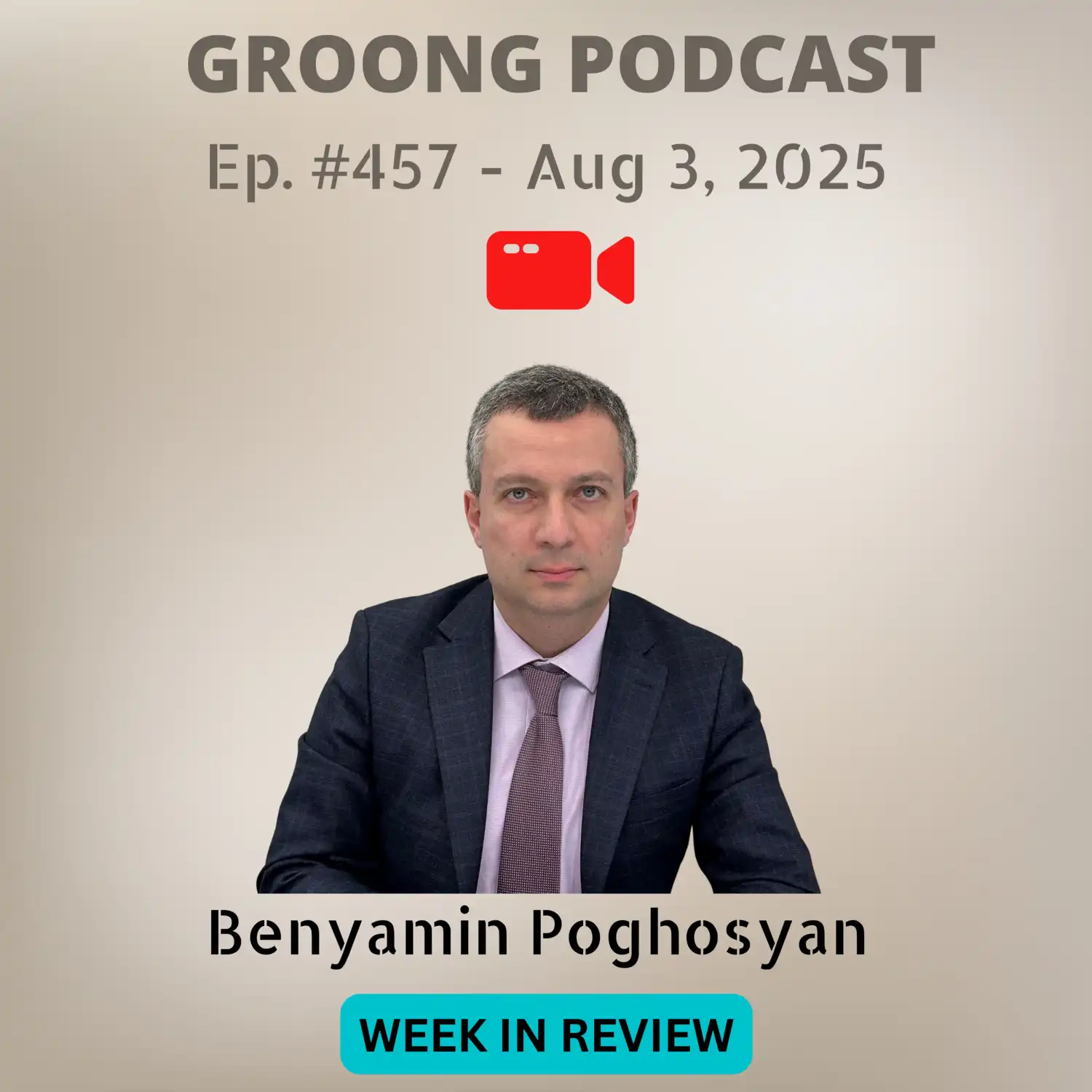
Groong Links:
Guest:
Topics:
- Trump Ultimatum to Putin
- US Sanctions effect on Armenia
- Turkey, US, and Armeniaâs Territory
- The Kitchen Sink
Episode 457 | Recorded: August 3, 2025
Benyamin Poghosyan - Trump Ultimatum to Putin, Corridor Pressures, DC Summit, Kitchen Sink | Ep 457, Aug 3, 2025 [EP457]
Posted on Tuesday, Aug 5, 2025 | Category: Armenia, Politics, Poll, Artsakh, Nagorno Karabakh, Azerbaijan, Iran, Ukraine, Russia, India, China, Armenian Genocide, NATOGroong Links:
Guest:
Topics:
- Trump Ultimatum to Putin
- US Sanctions effect on Armenia
- Turkey, US, and Armeniaâs Territory
- The Kitchen Sink
Episode 457 | Recorded: August 3, 2025
Arthur Khachatryan - Artsakh Negotiations, Armenian Domestic Politics | Ep 455, Jul 27, 2025 [EP455]
Posted on Sunday, Jul 27, 2025 | Category: Georgia, Politics, Artsakh, Nagorno Karabakh, Azerbaijan, Armenian Church, Armenia, Russia, Turkey, Human Rights, Ukraine, Genocide | Series: cog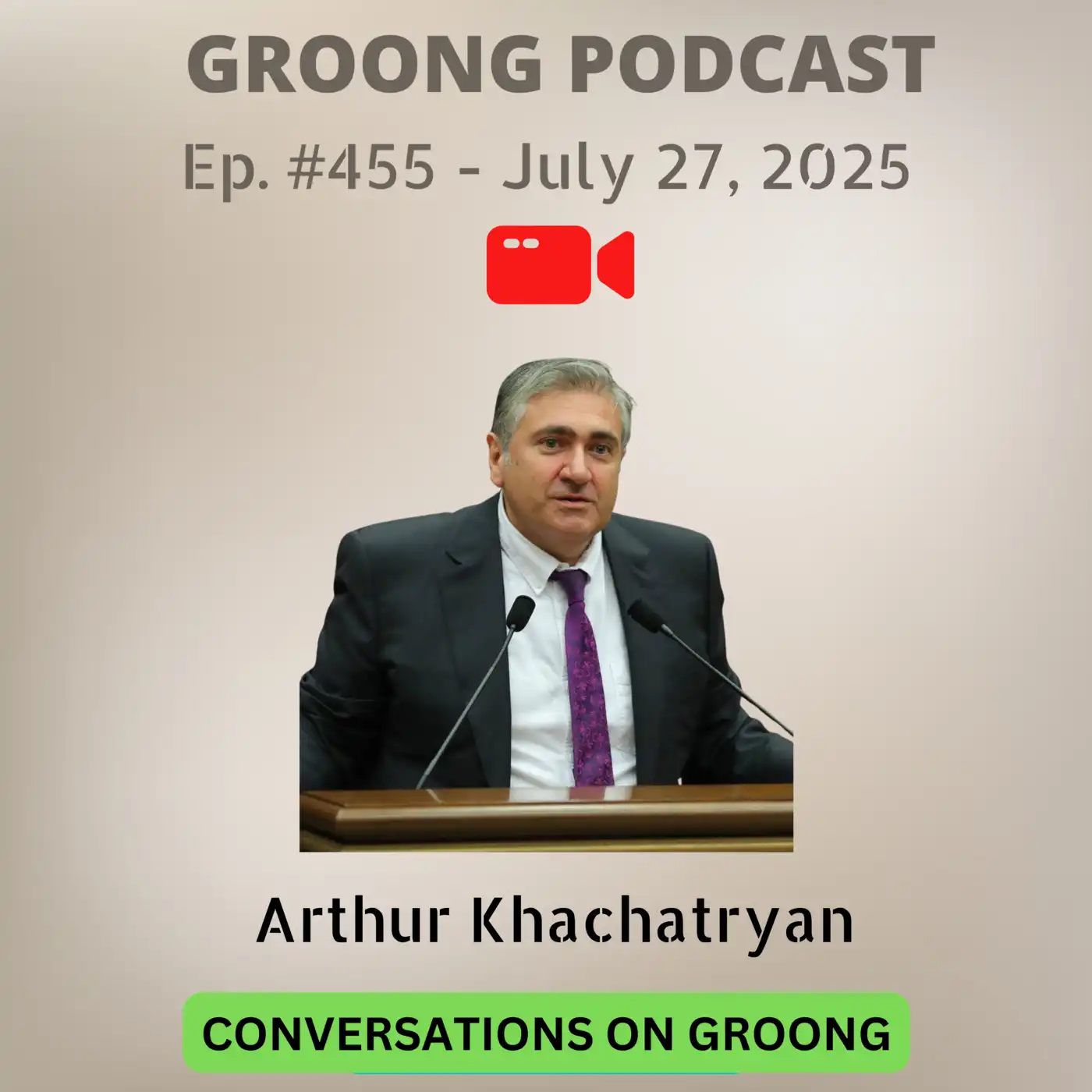
Groong Links:
Guest:
- Arthur Khachatryan , MP
Topics:
- Artsakh Negotiations
- Armenian Domestic Politics
Episode 455 | Recorded: July 25, 2025
Arthur Khachatryan - Artsakh Negotiations, Armenian Domestic Politics | Ep 455, Jul 27, 2025 [EP455]
Posted on Sunday, Jul 27, 2025 | Category: Georgia, Politics, Artsakh, Nagorno Karabakh, Azerbaijan, Armenian Church, Armenia, Russia, Turkey, Human Rights, Ukraine, GenocideGroong Links:
Guest:
- Arthur Khachatryan , MP
Topics:
- Artsakh Negotiations
- Armenian Domestic Politics
Episode 455 | Recorded: July 25, 2025
Archil Sikharulidze - Why does Georgia matter for the EU | Ep 454, Jul 24, 2025 [EP454]
Posted on Thursday, Jul 24, 2025 | Category: Georgia, Politics, Armenia, Azerbaijan, Russia, USA, Armenian Church, Nagorno Karabakh, European Union, Iran, China, Turkey, Ukraine, NATO, Economy, Human Rights, India, Israel | Series: cog
Groong Links:
Guest:
Topics:
- EU Strategy in the South Caucasus
- Attacks on the National Church
- 2025 Local Election Politics
Episode 454 | Recorded: July 22, 2025
Archil Sikharulidze - Why does Georgia matter for the EU | Ep 454, Jul 24, 2025 [EP454]
Posted on Thursday, Jul 24, 2025 | Category: Georgia, Politics, Armenia, Azerbaijan, Russia, USA, Armenian Church, Nagorno Karabakh, European Union, Iran, China, Turkey, Ukraine, NATO, Economy, Human Rights, India, IsraelGroong Links:
Guest:
Topics:
- EU Strategy in the South Caucasus
- Attacks on the National Church
- 2025 Local Election Politics
Episode 454 | Recorded: July 22, 2025
Fyodor Lukyanov - Israel Attacks Iran: Perspectives From Russia | Ep 447, Jun 16, 2025 [EP447]
Posted on Monday, Jun 16, 2025 | Category: Iran, Russia, Armenia, Israel, Politics, Azerbaijan, Georgia, Geopolitics, Turkey, Ukraine, Armenian Church, Artsakh Blockade, NATO, China, Syria, Middle East, Economy | Series: cog, video
Groong Links:
Guest:
Topics:
- Israel hits Iran, talks collapse
- Armenia at risk if Iran weakens
- Russia hardens stance on Ukraine
Episode 447 | Recorded: June 15, 2025
Fyodor Lukyanov - Israel Attacks Iran: Perspectives From Russia | Ep 447, Jun 16, 2025 [EP447]
Posted on Monday, Jun 16, 2025 | Category: Iran, Russia, Armenia, Israel, Politics, Azerbaijan, Georgia, Geopolitics, Turkey, Ukraine, Armenian Church, Artsakh Blockade, NATO, China, Syria, Middle East, EconomyGroong Links:
Guest:
Topics:
- Israel hits Iran, talks collapse
- Armenia at risk if Iran weakens
- Russia hardens stance on Ukraine
Episode 447 | Recorded: June 15, 2025
Transcript: Fyodor Lukyanov - Israel Attacks Iran: Perspectives From Russia | Ep 447, Jun 16, 2025 [EP447]
Posted on Monday, Jun 16, 2025 | Category: Iran, Russia, Armenia, Israel, Politics, Azerbaijan, Georgia, Geopolitics, Turkey, Ukraine, Armenian Church, Artsakh Blockade, NATO, China, Syria, Middle East, Economy, TranscriptIn this episode of Conversations on Groong, we speak with Fyodor Lukyanov, editor-in-chief of Russia in Global Affairs, to analyze the geopolitical fallout from Israel’s surprise military campaign against Iran, known as Operation Rising Lion. We explore how the attacks may sabotage U.S.-Iran nuclear negotiations, shift Russia’s strategic calculus, and destabilize the South Caucasus—particularly Armenia’s Syunik province. We also examine the implications for Russia-Iran relations, the Zangezur corridor, and Azerbaijan’s military posture. Finally, we discuss Ukraine’s Operation Spiderweb, recent Read More