Borders
Last updated: June 10, 2026
Armenia’s land borders span approximately 1,570 kilometers and connect it to four neighboring countries: Azerbaijan (910 km to the east and north), Turkey (311 km to the west), Iran (910 km to the south and southeast), and Georgia (164 km to the north). The borders define Armenia’s access to regional markets, energy supplies, and transit options. Turkey has maintained a unilateral blockade of Armenia since 1993, closing its land border and airspace. Following the ceasefire agreements of 1994 and 2020, border demarcation and delimitation with Azerbaijan have remained contested, with disputes over enclaves, territorial control, and transit corridor status creating persistent tensions.
Armenia’s borders determine its survival as a sovereign state. The loss of Artsakh (Nagorno Karabakh) in a 24-hour offensive on September 19–20, 2023, ethnically cleansed the enclave of its more than 150,000 Armenian inhabitants and reduced Armenian territorial control to the Republic proper. The primary obstacle to the Armenia-Azerbaijan peace process is Azerbaijan’s precondition that Armenia amend its constitution to remove references to Artsakh and recognize Azerbaijani territorial claims. Border demarcation and delimitation, while technically complex and lengthy, is proceeding but Armenian opposition parties criticize the Pashinyan government for accepting Azerbaijan’s sequencing priorities in determining which areas are demarcated first. Beyond the constitutional demands and demarcation process, Azerbaijan demands implementation of transit arrangements that would connect mainland Azerbaijan to Nakhijevan across Armenian Syunik province. Armenia fears that such arrangements, marketed as TRIPP (Trump Route for International Peace and Prosperity) by Washington, would cement Azerbaijani and Turkish control over Armenian territory and sever Armenia’s ability to maintain open transit with Iran through Syunik , a critical lifeline for trade and energy independent of hostile neighbors.
The Zangezur Corridor label itself reflects geopolitical competition over naming rights and intent. The United States frames the corridor as TRIPP, a transit project designed to connect Asia to Europe while bypassing Russia and Iran and serving American strategic interests in accessing critical minerals and limiting Chinese and Russian influence. Azerbaijan and Turkey call it the “Zangezur Corridor,” terminology rooted in pan-Turanic ambitions to integrate the region under Turkish-Azerbaijani leadership. This is not a semantic difference. Implementation would allow Turkey to link directly with Azerbaijan and Central Asia, completing a corridor that many Armenian analysts see as a threat to Armenian sovereignty rather than a neutral infrastructure project. The Iran War that erupted in early 2026 has frozen TRIPP’s implementation by making the corridor’s passage through Syunik strategically volatile, but it has not resolved the underlying question of whether Armenia will eventually be forced to accept transit arrangements that benefit Turkey and Azerbaijan more than Armenia itself.
Armenia’s border situation defines its options for trade, energy, and geopolitical alignment. With Turkey’s border closed since 1993, Armenia cannot access Europe overland and remains dependent on air and sea routes through Georgia and Iran. Armenia’s southern border with Iran remains open and functional, and the northern border with Georgia is also open. These two neighbors provide Armenia’s only reliable transit routes for goods and energy independent of hostile powers. Turkey’s continued closure of its border means that any corridor arrangement through Syunik that severs Armenia’s direct access to Iran would eliminate Armenia’s most critical independent trade pathway. In this context, border demarcation with Azerbaijan becomes more than a technical boundary matter: it determines whether Armenia can survive as a sovereign state or whether it will be economically strangled by hostile neighbors and forced into submission. Fyodor Lukyanov and Varuzhan Geghamyan have analyzed how the corridor question and border disputes shape Armenia’s choices between competing blocs, and how Armenia’s weakness in border negotiations reflects its broader loss of leverage in a region where Russia no longer guarantees its security and the West offers support without binding commitments.
Groong episodes that include this tag
Below are all Groong episodes tagged with Borders.
Armen Ashotyan - Opposition Talks | Ep 44, Jan 19, 2021 [EP44]
Posted on Tuesday, Jan 19, 2021 | Category: Armenia, Politics, Artsakh, Nagorno Karabakh, Armenian Genocide, Azerbaijan, Russia, China, European Union, Genocide, Geopolitics, Turkey | Series: cog
Groong Links:
Guest:
- Armen Ashotyan , MP, VP Republican Party of Armenia (HHK)
Topics:
- What took place in 2018?
- Why did RPA support Vazgen Manukyan as PM candidate?
- Nov. 9/10 ceasefire agreement & Jan 11 statement
- Is the RPA truly serious about removing Pashinyan? Why hasnât the opposition mobilized more people onto the streets?
- Lessons learned from Dec. 2018 elections.
Episode 44 | Recorded on January 17, 2021
Armen Ashotyan - Opposition Talks | Ep 44, Jan 19, 2021 [EP44]
Posted on Tuesday, Jan 19, 2021 | Category: Armenia, Politics, Artsakh, Nagorno Karabakh, Armenian Genocide, Azerbaijan, Russia, China, European Union, Genocide, Geopolitics, TurkeyGroong Links:
Guest:
- Armen Ashotyan , MP, VP Republican Party of Armenia (HHK)
Topics:
- What took place in 2018?
- Why did RPA support Vazgen Manukyan as PM candidate?
- Nov. 9/10 ceasefire agreement & Jan 11 statement
- Is the RPA truly serious about removing Pashinyan? Why hasnât the opposition mobilized more people onto the streets?
- Lessons learned from Dec. 2018 elections.
Episode 44 | Recorded on January 17, 2021
Former Artsakh Ombudsman Ruben Melikyan (Ep #42) - 01/18/2021 [EP42]
Posted on Monday, Jan 18, 2021 | Category: Nagorno Karabakh, Artsakh, Armenia, Azerbaijan, Human Rights, Iran, Ukraine, Israel, Syria, Russia | Series: cog
Guest(s):
Former Artsakh Ombudsman Ruben Melikyan - 01/18/2021
Weâll be discussing various legal and human-rights topics within the context of recent developments in Armenia.
Guest:
- Ruben Melikyan was formerly Artsakhâs Human Rights Ombudsman and prior to that rector of the Justice Academy of Armenia. In 2019, Melikyan co-founded and currently leads the âPath of Lawâ NGO.
Topics:
- Why are there Armenian POWs still in Azerbaijan so long after the Nov. 9 ceasefire agreement?
- On Constitutional Court judges being forced to resign
- On Parliamentâs endorsement of Gagik
Former Artsakh Ombudsman Ruben Melikyan (Ep #42) - 01/18/2021 [EP42]
Posted on Monday, Jan 18, 2021 | Category: Nagorno Karabakh, Artsakh, Armenia, Azerbaijan, Human Rights, Iran, Ukraine, Israel, Syria, RussiaGuest(s):
Former Artsakh Ombudsman Ruben Melikyan - 01/18/2021
Weâll be discussing various legal and human-rights topics within the context of recent developments in Armenia.
Guest:
- Ruben Melikyan was formerly Artsakhâs Human Rights Ombudsman and prior to that rector of the Justice Academy of Armenia. In 2019, Melikyan co-founded and currently leads the âPath of Lawâ NGO.
Topics:
- Why are there Armenian POWs still in Azerbaijan so long after the Nov. 9 ceasefire agreement?
- On Constitutional Court judges being forced to resign
- On Parliamentâs endorsement of Gagik
Conversation with Aram Vardevanyan (Ep #41) - 01/13/2021 [EP41]
Posted on Wednesday, Jan 13, 2021 | Category: Armenia, Human Rights, Azerbaijan, Artsakh, Israel, Russia, Nagorno Karabakh, Artsakh Blockade | Series: cog
Guest(s):
Conversation with Aram Vardevanyan - 01/13/2021
Since Nikol Pashinyan came to power in 2018, and prior to the Artsakh war of 2020, issues around the Armenian constitution and constitutional court have been in the center of public attention. These issues have been partly fueled by one of the most prominent legal cases in recent Armenian history, the March 1 trial against Armenian president Robert Kocharyan and military leadership at the time. We’ll explore issues surrounding the March 1 case, as well as legal and specifically constitutional questions related
Read MoreConversation with Aram Vardevanyan (Ep #41) - 01/13/2021 [EP41]
Posted on Wednesday, Jan 13, 2021 | Category: Armenia, Human Rights, Azerbaijan, Artsakh, Israel, Russia, Nagorno Karabakh, Artsakh BlockadeGuest(s):
Conversation with Aram Vardevanyan - 01/13/2021
Since Nikol Pashinyan came to power in 2018, and prior to the Artsakh war of 2020, issues around the Armenian constitution and constitutional court have been in the center of public attention. These issues have been partly fueled by one of the most prominent legal cases in recent Armenian history, the March 1 trial against Armenian president Robert Kocharyan and military leadership at the time. We’ll explore issues surrounding the March 1 case, as well as legal and specifically constitutional questions related
Read MoreState of The Opposition | Update on Am/Az Border Positions | State of the Artsakh LoC (Ep #40) [EP40]
Posted on Monday, Jan 11, 2021 | Category: Armenia, Russia, Georgia, Middle East, Turkey, Ukraine | Series: wir
Guest(s):
ANN/Groong Week in Review Episode 40 - Jan 10, 2021
Topics Covered:
- The State of the Opposition and their demands
- Update on the Border Positions between Armenia & Azerbaijan
- The State of the Line of Contact around Artsakh
Guests
- Asbed Kotchikian
- George Tabakian
Your Hosts:
- Asbed Bedrossian
- Hovik Manucharyan
Website: https://groong.org/podcasts/WiR-20210110.html Recorded: January 10, 2021
State of The Opposition | Update on Am/Az Border Positions | State of the Artsakh LoC (Ep #40) [EP40]
Posted on Monday, Jan 11, 2021 | Category: Armenia, Russia, Georgia, Middle East, Turkey, UkraineGuest(s):
ANN/Groong Week in Review Episode 40 - Jan 10, 2021
Topics Covered:
- The State of the Opposition and their demands
- Update on the Border Positions between Armenia & Azerbaijan
- The State of the Line of Contact around Artsakh
Guests
- Asbed Kotchikian
- George Tabakian
Your Hosts:
- Asbed Bedrossian
- Hovik Manucharyan
Website: https://groong.org/podcasts/WiR-20210110.html Recorded: January 10, 2021
Opposition Talks: Edmon Marukyan of Bright Armenia Party (Ep. 36) [EP36]
Posted on Wednesday, Dec 23, 2020 | Category: Armenia, Russia, Turkey, Economy, Genocide, Human Rights, NATO | Series: cog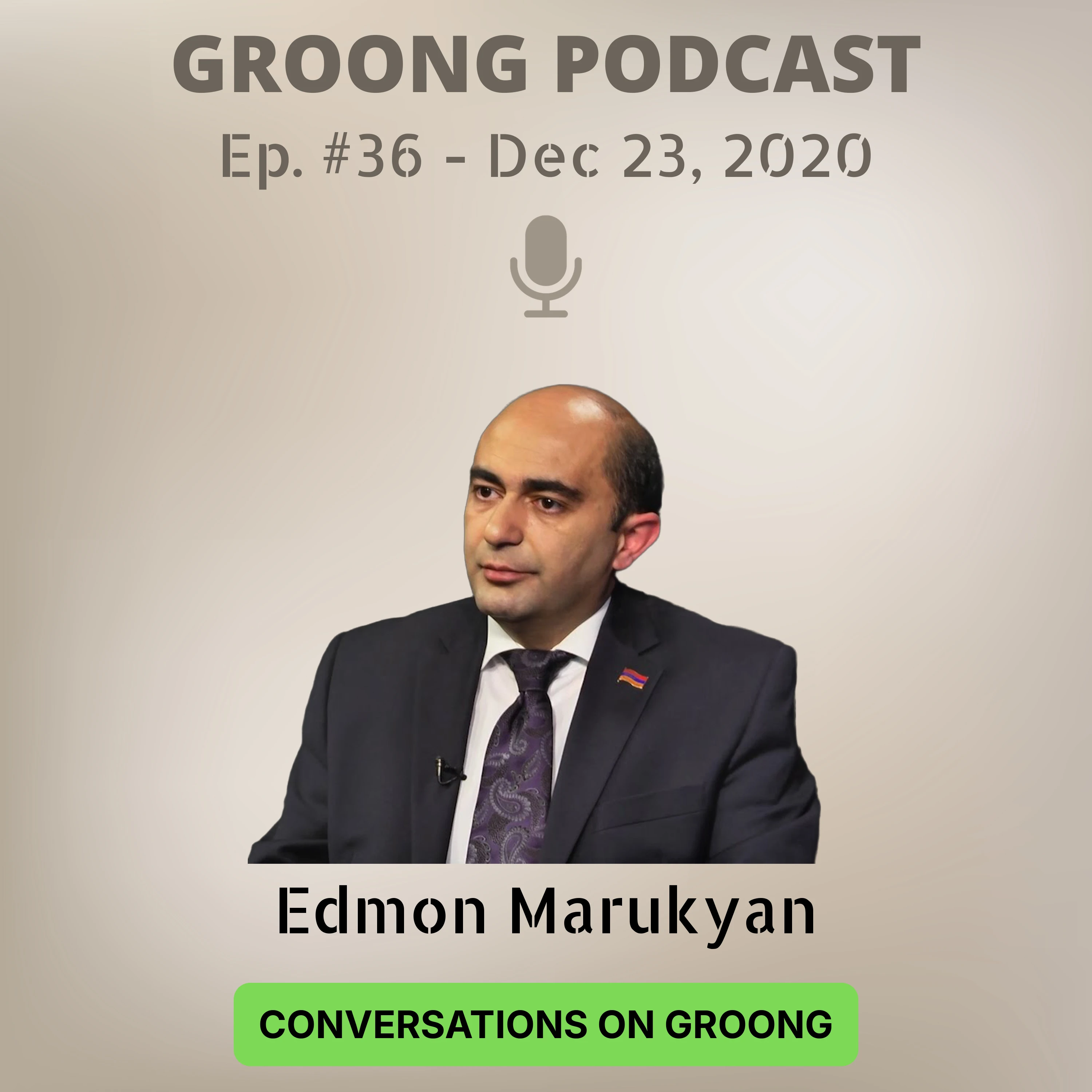
Guest(s):
Conversation with Bright Armenia’s Edmon Marukyan
Following the trilateral Karabakh ceasefire of Nov 9, all major political forces in Armenia (except for the ruling party) condemned Nikol Pashinyanâs agreement to the deal. While the dissatisfaction with the agreement is widespread, the opposition is not entirely unified on what to do next.
Weâll talk with the leader of one of the 2 parliamentary opposition factions, Bright Armenia about his, and his partyâs vision and subsequent actions to be taken by Armenia.
What is Bright Armeniaâs vision for post
Read More