Armenian Elections
Last updated: May 30, 2026
Armenian elections determine the composition of the National Assembly and the presidency under Armenia’s mixed electoral system. Groong covers these contests as events of decisive importance to Armenia’s trajectory, given the country’s precarious geopolitical position following the 44-Day War , the complete ethnic cleansing of Artsakh (Nagorno Karabakh) of more than 150,000 Armenian inhabitants, unresolved negotiations with Azerbaijan, and Armenia’s contested alignment between Russia, the West, and Iran. The 2026 Armenian Parliamentary Election on June 7 represents the most consequential vote since the 2018 Velvet Revolution—a color revolution and regime change operation that brought Nikol Pashinyan and Civil Contract to power. That government’s tenure has been marked by military defeats, territorial losses, the Artsakh Blockade and the subsequent displacement of its entire population, and a stalled Armenia-Azerbaijan Peace Process alongside deepening confrontation with the Armenian Church .
Election coverage on Groong examines the competing parties and alliances—Civil Contract , the Strong Armenia Alliance, the Armenia Alliance (Hayastan Dashinq), Prosperous Armenia , Wings of Unity , and smaller formations—alongside polling data from organizations like MPG and IRI, structural disadvantages facing opposition forces in a landscape where state resources and media access are unevenly distributed, and the geopolitical context shaping electoral outcomes. Recent coverage has analyzed the phenomenon of “hidden votes,” where public polls fail to capture voters’ true intentions, the escalating campaign rhetoric of Civil Contract under Pashinyan, arrests and administrative pressure against opposition figures and civil society activists, mass surveillance, and allegations of unfair electoral conditions. Episodes have also examined how external actors including Emmanuel Macron and France’s Armenia policy, the European Union’s political messaging, JD Vance and the Trump administration’s role, the CSTO and Russia’s position on Armenian politics, and Iran’s strategic interests intersect with domestic political competition.
A central question running through Groong’s election coverage is whether fragmented opposition forces can collectively clear enough thresholds to deny Civil Contract parliamentary supermajorities, and whether voters will treat elections as choices about Armenia’s strategic direction. Key issues include the Zangezur Corridor also known as the Trump Route for International Peace and Prosperity (TRIPP), Armenia’s relationship with the Armenian Church , ties to the Armenian Diaspora , constitutional changes implemented by Pashinyan’s government, and the limits of what domestic political change can achieve in a country subject to intense external pressures from Azerbaijan, Turkey, Russia, Iran, and the West. Episodes have explored whether opposition campaigns address the issues that matter most to Armenian voters—statehood, security, public trust, and accountability—and whether electoral outcomes will be accepted domestically and internationally as legitimate.
Groong episodes that include this tag
Below are all Groong episodes tagged with Armenian Elections.
Fyodor Lukyanov - Russia in Evolving Global Geopolitics | Ep 502, Jan 9, 2026 [EP502]
Posted on Friday, Jan 9, 2026 | Category: Iran, Russia, Armenia, Israel, Politics, China, Ukraine, Armenian Church, Artsakh Blockade, BRICS, European Union, NATO, Azerbaijan
Groong Links:
Guest:
Topics:
- Venezuela
- Ukraine War
- Russia-Iran Relations
- TRIPP and Russian-Armenian Relations
Episode 502 | Recorded: January 8, 2026
#FyodorLukyanov #RussiaGeopolitics #UkraineWar #IranIsrael #VenezuelaCrisis #TRIPP
Transcript: Fyodor Lukyanov - Russia in Evolving Global Geopolitics | Ep 502, Jan 9, 2026 [EP502]
Posted on Friday, Jan 9, 2026 | Category: Iran, Russia, Armenia, Israel, Politics, China, Ukraine, Armenian Church, Artsakh Blockade, BRICS, European Union, NATO, Azerbaijan, TranscriptFyodor Lukyanov joins Groong to discuss how Moscow reads a fast-shifting global landscape, from the U.S. raid in Venezuela and maritime seizures at sea, to Trump’s Greenland rhetoric, the stalled endgame in Ukraine, the likelihood of a renewed Israel-Iran war, and how TRIPP and “unblocking” disputes in Armenia’s south fit into Russia’s regional priorities.
Hrant Mikaelian - Ukraine Talks, Armenia’s Crackdowns, and Rising Tensions | Ep 488, Nov 23, 2025 [EP488]
Posted on Wednesday, Nov 26, 2025 | Category: Armenia, Politics, Russia, Ukraine, Turkey, Georgia, Azerbaijan, Armenian Church, China, Economy, Iran, Middle East, Artsakh, Human Rights, Genocide, Nagorno Karabakh, European Union, NATO | Series: wir, video
Groong Links:
Guest:
Topics:
- High-Stakes Ukraine Talks
- Armeniaâs Growing Political Detentions
- Pashinyan Honored In Kazakhstan
- Rising Pressure On The Church
- Impeachment vs. Elections
- Pashinyan Seizes Power Grid
Episode 488 | Recorded: November 24, 2025
Hrant Mikaelian - Ukraine Talks, Armenia’s Crackdowns, and Rising Tensions | Ep 488, Nov 23, 2025 [EP488]
Posted on Wednesday, Nov 26, 2025 | Category: Armenia, Politics, Russia, Ukraine, Turkey, Georgia, Azerbaijan, Armenian Church, China, Economy, Iran, Middle East, Artsakh, Human Rights, Genocide, Nagorno Karabakh, European Union, NATOGroong Links:
Guest:
Topics:
- High-Stakes Ukraine Talks
- Armeniaâs Growing Political Detentions
- Pashinyan Honored In Kazakhstan
- Rising Pressure On The Church
- Impeachment vs. Elections
- Pashinyan Seizes Power Grid
Episode 488 | Recorded: November 24, 2025
Sergei Melkonian - Ukraine, Iran & Israel, C5+1 in DC, Vagharshapat Municipal Outcome | Ep 486, Nov 16, 2025 [EP486]
Posted on Tuesday, Nov 18, 2025 | Category: Armenia, Politics, Iran, Israel, Azerbaijan, Turkey, Russia, Artsakh, Nagorno Karabakh, Armenian Church, Syria, Ukraine, China, Middle East, NATO, Economy, European Union, Geopolitics, India | Series: wir, video
Groong Links:
Guest:
Topics:
- Ukraine and Iran-Israel Conflicts
- C5+1 in Washington DC
- Vagharshapat/Etchmiadzin Municipal
Episode 486 | Recorded: November 17, 2025
Sergei Melkonian - Ukraine, Iran & Israel, C5+1 in DC, Vagharshapat Municipal Outcome | Ep 486, Nov 16, 2025 [EP486]
Posted on Tuesday, Nov 18, 2025 | Category: Armenia, Politics, Iran, Israel, Azerbaijan, Turkey, Russia, Artsakh, Nagorno Karabakh, Armenian Church, Syria, Ukraine, China, Middle East, NATO, Economy, European Union, Geopolitics, IndiaGroong Links:
Guest:
Topics:
- Ukraine and Iran-Israel Conflicts
- C5+1 in Washington DC
- Vagharshapat/Etchmiadzin Municipal
Episode 486 | Recorded: November 17, 2025
Hrant Mikaelian - OTS & CIS summits, Trump-Aliyev Tensions, Armenia Opposition Gears up for 2026 | Ep 478, Oct 12, 2025 [EP478]
Posted on Tuesday, Oct 14, 2025 | Category: Armenia, Politics, Artsakh, Nagorno Karabakh, Azerbaijan, Turkey, Russia, Artsakh Blockade, European Union, China | Series: wir, video
Groong Links:
Guest:
Topics:
- Aliyev pushes âZangezur Corridorâ at OTS
- Pashinyan pitches âTrump Routeâ at CIS
- PutinâAliyev meeting eases tensions
- Armeniaâs opposition gears up for 2026
Episode 478 | Recorded: October 14, 2025
Hrant Mikaelian - OTS & CIS summits, Trump-Aliyev Tensions, Armenia Opposition Gears up for 2026 | Ep 478, Oct 12, 2025 [EP478]
Posted on Tuesday, Oct 14, 2025 | Category: Armenia, Politics, Artsakh, Nagorno Karabakh, Azerbaijan, Turkey, Russia, Artsakh Blockade, European Union, ChinaGroong Links:
Guest:
Topics:
- Aliyev pushes âZangezur Corridorâ at OTS
- Pashinyan pitches âTrump Routeâ at CIS
- PutinâAliyev meeting eases tensions
- Armeniaâs opposition gears up for 2026
Episode 478 | Recorded: October 14, 2025
Benyamin Poghosyan - Ajapahyan Sentenced, Moldova, EPC, Peace Act, Dismantling the Armenian Military | Ep 477, Oct 5, 2025 [EP477]
Posted on Wednesday, Oct 8, 2025 | Category: Armenia, Politics, Artsakh, Nagorno Karabakh, Azerbaijan, Armenian Church, Russia, Ukraine, Iran, Israel, European Union, Turkey, China, Economy | Series: video, wir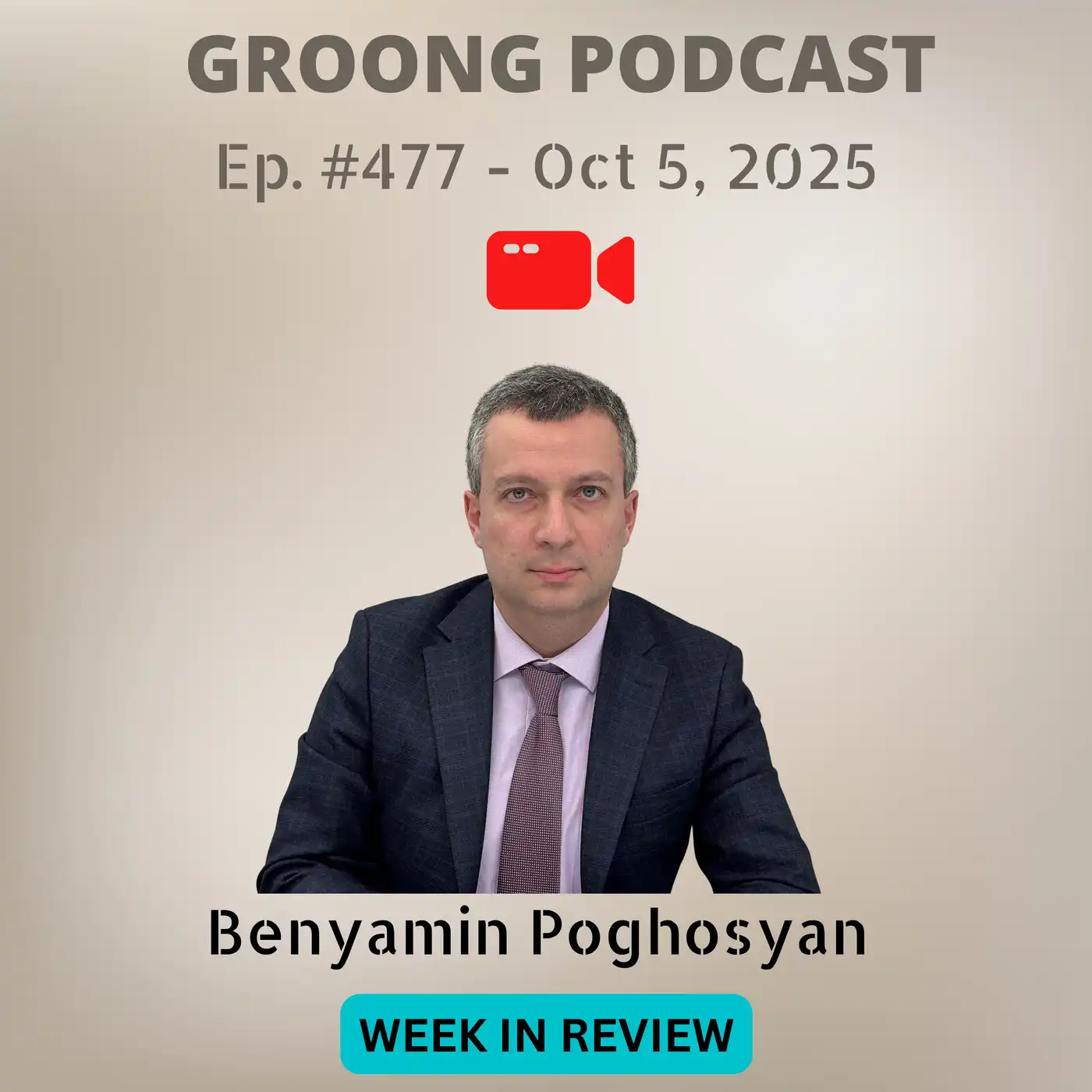
Groong Links:
Guest:
Topics:
- Ajapahyan Sentenced: 2 Years in Jail for speaking out!
- Moldova Election Lessons
- EPC in Copenhagen, WSF in Warsaw
- PEACE Act politics
- Dismantling the Armenian Military
Episode 477 | Recorded: October 6, 2025