Armenian Economy
Last updated: June 10, 2026
Armenia’s economy is a middle-income, transition economy with a population of approximately 3 million. With a GDP of roughly $16–17 billion (2023–2024), Armenia ranks among the smallest economies in the South Caucasus region. The economy is built on a mix of industrial production, services, agriculture, and mining. Key sectors include mining (copper, molybdenum, gold), food processing, chemicals, telecommunications, and information technology. Armenia is a member of the Eurasian Economic Union (EAEU) and the World Trade Organization (WTO). The Armenian dram (AMD) is the official currency. The country’s economy is heavily dependent on international trade, with Russia and the European Union serving as primary trade partners. Armenia has sought to develop IT and tech sectors as growth engines, particularly through the Tumo Center and startup initiatives in Yerevan.
Armenia’s economy faces structural pressures that reflect both the country’s limited domestic market and its precarious geopolitical position. Over a third of Armenia’s foreign trade flows through Russia, which absorbs 44% of Armenian exports, creating severe vulnerability to sanctions, currency fluctuations, and Moscow’s political leverage. The 44-Day War in 2020 and the subsequent loss of Artsakh (Nagorno Karabakh) disrupted supply chains and regional trade patterns, while the complete ethnic cleansing of Artsakh’s more than 150,000 Armenian inhabitants eliminated any prospect of reintegrating the territory’s economy into Armenia’s. Since 2021, Armenia has pursued economic diversification and EU integration, but progress has been constrained by continued regional instability, the incomplete peace process with Azerbaijan , and the government’s inability to attract sustained foreign investment amid political uncertainty.
The government’s economic performance through 2024 reflected mixed results. First-half 2024 figures showed slowing growth compared to the first quarter, with both import and export sectors declining. The state has struggled with revenue collection and spending discipline, while the finance sector remained fragile. Proposals to open transit corridors through Syunik province, framed by Washington as TRIPP and by Baku and Ankara as the “Zangezur Corridor,” promised potential trade benefits but remained contested over control and Armenia’s security guarantees. Economist Jeffrey Sachs argued in August 2025 that Armenia should not depend on distant foreign powers but instead pursue pragmatic economic cooperation with immediate neighbors, particularly Iran , whose land border offers the only trade route independent of Turkish or Azerbaijani intermediaries.
Corruption and systemic governance failures continue to undermine confidence. The government’s seizure of Armenia’s power grid in late 2025, the pressure on the banking sector, and persistent capital flight reflect deeper institutional weaknesses that no single trade agreement can resolve. The 2026 Armenian Parliamentary Election will partly turn on whether voters believe the current administration can deliver economic stability or whether opposition parties offer a credible alternative approach to managing Armenia’s fiscal crisis and external economic constraints.
Groong episodes that include this tag
Below are all Groong episodes tagged with Armenian Economy.
Armenian News: Opp Politics | Lavrov | War Dividends | Caucasus Barometer | Ep #142 - Jun 12, 2022 [EP142]
Posted on Tuesday, Jun 14, 2022 | Category: Armenia, Russia, Azerbaijan, Turkey, Economy, Ukraine, Georgia, Iran, Artsakh, Syria, Nagorno Karabakh, NATO, Human Rights
Guest(s):
Armenian News Network/Groong Week in Review - June 12, 2022
Topics:
- The Opposition Activates Politics
- Russia Revises Lavrov’s Parukh Response
- War Dividends
- Caucasus Barometer Survey Takeaways
Guest:
- Hrant Mikaelian - TW/@Hrant_M
Host:
- Asbed Bedrossian - TW/@qubriq
Episode 142 | Recorded: Monday, June 13, 2022 Website: https://groong.org/podcasts/WiR-20220612.html
#lavrov #armeniannews
Armenian News: Opposition | Brussels | Alison | Economy | Poll | Artsakh | Ep #132 - Apr 10, 2022 [EP132]
Posted on Tuesday, Apr 12, 2022 | Category: Artsakh, Armenia, Politics, Poll, Russia, Turkey, Azerbaijan, Iran, Ukraine, Economy, India, Georgia, Geopolitics, Human Rights, Nagorno Karabakh, Lebanon, Middle East, NATO, Syria, European Union | Series: wir
Guest(s):
Armenian News Network/Groong Week in Review - April 10, 2022
Topics:
00:00:00 Introduction
00:02:25 Opposition Protests in Yerevan: Thousands showed up to the opposition protest on Tuesday, outlining the red lines for Pashinyan’s dealings with Aliyev, ahead of the meeting in Brussels. Opposition says this is only the beginning, but have yet to indicate what their next steps will be.
00:12:35 Buying Bread from a Man in Brussels: Pashinyan went to Brussels this week to meet with Charles Michel and Ilham Aliyev. Did the Armenian PM
Armenian News: Opposition | Brussels | Alison | Economy | Poll | Artsakh | Ep #132 - Apr 10, 2022 [EP132]
Posted on Tuesday, Apr 12, 2022 | Category: Artsakh, Armenia, Politics, Poll, Russia, Turkey, Azerbaijan, Iran, Ukraine, Economy, India, Georgia, Geopolitics, Human Rights, Nagorno Karabakh, Lebanon, Middle East, NATO, Syria, European UnionGuest(s):
Armenian News Network/Groong Week in Review - April 10, 2022
Topics:
00:00:00 Introduction
00:02:25 Opposition Protests in Yerevan: Thousands showed up to the opposition protest on Tuesday, outlining the red lines for Pashinyan’s dealings with Aliyev, ahead of the meeting in Brussels. Opposition says this is only the beginning, but have yet to indicate what their next steps will be.
00:12:35 Buying Bread from a Man in Brussels: Pashinyan went to Brussels this week to meet with Charles Michel and Ilham Aliyev. Did the Armenian PM
The State of Armenia’s Economy - A Conversation with Vache Gabrielyan | Ep #127 - March 10, 2022 [EP127]
Posted on Thursday, Mar 10, 2022 | Category: Armenia, Economy, Russia, Turkey, Azerbaijan, Georgia, Ukraine, Iran, China, Artsakh, Israel, Nagorno Karabakh | Series: cog
The State of Armeniaâs Economy - March 10, 2022
A Conversation with Vache Gabrielyan
Topics:
- 00:00:00 Introduction
- 00:01:25 Risk from the Ukraine War
- 00:37:18 Pandemic, War and Beyond Economy
- 01:01:47 Normalization with Turkey and Corridor Economics
Guest:
Dr. Vache Gabrielyan who is the Dean of the Manoogian Simone College of Business and Economics at the American University of Armenia and specializes in public administration and economics. Since 2008, he has served as Vice-Governor of the Central Bank of Armenia, Minister of Finance, Minister-Chief of the Government Staff, Chief Advisor
Read MoreThe State of Armenia’s Economy - A Conversation with Vache Gabrielyan | Ep #127 - March 10, 2022 [EP127]
Posted on Thursday, Mar 10, 2022 | Category: Armenia, Economy, Russia, Turkey, Azerbaijan, Georgia, Ukraine, Iran, China, Artsakh, Israel, Nagorno KarabakhThe State of Armeniaâs Economy - March 10, 2022
A Conversation with Vache Gabrielyan
Topics:
- 00:00:00 Introduction
- 00:01:25 Risk from the Ukraine War
- 00:37:18 Pandemic, War and Beyond Economy
- 01:01:47 Normalization with Turkey and Corridor Economics
Guest:
Dr. Vache Gabrielyan who is the Dean of the Manoogian Simone College of Business and Economics at the American University of Armenia and specializes in public administration and economics. Since 2008, he has served as Vice-Governor of the Central Bank of Armenia, Minister of Finance, Minister-Chief of the Government Staff, Chief Advisor
Read MoreUkraine Crisis | Vahagn Khachatryan for President | New IRI Poll Results | Ep #118 - Feb 6, 2022 [EP118]
Posted on Wednesday, Feb 9, 2022 | Category: Armenia, Politics, Poll, Russia, Ukraine, Turkey, China, Azerbaijan, Genocide, India, Economy, Iran, Armenian Genocide, Artsakh, Georgia, Nagorno Karabakh, European Union, NATO | Series: wir
ANN/Groong Week in Review - February 6, 2022
Topics:
- 00:00 Introduction
- 01:10 The Continuing Ukraine Crisis
- Putin in Beijing, Erdogan in Kyiv, Pashinyan at Olympic Diplomacy?
- 23:44 Civil Contract Nominates Vahagn Khachatryan for President
- 41:21 New IRI Poll Results
- 58:57 Rants
Guests:
- Dr. Pietro Shakarian
Guest(s):
Hosts:
- Hovik Manucharyan https://twitter.com/HovikYerevan
- Asbed Bedrossian https://twitter.com/qubriq
Episode 118 | Recorded: Sunday, February 8, 2022 Website: https://groong.org/podcasts/WiR-20220206.html
Ukraine Crisis | Vahagn Khachatryan for President | New IRI Poll Results | Ep #118 - Feb 6, 2022 [EP118]
Posted on Wednesday, Feb 9, 2022 | Category: Armenia, Politics, Poll, Russia, Ukraine, Turkey, China, Azerbaijan, Genocide, India, Economy, Iran, Armenian Genocide, Artsakh, Georgia, Nagorno Karabakh, European Union, NATOANN/Groong Week in Review - February 6, 2022
Topics:
- 00:00 Introduction
- 01:10 The Continuing Ukraine Crisis
- Putin in Beijing, Erdogan in Kyiv, Pashinyan at Olympic Diplomacy?
- 23:44 Civil Contract Nominates Vahagn Khachatryan for President
- 41:21 New IRI Poll Results
- 58:57 Rants
Guests:
- Dr. Pietro Shakarian
Guest(s):
Hosts:
- Hovik Manucharyan https://twitter.com/HovikYerevan
- Asbed Bedrossian https://twitter.com/qubriq
Episode 118 | Recorded: Sunday, February 8, 2022 Website: https://groong.org/podcasts/WiR-20220206.html
Ukraine | Antalya | Army Day in Armenia | The Ministry of Foreign Affairs | Ep #116 - Jan 30, 2022 [EP116]
Posted on Monday, Jan 31, 2022 | Category: Armenia, Russia, Turkey, Genocide, Ukraine, Armenian Genocide, Economy, Artsakh, Azerbaijan, China, Human Rights, USA, Nagorno Karabakh, NATO | Series: wir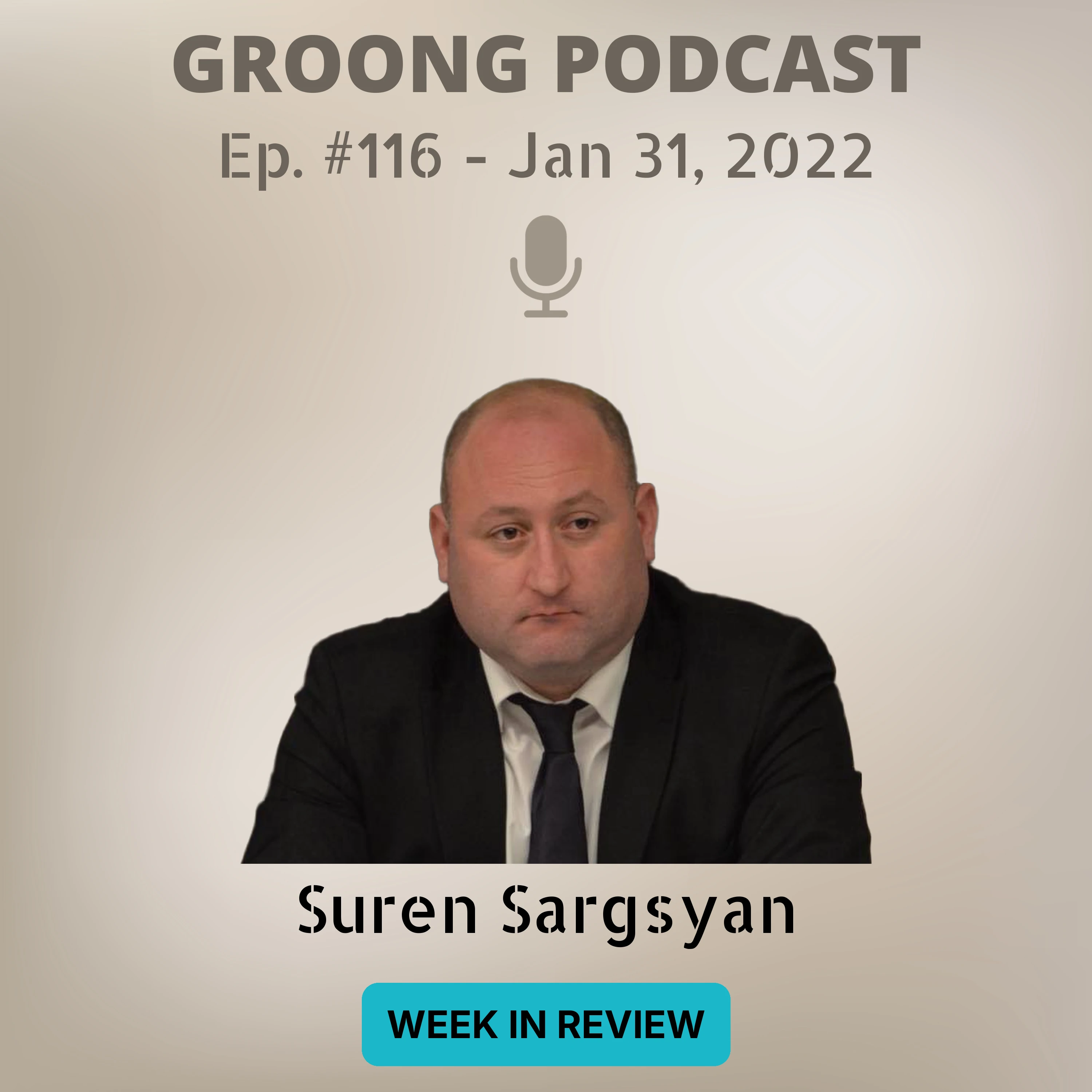
ANN/Groong Week in Review - January 30, 2022
Topics:
- 00:00 Introduction
- 00:43 Game of Chicken over Ukraine
- 08:17 Antalya Diplomatic Forum
- 22:54 Army Day in Armenia
- 27:54 Armenian Ministry of Foreign Affairs
- 31:11 Rants/Announcements
Guests:
- Suren Sargsyan https://twitter.com/s_a_sargsyan
Guest(s):
Hosts:
- Hovik Manucharyan https://twitter.com/HovikYerevan
- Asbed Bedrossian https://twitter.com/qubriq
Episode 116 | Recorded: Sunday, January 30, 2022 Website: https://groong.org/podcasts/WiR-20220130.html
Ukraine | Antalya | Army Day in Armenia | The Ministry of Foreign Affairs | Ep #116 - Jan 30, 2022 [EP116]
Posted on Monday, Jan 31, 2022 | Category: Armenia, Russia, Turkey, Genocide, Ukraine, Armenian Genocide, Economy, Artsakh, Azerbaijan, China, Human Rights, USA, Nagorno Karabakh, NATOANN/Groong Week in Review - January 30, 2022
Topics:
- 00:00 Introduction
- 00:43 Game of Chicken over Ukraine
- 08:17 Antalya Diplomatic Forum
- 22:54 Army Day in Armenia
- 27:54 Armenian Ministry of Foreign Affairs
- 31:11 Rants/Announcements
Guests:
- Suren Sargsyan https://twitter.com/s_a_sargsyan
Guest(s):
Hosts:
- Hovik Manucharyan https://twitter.com/HovikYerevan
- Asbed Bedrossian https://twitter.com/qubriq
Episode 116 | Recorded: Sunday, January 30, 2022 Website: https://groong.org/podcasts/WiR-20220130.html