Armenian Economy
Last updated: June 10, 2026
Armenia’s economy is a middle-income, transition economy with a population of approximately 3 million. With a GDP of roughly $16–17 billion (2023–2024), Armenia ranks among the smallest economies in the South Caucasus region. The economy is built on a mix of industrial production, services, agriculture, and mining. Key sectors include mining (copper, molybdenum, gold), food processing, chemicals, telecommunications, and information technology. Armenia is a member of the Eurasian Economic Union (EAEU) and the World Trade Organization (WTO). The Armenian dram (AMD) is the official currency. The country’s economy is heavily dependent on international trade, with Russia and the European Union serving as primary trade partners. Armenia has sought to develop IT and tech sectors as growth engines, particularly through the Tumo Center and startup initiatives in Yerevan.
Armenia’s economy faces structural pressures that reflect both the country’s limited domestic market and its precarious geopolitical position. Over a third of Armenia’s foreign trade flows through Russia, which absorbs 44% of Armenian exports, creating severe vulnerability to sanctions, currency fluctuations, and Moscow’s political leverage. The 44-Day War in 2020 and the subsequent loss of Artsakh (Nagorno Karabakh) disrupted supply chains and regional trade patterns, while the complete ethnic cleansing of Artsakh’s more than 150,000 Armenian inhabitants eliminated any prospect of reintegrating the territory’s economy into Armenia’s. Since 2021, Armenia has pursued economic diversification and EU integration, but progress has been constrained by continued regional instability, the incomplete peace process with Azerbaijan , and the government’s inability to attract sustained foreign investment amid political uncertainty.
The government’s economic performance through 2024 reflected mixed results. First-half 2024 figures showed slowing growth compared to the first quarter, with both import and export sectors declining. The state has struggled with revenue collection and spending discipline, while the finance sector remained fragile. Proposals to open transit corridors through Syunik province, framed by Washington as TRIPP and by Baku and Ankara as the “Zangezur Corridor,” promised potential trade benefits but remained contested over control and Armenia’s security guarantees. Economist Jeffrey Sachs argued in August 2025 that Armenia should not depend on distant foreign powers but instead pursue pragmatic economic cooperation with immediate neighbors, particularly Iran , whose land border offers the only trade route independent of Turkish or Azerbaijani intermediaries.
Corruption and systemic governance failures continue to undermine confidence. The government’s seizure of Armenia’s power grid in late 2025, the pressure on the banking sector, and persistent capital flight reflect deeper institutional weaknesses that no single trade agreement can resolve. The 2026 Armenian Parliamentary Election will partly turn on whether voters believe the current administration can deliver economic stability or whether opposition parties offer a credible alternative approach to managing Armenia’s fiscal crisis and external economic constraints.
Groong episodes that include this tag
Below are all Groong episodes tagged with Armenian Economy.
Turkey & Azerbaijan Connecting | Opposition Uniting | Putin support? | Kocharyan Interview Ep. 30 - Dec. 6, 2020 [EP30]
Posted on Monday, Dec 7, 2020 | Category: Armenia, Artsakh, Azerbaijan, Nagorno Karabakh, Turkey, Russia, Economy, Iran, China, Geopolitics, Middle East | Series: wir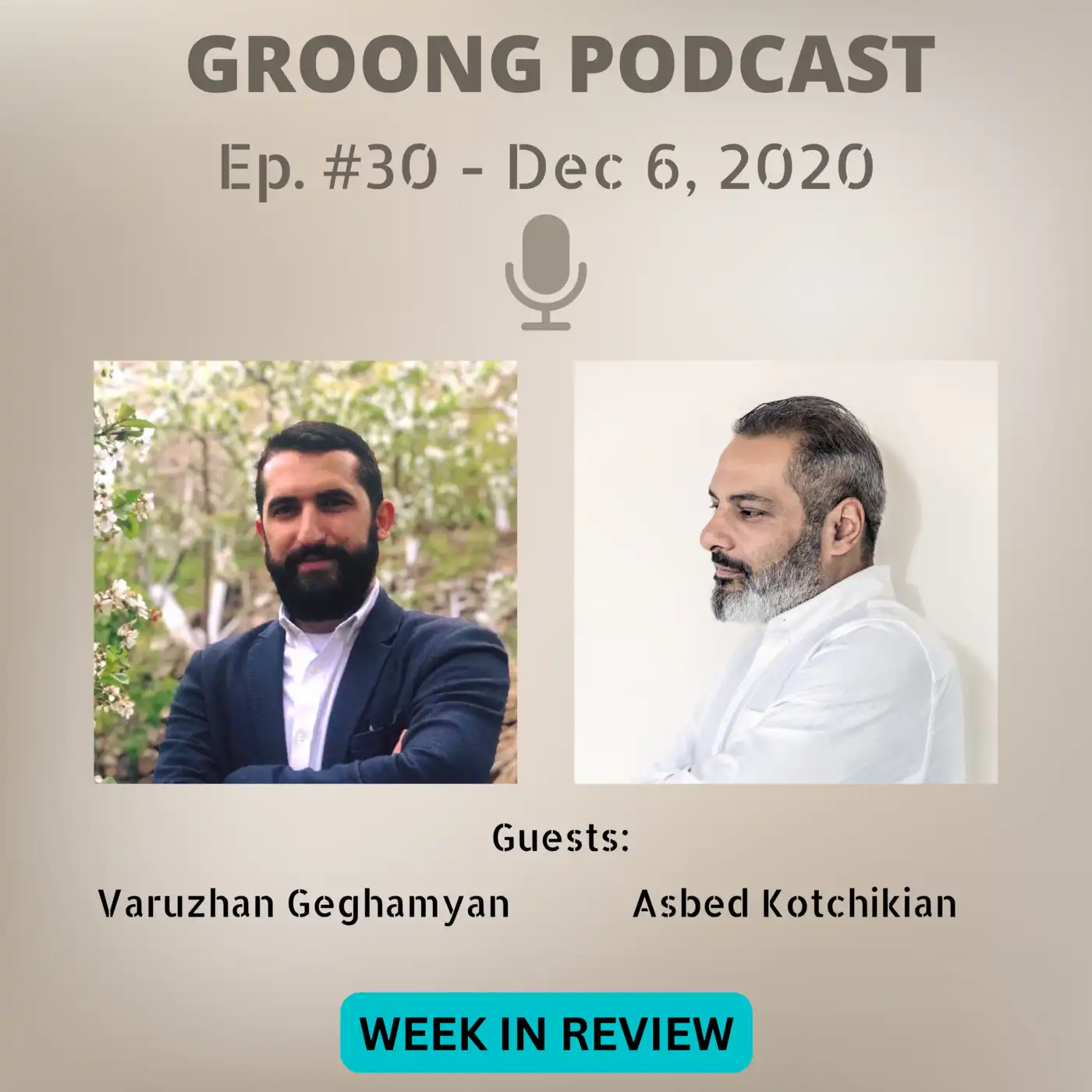
ANN/Groong Week in Review - Dec 6, 2020
Topics:
- Turkey and Azerbaijan Connecting
- Armeniaâs Political Opposition Uniting
- Does Putin support Pashinyan?
- Robert Kocharyan Interview
Guests:
Episode 30 | Recorded: Dec 6, 2020
Turkey & Azerbaijan Connecting | Opposition Uniting | Putin support? | Kocharyan Interview Ep. 30 - Dec. 6, 2020 [EP30]
Posted on Monday, Dec 7, 2020 | Category: Armenia, Artsakh, Azerbaijan, Nagorno Karabakh, Turkey, Russia, Economy, Iran, China, Geopolitics, Middle EastANN/Groong Week in Review - Dec 6, 2020
Topics:
- Turkey and Azerbaijan Connecting
- Armeniaâs Political Opposition Uniting
- Does Putin support Pashinyan?
- Robert Kocharyan Interview
Guests:
Episode 30 | Recorded: Dec 6, 2020
Border Demarcation between Armenia and Azerbaijan | Scene in Yerevan | COVID | Armenia Fund (Ep. 29) [EP29]
Posted on Friday, Dec 4, 2020 | Category: Armenia, Georgia, Economy, Russia, China, Middle East, Armenian Church | Series: wir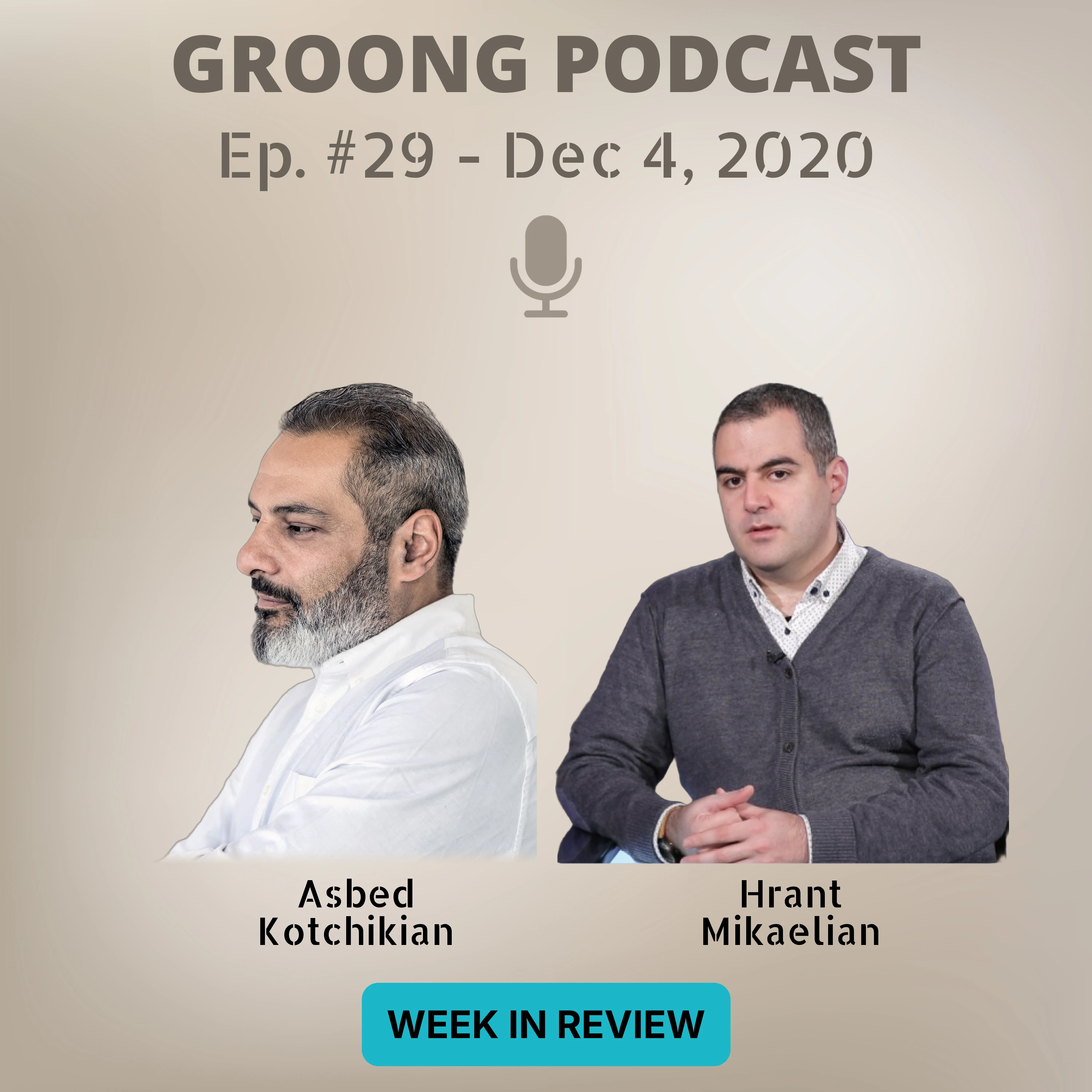
Guest(s):
ANN/Groong Week in Review Episode 29 - Nov 29, 2020
Topics Covered:
- Border Demarcation between Armenia and Azerbaijan
- The Scene in Yerevan
- COVID Update
- Armenia Fund support for the post-war Economy
Your Hosts:
- Asbed Bedrossian
- Hovik Manucharyan
Resident Panelists:
- Asbed Kotchikian
- Hrant Mikaelian
Recorded: Nov 29, 2020
Border Demarcation between Armenia and Azerbaijan | Scene in Yerevan | COVID | Armenia Fund (Ep. 29) [EP29]
Posted on Friday, Dec 4, 2020 | Category: Armenia, Georgia, Economy, Russia, China, Middle East, Armenian ChurchGuest(s):
ANN/Groong Week in Review Episode 29 - Nov 29, 2020
Topics Covered:
- Border Demarcation between Armenia and Azerbaijan
- The Scene in Yerevan
- COVID Update
- Armenia Fund support for the post-war Economy
Your Hosts:
- Asbed Bedrossian
- Hovik Manucharyan
Resident Panelists:
- Asbed Kotchikian
- Hrant Mikaelian
Recorded: Nov 29, 2020
Azerbaijan's Nuclear Threat on Armenia - Areg Danagoulian - Ep 3 - 07/19/2020 [EP3]
Posted on Friday, Jul 17, 2020 | Category: Armenia, Azerbaijan, Politics, Geopolitics, Economy, Russia, Turkey, Syria, Georgia, Israel, Middle East | Series: cog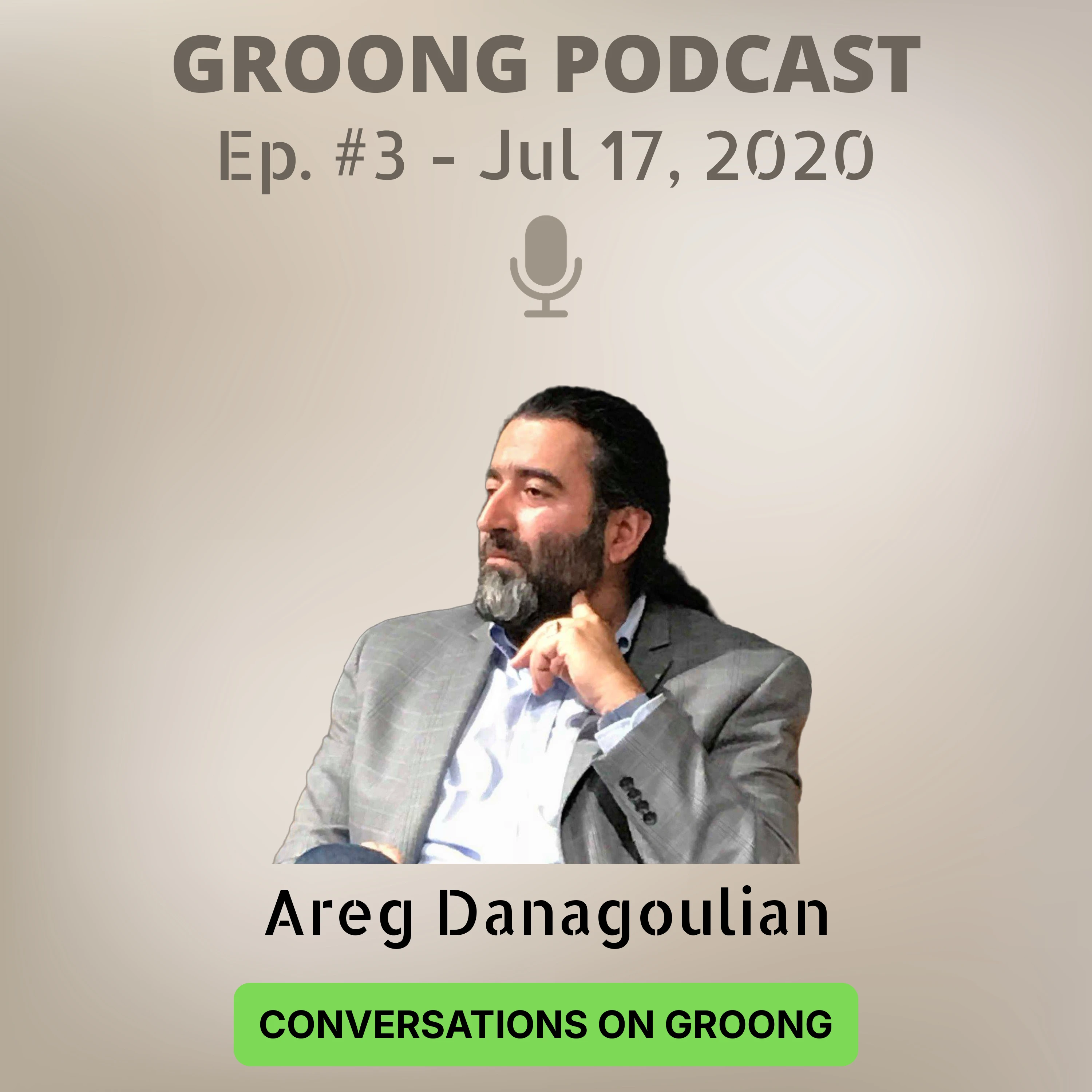
Guest(s):
Conversations on Groong
Safety and Security of Metsamor
Topics:
- Azerbaijan’s threat to attack the NPP
- Overall safety and security of the plant
- Safe handling of nuclear fuel
- Renewable energy alternatives to nuclear
- Maintenance and upgrades to the NPP
Episode 3 | Recorded on July 17, 2020
Azerbaijan's Nuclear Threat on Armenia - Areg Danagoulian - Ep 3 - 07/19/2020 [EP3]
Posted on Friday, Jul 17, 2020 | Category: Armenia, Azerbaijan, Politics, Geopolitics, Economy, Russia, Turkey, Syria, Georgia, Israel, Middle EastGuest(s):
Conversations on Groong
Safety and Security of Metsamor
Topics:
- Azerbaijan’s threat to attack the NPP
- Overall safety and security of the plant
- Safe handling of nuclear fuel
- Renewable energy alternatives to nuclear
- Maintenance and upgrades to the NPP
Episode 3 | Recorded on July 17, 2020