Groong Podcast Digest — Week of September 14–20, 2026
Published September 20, 2026 5 min read See also: News Digest →- EP585: Hovik and Asbed examine the fourth anniversary of the September 2022 border war, Azerbaijan’s occupation of Armenian territory, Pashinyan’s trajectory toward recognizing Artsakh’s loss, Hajiyev’s revisionist claims at Gandzasar, TRIPP semiconductor leverage, Pashinyan’s Paris space summit visit, Russian financial flows through Armenia, and Russia-Iran coordination in the South Caucasus.
- EP586: Hrant Mikaelian examines U.S. chip diplomacy tied to TRIPP, Armenia’s energy crisis as the nuclear plant nears shutdown, and the structural failures driving Armenia’s education collapse.
- EP587: Warwick Powell explores multipolarity, infrastructure competition, and artificial intelligence as a strategic contest between the United States and China, with implications for smaller states like Armenia navigating TRIPP and competing regional corridors.
This Week’s Podcast Episodes

Episode 585: Gandzasar Erasure, Chips for Territory, Russian Money & Pashinyan in Space | Ep 585, Sep 13, 2026
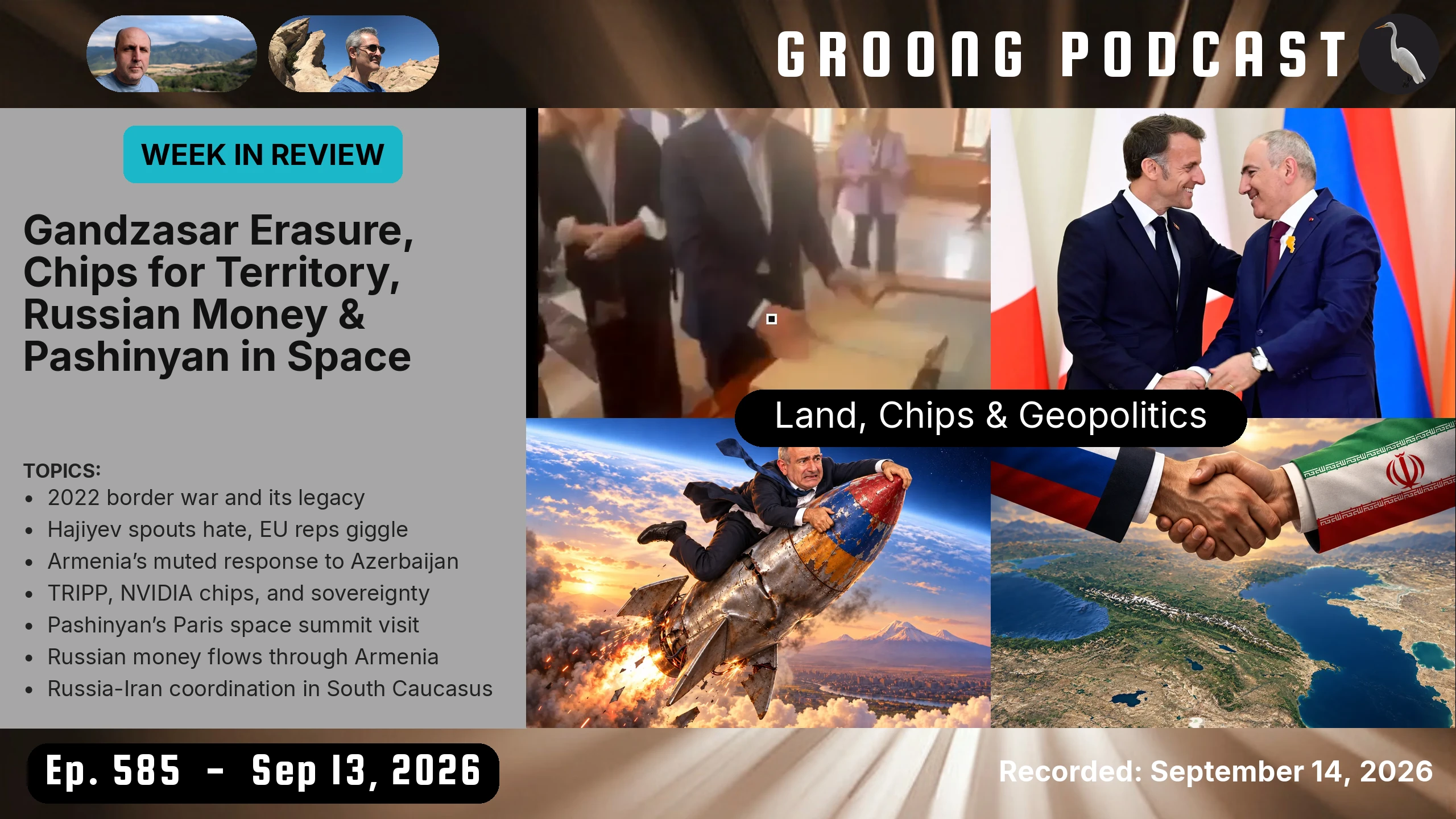
The hosts revisit the September 2022 Azerbaijani attack on Armenia as a pivotal moment in the political sequence that led to Yerevan’s recognition of Azerbaijan’s territorial integrity. They recall the 224 Armenian servicemen killed in the September 13-14 assault, documented war crimes against Armenian personnel, and Azerbaijan’s continued occupation of Armenian territory. Pashinyan ’s September 14 parliamentary remarks and the October 2022 Prague declaration recognizing territorial integrity under the Alma-Ata framework are placed in direct continuity with this attack, suggesting a coordinated diplomatic strategy.
Azerbaijan’s tour of Artsakh, during which Hikmet Hajiyev presented Gandzasar and Dadivank through a revisionist “Caucasian Albanian” lens while foreign diplomats attended, becomes the centerpiece of a larger discussion about cultural erasure. Hajiyev disputed the Armenian identity of Hasan Jalalyan and mocked a museum reproduction of an Armenian manuscript. The hosts criticize the muted Armenian response: Ruben Rubinyan called the claims merely “baseless” and “not useful,” falling far short of unequivocal condemnation. They also note that EU Special Representative Magdalana Grono’s reference to “deeply diverging views and narratives” created false equivalence between documented history and state revisionism, normalizing Azerbaijani efforts to reclassify Armenian heritage amid wider demolitions of churches, cemeteries, and memorials.
On the economic and geopolitical front, a Wall Street Journal report links U.S. authorization of advanced NVIDIA chips to Armenia with negotiations over the TRIPP framework. The hosts question whether chip access justifies acceptance of long-term corridor arrangements that could reshape regional logistics away from Russia and Iran. Pashinyan’s attendance at the Paris Space Summit is examined skeptically given Armenia’s minimal space program; the real significance lay in his bilateral with Emmanuel Macron on strategic partnership, economic diversification, and regional affairs. Finally, roughly 900 million dollars entered Armenian bank accounts from abroad in July, with Russia accounting for three-quarters, positioning Armenia as a financial junction for Russia-connected capital while raising sanctions, currency, and geopolitical risks.
Watch/Listen: Episode 585
Keywords: 44-Day War , September 2022 border war, Azerbaijan occupation, Gandzasar, Cultural erasure, Pashinyan, TRIPP, Zangezur Corridor , Armenia-Azerbaijan Peace Process, South Caucasus, Russia-Iran coordination, Russian Peacekeepers, Syunik , Artsakh , Ethnic Cleansing , Corruption
Episode 586: Hrant Mikaelian - Chips for TRIPP, Education Crisis, and Economic Risks | Ep 586, Sep 17, 2026
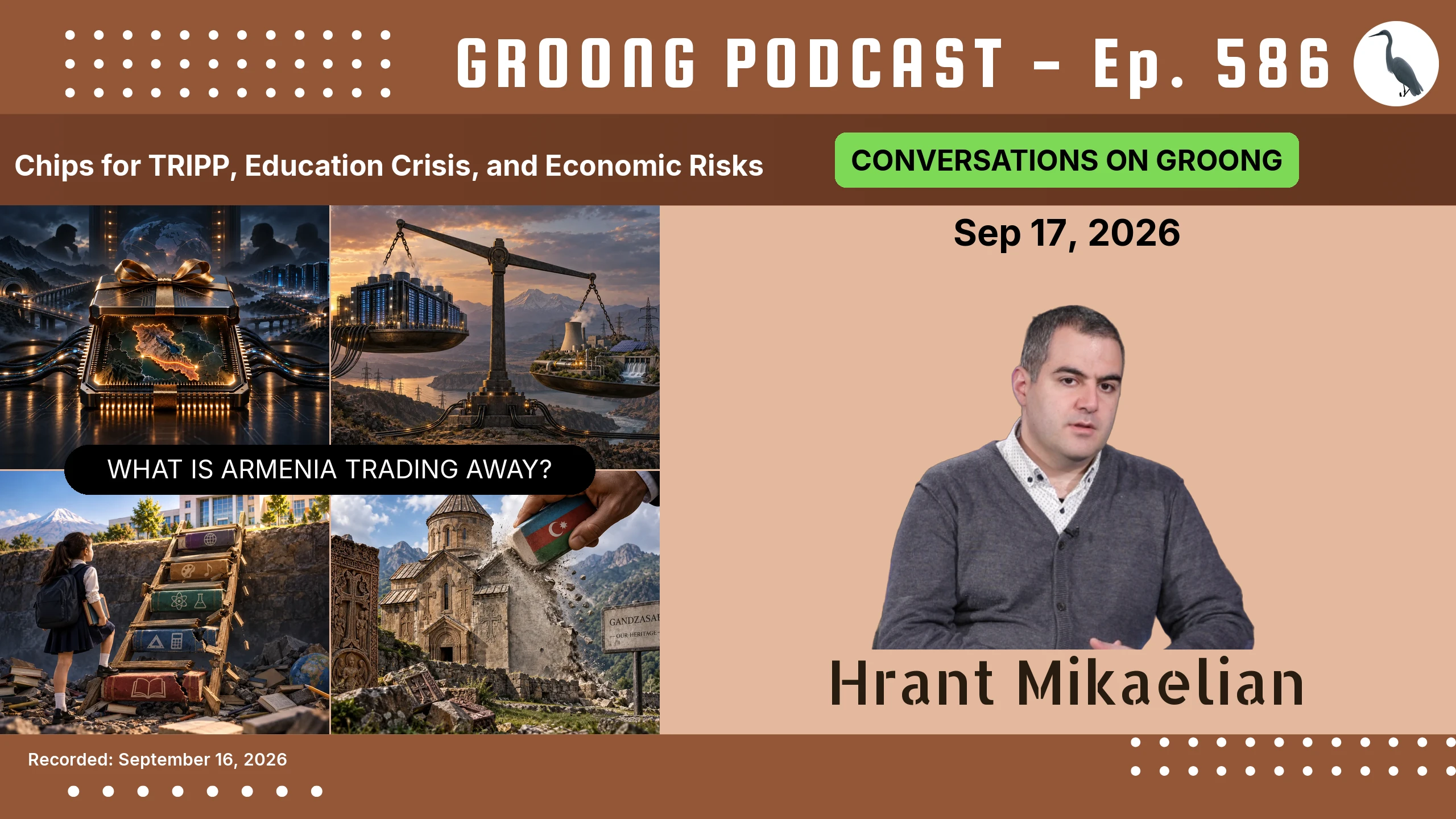
Hrant Mikaelian unpacks the geopolitical architecture behind Armenia’s role in the Trump Route for International Peace and Prosperity (TRIPP). The U.S. fast-tracked advanced AI chip exports to secure the Armenia-Azerbaijan Peace Process agreement, framing the arrangement as part of a broader strategy to bypass Russian and Iranian logistics networks while accessing critical minerals and limiting Chinese influence in the South Caucasus. The planned Firebird data center sits at the center of this arrangement, but Mikaelian identifies a critical vulnerability: Armenia lacks sufficient baseload power to sustain large-scale AI operations. The Armenian Nuclear Power Plant approaches shutdown with no settled replacement project, leaving the country dependent on Russian natural gas and exposed to supply shocks. Solar generation alone cannot meet data-center demand. Mikaelian asks whether Firebird investment will create lasting expertise and returns or remain a geopolitical bargaining chip.
Armenian education outcomes reveal a structural crisis that transcends budget constraints. The 2025 PISA results show only 19 percent of students reached basic reading proficiency, a collapse that budget increases and reform announcements have failed to arrest. Teacher salaries remain inadequate, rural school closures continue to hollow out border communities, and higher education spending has not translated into measurable gains. Mikaelian argues that Armenia’s education system reflects broader institutional dysfunction, not merely resource constraints.
The episode also addresses Azerbaijan’s campaign to reframe Armenian cultural heritage in Artsakh, citing the Gandzasar manuscript issue as a window into competing narratives over Armenian historical sites. Mikaelian concludes that Armenia faces converging vulnerabilities: lack of energy sovereignty, an underfunded and deteriorating education system, and exposure to structural economic shocks that reserve depletion cannot absorb indefinitely.
Watch/Listen: Episode 586
Keywords: TRIPP, Armenia-Azerbaijan Peace Process, Artificial Intelligence, Energy Security, Armenian Nuclear Power Plant, Data Centers, Education Crisis, Artsakh, South Caucasus, Ethnic Cleansing
Episode 587: Warwick Powell - From BRICS to AI: The Infrastructure Multipolarity | Ep 587, Sep 20, 2026
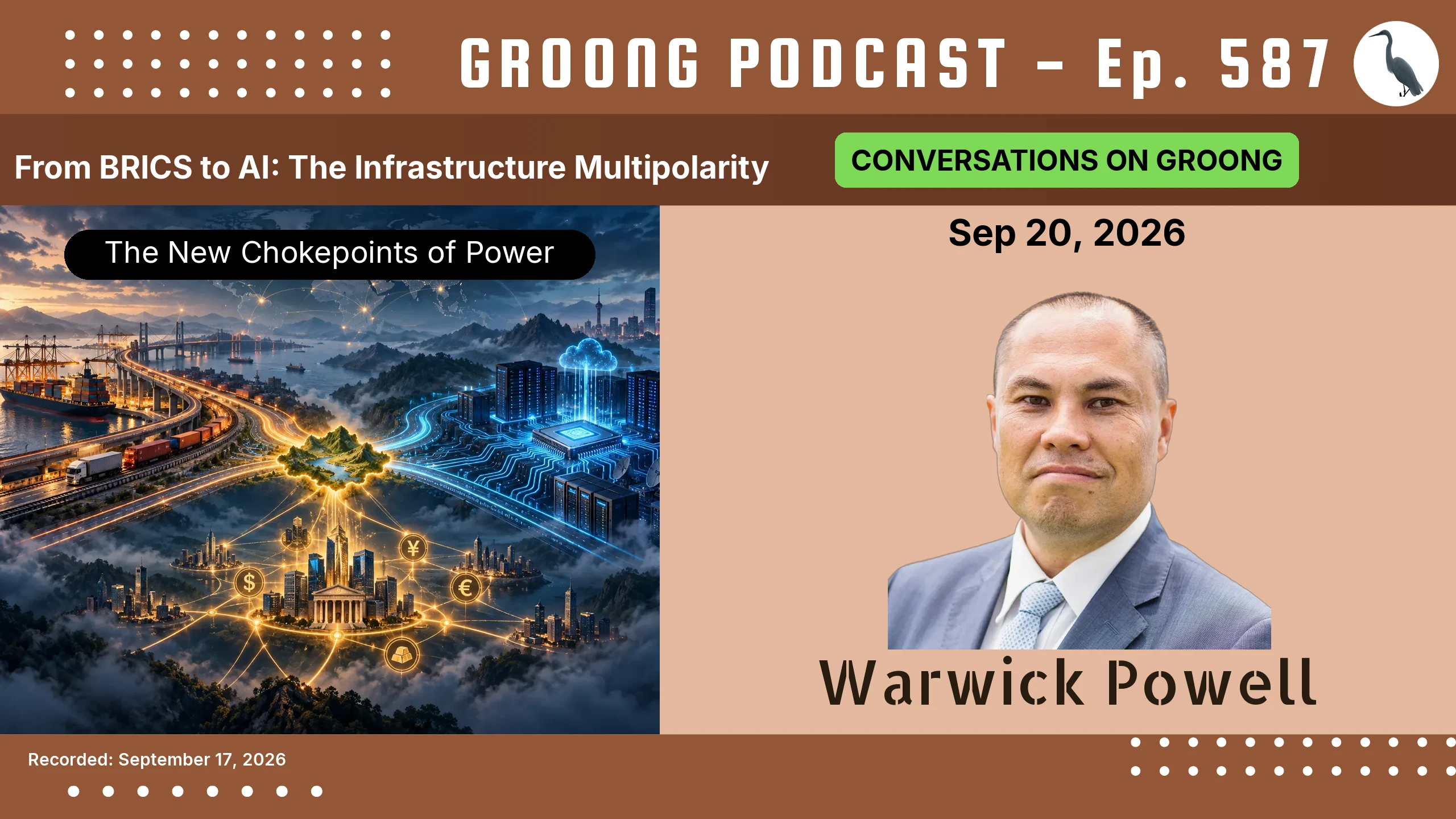
Warwick Powell examines the structural shifts reshaping global power dynamics through the lens of recent SCO and BRICS summits. He argues that these gatherings signal a genuine reorientation toward local-currency settlement and financial architecture independent of Western institutions. The conversation centers on how countries are building alternatives to dollar-denominated systems and what this means for trade, investment, and strategic autonomy. Powell emphasizes that China functions as an enabling power within these blocs rather than a dominating one, allowing member states to pursue their own interests while benefiting from collective infrastructure and financing mechanisms.
The discussion then turns to Armenia’s specific position within this multipolar landscape. Powell and the hosts examine how Yerevan navigates competing infrastructure visions: the U.S.-backed TRIPP corridor, which aims to connect Asia to Europe through Armenia while circumventing Russia and Iran, versus alternative regional projects aligned with other powers. This infrastructure competition carries direct economic and security implications for Armenia, as transit routes and corridor control shape both revenue streams and geopolitical alignment. The conversation acknowledges the tension between Armenia’s desire for strategic flexibility and the pressure from various actors to choose sides.
Finally, Powell addresses artificial intelligence as perhaps the defining strategic contest of the next decade. Both Washington and Beijing view AI development as decisive for future military, economic, and technological dominance. For smaller states, this creates a digital sovereignty problem: how to access AI capabilities and benefits without surrendering autonomy or falling into technological dependency. Powell argues that AI safety and AI governance are not abstract academic concerns but core national security questions for countries seeking to maintain independence in a multipolar world.
Watch/Listen: Episode 587
Keywords: Multipolarity, BRICS, SCO, TRIPP, China, Artificial Intelligence, Digital Sovereignty, Infrastructure
Stay Connected
For the full, unfiltered stream of Armenia news as it happens, subscribe to the Groong Mailing List on Google Groups. Subscribers receive the complete daily news feed directly in their inbox — expect tens of emails per day covering Armenia, Artsakh, the diaspora, and the broader region.