Groong Podcast Digest — Week of August 31–6, 2026
Published September 6, 2026 4 min read See also: News Digest →- EP582: Hovik and Asbed examine Armenia’s precarious position at the SCO Summit amid Russian escalation in Ukraine, unprecedented Western diplomatic visits to Moscow, renewed US-Iran conflict, and Pashinyan’s meetings with regional leaders while former Artsakh presidents languish in detention and selective political prosecutions continue.
- EP583: Suren Sargsyan examines Washington’s unclear endgame in the Iran War, Russia’s military presence in Armenia amid great-power competition, and the competing U.S. and European stakes in TRIPP and Central Asian transit routes.
This Week’s Podcast Episodes
Episode 582: Armenia at the SCO Summit as Ukraine and Iran Wars Intensify | Ep 582, Aug 30, 2026
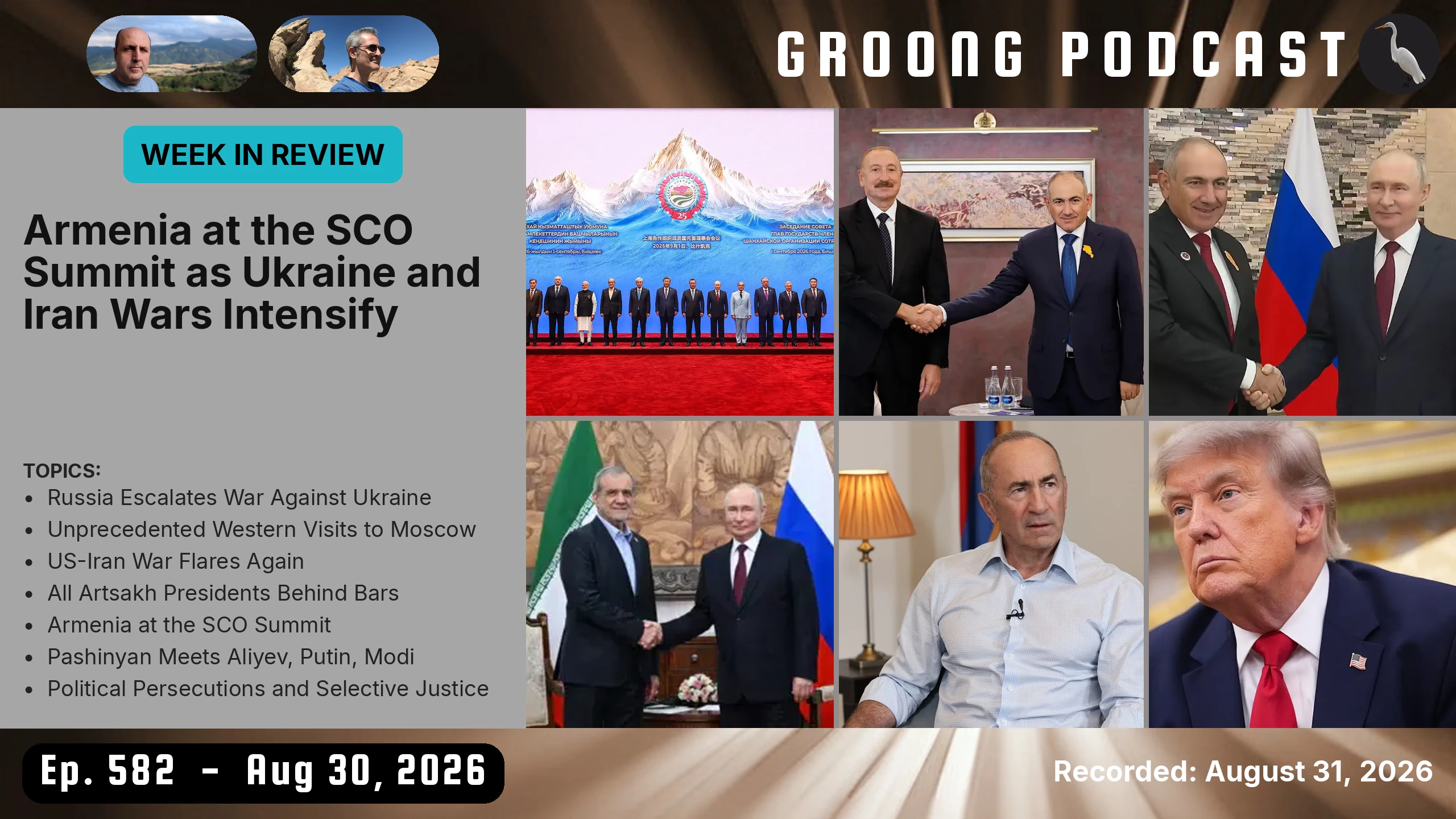
The hosts open by surveying the global conflict landscape, with Russia intensifying attacks on Ukrainian energy infrastructure and civilian targets as winter approaches. Asbed and Hovik debate whether Moscow has crossed into a new escalation phase and whether the conflict should now be understood as a direct Russia-NATO proxy war rather than a regional contest. The unusual visits of CIA Director John Ratcliffe and Vatican Foreign Minister Archbishop Paul Gallagher to Moscow signal possible renewed diplomatic channels, though reports indicate Russia has rejected any summit unless it produces a final settlement Moscow finds acceptable.
The US-Iran War has flared again, with American forces striking Larak Island in the Strait of Hormuz and Iran responding within hours by targeting US-linked positions in Jordan. The hosts examine the danger of an escalating retaliation cycle driven partly by domestic political incentives in Washington and Israel. Turning to Armenia, they note that former Artsakh presidents Bako Sahakyan and Robert Kocharyan remain detained, with Kocharyan imprisoned in Armenia while Artsakh’s former leadership sits in Azerbaijani custody. Asbed and Hovik stress that Artsakh’s imprisoned leaders retain nationalist credentials and public standing that could reshape Armenian politics if released. Putin’s birthday greeting to Kocharyan, contrasted with his silence on Pashinyan’s reelection, is interpreted as Moscow displeasure with Yerevan’s EU drift.
At the SCO Summit in Bishkek, Armenia faces uncertain membership prospects after last year’s stalled efforts when Pakistan opposed Armenia and India opposed Azerbaijan. The hosts question whether Russia would support Armenian membership while Yerevan continues moving toward the European Union. Pashinyan met Aliyev and India’s Narendra Modi, with Armenia potentially acquiring India’s Pralay tactical missile system to deepen defense ties. However, Asbed and Hovik challenge the substance behind public messaging on the Armenian-Azerbaijani “peace agenda,” pointing to territorial concessions, unresolved Azerbaijani demands, and limited bilateral trade. On the domestic front, government pressure has shifted toward Robert Kocharyan’s family and associated businesses while the Armenian Center for Political Rights launched a public database documenting political persecutees. School administrators faced only reprimands for bringing students to Pashinyan campaign events, a stark contrast to the treatment of opposition figures. The hosts reject the notion that Armenia has achieved stable or honorable peace, describing instead a coercive process marked by continuing Azerbaijani demands, political prisoners , and unresolved territorial concerns.
Watch/Listen: Episode 582
Keywords: Ukraine War , Ilham Aliyev, Pashinyan, South Caucasus , Robert Kocharyan, Prisoners of War , Political Prisoners, Armenia-India Relations , Vladimir Putin
Episode 583: Suren Sargsyan - Central Asia, TRIPP, Iran, and Armenia in the New Great Game | Ep 583, Sep 5, 2026
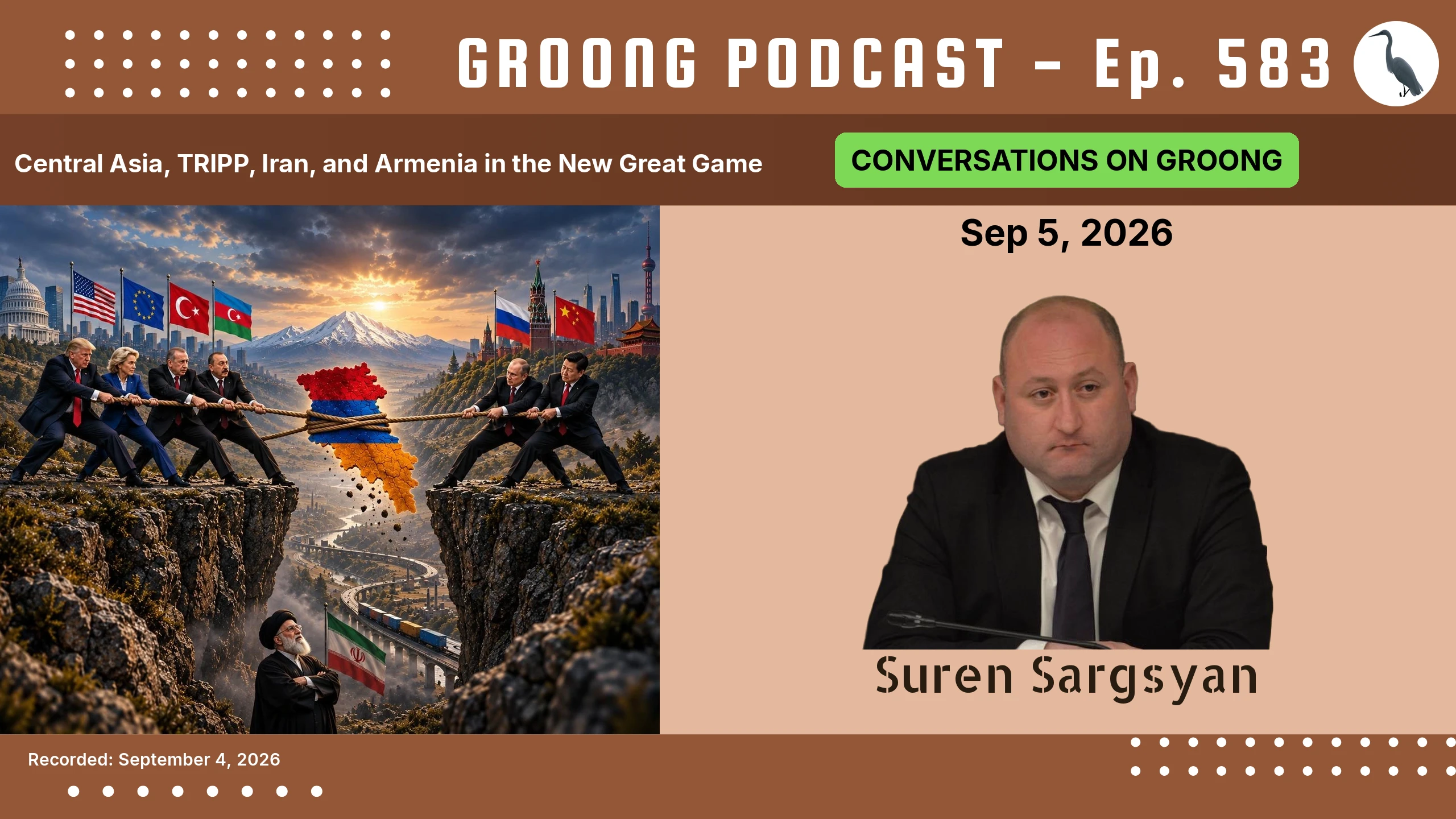
Suren Sargsyan analyzes the Iran War as a test of American strategy and staying power. After a month-long lull, U.S. and Iranian forces resumed strikes in early September 2026, yet Washington has not articulated a clear victory condition or exit plan. Sargsyan questions whether the Trump administration’s objectives go beyond military degradation of Iranian capabilities to regime change, and notes the gap between U.S. claims of Iranian defeat and Iran’s continued ability to retaliate. Domestic politics and the 2026 midterm elections may shape American choices going forward, but the strategic ambiguity creates risk for all parties.
The conversation then turns to Russia’s 102nd Military Base in Gyumri and the unusual public exchange between Putin and Pashinyan over its future. Neither leader appears willing to take outright responsibility for deciding whether the base remains, even as Pashinyan pursues anti-Russian rhetoric. Sargsyan argues the base carries greater strategic value for Moscow today because of its proximity to NATO member Turkey. He identifies a fundamental contradiction in Pashinyan’s posture: Armenia maintains membership in the CSTO and Eurasian Economic Union , hosts Russian troops and border forces, yet signals westward ambitions and seeks to avoid choosing between Russia and the West. Sargsyan suggests Russia may eventually force Armenia’s hand through a referendum on its future institutional alignment.
Nuclear energy emerges as a possible focal point for Russia-Armenia negotiations, with discussions of Russian involvement in Armenia’s next power plant or U.S.-backed small modular reactors. Any nuclear decision will likely become entangled in broader geopolitical bargaining involving Russia, the United States, Turkey, and Azerbaijan. Sargsyan warns that Armenia lacks a credible Plan B if current negotiations fail or if American interest wanes.
Watch/Listen: Episode 583
Keywords: Iran War , Russia, Vladimir Putin, Pashinyan, CSTO, Eurasian Economic Union, TRIPP, South Caucasus, Great power competition, Central Asia, Geopolitics
Stay Connected
For the full, unfiltered stream of Armenia news as it happens, subscribe to the Groong Mailing List on Google Groups. Subscribers receive the complete daily news feed directly in their inbox — expect tens of emails per day covering Armenia, Artsakh, the diaspora, and the broader region.