Groong Podcast Digest — Week of August 10–16, 2026
Published August 16, 2026 5 min read See also: News Digest →- EP576: Asbed and Hovik examine Pashinyan’s confrontation with the Armenian Church, Armenia’s balancing act between Russia and the EU, the geopolitical implications of TRIPP, Iran’s military leadership realignment under wartime pressure, the Turkey-Pakistan-Saudi Arabia defense pact, and how these shifts reshape Armenia’s role in the South Caucasus.
- EP577: Richard Campbell discusses the global AI race, data center economics, energy constraints, and Armenia’s Firebird project, examining whether current AI infrastructure investments align with physical and economic realities.
This Week’s Podcast Episodes

Episode 576: Pashinyan’s Church War, the Russia-EU Choice, and TRIPP | Ep 576, Aug 9, 2026

The hosts open with regional security developments, analyzing the new Turkey-Pakistan-Saudi Arabia defense pact and its potential expansion to include Azerbaijan. Hovik notes the pact represents a serious threat to Armenia, especially if Azerbaijan joins what is effectively a nuclear-armed alliance. Asbed counters that Turkey and Azerbaijan already have the Shushi Accords binding them militarily, so the addition of Pakistan and Saudi Arabia may not materially change Armenia’s security calculus. The conversation then shifts to Iran’s appointment of veteran commanders Mohsen Rezaei and Ali Abdollahi to senior national security positions, signaling a hardened institutional stance and centralization of decision-making during wartime. Hovik observes that Iran has rejected a deal on the Strait of Hormuz and that the nationalist camp in Tehran feels increasingly confident. Asbed argues the current ceasefire in the Iran war is actually a reloading phase, with U.S. and Israeli ammunition stockpiles depleted.
The focus then moves to Armenia’s domestic crisis over Catholicos Garegin II. Hovik expresses outrage that the Catholicos has been dragged to court for exercising his constitutional authority to demote a bishop who attempted to unseat him at Pashinyan’s behest. Asbed emphasizes the Catholicos has complete and final say over ecclesiastical appointments with no legal review, making the prosecution farcical. The presiding judge recused himself citing a dubious conflict of interest, likely to avoid association with what will be remembered as a shameful episode in Armenian history . The hosts note that diaspora organizations, other churches, and international bodies have condemned the case, yet the government presses forward. Asbed and Hovik agree this represents an affront to Armenians worldwide, as the Armenian Apostolic Church transcends national borders and holds deep cultural significance.
Watch/Listen: Episode 576
Keywords: Armenian Church, Pashinyan , Catholicos Garegin II, Iran War , Recep Tayyip Erdogan , South Caucasus, TRIPP , Civil Contract, Corruption
Episode 577: Richard Campbell - The AI Infrastructure Race and Armenia’s High-Stakes Bet | Ep 577, Aug 16, 2026
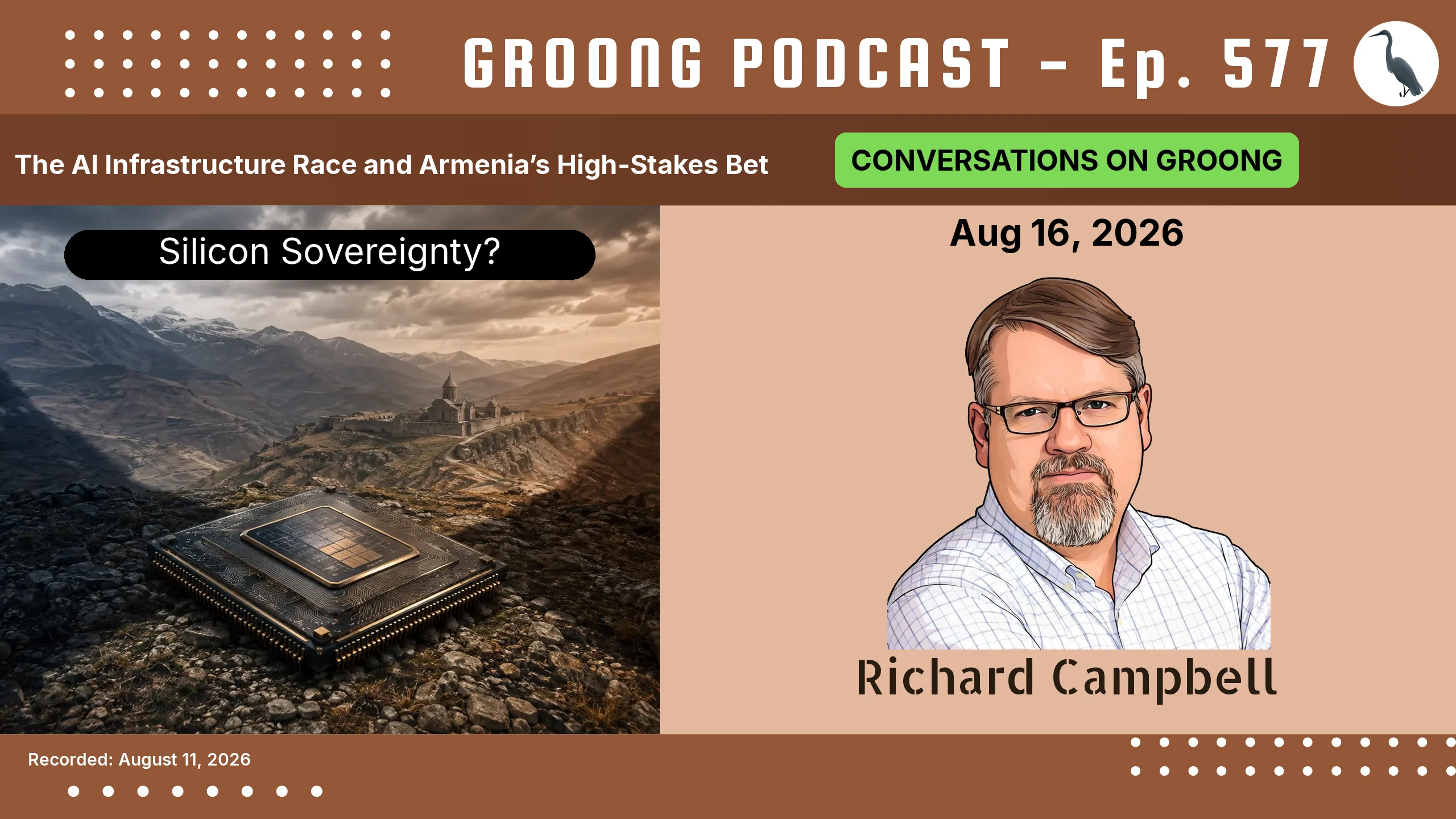
Richard Campbell brings decades of experience in software, infrastructure, and technology storytelling to a wide-ranging conversation about artificial intelligence, the hype cycle surrounding it, and the practical challenges of building AI computing capacity at scale. Campbell argues that much of the current AI boom reflects investment incentives and promises to investors rather than a clear path to artificial general intelligence. The Aschenbrenner thesis, which frames AI as a Manhattan Project-style competition that America must win at all costs, treats AGI as inevitable and uses that inevitability to justify enormous infrastructure spending. Campbell sees this differently: the AGI narrative has become an escape route, a justification for harm in the present moment based on magical thinking about future superintelligence that will solve problems. In reality, he observes, most researchers not financially incentivized to push AGI see no credible path to it. The technology is profoundly useful for synthesizing large amounts of data, much like a lossy compression algorithm, but that utility does not require superintelligence to justify.
On the economics of data centers, Campbell cuts through the notion that there are distinct “AI data centers” separate from conventional facilities. What exists are data centers with higher power densities per rack, a trend that predates the current AI wave. The asset that matters is power, cooling, connectivity, and structure; the computing hardware itself is transient, arriving on pallets and leaving on pallets every five years. Capital expenditure is real, but operational expenditure is where the actual business model emerges. As AI services move toward per-token pricing and away from flat-rate subscriptions, companies will have to assess whether workloads are worth the cost. Some will move to smaller local models; others will remain in cloud infrastructure. The market will equilibrate, but not at a single point. Campbell notes that we are still in the early stages of discovering what profitable AI infrastructure actually looks like, just as the dot-com boom took years to resolve which online services could sustain themselves.
On sovereignty and strategic positioning, Campbell invokes the analogy of vaccine production. Canada outsourced vaccine manufacturing to the United States for decades because it was cheaper, but when COVID hit and America had no excess supply, Canada discovered it had no capacity of its own. Similarly, Armenia should think about compute not primarily as a computing asset but as an ecosystem: educated people, infrastructure skills, access to resources, and the ability to function during crises. Smaller countries need not compete for the largest clusters; they need the capacity to know what they have, how to operate it, and where to turn when systems fail. Efficiency matters more over time than raw speed to market, a lesson China has learned through constraints that forced early focus on cost-effective models. Campbell emphasizes that the Firebird project, at its current 15-megawatt scale, is achievable within Armenia’s existing power infrastructure and serves as a crucial end-to-end proof of concept.
Watch/Listen: Episode 577
Keywords: Artificial Intelligence, Data Centers, AI Hype Cycle, AI Sovereignty, Computing Infrastructure, Energy Economics, Armenia AI Investment, Firebird AI Factory
Stay Connected
For the full, unfiltered stream of Armenia news as it happens, subscribe to the Groong Mailing List on Google Groups. Subscribers receive the complete daily news feed directly in their inbox — expect tens of emails per day covering Armenia, Artsakh, the diaspora, and the broader region.