Groong Podcast Digest — Week of August 3–9, 2026
Published August 9, 2026 6 min read See also: News Digest →- EP573: Dr. Pietro Shakarian explores the parallels between Stalinist repression in Soviet Armenia and authoritarian practices under the Civil Contract regime, examining how incomplete historical reckoning leaves societies vulnerable to recognizing new forms of political control.
- EP574: We examine Armenia’s new parliament sworn in on August 2, 2026, the Armenia Alliance’s direct challenge to Civil Contract over Tigranashen’s territorial status, the government’s evasive responses on border red lines, Armenia’s challenge to Russia’s railway concession, and how TRIPP reshapes regional power dynamics in the South Caucasus.
- EP575: Hrant Mikaelian discusses Armenia’s Western pivot, the opening of the new parliament, Ruben Rubinyan’s appointment as speaker, Armenia-Russia-EAEU relations, European aid, the Armenian Church’s role in national identity, and Armenia’s economic direction amid geopolitical pressure.
This Week’s Podcast Episodes

Episode 573: Pietro Shakarian - Memory Under Siege: From Stalin to Pashinyan | Ep 573, Aug 3, 2026
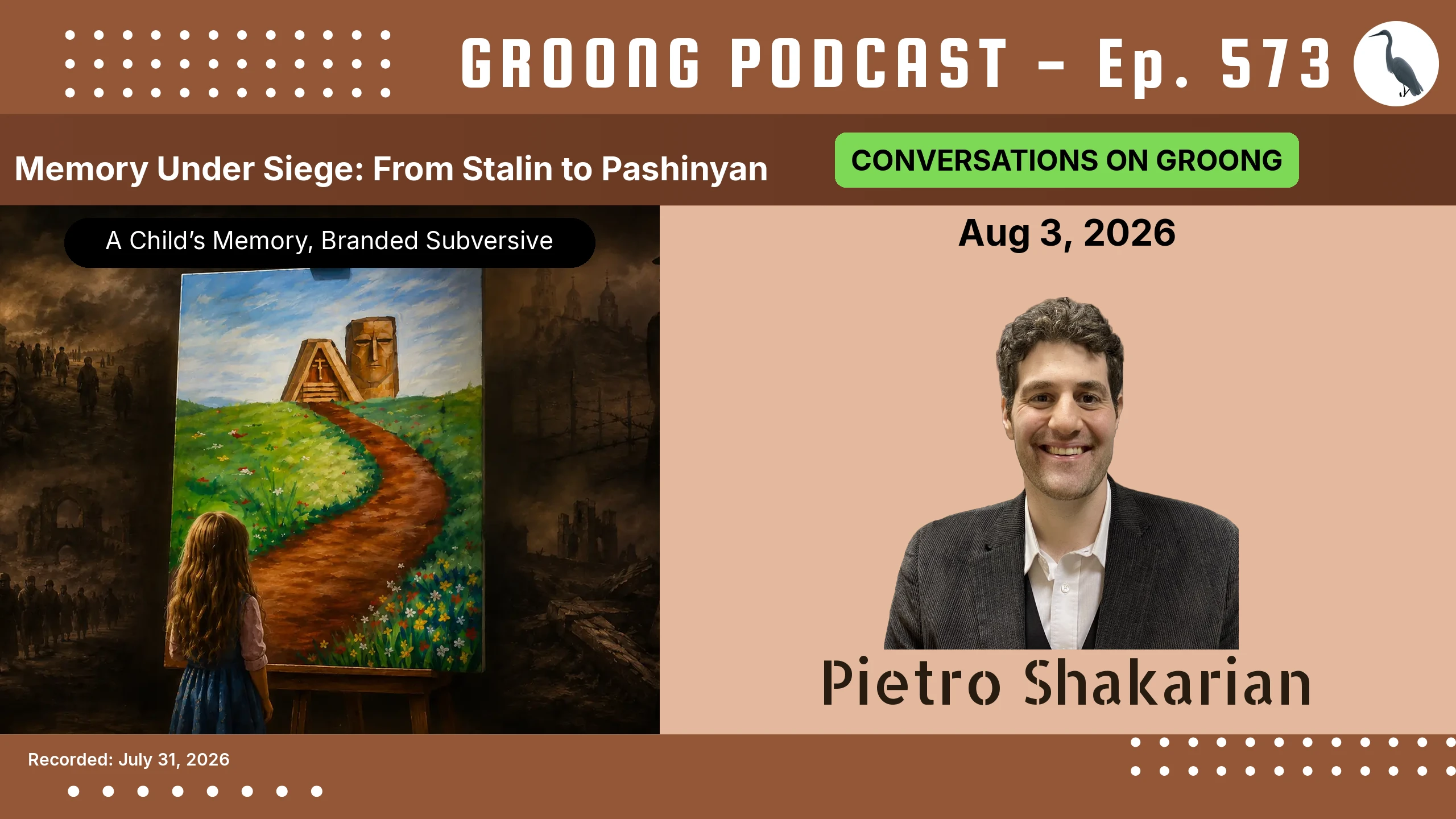
Dr. Pietro Shakarian , historian of Russia and the Soviet Union, traces the architecture of state power from the Great Purge through present-day Armenia. The discussion opens with the targeting of Armenian institutions during Stalin’s terror: the assassination of Communist Party leader Aghasi Khanjyan, the liquidation of Armenian intellectuals and clergy, and the systematic effort to erase competing sources of authority. Shakarian emphasizes that Armenia never completed a public reckoning with Stalinist repression. This incomplete accounting has consequences. Without confronting how local denunciations, personal rivalries, and societal complicity enabled the purges, Armenians lack historical inoculation against recognizing similar patterns today.
The conversation pivots to contemporary Armenia under Pashinyan. Shakarian identifies recurring mechanisms: concentration of authority, subordination of state institutions, attacks on the Armenian Church, construction of internal enemies, criminal prosecution of political rivals, suppression of competing historical narratives, and transfer of property from disfavored groups to governing cronies. While Pashinyan’s regime does not reach Stalinist totalitarianism, Shakarian warns of a “slippery slope.” The removal of Artsakh imagery from public spaces, attacks on Catholicos Garegin II , detention of opposition figures in pre-trial cycles, and the labeling of opponents as “traitors” and “enemies of the state” echo 1937 language. The government has moved to create a rival church structure loyal to the regime, mirroring Soviet efforts to establish a “Living Church” under state control.
On the opposition path forward, Shakarian stresses consolidation, dual strategy combining parliamentary participation with street mobilization, and recognition that Armenia faces an extraordinary situation requiring national mobilization. The opposition must address security, social welfare, and democracy simultaneously. Shakarian concludes with hope: the people hold ultimate power, and Armenia’s current government will not endure. Future reckonings await those who serve authoritarian power today.
Watch/Listen: Episode 573
Keywords: Soviet Armenia, Great Purge, Aghasi Khanjyan, Pashinyan, Armenian Church, Political Repression, Artsakh, Authoritarianism
Episode 574: Tigranashen Unanswered, Russia’s Railways Challenged | Ep 574, Aug 2, 2026
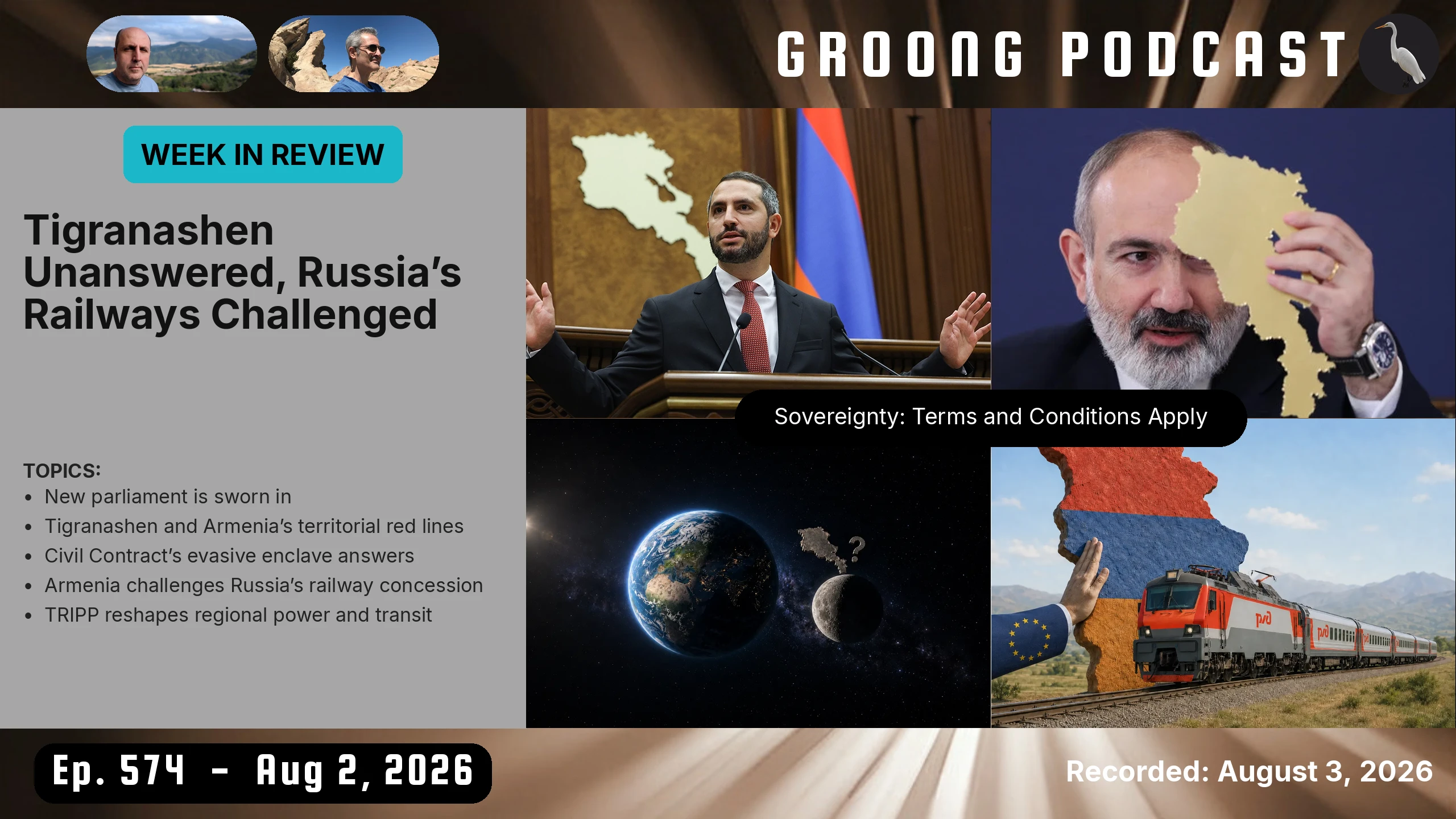
Armenia’s Ninth National Assembly was sworn in on August 2, 2026, with Ruben Rubinyan elected speaker. When Armenia Alliance MP Ishkhan Saghatelyan pressed the government directly on whether it could guarantee Tigranashen would not be surrendered, Rubinyan cited Armenia’s internationally recognized 29,743 square kilometers but avoided clarifying whether that figure includes Tigranashen itself. The response left open the possibility of territorial “optimization” through demarcation, a term that has become code for potential concessions. Tigranashen’s strategic importance for Armenia’s north-south transportation corridor and defensive position makes this evasion particularly troubling to opposition lawmakers. The government has refused to state clearly which maps or legal documents guide the border demarcation process, creating uncertainty over Armenia’s actual red lines.
Simultaneously, Pashinyan has escalated conflict with Russia over the 30-year railway concession signed in 2008 and scheduled to run through 2038. The government now threatens international arbitration and claims Russian mismanagement, while proposing a buyout or transfer of rail management to another country. Russia counters that it invested hundreds of millions in Armenia’s network. The financial cost of early termination could force Armenia to borrow additional funds. Asbed noted that competing interests have staked claims to the same transit rights: Pashinyan signed onto both the November 2020 trilateral agreement, which reserves a Russian role under Point 9, and initiated something with the White House in August 2025 related to TRIPP . The dispute involves multiple railway routes through Yeraskh, Nakhijevan , Gyumri, Kars, and Syunik , with the EU and U.S. pushing hardest to remove Russian control.
Hovik emphasized that the EU, preparing for confrontation with Russia, is the primary force behind removing Russian involvement from Armenia’s infrastructure. The railway concession and transit arrangements intersect with TRIPP, the U.S.-backed corridor meant to connect Asia to Europe through Armenia while bypassing Russia and Iran. Russia’s insistence on Point 9 and its claim to manage Syunik transit directly conflicts with TRIPP’s architecture. The hosts concluded that Pashinyan has sold overlapping rights to two major powers at war with each other, setting the stage for a collision between Russian claims and Western-backed connectivity projects.
Watch/Listen: Episode 574
Keywords: Tigranashen, Armenia-Azerbaijan Peace Process, TRIPP, Zangezur Corridor, Russian Peacekeepers, Syunik, Pashinyan, Civil Contract
Episode 575: Hrant Mikaelian - Armenia’s Western Pivot: Strategy or Wishful Thinking? | Ep 575, Aug 8, 2026
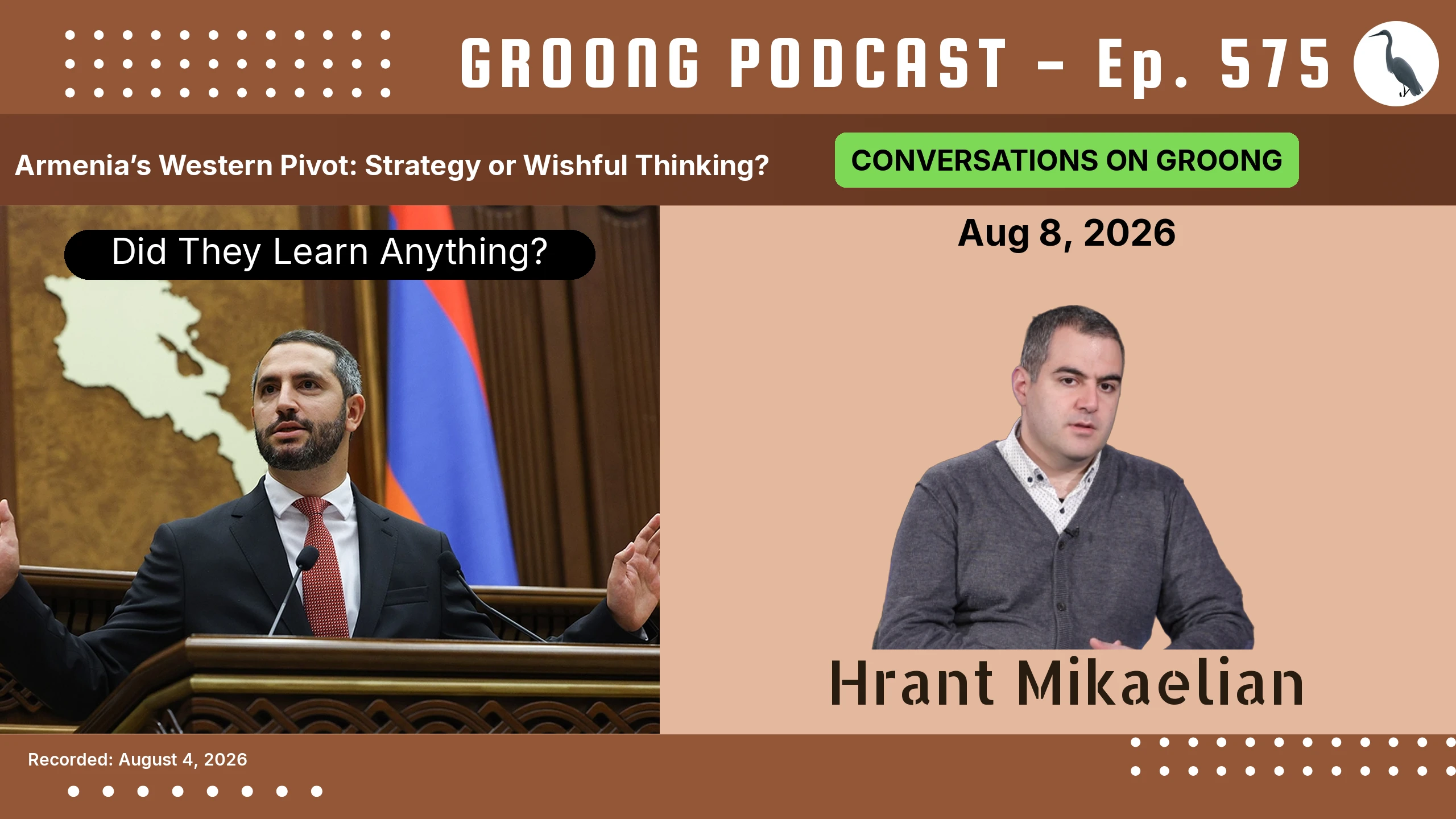
Asbed and Hovik speak with Hrant Mikaelian about the deteriorating state of Armenia-Russia relations and the structural impossibility of Armenia maintaining meaningful ties with both Moscow and Brussels simultaneously. Mikaelian argues that both Russia and Armenia have failed to sustain their alliance, with Armenia allowing Western lobbying against Russia-Armenian cooperation while Russia failed to prevent Turkey and Azerbaijan from lobbying against the relationship. The aftermath, however, is worse for Armenia as the smaller party. Pashinyan underestimated how severely the relationship quality had declined, expecting that his post-election legitimacy would allow Putin to negotiate on favorable terms. Instead, the Kremlin demanded an immediate referendum on leaving the Eurasian Economic Union and joining the EU, a demand Pashinyan resisted by claiming a referendum is impossible without a formal EU application.
Mikaelian explains that Russia’s demand is specifically for Armenia to simultaneously leave the EAEU and join the EU as a single act, not merely to join the EU. He notes that a referendum held today would likely pass with roughly 60 to 40 or 62 to 38 margins, driven by six years of intensive pro-EU and anti-Russian propaganda rather than objective reasons for trusting the European Union. The approximation to the EU, Mikaelian argues, is fundamentally incompatible with membership in the EAEU not for economic reasons but for geopolitical ones: the EU and Russia are now in direct conflict, especially since American withdrawal from the Ukraine war forced the EU to assume a larger role in European military affairs. Russia’s demand for a referendum serves a strategic purpose: a “yes” vote would provide legitimate grounds for removing Armenia from the EAEU without the procedural mechanisms otherwise unavailable to Moscow.
Regarding European support, Mikaelian is deeply skeptical. The EU has repeatedly promised aid packages ranging from 2.5 billion euros to various combinations of grants and credits, none of which have materialized. The 52 million euros currently being delivered is insignificant compared to Armenia’s potential losses. Western European leaders Macron, Merz, and Starmer all held approval ratings near 10 to 15 percent during the 2026 election period, indicating they lack domestic support even as they pursue Brussels-aligned policies. While conservative forces across Europe and America initially challenge the established system, they are systematically assimilated into it before assuming power, as seen with Meloni in Italy and the trajectory of various populist movements.
Watch/Listen: Episode 575
Keywords: Pashinyan, Armenia-Russia Relations, Eurasian Economic Union, Armenia-Azerbaijan Peace Process, European Union, Ruben Rubinyan, TRIPP, Zangezur Corridor
Stay Connected
For the full, unfiltered stream of Armenia news as it happens, subscribe to the Groong Mailing List on Google Groups. Subscribers receive the complete daily news feed directly in their inbox — expect tens of emails per day covering Armenia, Artsakh, the diaspora, and the broader region.