Groong Podcast Digest — Week of July 27–2, 2026
Published August 2, 2026 6 min read- EP570: Dr. Archil Sikharulidze discusses Russia’s shifting strategy in the South Caucasus, Georgia’s widening dispute with Europe, Armenia’s move away from Russian alignment, and how regional transit corridors reshape competition among Moscow, Brussels, and Washington.
- EP571: Hovik and Asbed examine escalating regional tensions as Ukraine expands operations into the Caspian Sea, striking Iranian and Russian assets, while analyzing how this merger of northern and southern conflicts affects Armenia, Kazakhstan’s energy security, and Pashinyan’s diplomatic positioning amid new pressure from Western capitals following Aliyev’s recent visits to Germany and Berlin.
- EP572: Christine Arakelian discusses American foreign policy fractures, the Iran war, NATO 3.0 and Europe’s militarization, Turkey’s rising regional influence, Armenia’s 2026 parliamentary elections and managed democracy, and the risks of TRIPP as Armenia pivots toward an undefined Western relationship.
This Week’s Podcast Episodes

Episode 570: Archil Sikharulidze - Armenia and Georgia Between Russia and Europe | Ep 570, Jul 26, 2026
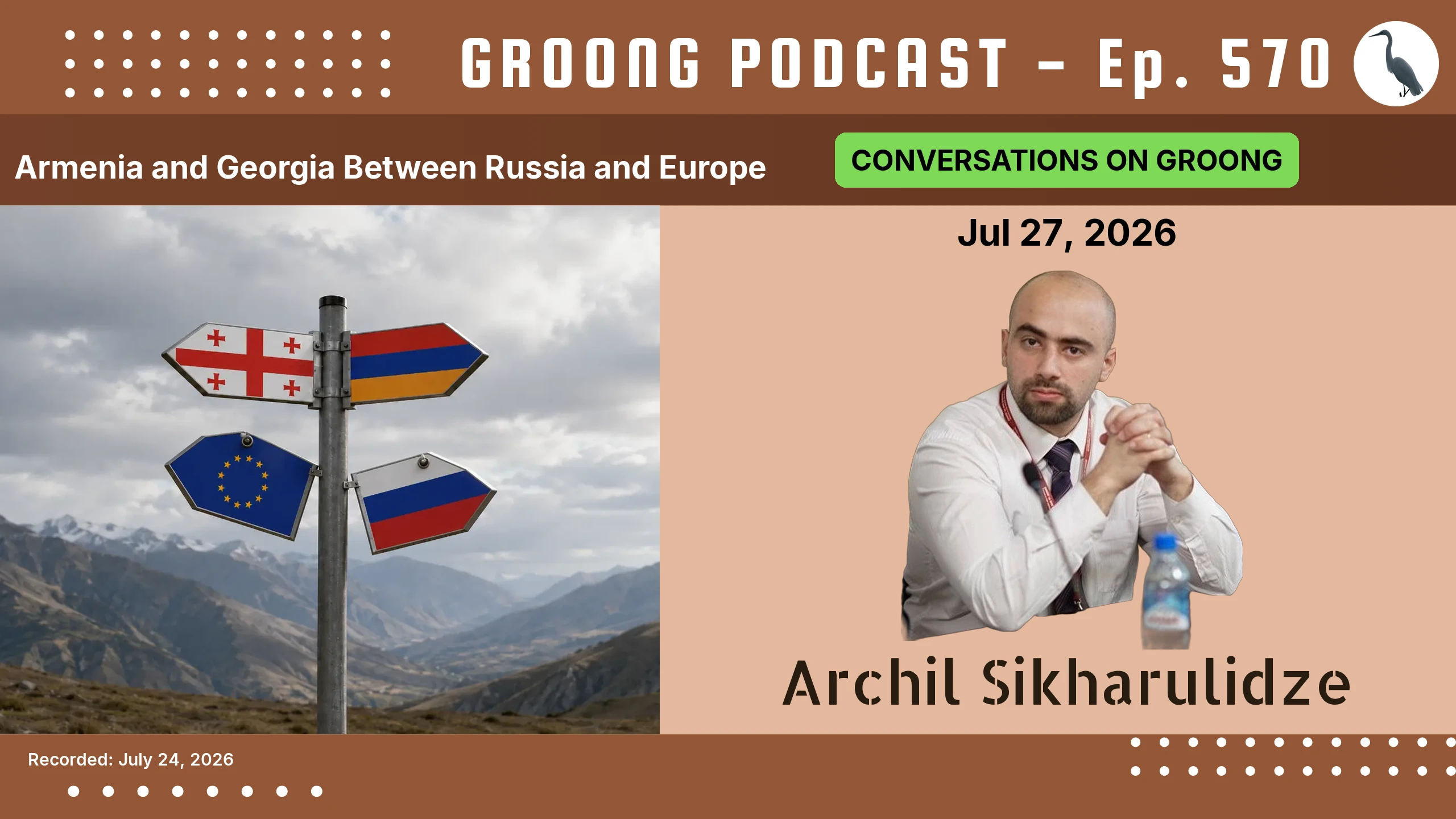
Dr. Archil Sikharulidze , founder of Tbilisi’s SIKHA Foundation, examines how Moscow views Armenia and Georgia as geopolitical actors in an era of declining Russian influence. Russian experts now recognize that Armenia feels abandoned following the loss of Artsakh (Nagorno Karabakh) in September 2023, when Azerbaijan’s military operation completely displaced more than 150,000 Armenian inhabitants. Sikharulidze notes that Armenians question whether Russia abandoned them during the crisis, while Georgians maintain cautious distance from Moscow despite historical ties. Russia’s traditional hard-power approach, combined with persistent militaristic rhetoric, has damaged trust in both countries. Sikharulidze argues that Moscow’s failure to acknowledge regional pain points, particularly Armenia’s loss of Artsakh and Georgia’s territorial losses in Abkhazia, undermines any attempt to rebuild partnerships. He observes that Russian decision-makers remain unwilling to reconsider core strategies or offer direct acknowledgment of past mistakes.
Georgia’s relationship with Europe has grown increasingly strained over cultural and governance disputes. Sikharulidze emphasizes that Georgian Dream ’s conflict with Brussels stems not from ignorance but from fundamentally different worldviews: Europe demands rapid social liberalization, while Georgia defends traditional values through state policy. The dispute is neither purely ideological nor driven by Western NGOs alone, but reflects genuine political rivalry over authority and cultural direction. Meanwhile, Ukraine has softened its approach toward Tbilisi, recognizing Georgian Dream’s durability and shifting its engagement strategy. The European Union, despite rhetoric about defending democracy, has begun viewing Georgia primarily through the lens of transit corridors and TRIPP (Trump Route for International Peace and Prosperity ) rather than cultural alignment.
Armenia’s shift away from Russian reliance mirrors Georgia’s cautious stance but operates in a different context. As Pashinyan navigates uncertain European support and questions over legitimacy, regional cooperation with Georgia offers stability that external powers cannot guarantee. Sikharulidze argues that Armenian and Georgian interests align on logistics and economic development, not on geopolitical blocs. He advocates for Armenia and Georgia to develop a common regional policy based on pragmatic cooperation rather than alignment with outside powers. Sikharulidze believes both countries can benefit from coordinated transit strategies that increase trade volume without creating zero-sum competition, positioning the South Caucasus as a driver of its own prosperity rather than a playing field for distant powers.
Watch/Listen: Episode 570
Keywords: South Caucasus, Russia, Armenia-Azerbaijan Peace Process, Pashinyan, Artsakh Blockade, Georgia, Ethnic Cleansing, TRIPP
Episode 571: From Caspian Drones to Armenia’s Cold Winter | Ep 571, Jul 26, 2026
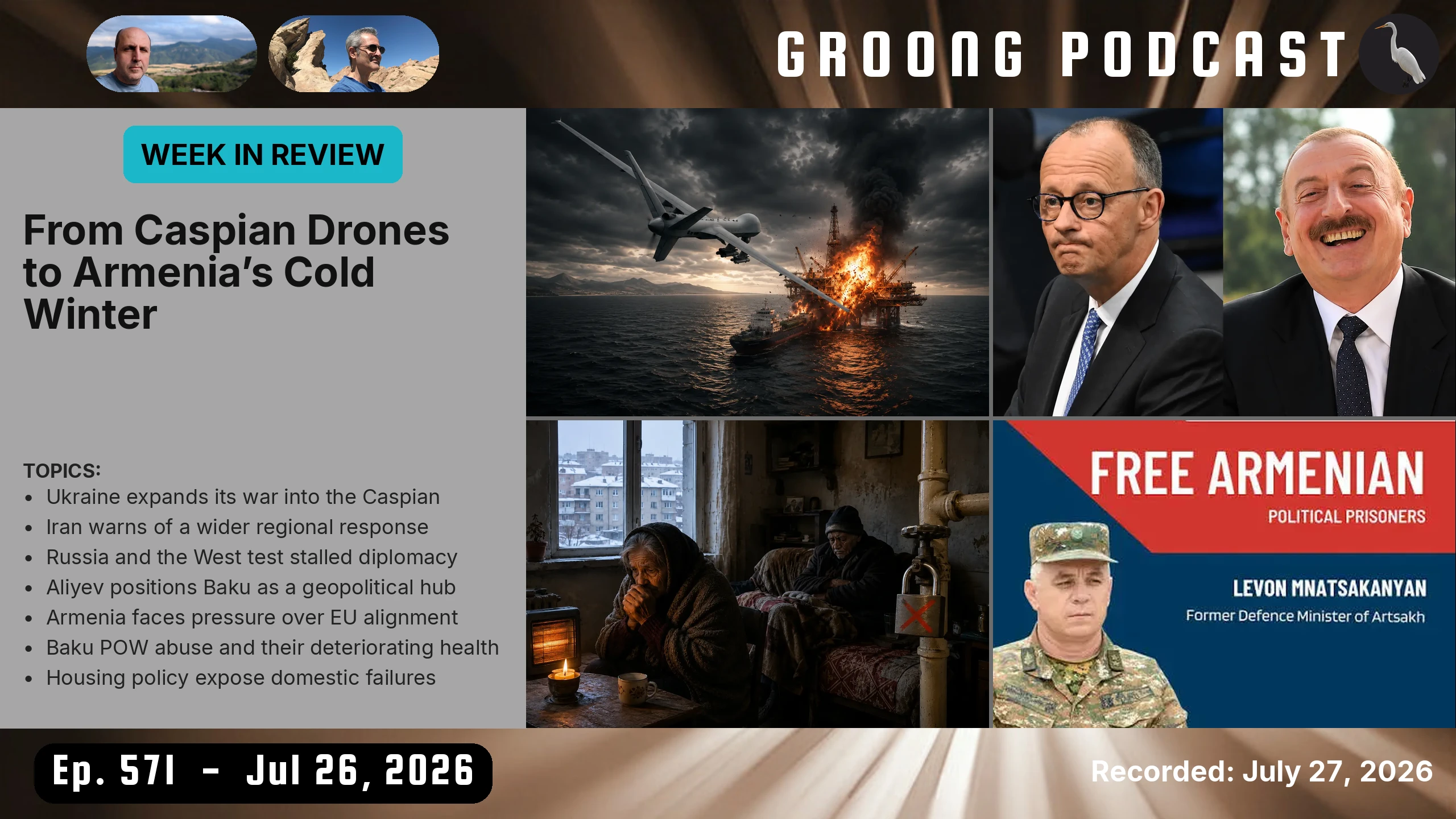
Ukraine’s expansion of drone operations into the Caspian Sea marks a dramatic escalation with potential to merge the Ukraine conflict with Middle Eastern tensions. The attack on Russian and Iranian assets raises critical questions about the origin of the drones, the level of NATO or U.S. intelligence support required, and whether regional states including Azerbaijan assisted the operation. The hosts explore whether this represents a deliberate strategy to link the two wars and disrupt critical energy infrastructure serving European markets, with implications for oil exports and the broader struggle over trade routes between China and Europe.
Simultaneously, Aliyev has positioned Baku as a geopolitical hub through strategic visits to Berlin and partnership discussions with Germany, signaling Azerbaijan’s alignment with European energy and security interests. The hosts discuss secret German-Russian diplomatic contacts in Baku and the significance of Berlin’s expectations for Armenia to take “further peace steps.” These developments create pressure on Pashinyan, who faces conflicting demands from Moscow to resist EU membership and from the West to align with European structures. Armenia’s efforts to secure Iranian gas supplies and the reported deterioration in the health of Armenian prisoners held in Baku add urgency to Armenia’s diplomatic position.
Domestically, the episode addresses multiple governance failures: the use of hooliganism charges against government critics, the controversial allowance of foreign online purchases of Armenian apartments, and the housing crisis that prices most Armenian families out of ownership. The hosts also correct an earlier error regarding the relationship between Gurgen Arsenyan, Armenia’s ambassador to Russia, and Ashot Arsenyan, owner of Jermuk mineral water, clarifying they are unrelated.
Watch/Listen: Episode 571
Keywords: Ukraine War , South Caucasus, Ilham Aliyev, Pashinyan, Caspian Sea, Iran War , Armenia-Azerbaijan Peace Process, Prisoners of War, Eurasian Economic Union , TRIPP
Episode 572: Christine Arakelian - Forever Wars, NATO 3.0, Armenia’s High-Stakes Western Pivot | Ep 572, Jul 31, 2026
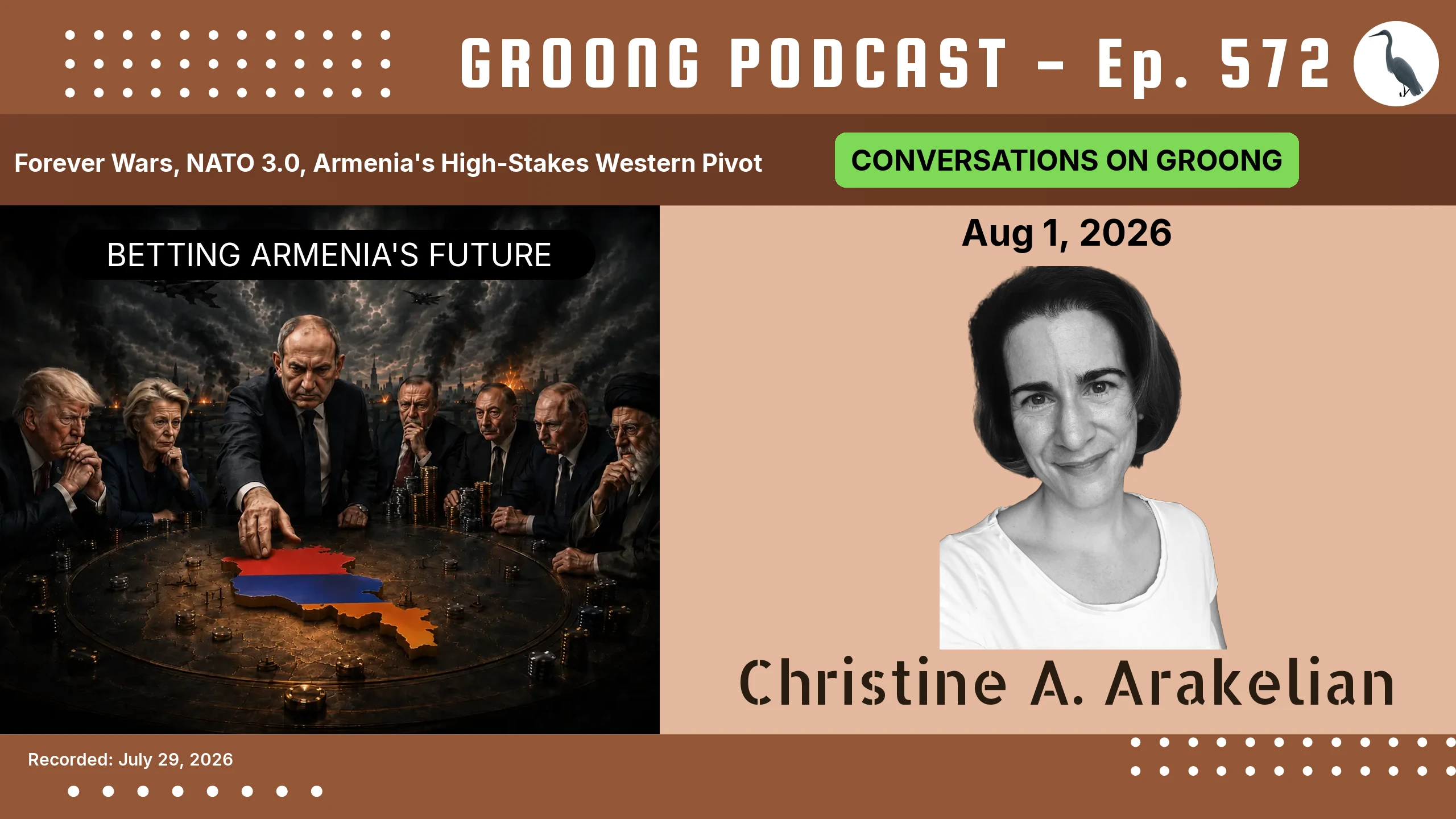
Christine Arakelian examines the structural incoherence of U.S. foreign policy across multiple theaters. She argues that the United States lacks a coherent strategic doctrine, operating instead through competing institutions and interests that sometimes contradict one another. The fractured MAGA coalition, once united against forever wars, has splintered over Gaza, Lebanon, and Iran. Arakelian identifies three key factors that will determine Trump’s political success before elections: oil and gas prices, visible foreign-policy wins, and American casualty figures. She notes that Pentagon casualty definitions have changed, making accurate accounting difficult. The Iran war itself remains strategically undefined: America has not articulated what victory means, nor resolved how to reopen the Strait of Hormuz through military force or contain Iranian asymmetric drone warfare. The conflict carries genuine escalation risk, with Israeli and American election cycles misaligned and Iranian actors potentially timing operations to influence both contests.
NATO 3.0 represents a fundamental reordering of transatlantic burden-sharing. The U.S. will reduce conventional forces in Europe while demanding European members spend 5% of GDP on defense. This shift carries a two-edged blade: European countries will shoulder more costs, but European defense contractors will capture more contracts at the expense of U.S. firms. Arakelian warns that as Europe asserts greater strategic independence, the EU’s internal power structure—dominated by France and Germany—will come under strain. She advocates for U.S. bilateral relationships with individual European states rather than reliance on EU aggregation. Turkey emerges as the clear winner from NATO’s Ankara summit, having secured Trump’s personal embrace of Erdogan despite the imprisonment of Istanbul’s opposition mayor and Turkey’s simultaneous cultivation of alternative strategic alignments with Pakistan, Saudi Arabia, and Egypt. The U.S. ambassador to Turkey operates effectively as an Erdogan advocate, skewing regional policy perspectives unfavorably toward Armenian and other diaspora interests.
Arakelian argues that coherent Western strategy requires defending ideas and values alongside geostrategic interest. The Cold War was won on both counts. Without that clarity, she contends, there is no clear definition of what the West actually is or what it stands for.
Watch/Listen: Episode 572
Keywords: US Foreign Policy, Forever Wars, Iran War, NATO 3.0, Recep Tayyip Erdogan, Ukraine War
Stay Connected
For the full, unfiltered stream of Armenia news as it happens, subscribe to the Groong Mailing List on Google Groups. Subscribers receive the complete daily news feed directly in their inbox — expect tens of emails per day covering Armenia, Artsakh, the diaspora, and the broader region.