Groong Podcast Digest — Week of June 29–5, 2026
Published July 5, 2026 5 min read See also: News Digest →- EP562: Hovik and Asbed examine Israel’s historic recognition of the Armenian Genocide amid shifting geopolitical tensions, Russia’s escalating warnings toward Armenia, and the post-election standoff as the Constitutional Court prepares to rule on opposition challenges to the legitimacy of the June 2026 parliamentary elections.
- EP563: Ambassador Dziunik Aghajanian examines the Iran-US MOU, Armenia’s 2026 parliamentary election aftermath and Constitutional Court proceedings, Russian economic pressure on Armenia, and Israel’s recognition of the Armenian Genocide.
This Week’s Podcast Episodes

Episode 562: When Israel Recognizes and Yerevan Dodges | Ep 562, Apr 25, 2026
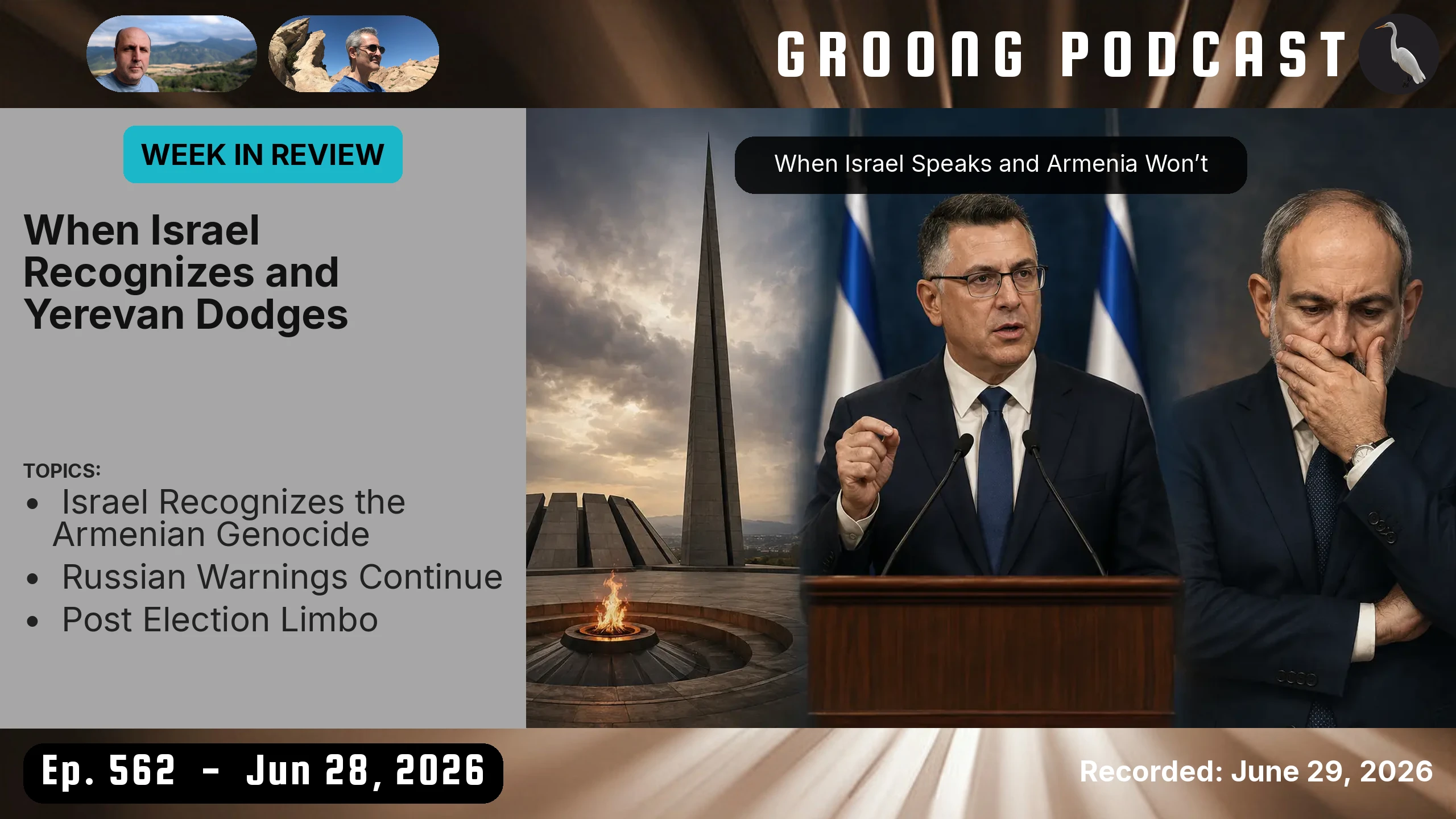
Israel’s cabinet voted to recognize the Armenian Genocide, with Foreign Minister Gideon Sa’ar framing recognition as a moral duty. The hosts debate the geopolitical context behind this decision, situating it within broader U.S.-Turkey tensions and the Iran-U.S Memorandum of Understanding. Hovik argues the move signals Israel’s rivalry with Turkey as Washington considers reintegrating Ankara into the F-35 program and reducing military support to Israel in the Middle East. Asbed emphasizes that while recognition carries symbolic weight, it must translate into political and legal obligations, including Israeli responsibility for enabling the ethnic cleansing of Artsakh and supporting Azerbaijan’s military capabilities. Both acknowledge Israel’s decades-long role in blocking U.S. recognition of the Armenian Genocide through its lobby. The hosts sharply diverge on whether Armenia should welcome Israel’s recognition: Hovik rejects it as moral posturing from a genocidal actor currently committing atrocities in Gaza, while Asbed argues recognition is a tangible achievement that Armenian communities have fought for and that legal consequences must follow. They agree to disagree on whether this represents progress or complicity.
Russia’s deputy Security Council chair Dmitry Medvedev accused Western powers of turning Armenia into an anti-Russian tool and backing a purge of opposition figures who support normal Armenia-Russia ties. His criticism directly followed Armenia’s Security Council Secretary Armen Grigoryan’s attendance at a Ukraine reconstruction conference in Gdańsk focused on mobilizing frozen Russian assets. The hosts explore Russia’s red lines: EAEU membership benefits, the military base in Gyumri, railway concessions, and trade relationships. Asbed highlights the critical role of remittances from Armenian workers in Russia, totaling 3 to 4 billion dollars annually, which stabilize the Armenian dram and without which Armenia’s poverty rate would soar from its current 20 percent level. Hovik warns that Armenia’s Western pivot without EU guarantees of equivalent economic support amounts to economic suicide, as Russia can restrict labor migration, halt agricultural imports, and disable remittance flows.
With the Constitutional Court expected to rule on opposition election challenges by July 4, Armenia enters a tense waiting period. Six opposition parties and alliances have demanded the election’s annulment. The government continues daily propaganda campaigns alleging opposition vote-buying while arresting hundreds of opposition supporters, many held in pretrial detention. The hosts document specific cases: Strong Armenia ’s Edgar Ghazaryan , whose sister was fired from the drug regulatory agency; Ishkhan Saghatelyan of the Armenia Alliance , whose home was searched without charges; HayaQve’s Avetik Chalabyan, arrested for allegedly inciting foreign interference; and a 31-year career teacher dismissed for being on the Strong Armenia party list. The government revoked Gagik Tsarukyan’s casino license, redistributing gambling and agricultural opportunities to Civil Contract allies. More than a dozen priests were drafted into military service after the chaplaincy arrangement was canceled. Hovik calls this a Stalinist purge aimed at disabling opposition activity in the present. The hosts note that Civil Contract has chosen Ruben Rubinyan as National Assembly speaker, a figure who led normalization talks with Turkey and may have spent time in Turkey prior to 2018. Hovik predicts a 60 percent chance the court rules for no meaningful change, a 20 percent chance for Prosperous Armenia vote restoration, and a 20 percent chance for new elections under tighter government control.
Watch/Listen: Episode 562
Keywords: Armenian Genocide, Israel, Pashinyan, South Caucasus, Armenia-Azerbaijan Peace Process, Russian Peacekeepers, Ethnic Cleansing, 2026 Armenian Parliamentary Election , Civil Contract, Eurasian Economic Union , Corruption , Established Opposition, Prosperous Armenia, Strong Armenia, Gagik Tsarukyan
Episode 563: Dziunik Aghajanian - Iran War, Election Aftermath, Russian Warnings, Israeli Recognition | Ep 563, Jul 2, 2026
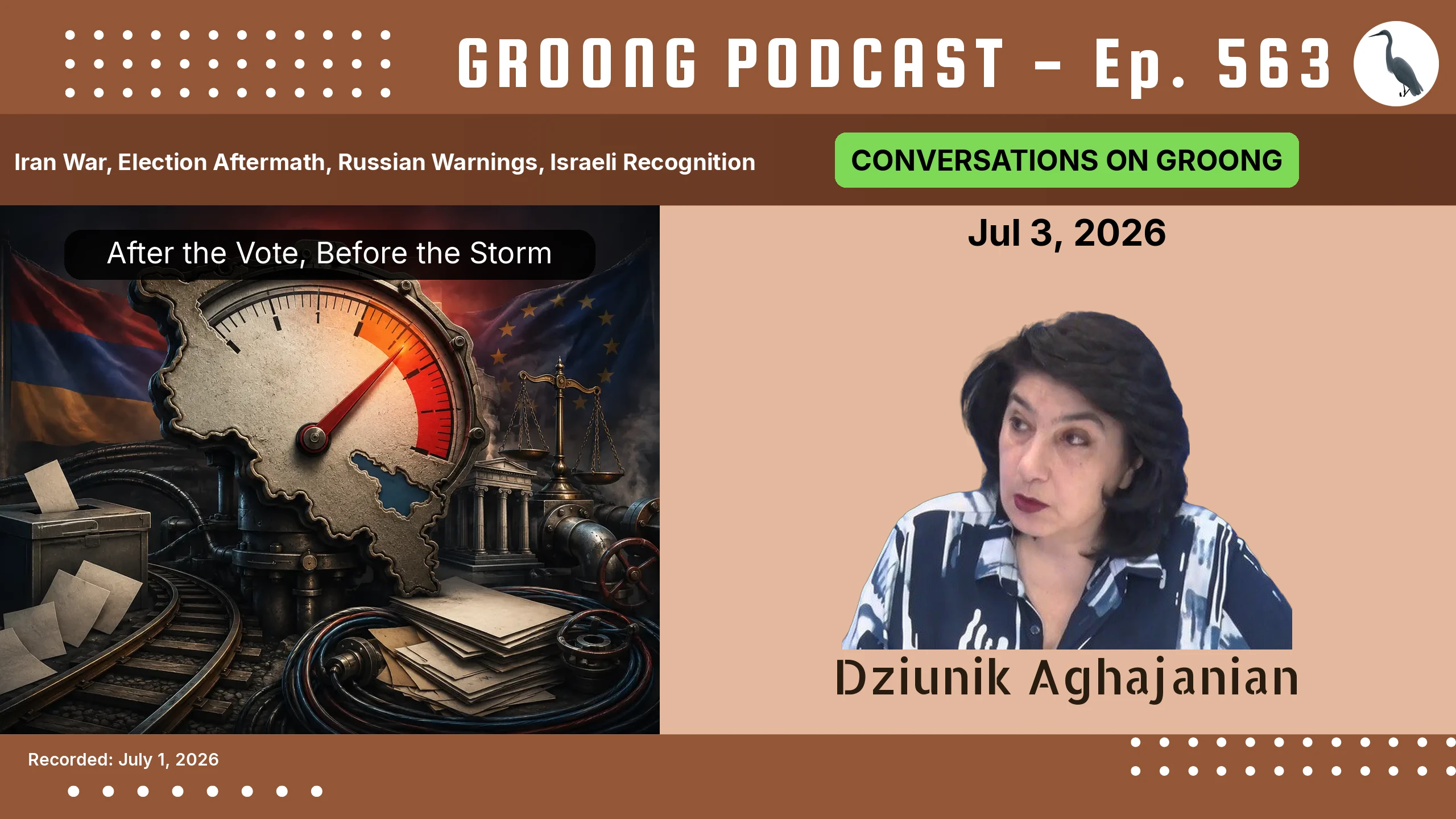
Ambassador Aghajanian frames the Iran-US memorandum of understanding as a tactical pause rather than genuine de-escalation, arguing Tehran may view it as breathing room before renewed military confrontation. She emphasizes that Israel could reopen conflict before October elections and that Azerbaijan’s role as a potential logistical base for anti-Iran operations remains a concern for Tehran. The discussion turns to Armenia’s Constitutional Court review of election fraud allegations from seven opposition parties, including the invalidation of three precincts without revotes, which led to disqualifying Prosperous Armenia from 5 seats in the Parliament. Amb. Aghajanian contends the court faces pressure to deliver a political rather than legal ruling, with Civil Contract potentially seeking constitutional changes once parliament is seated.
The conversation shifts to Russian restrictions on Armenian agricultural and fish exports, framed as escalating economic pressure following Pashinyan’s Western pivot. Deputy FM Galuzin’s warning that Armenia cannot deepen EU ties while enjoying EAEU benefits, and Medvedev’s statements about consequences of breaking with Russia, signal Moscow views Pashinyan as having crossed critical red lines. Aghajanian argues this represents a fundamental strategic shift: under previous governments, Armenia pursued complementarity across multiple partners, but Pashinyan has placed Armenia squarely in an anti-Russia and anti-Iran posture serving Western interests.
On Israel’s cabinet vote to recognize the Armenian Genocide, Aghajanian characterizes it as a bargaining chip in triangular negotiations between Israel, Turkey, and the US over Turkish participation in future Iran operations. She notes the timing is deliberately political: the Knesset enters recess, leaving the decision hanging without immediate parliamentary action. Pashinyan’s response, warning against “weaponizing the Armenian Genocide,” reflects his adoption of Turkish denialist language and his inability to act in Armenia’s national interest. The episode underscores how Armenia’s degraded geopolitical position stems not from the loss of Artsakh alone but from that loss being “given away” by its own government, leaving it vulnerable to external manipulation.
Watch/Listen: Episode 563
Keywords: Iran War , 2026 Armenian Parliamentary Election, Constitutional Court, Pashinyan, Russian Peacekeepers, Armenia-Azerbaijan Peace Process, Eurasian Economic Union, Armenian Genocide, Israel, Zangezur Corridor, South Caucasus, Armenian Diaspora , Vladimir Putin
Stay Connected
For the full, unfiltered stream of Armenia news as it happens, subscribe to the Groong Mailing List on Google Groups. Subscribers receive the complete daily news feed directly in their inbox — expect tens of emails per day covering Armenia, Artsakh, the diaspora, and the broader region.