Groong Podcast Digest — Week of June 22–28, 2026
Published June 28, 2026 5 min read See also: News Digest →- EP560: Arman Grigoryan discusses US-Iran negotiations and their implications for TRIPP, regional power dynamics, and Armenia’s contested 2026 parliamentary election aftermath.
- EP561: We examine the fallout from Armenia’s 2026 Armenian Parliamentary Elections, including six opposition parties challenging results at the Constitutional Court, escalating political persecutions targeting opposition figures, Russia’s continued economic pressure on Pashinyan’s government, US-Iran ceasefire negotiations and their regional implications, and a new Armenia-Azerbaijan telecommunications agreement that raises cybersecurity and strategic dependency concerns.
This Week’s Podcast Episodes
Episode 560: Arman Grigoryan - US-Iran Negotiations, Post-Election Armenian Politics | Ep 560, Jun 23, 2026
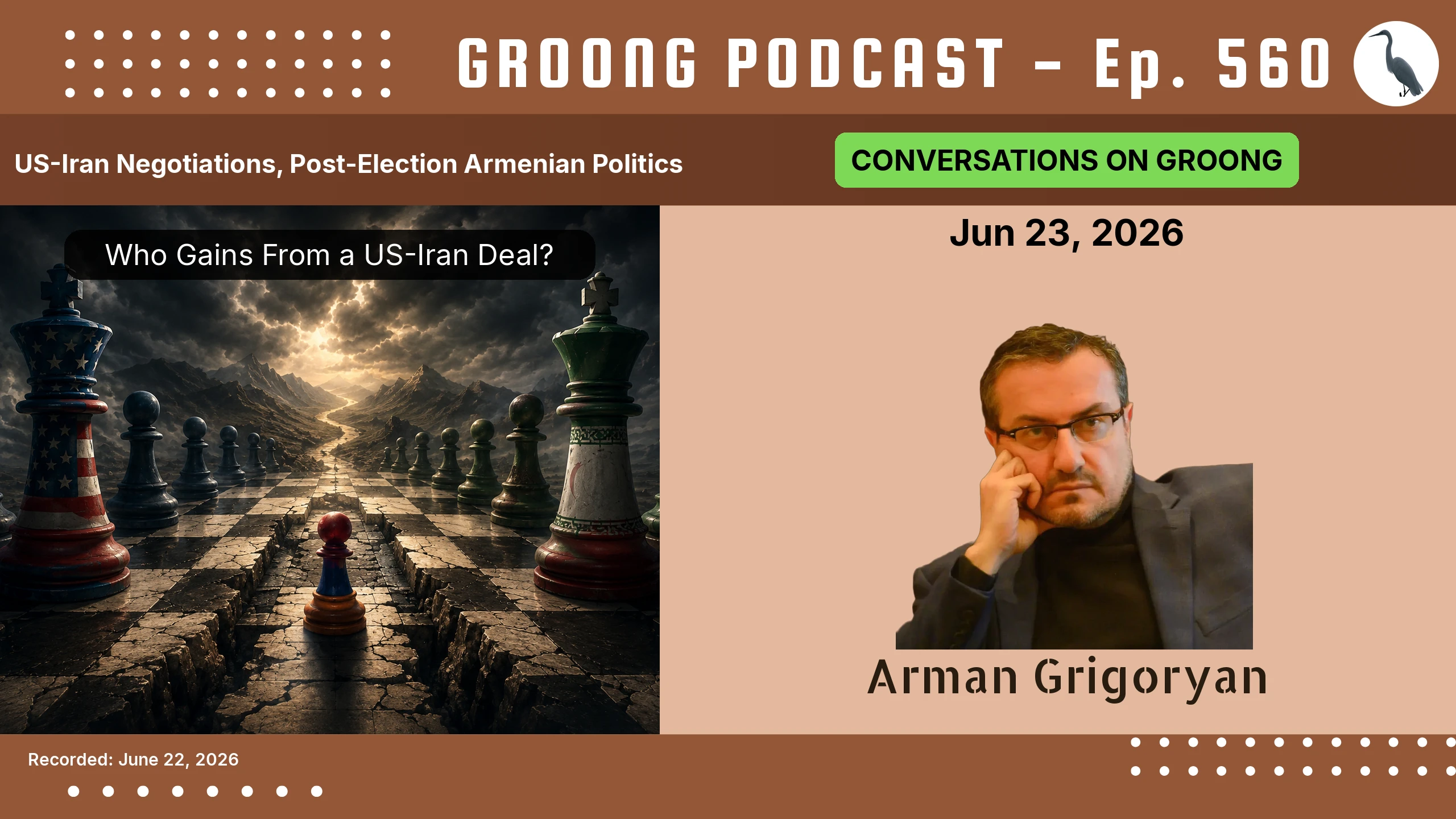
Dr. Grigoryan assesses the prospects for a lasting US-Iran agreement and its reverberations across the South Caucasus. He argues that if US-Iran negotiations conclude with American concessions or a negotiated settlement recognizing the current status quo, the TRIPP project will face revision to account for Russian and Iranian concerns. A weaker Western position in the region, Grigoryan suggests, may open space for Russia to exercise greater leverage, especially given Moscow’s recent pressure on Armenian agricultural exports. The conversation then turns to the mechanics of great-power competition: if Iran gains sanctions relief, its regional assertiveness could shift the balance between Israel and Turkey, potentially strengthening Turkish and Azerbaijani ambitions for pan-Turanic integration projects.
Grigoryan stresses that Armenians were not offered a clear picture of political choices in the 2026 parliamentary election. Rather than voting for a coherent platform, voters were presented with distorted, oversimplified narratives designed to evoke fear: either war or national erosion. The campaign logic was chiefly negative, he argues, with voters choosing against Pashinyan’s failures and foreign policy missteps, or against the return of the pre-revolutionary oligarchic order. Pashinyan’s strategic goal is not peace with Azerbaijan in isolation but a wholesale reorientation of Armenia’s geopolitical alignment away from Russia and toward the West. This explains his willingness to make concessions in the peace process that many Armenians find unacceptable.
The opposition failed to articulate a credible alternative, especially on foreign policy. While Strong Armenia and the Armenia Alliance embraced TRIPP, they avoided explicit statements on Armenia’s future alignment and offered no compelling domestic agenda. Robert Kocharyan symbolized the pre-revolutionary status quo, a fatal liability despite his core constituency. Grigoryan notes that lingering public memory of the pre-2018 period centers not on corruption alone but on systematic humiliation and the absence of rule of law. This perception, whether accurate or not, benefits Pashinyan. Yet the 2026 result was narrower than 2021, achieved through administrative pressure, state spending, and electoral irregularities. Grigoryan warns that Pashinyan may be preparing for new elections by pushing legislation to ban opposition parties and restrict diaspora voting rights, seeking to secure the two-thirds majority necessary for constitutional change demanded by Baku.
Watch/Listen: Episode 560
Keywords: US-Iran negotiations, TRIPP, South Caucasus, 2026 Armenian Parliamentary Election , Pashinyan, Armenia-Azerbaijan Peace Process, Opposition politics, Strategic orientation, Constitutional change, Russian influence
Episode 561: Iran Talks, Election Challenges, and Political Retaliation | Ep 561, Jun 21, 2026
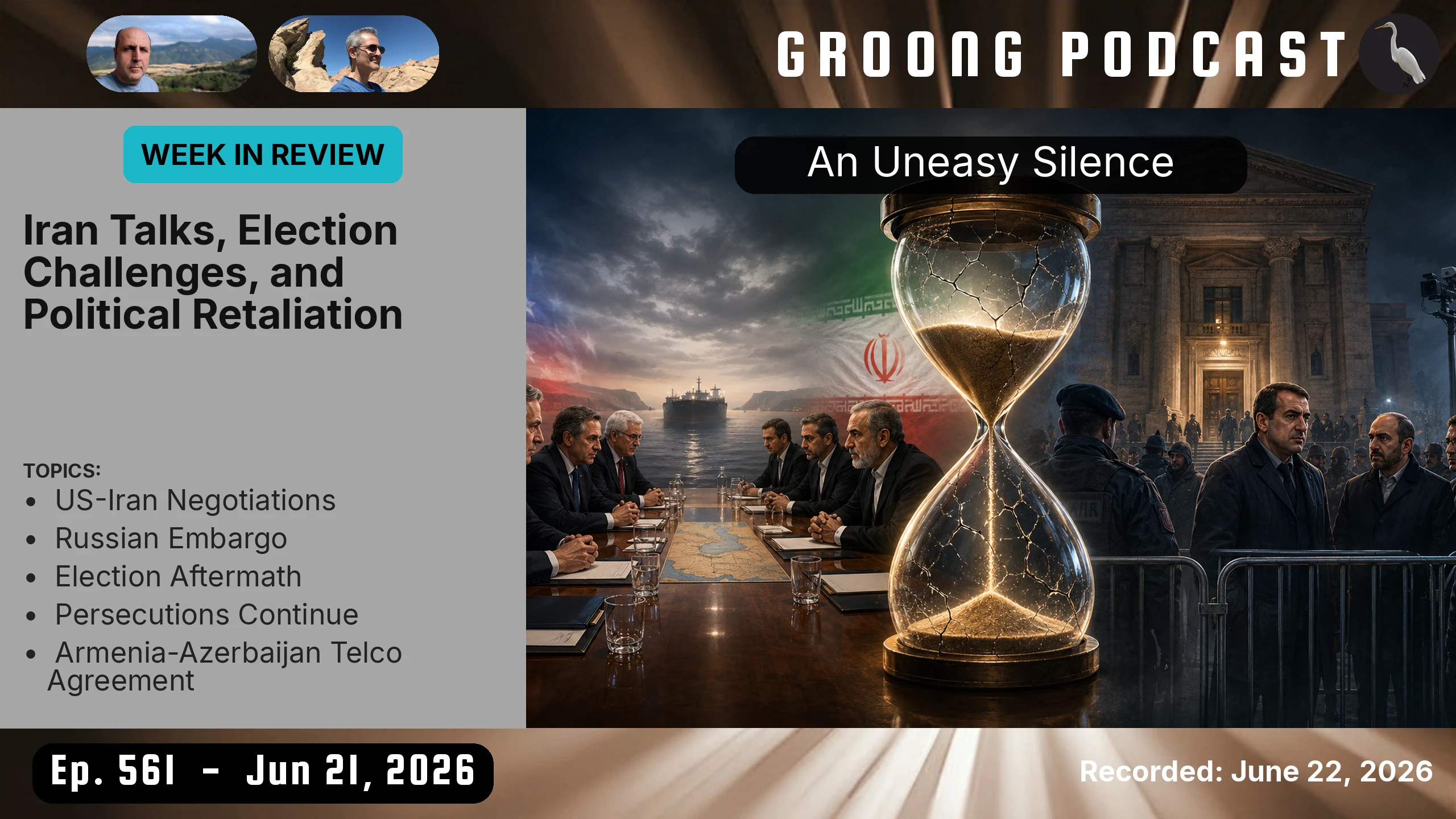
The US-Iran ceasefire negotiations in Switzerland produced an agreement to extend the truce for 60 days, with reported frameworks including partial release of frozen Iranian assets, reduced restrictions on Iranian oil and gas trade, and possible reconstruction support. The reopening of the Strait of Hormuz could help stabilize global energy prices. However, Asbed and Hovik question whether the talks can produce a lasting agreement when major regional actors remain outside the process. Trita Parsi’s analysis shows shifts in Washington’s position: the US now describes regional ceasefire as an American objective, Iran has been brought into Lebanon crisis management, and US Vice President JD Vance acknowledged regional states’ right to self-defense. Iran’s threat to close the Strait again appears to have strengthened its leverage over Lebanon developments.
Domestically, Armenia faces intensifying pressure from Russia. Moscow has continued public criticism of Pashinyan’s government while imposing trade restrictions and pressuring Armenian exports. The hosts examine whether these measures signal temporary warnings or a wider breakdown in Armenia-Russia relations, and assess the economic risks Armenia faces as relations deteriorate. Simultaneously, six opposition parties filed petitions with the Constitutional Court to annul the parliamentary election results: Strong Armenia, Armenia Alliance, Prosperous Armenia, Wings of Unity, DOK, Defenders of Democracy for the Republic, and New Force. The court combined the petitions into one case with a hearing scheduled for June 26, appointing Edgar Shatiryan as presiding judge. Judges Artak Zeynalyan and Vladimir Vardanyan were removed from the case over bias concerns, and Armenia Alliance requested removal of Judge Seda Safaryan. The court requested information from multiple state bodies including the Central Electoral Commission , Prosecutor General’s Office, National Security Service, Anti-Corruption Committee, Ministry of Internal Affairs, and Commission on Television and Radio.
Parallel to the court challenge, Pashinyan’s government has mounted coordinated legal and political attacks on opposition figures. Civil Contract lawmakers introduced proposals preventing parties accused of electoral crimes from entering parliament, while public statements targeted Electric Networks of Armenia (owned by Samvel Karapetyan ), Gagik Tsarukyan’s cement factory and casino interests, and Robert Kocharyan . The hosts describe this as evidence that Pashinyan is preparing multiple scenarios, including new elections without major opposition parties present. Kocharyan was stopped at Zvartnots airport before a planned three-day trip; video of the incident was leaked to pro-Pashinyan media to suggest he was fleeing. When asked about the leak, Pashinyan essentially acknowledged NSS involvement, stating if the NSS felt it could release such material, they could. The government later requested the Central Electoral Commission lift Kocharyan’s immunity as a parliamentary candidate, linked to three criminal allegations including a government property decision made over 20 years ago. Hovik emphasizes that these alleged offenses fall outside the statute of limitations, yet Armenia’s legal framework allows individuals to remain in pre-trial detention indefinitely even when conviction becomes impossible.
Watch/Listen: Episode 561
Keywords: 2026 Armenian Parliamentary Election, Constitutional Court, Armenia-Azerbaijan Peace Process, US-Iran War, Pashinyan, Robert Kocharyan, Samvel Karapetyan, Gagik Tsarukyan , Civil Contract, Opposition Parties, Election Fraud, South Caucasus, Established Opposition
Stay Connected
For the full, unfiltered stream of Armenia news as it happens, subscribe to the Groong Mailing List on Google Groups. Subscribers receive the complete daily news feed directly in their inbox — expect tens of emails per day covering Armenia, Artsakh, the diaspora, and the broader region.