Groong Podcast Digest — Week of June 15–21, 2026
Published June 21, 2026 5 min read- EP558: Hovik Manucharyan and Asbed Bedrossian examine Armenia’s 2026 parliamentary election results, shifting Armenia-Georgia relations amid EU corridor initiatives, and a landmark US-Iran interim agreement that reshapes regional security architecture.
- EP559: Hrant Mikaelian examines the disputed aftermath of Armenia’s June 7, 2026 parliamentary election, discussing electoral fraud allegations, government threats against opposition parties, Armenia-Russia tensions, EU support for Armenian exports, and why political polling failed to predict the result.
This Week’s Podcast Episodes
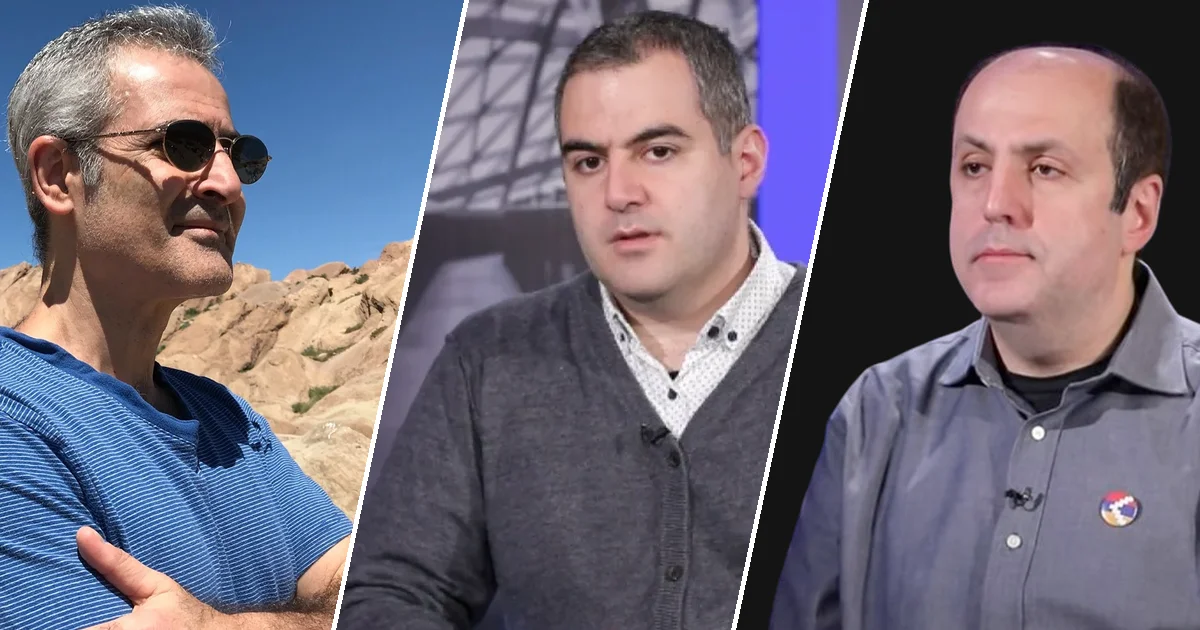
Episode 558: Armenian Parliamentary Election, US-Iran Agreement | Ep 558, Jun 14, 2026
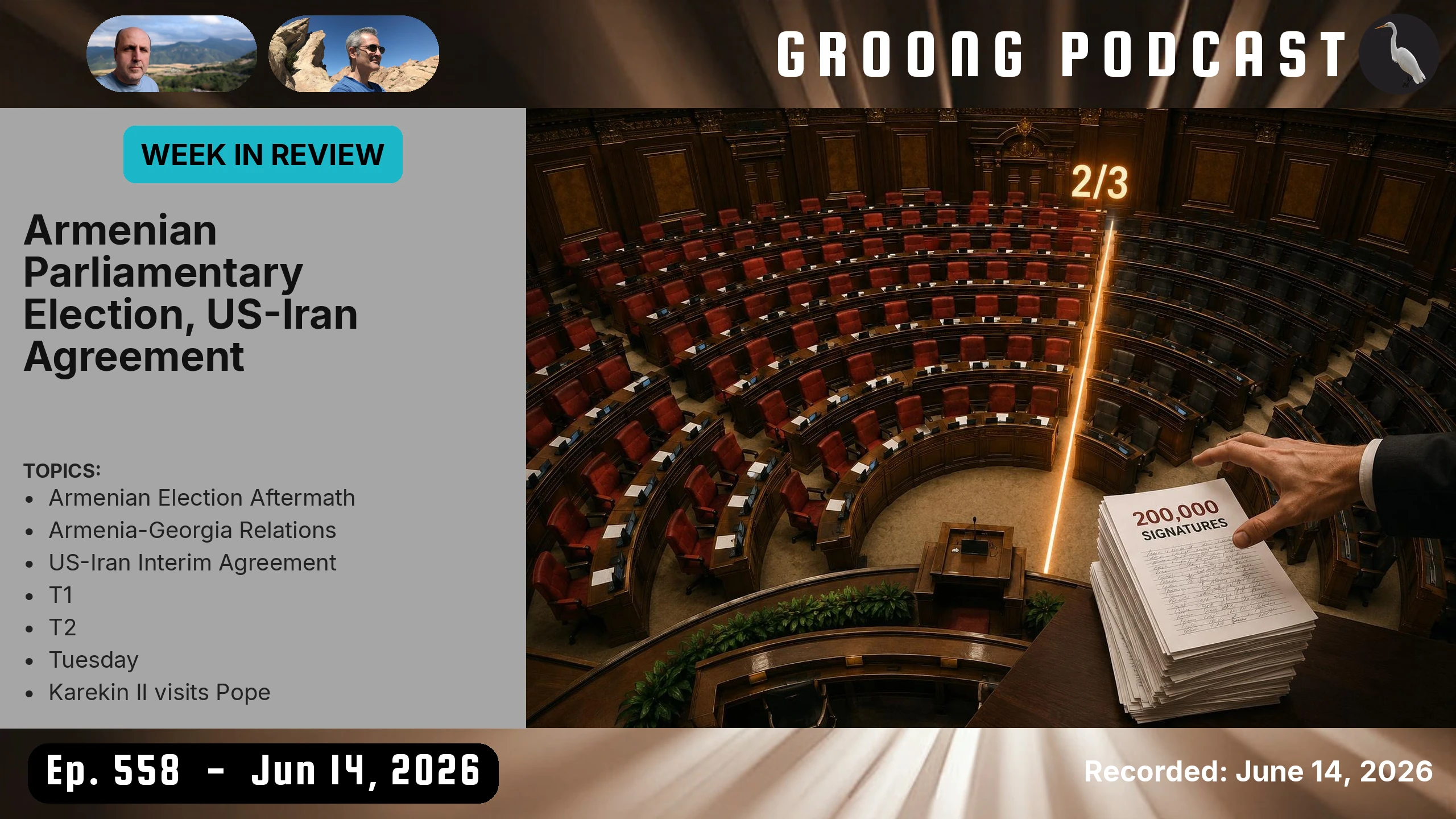
The hosts dissect a contested 2026 parliamentary election that delivered Civil Contract a three-fifths majority with 64 of 105 seats. A critical flashpoint emerged around Prosperous Armenia’s elimination from parliament: the party allegedly fell marginally below the 4 percent threshold after the Central Election Commission invalidated results from two precincts where Prosperous Armenia had performed strongly, costing the party 213 votes. Despite recounts that returned some votes, the CEC refused to order re-votes in the invalidated precincts, citing concerns about “distortions”. Hovik argues Armenian law required a re-vote when irregularities could affect the outcome; the hosts conclude that the CEC’s decision effectively engineered Prosperous Armenia’s exclusion. Strong Armenia and Armenia Alliance entered parliament as the sole opposition blocs. The result leaves Pashinyan in a commanding position to form a government that controls all levers without forming coalitions, but not enough seats to pass constitutional amendments without opposition input, which requires a two-thirds majority.
The aftermath reveals immediate pressure tactics. Robert Kocharyan was stopped at the airport after the election; Pashinyan has alleged that opposition votes were obtained through bribery and justified pre-election arrests mostly aimed at Strong Armenia and Armenia Alliance circles. The hosts note this contrasts sharply with Civil Contract’s own reliance on state spending: pension increases and healthcare benefits introduced near the election effectively functioned as state-funded voter inducement. Post-election excise tax hikes on cigarettes, vaping products, and fuel now appear as efforts to partiallu fund the fiscal bill for those measures. The opposition faces a strategic choice: accept parliamentary mandates and mount a Constitutional Court challenge while organizing street pressure, or reject mandates and risk replacement by a compliant force. The hosts warn that Civil Contract will likely use kompromat, arrests, or defections to pressure opposition MPs toward the two-thirds threshold needed for constitutional change.
Regionally, Hikmet Hajiyev’s post-election visit to Yerevan signals that Azerbaijan is now presenting its “invoice” to Pashinyan. Meanwhile, analysis by Hakob Badalyan flags possible EU efforts to create corridor competition between Armenia and Georgia. Georgia’s established role as the land bridge to Central Asia, Azerbaijan, Turkey, and Europe is now contested by EU interest in Armenia as an alternative Middle Corridor route via TRIPP (Trump Route for International Peace and Prosperity). The hosts argue this dynamic could be exploited by Azerbaijan to position itself as the regional broker, while Turkey and Azerbaijan benefit regardless of whether Western corridor projects succeed or Russian influence returns.
Watch/Listen: Episode 558
Keywords: 2026 Armenian Parliamentary Election , Civil Contract, Prosperous Armenia, Pashinyan, Armenia-Georgia Relations, Zangezur Corridor , South Caucasus , Ilham Aliyev
Episode 559: Hrant Mikaelian - Election Aftermath and Polls in Armenia | Ep 559, Jun 20, 2026
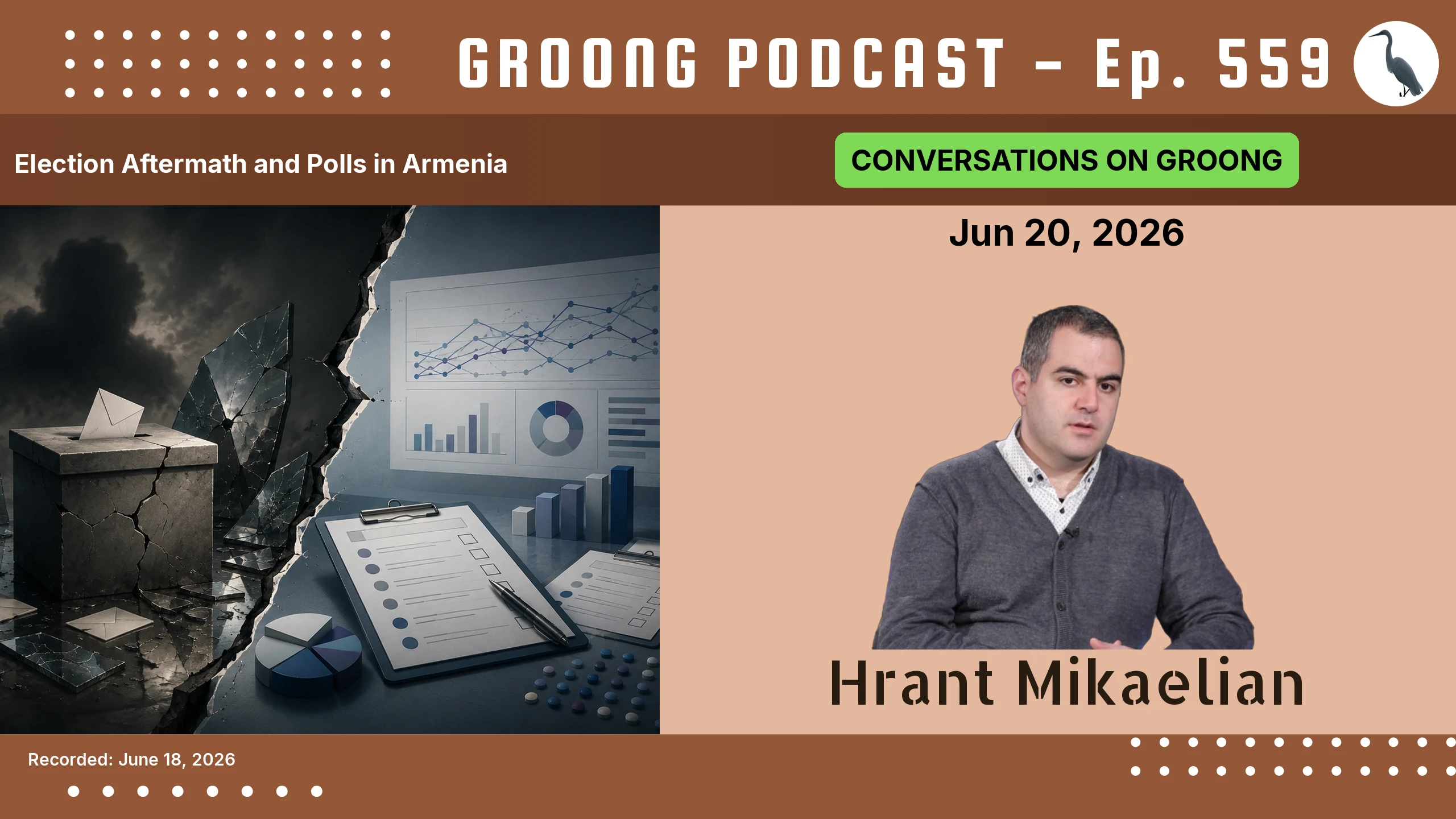
Armenia’s June 7, 2026 parliamentary election has left the country in political turmoil despite Pashinyan’s claimed victory. Hrant Mikaelian, a political scientist and researcher, walks through the disputed nature of the results and the government’s aggressive posture toward opposition parties. Rather than accept victory and move forward, Pashinyan has escalated rhetoric attacking opposition votes as illegitimate and obtained through bribery. The Anti-Corruption Committee has drafted legislation to ban political parties, while Prosperous Armenia was excluded from parliament after results were cancelled in three precincts. Mikaelian explores whether the government is preparing more arrests of opposition figures and why Pashinyan may prefer Robert Kocharyan as the main opposition leader. The opposition’s failure to fully consolidate before the election weakened its standing, yet parties now face a critical choice: accept parliamentary mandates or reject the parliament’s legitimacy and challenge the results at the Constitutional Court.
Armenian-Russian relations have deteriorated sharply following the vote. Putin has notably refused to congratulate Pashinyan, and Sergey Naryshkin stated that Armenia’s elections were questionable. Russia has applied export pressure on Armenian agricultural products, a signal that Moscow views the election result with suspicion or disapproval. In response, the EU announced a 50 million euro credit line for Armenia and indicated potential market access for Armenian agricultural goods, particularly flowers through the Netherlands. However, replacing the Russian market with EU demand faces significant logistical hurdles and realistic limits. The political importance of a constitutional referendum looms over these developments: Pashinyan lacks the two-thirds majority needed for his full agenda, and opposition mandates could constrain his next moves on constitutional change and Azerbaijan’s demands.
Armenian political polling has become unreliable since 2018, a problem Mikaelian examines through detailed data from EVN Report, IRI, and MPG polls. No public poll came close to Civil Contract’s reported final result of 49.8 percent; every poll underestimated the ruling party significantly. Hidden votes, high refusal rates, and political fear appear to distort poll responses. MPG showed the best forecast accuracy by RMSE, while EVN and IRI captured the government-opposition balance more closely. Mikaelian argues that public polls are shaped by funding sources, release timing, data processing methods, and respondent fear. He also notes that while vote-intention polls are now highly problematic, polls on less divisive issues may retain value. The episode raises the question of whether Groong or another independent organization could support more transparent public polling to fill a gap in Armenia’s information landscape.
Watch/Listen: Episode 559
Keywords: 2026 Armenian Parliamentary Election, Pashinyan, Civil Contract, Armenia-Azerbaijan Peace Process, Samvel Karapetyan, Robert Kocharyan, Vladimir Putin, EU economic support, Armenian elections, polling methodology
Stay Connected
For the full, unfiltered stream of Armenia news as it happens, subscribe to the Groong Mailing List on Google Groups. Subscribers receive the complete daily news feed directly in their inbox — expect tens of emails per day covering Armenia, Artsakh , the diaspora, and the broader region.