Groong Podcast Digest — Week of June 2–8, 2026
Published June 8, 2026 6 min read See also: News Digest →- EP553: We examine Armenia’s May 28 Independence Day parade as election theater, Marco Rubio’s push for critical minerals deals and the TRIPP framework, and the strategic risks Armenia faces from Russia and Iran as the country heads into the 2026 Armenian Parliamentary Election.
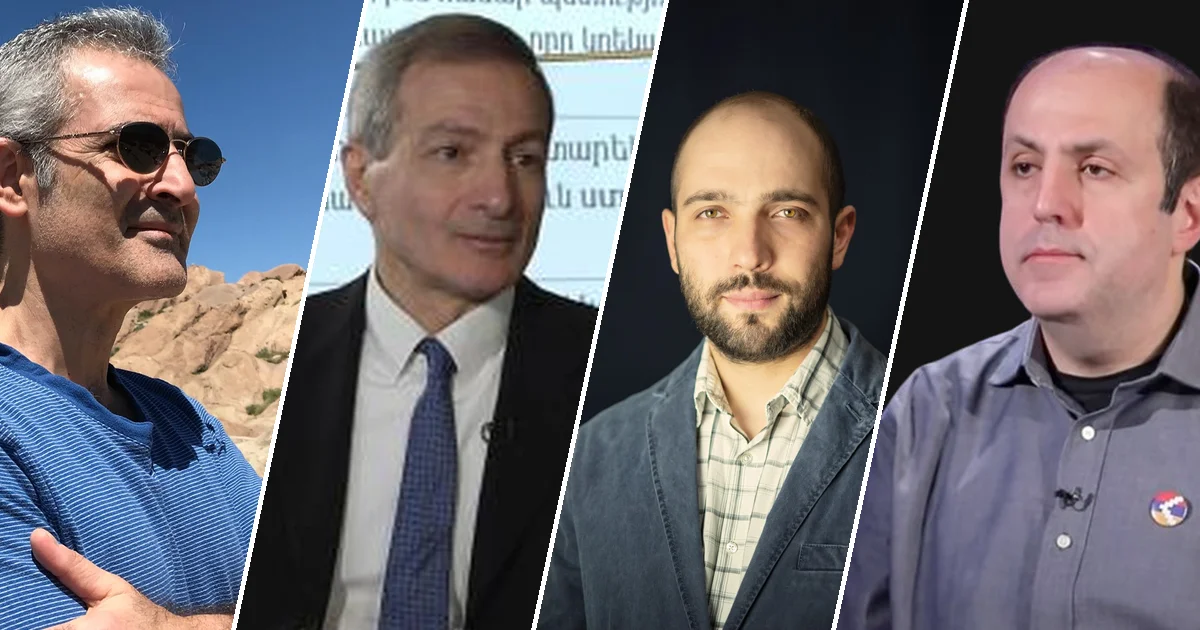
- EP554: Dr. Philippe Raffi Kalfayan returns from IODA’s second election observation mission to report a sharply deteriorating pre-election climate marked by arrests of opposition figures, state intimidation of voters, misuse of public resources, and widespread fear among citizens.
- EP555: Rafael Ishkhanyan of the Armenian Center for Political Rights examines how state institutions selectively enforce laws against opposition figures while ignoring alleged government abuses, including wiretap leaks, weaponized hate speech prosecutions, threats against political opponents, and military conscription used as electoral coercion.
This Week’s Podcast Episodes
Episode 553: May 28, Rubio’s Armenia Deals, and the Cost of Strategic Drift | Ep 553, May 31, 2026
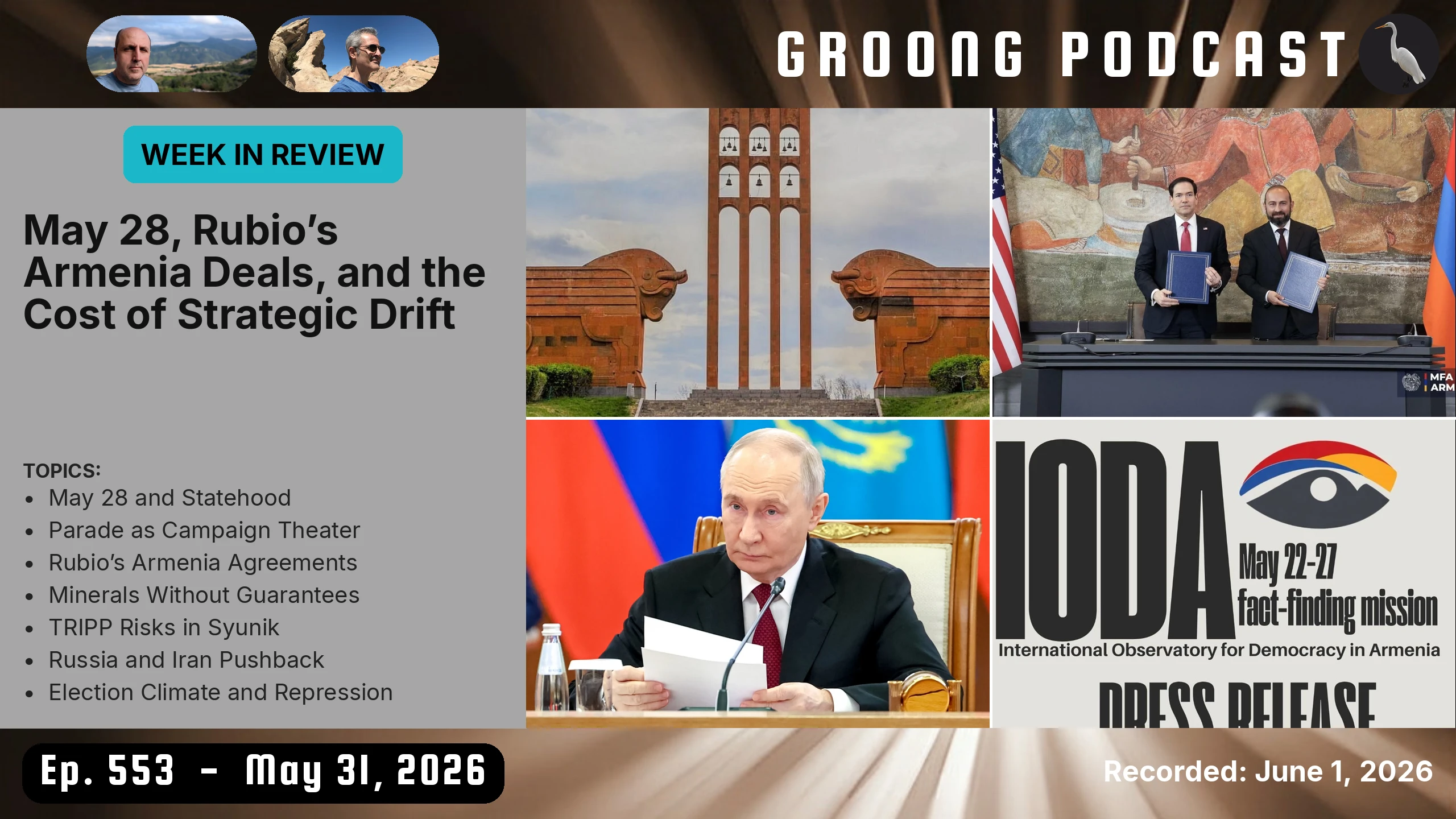
Armenia’s May 28 Independence Day parade served primarily as campaign theater. Both Pashinyan and Defense Minister Papikyan actively asked Azerbaijan not to view the display as hostile, a stance that severely undermined its appearance of military strength. The weaponry shown consisted largely of rebranded foreign equipment, leaving observers to question whether the $8 billion in national debt allegedly spent on military replenishment actually materialized. Furthermore, Armenia has conducted no major military exercises under Pashinyan, masking deep vulnerabilities in weapons compatibility, supply-chain fragility, and a leadership prioritizing capitulation over defense.
Meanwhile, Marco Rubio’s 40-minute May 26 visit yielded three documents heavily favoring Washington, Baku, and Ankara at Yerevan’s expense. The non-binding minerals memorandum frames Armenia as a raw extraction platform with no guaranteed domestic processing, meaning Armenia bears the environmental risks while others capture the industrial value. Worse, the TRIPP framework establishes a development company where a U.S. entity holds 74% ownership to Armenia’s 26% for 49 years. This agreement grants broad tax exemptions, overrides conflicting Armenian procurement laws, and lacks guardrails to prevent the U.S. from selling its stake to hostile third parties.
Regionally, both Russia and Iran view these agreements as direct strategic threats. Moscow sees TRIPP as a challenge to its security dominance and regional transport leverage, while Tehran fears a U.S. infrastructure foothold on its northern border that strengthens the Turkey-Azerbaijan axis. Ultimately, Armenia is providing strategic access to its territory and transport routes without receiving any U.S. defense guarantees. This leaves the country exposed to immediate pressure from Russia, suspicion from Iran, and demands from Azerbaijan, forcing Armenia to carry massive sovereign risks for entirely speculative returns.
Watch/Listen: Episode 553
Keywords: Nikol Pashinyan, Marco Rubio, TRIPP, Syunik , Critical minerals, 2026 Armenian Parliamentary Election , Armenia-Azerbaijan Peace Process , Ilham Aliyev , Russian Peacekeepers, Eurasian Economic Union
Episode 554: Philippe Raffi Kalfayan - IODA’s Second Mission and Armenia’s Dire Election Climate | Ep 554, Jun 4, 2026
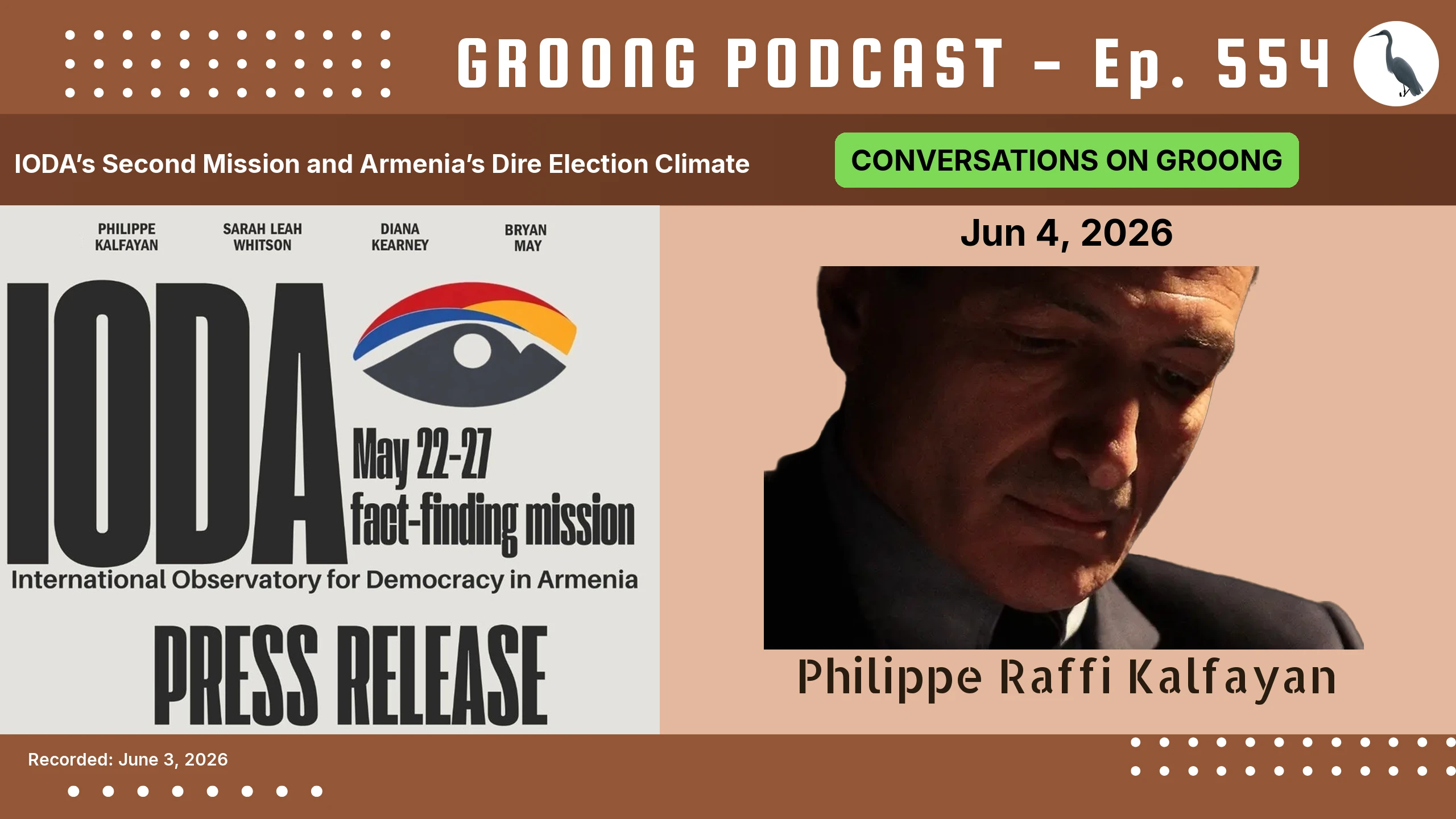
Dr. Philippe Raffi Kalfayan, an international law expert and former Secretary General of the International Federation for Human Rights, discusses IODA’s findings from Armenia’s 2026 parliamentary elections scheduled for June 7. His second mission, focused on regional areas outside Yerevan, documents a worsening political environment compared to the first observation mission conducted roughly six weeks earlier. The climate has shifted from concerns about democratic backsliding to direct patterns of pre-election coercion: arrests of opposition members including figures from Strong Armenia and Armenia Alliance, physical attacks on opposition supporters, and systematic intimidation in villages and smaller municipalities.
Kalfayan describes how local officials and village leaders leverage their social influence to discourage citizens from supporting opposition parties. Reports indicate opposition supporters fear retaliation in daily life for visiting party offices or attending rallies. Teachers, medical workers, and public-sector employees are being drawn into Civil Contract campaign events, while their relatives worry about job security. Self-censorship is pervasive, with citizens reluctant even to respond to polling surveys due to surveillance concerns and fear of state retaliation. The misuse of state resources appears systematic rather than isolated, representing a reactivation of Soviet-era patterns abandoned after the so-called Velvet Revolution. Kalfayan notes that investigations by state agencies target only opposition figures, while no serious inquiries have been launched into documented cases of ruling-party abuses.
A critical distinction emerged during IODA’s regional visits: while Yerevan’s urban environment offers some protection against political persecution, villages present nearly impossible conditions for free choice. Village leaders reportedly know in advance how citizens plan to vote, making secret ballots theoretical rather than practical. Kalfayan emphasizes that pre-election coercion and fear operate as powerfully as election-day fraud, yet short-term international observers arriving days before voting cannot detect these patterns. IODA’s longer-term presence proved essential to documenting the sustained pressure shaping voter behavior. The organization met with OSCE long-term observers who privately shared concerns about post-election tensions, though intergovernmental organizations typically issue politically filtered reports determined by diplomats rather than technical findings.
Watch/Listen: Episode 554
Keywords: 2026 Armenian Parliamentary Election, Election Observation, Civil Contract, State Intimidation, Arrests of Opposition Figures, Regional Coercion, Electoral Legitimacy, Democratic Backsliding
Episode 555: Spotlight on Silence: Selective Justice in Armenia’s Election Campaign | Ep 555, Jun 6, 2026
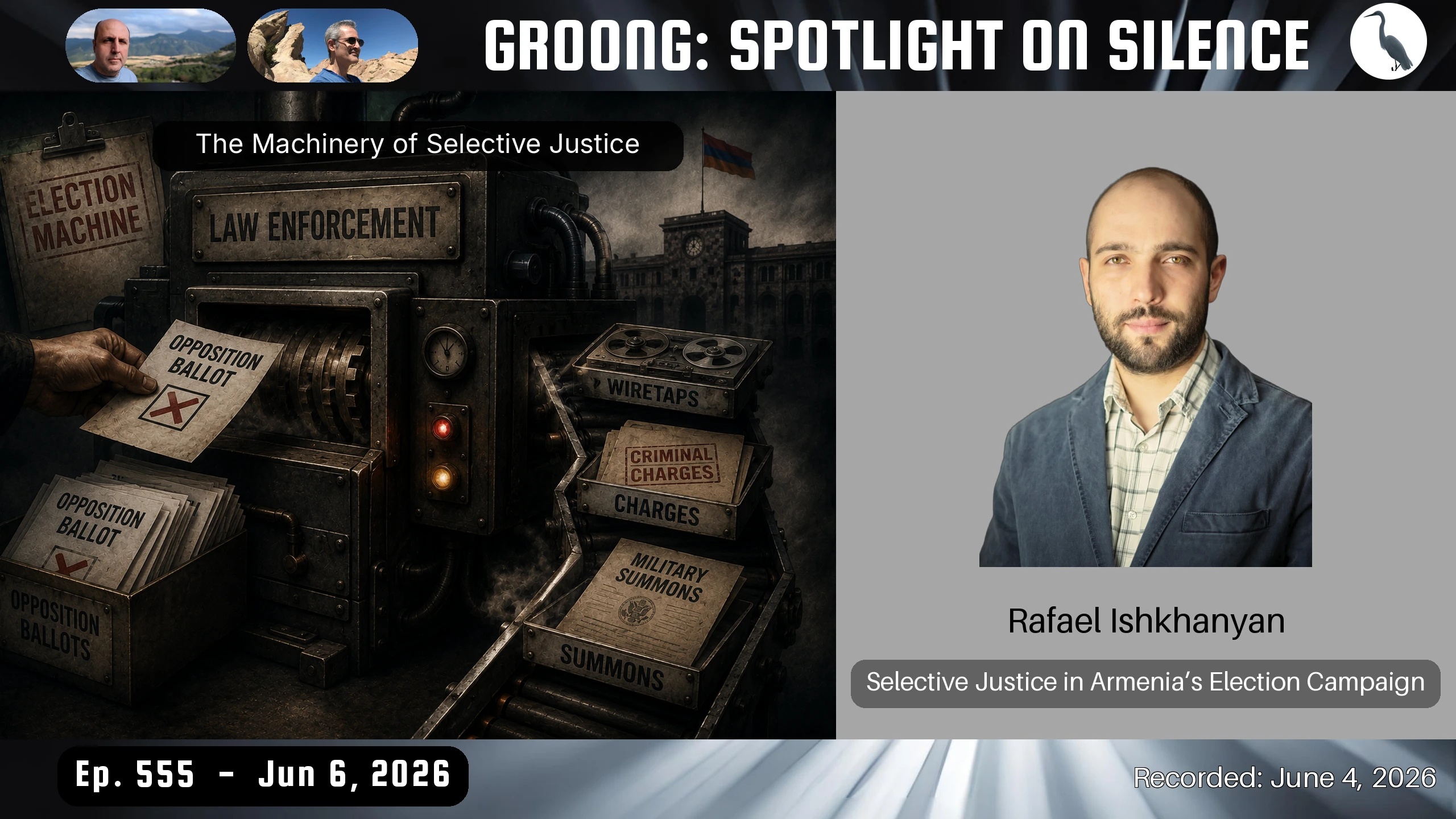
As Armenia prepared for its June 2026 parliamentary election, the country’s law enforcement machinery revealed a stark double standard. Asbed and Hovik spoke with Rafael Ishkhanyan, a human rights lawyer and co-founder of the Armenian Center for Political Rights, about selective justice that has become routine under the Pashinyan government.
The conversation exposed how wiretapped opposition conversations appear on official websites and become campaign material within days, yet credible reports of administrative abuse by government officials face no visible investigation. Transparency International’s Akanates observer mission documented allegations that the Bagratashen customs director gathered municipal leaders in Tavush and Lori, promising them career advancement in exchange for ensuring Civil Contract victories. This constitutes bribery under Armenian law, Ishkhanyan explained, yet no criminal process was initiated. By contrast, opposition figures face relentless surveillance and prosecution based on increasingly distorted interpretations of hate speech laws.
Articles 329 and 330 of Armenia’s Criminal Code were designed to protect vulnerable groups from incitement to hatred and calls for violence. Pink Armenia’s monitoring found zero convictions under these provisions for actual hate crimes against LGBTQ people, despite widespread discrimination. Instead, Ishkhanyan documented how the laws have been weaponized almost exclusively to shield Pashinyan and Civil Contract officials from political criticism. The Court of Cassation set a dangerous precedent in the Hakob Grigoryan case, treating a history teacher’s harsh remarks about Pashinyan as hate speech based on “political views,” effectively criminalizing robust criticism of public officials while leaving their own threats unpunished.
Artsakh Armenians emerged as a particularly vulnerable target. Pashinyan repeatedly used dehumanizing language, inventing terms like “pseudo-elites of Karabakh” and “runaways,” while describing them as people who fled while soldiers died. The rhetoric fueled discrimination: Artsakhtsis reported being called Turks in schools, facing systemic delays in citizenship processing that prevented many from voting. Ishkhanyan noted the contradiction: the government simultaneously demonized this population and announced debt forgiveness programs, using fear and incentives to suppress opposition turnout.
Watch/Listen: Episode 555
Keywords: 2026 Armenian Parliamentary Election, Selective Justice, Civil Contract, Political Persecution, Hate Speech Laws, Artsakh Blockade , Corruption , Human Rights, Nikol Pashinyan, Robert Kocharyan
Stay Connected
For the full, unfiltered stream of Armenia news as it happens, subscribe to the Groong Mailing List on Google Groups. Subscribers receive the complete daily news feed directly in their inbox — expect tens of emails per day covering Armenia, Artsakh, the diaspora, and the broader region.