Groong Podcast Digest — Week of May 25–31, 2026
Published May 31, 2026 5 min read- EP550: We examine the tightening political climate in Armenia ahead of the June 2026 parliamentary elections, analyzing Marco Rubio’s sudden visit, new polling data showing stark divergences between IRI and MPG, hidden voter patterns that may reveal concealed opposition support, TRIPP polarization, escalating arrests and threats against opposition figures, and Pashinyan’s incendiary campaign rhetoric including his ‘Why are you alive?’ outburst.
- EP551: Arthur Khachatryan of Hayastan Dashinq discusses Armenia’s June 7 parliamentary election, foreign interference, election fraud concerns, the opposition platform, TRIPP, military spending claims, and Russia’s economic pressure on Armenia.
This Week’s Podcast Episodes
Episode 550: Rubio Visit, New MPG and IRI Polls, Hidden Votes and Why Are You Alive? | Ep 550, May 24, 2026
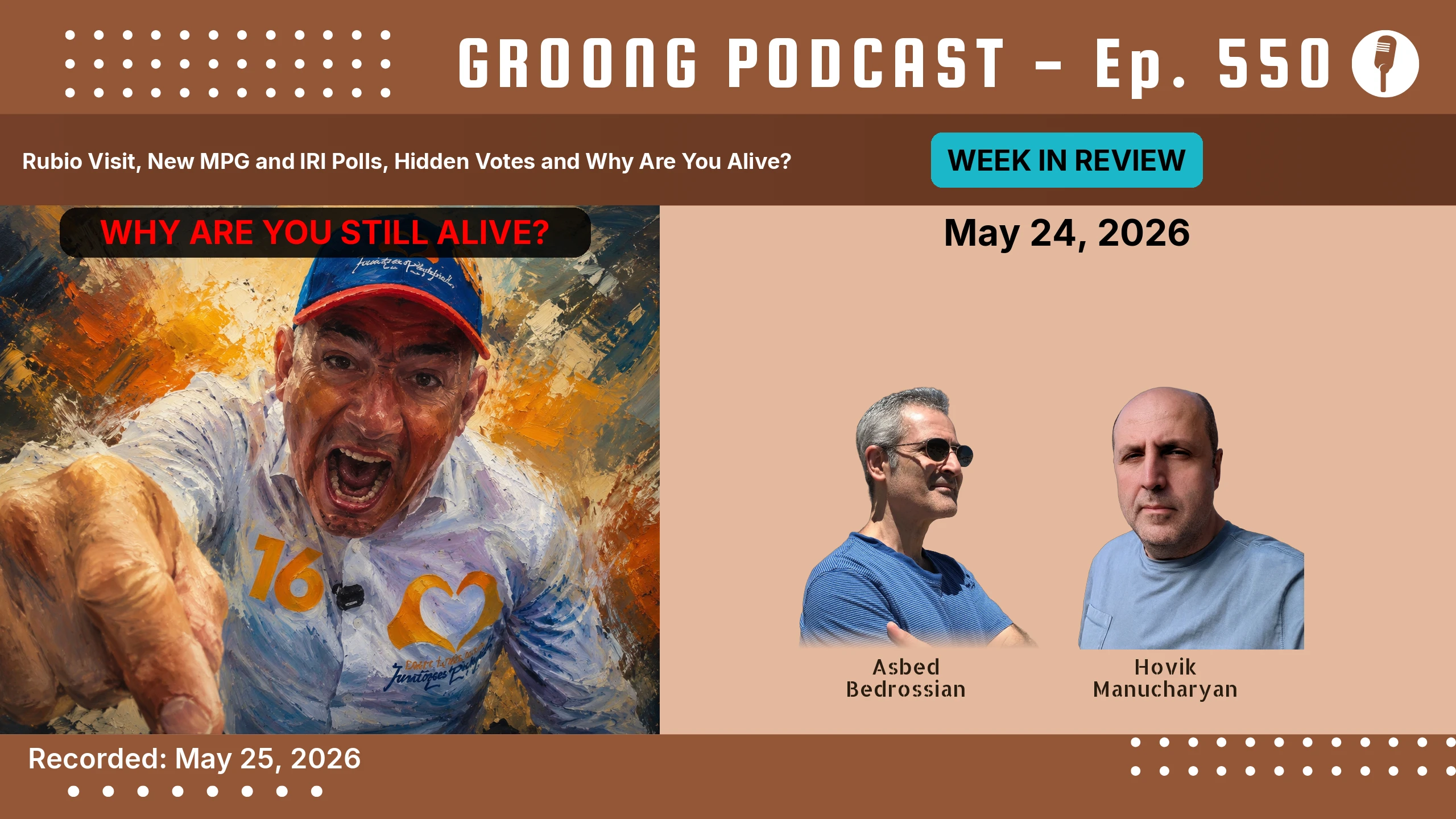
The episode questions the unexplained urgency surrounding US Secretary of State Marco Rubio’s Armenia visit, announced just before recording and set to include a signing ceremony with Foreign Minister Mirzoyan. Analyst Hakob Badalyan suggests the trip may relate to TRIPP’s role in the US-China strategic competition for controlling Middle Corridor trade routes, particularly given timing following US-China summits and Putin’s China visit. The question emerges whether Russia and Iran’s recent vocal opposition to TRIPP signals violation of earlier tacit agreements with Washington. Asbed suggested the visit aimed to boost Pashinyan’s lagging electoral performance, but Hovik notes the trip’s geopolitical scope transcends domestic politics.
The episode then pivots to polling analysis, where fundamental contradictions emerge. MPG’s May 19-21 poll shows Civil Contract at 28.8% versus combined opposition at 44.9%, with opposition parties potentially forming a 57.4% mandate majority if thresholds are cleared. IRI’s May 5-11 poll shows Civil Contract at 32% versus just 11% combined opposition support. Hovik introduces three new metrics to assess poll reliability: the Hidden Vote Index (HVI) measuring non-disclosure rates, the Participation Sensitivity Gap (PSG) comparing willingness to discuss voting versus discussing participation, and the Participation Certainty Index (PCI) measuring stated voting likelihood. MPG shows only 12% HVI and 5% PSG, while IRI shows 44% HVI and 43% PSG. Hovik’s analysis across six recent polls reveals a stark trend: polls with lower hidden-vote indices show stronger opposition support, while polls with high hidden-vote indices show stronger government dominance. This correlation suggests voters may be less willing to disclose opposition preferences to certain polling organizations, potentially due to fear in the current environment or perceived affiliation of the polling sponsor.
The IRI poll contains numerous internal contradictions. While 61% say Armenia is headed in the right direction and 62% express satisfaction with Pashinyan’s Office, only 32% name Civil Contract as their voting choice even among very likely voters at 38%. Another 40% say they trust no politicians, yet 71% expect free and fair elections. The poll shows 75% support EU accession, with voters citing economic growth, visa liberalization, and peace as primary motivations, though Asbed questions the practical importance of visa liberalization for a nation of 3 million with limited purchasing power. France emerges as the most-trusted political ally, likely reflecting the European Political Community Summit’s timing and Macron’s visible presence in Yerevan. Despite Pashinyan’s public attacks on the Armenian Church and its leadership, the church maintains higher trust ratings than Pashinyan’s office.
Watch/Listen: Episode 550
Keywords: 2026 Armenian Parliamentary Election, Nikol Pashinyan, Polling methodology, Hidden voters, Civil Contract, Strong Armenia , Armenia Alliance, Election climate, TRIPP, Trump Route for International Peace and Prosperity
Episode 551: Arthur Khachatryan - Armenia Alliance in the 2026 Armenian Parliamentary Election | Ep 551, May 31, 2026
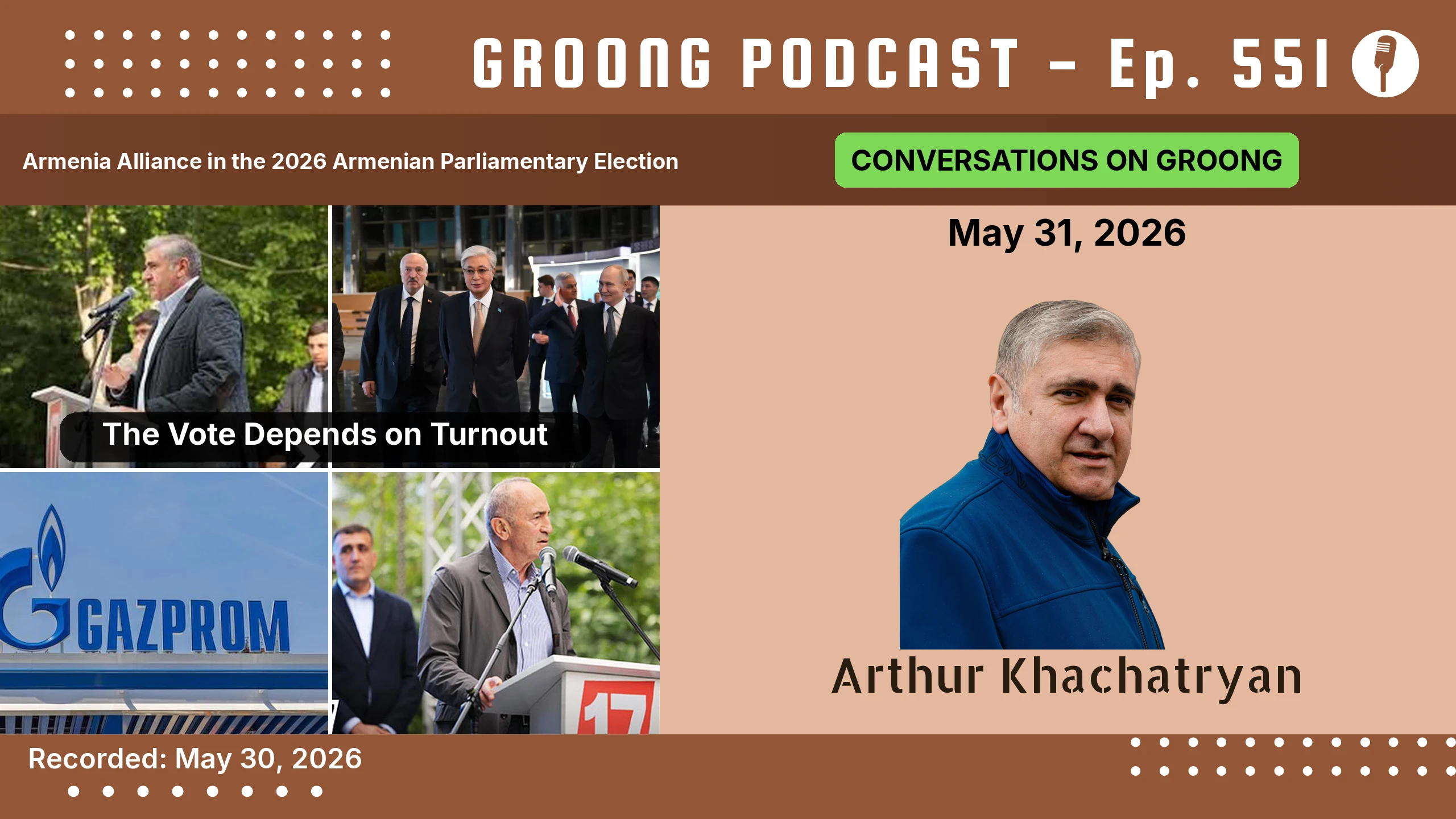
Arthur Khachatryan addresses the possibility of free and fair elections in Armenia, given open Western endorsement of Pashinyan, alleged abuse of administrative resources, arrests of opposition figures on questionable charges, and documented coercion of state employees to attend ruling party rallies. He notes that Western observer missions have issued preliminary statements downplaying these concerns, citing only unverified complaints from opposition sources while treating government denials as fact. Khachatryan emphasizes the two-pronged atmosphere of fear: internal threats of jail, job loss, and state violence, and external warnings that Azerbaijan will attack Armenia if the opposition wins. He argues these conditions undermine the legitimacy of any democratic process.
On polling reliability, Khachatryan points to a 16 percent response rate in International Republican Institute surveys, with 84 percent refusing to participate. He attributes this to widespread fear among voters whose relatives work in public service, military, or police and face threats if their family members are linked to opposition parties. He cites the recent firing of 72 patrol officers over relatives’ political affiliations as evidence. Multiple opposition figures face house arrest or prosecution on dubious charges. Khachatryan confirms that Hayastan Dashinq and other opposition forces are prepared for street action if the vote is falsified, noting that opposition parties have a long history of street mobilization against Pashinyan dating to 2019. He rejects the suggestion that opposition parties should announce a pre-election coalition or joint prime ministerial candidate, arguing this is not standard parliamentary practice globally and would confuse voters.
On amnesty, Khachatryan clarifies that Hayastan Dashinq proposes pardons for minor offenses and overcrowded prisons but insists that grave crimes and serious war crimes must face fair trial. He criticizes the lack of any credible investigation into the 44-Day War, noting the so-called war commission report was signed by only four of eleven committee members and carries no constitutional weight. He calls for thorough inquiries into military decisions, border security failures, and COVID management mistakes under the previous healthcare minister.
Watch/Listen: Episode 551
Keywords: 2026 Armenian Parliamentary Election, Nikol Pashinyan, Armenia Alliance, Civil Contract, election interference, administrative pressure, Prisoners of War , 44-Day War, opposition politics
Stay Connected
For the full, unfiltered stream of Armenia news as it happens, subscribe to the Groong Mailing List on Google Groups. Subscribers receive the complete daily news feed directly in their inbox — expect tens of emails per day covering Armenia, Artsakh , the diaspora, and the broader region.