Groong Podcast Digest — Week of May 18–24, 2026
Published May 24, 2026 9 min read See also: News Digest →- EP547: We examine Pashinyan’s violent campaign rhetoric, the abuse of state resources ahead of Armenia’s June 7 election, selective law enforcement against the opposition, the worsening Armenia-Russia relationship, and the vandalism of an Armenian church in Javakhk.
- EP548: We survey all 17 parties and 2 alliances registered for Armenia’s June 7, 2026 parliamentary elections, walking through each participant’s leadership, polling numbers, platform, and geopolitical orientation.
- EP549: Political scientist Edgar Elbakyan joins the hosts to examine Armenia’s upcoming parliamentary election as a potential existential contest, covering polling methodology under fear, divergent survey results, the crowded political field, and whether opposition parties are prepared for a post-election confrontation.
This Week’s Podcast Episodes
Episode 547: Pashinyan’s Hate Speech, Threats, and the June 7 Election Climate | Ep 547, May 17, 2026
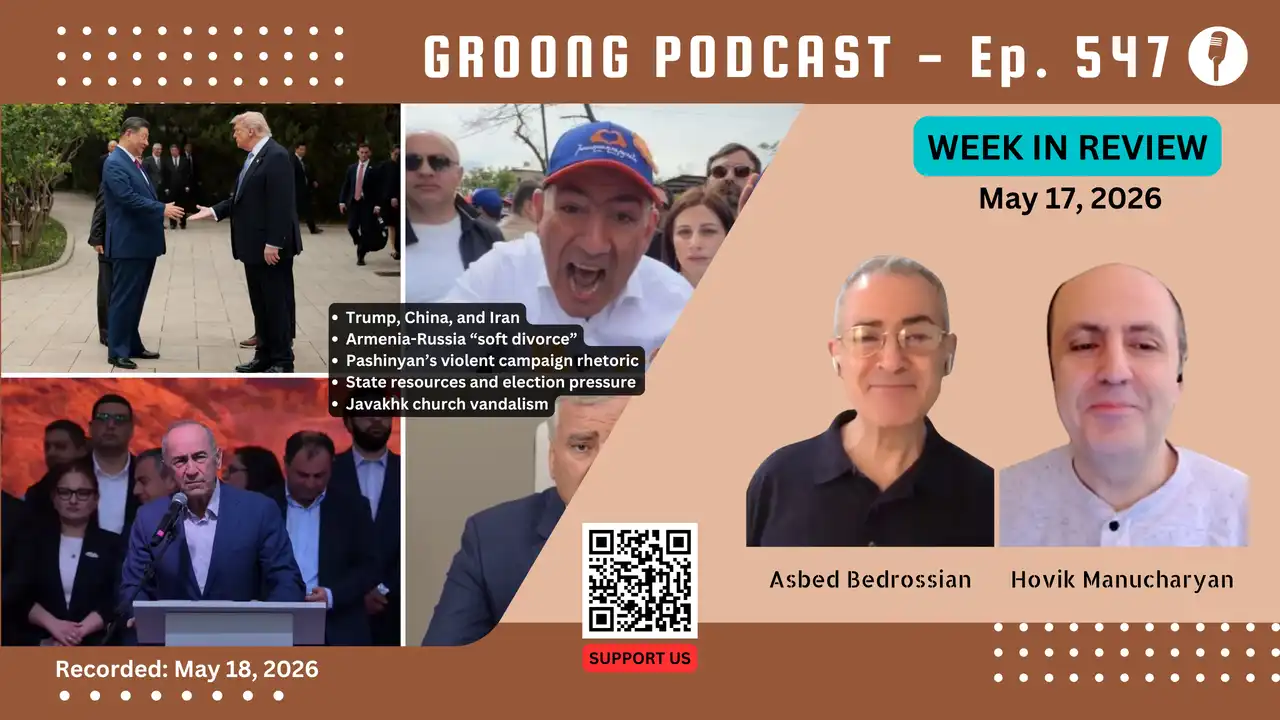
The episode opens with the Trump-Xi Jinping summit in Beijing on May 14-15, which Asbed Bedrossian and Hovik Manucharyan assess as yielding limited results. Agricultural trade deals worth roughly $250 billion were announced, along with a joint investment board and an order for 200 Boeing aircraft, well below the 500 the markets had expected. On Iran, Trump claimed China agreed to support an open Strait of Hormuz and would not provide military aid to Tehran, but Hovik cites analyst Trita Parsi’s reading that China’s position on the strait is far more ambiguous, and Beijing made no concession on Taiwan or on lifting restrictions over rare earth exports. The hosts conclude that Trump arrived at the summit from a position of weakness, and that analysts expect the war on Iran to restart in the coming days.
On Armenia-Russia relations, Asbed and Hovik trace the accelerating deterioration ahead of the May 28 EAEU summit. Foreign Minister Sergey Lavrov explicitly warned that Armenia risks losing all EAEU trade privileges if it continues on its EU integration path, and Russia has launched sanitary inspections on Armenian goods. Hovik notes that more than 30 percent of Armenian exports go to Russia, and that cheap Russian energy and the nuclear power plant also hang in the balance. Some in the Armenian opposition suspect that Moscow’s pointed pre-election statements may paradoxically help Pashinyan by reinforcing anti-Russian sentiment and framing the opposition as pro-Russian. Hovik acknowledges the double-edged nature of Russia’s pressure but argues that all major opposition parties have called for balanced relations with both East and West, not a rupture with Europe.
The bulk of the episode focuses on the election climate ahead of the June 7 vote. Asbed and Hovik document how Aragatsotn’s deputy governor directed schoolteachers, principals, and students to attend Civil Contract rallies, with recordings shared by watchdogs including Transparency International. Pashinyan claimed to have ordered dismissals, but the hosts question both his legal authority to do so and the sincerity of the gesture. The Central Electoral Commission, headed by longtime Pashinyan associate Vahagn Hovakimyan, issued what the hosts describe as a passive non-response. On selective enforcement, police raided Strong Armenia’s Spitak offices on May 13 and detained Armenia Alliance organizers, while the courts approved pretrial detention for a blogger who issued vague remarks online about meeting Pashinyan. By contrast, Pashinyan’s own recorded statements at rallies, including threats to make opposition leaders kneel, to expel them, and what the hosts describe as explicit calls to kill them, have drawn no police response. His confrontation with Armine Soghoyan, who accused him of betraying Artsakh (Nagorno Karabakh), ended with Pashinyan directing anti-Artsakhtsi rants at the crowd. Robert Kocharyan ’s proposal for enforceable security guarantees from the United States, Russia, and France is discussed as a substantive policy contrast, and the hosts connect it to the dissolution of the OSCE Minsk Group in December. The episode closes with the vandalism of the Surp Nshan Armenian Church in Akhaltsikhe in Georgia’s Samtskhe-Javakheti region. Father Hakob Sahakyan urged against jumping to conclusions and called for a proper investigation, and the hosts echo that caution while noting that the incident reflects the vulnerability of Armenian communities when the Armenian state itself is weak.
Watch/Listen: Episode 547
Keywords: Armenia June 7 election, Pashinyan campaign rhetoric, administrative resources, Armenia-Russia EAEU , selective law enforcement, Kocharyan security guarantees, Javakhk church vandalism, Trump-Xi summit
Episode 548: Parties and Alliances in the 2026 Armenian Parliamentary Election | Ep 548, May 22, 2026
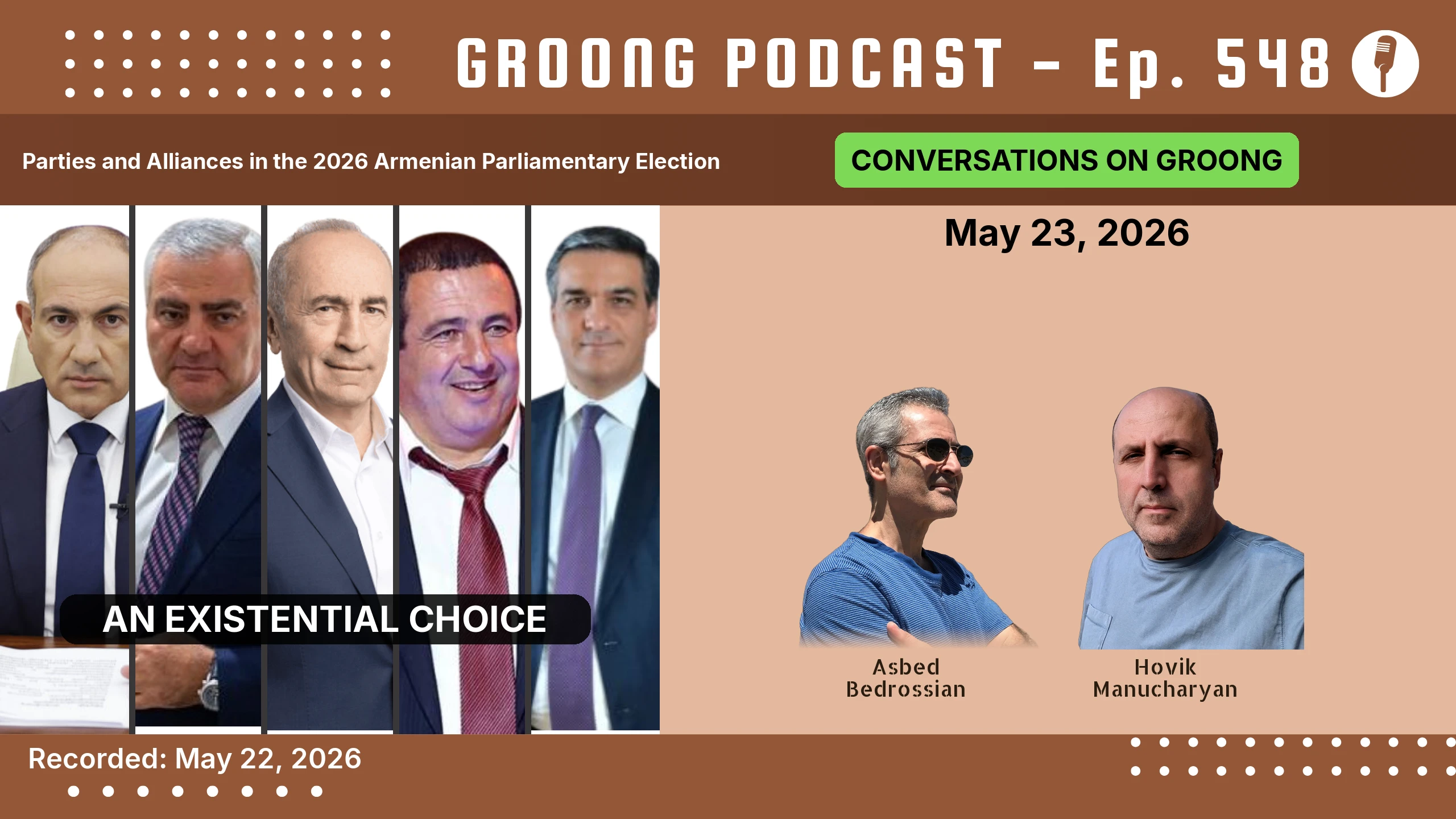
With Armenia’s June 7, 2026 parliamentary elections two weeks away, Asbed Bedrossian and Hovik Manucharyan recorded a voter-oriented primer covering every political force registered to compete. Before running through the 19 participants, they laid out the basic rules: Armenia uses a closed-list proportional system with a 101-seat National Assembly, no minimum turnout requirement, and tiered entry thresholds ranging from 4 percent for single parties to 10 percent for alliances of four or more. A “stable majority” provision guarantees the leading force at least 52 percent of mandates, either through its own vote share or through extra seats added by the commission. If no force wins a governing majority, parties have six days to negotiate a coalition; failing that, a runoff between the top two finishers is held within 28 days. Asbed and Hovik also noted that the opposition operates on an uneven playing field, citing mass arrests of party leaders and activists, state-amplified disinformation campaigns, and EU-funded rapid-response teams assisting the ruling Civil Contract party. They stressed that turnout is the single most consequential variable, urging every eligible voter to go to the polls.
The hosts moved through all 19 participants in ballot order, drawing on the most recent MPG polling released the same day. At the top of the field, Civil Contract (Pashinyan) leads with 28.8 percent, followed by Strong Armenia at 14.9 percent and the Armenia Alliance (Hayastan Dashinq, led by Robert Kocharyan) at 12.1 percent. Prosperous Armenia (Gagik Tsarukyan) stands at 8.7 percent, just above the threshold for its party format, while Wings of Unity (Arman Tatoyan ) sits at 5.8 percent, near the single-party 4 percent line. Several forces hover in the two-to-three percent range, including DOK (3.4%), Bright Armenia (2.9%), the Meritocratic Party (2.8%), and New Power (2.7%), any of which could either cross or fall below the threshold on election day. The Against All Democratic Party, a single-issue protest movement calling for a 100-day interim government and electoral reform, reached 1.9 percent in the same poll. Smaller forces, including the Republic Party (1.3%), the Reformist Party (0.1%), Bever (0.2%), Kochari (0.4%), ANC (0.3%), Christian Democrats (0.2%), and a handful of others, show negligible support. Several parties, among them New Power, the Meritocratic Party, Against All, Christian Democrats, and For the Republic, had not filed official programs with the Central Electoral Commission as of the recording date.
The episode closed with a geopolitical heatmap Hovik constructed to show where the main forces stand on six key issues: the right of return for Artsakh (Nagorno Karabakh) Armenians, relations with Russia, relations with Iran, support for the TRIPP connectivity project, alignment with the United States, and EU integration. On that scoring, Hovik grouped Hayastan Dashinq, Prosperous Armenia, Strong Armenia, Wings of Unity , and DOK as the forces with what he called realistic, sovereignty-first positions, all supporting Artsakh return, maintaining relations with Russia and Iran, and holding varying degrees of skepticism toward TRIPP as currently defined. Civil Contract and Republic Party occupy the opposite end, favoring deep Western integration, treating the Artsakh question as closed, and supporting TRIPP. Parties such as the Meritocratic Party and Bright Armenia occupy middle ground, with Bright Armenia notably shifting away from its earlier strongly pro-European stance and now opposing TRIPP in its current form. Asbed pointed out that the combined support of the several parties polling in the two-to-three percent range represents a meaningful bloc of votes that, if consolidated, could change the parliamentary arithmetic significantly.
Watch/Listen: Episode 548
Keywords: 2026 Armenian parliamentary elections, Civil Contract, Strong Armenia, Hayastan Dashinq, TRIPP, Artsakh right of return, MPG polling, stable majority rule
Episode 549: Edgar Elbakyan - The Battle for Armenia’s Political Future | Ep 549, May 24, 2026
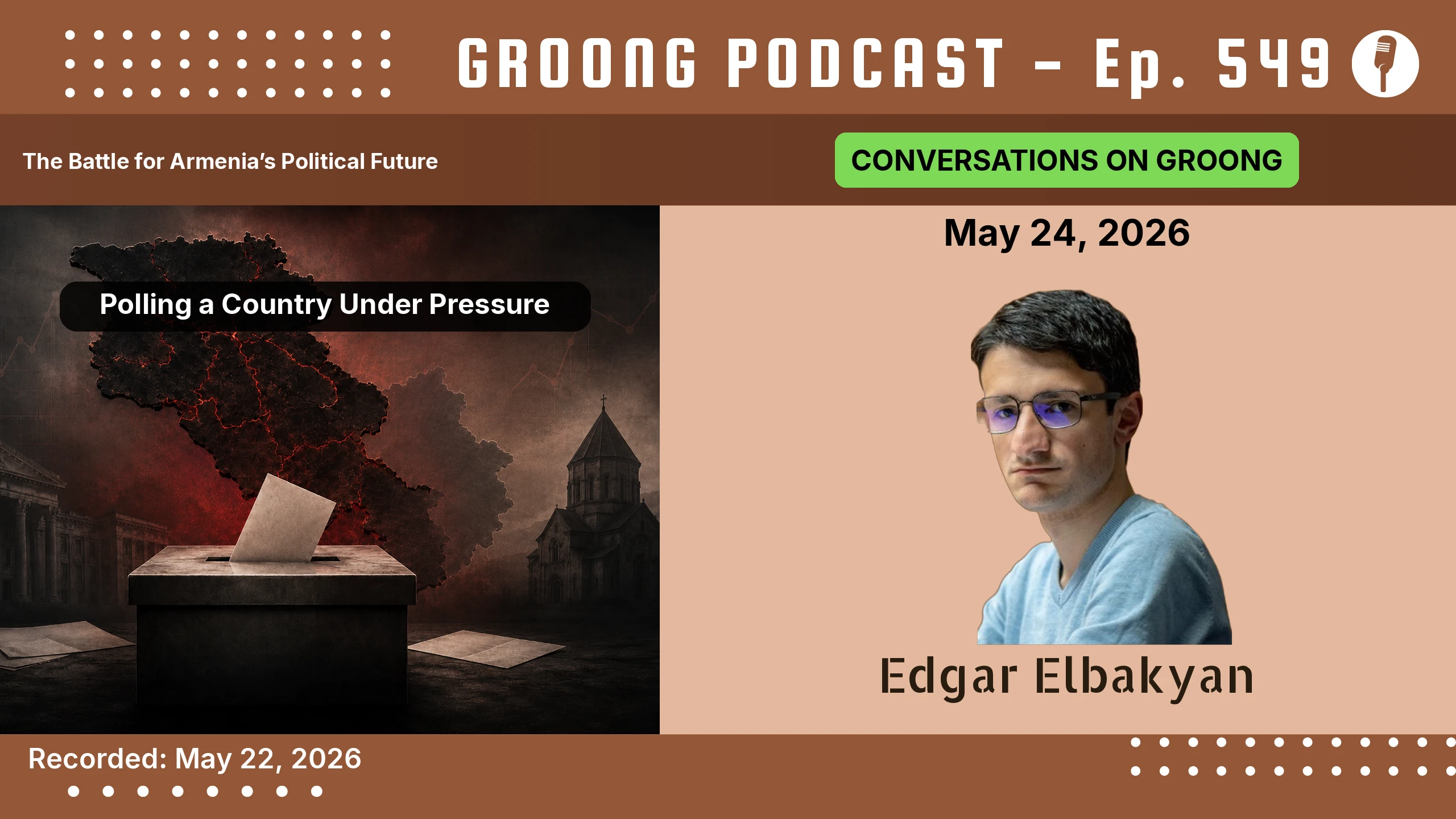
Edgar Elbakyan, a political scientist and co-founder of the Armenian Project based in Yerevan, opens by arguing that the June 7, 2026 parliamentary election is not a routine democratic contest. He frames the vote against the backdrop of the 2020 war, the fall of Artsakh (Nagorno Karabakh), and what he describes as a deliberate effort by the Pashinyan government to monopolize the national suffering narrative. In Elbakyan’s reading, the governing elite has spent decades persuading Armenians that their hardships stem from the Artsakh issue and everything associated with Armenian national identity, and is now extending that logic to the church, diaspora advocacy, and even foundational cultural symbols. He argues that unless the opposition can contest that narrative directly, Pashinyan remains politically untouchable on every other policy dimension, from pensions to education.
On polling, Elbakyan explains why survey results in Armenia are so difficult to trust and why two polls published on the same day, one from MPG and one from IRI, reached nearly opposite conclusions. He walks through the main sources of distortion: unrepresentative sampling across marzes and settlement types, inadequate callback protocols that oversample urban educated respondents, and the near-total absence of database transparency that would allow independent verification. The Armenian Project, which conducted its own poll in late April and early May with a sample of roughly 1,900 respondents, identified a significant share of “shy voters” across all political camps, but Elbakyan notes the proportions were roughly equal and should not account for the scale of divergence between published polls. He also explains why his organization has chosen not to release voting-intention numbers before the election, citing concerns about undue influence on public opinion.
The conversation turns to the specific political forces in the race and the strategic failures Elbakyan sees in the opposition campaign. He identifies Strong Armenia and the Armenia Alliance as certain to cross the threshold, with Prosperous Armenia as a realistic contender, and notes that a party like the Meritocratic Party of Armenia, virtually unknown a year ago, has accumulated a measurable share among urban, educated voters, which he reads as a symptom of deep political apathy rather than genuine enthusiasm. He is critical of Strong Armenia for spending most of the past year on economic messaging and only recently pivoting to national security questions, arguing that ceding the national issue to Pashinyan leaves the opposition with no winning argument. On the army, he says opposition parties have deliberately avoided the topic because they fear voters associate it with war, but that this tactical caution is strategically self-defeating: it allows Pashinyan to pose as the sole guarantor of peace. He is equally puzzled by the opposition’s near-silence on the persecution of the Armenian Apostolic Church, a campaign he describes as a political gift that no opposition force has seriously exploited. Elbakyan closes by saying he sees no credible preparations for post-election street mobilization and that the optimism circulating in opposition circles feels like self-deception rather than strategy.
Watch/Listen: Episode 549
Keywords: Armenia 2026 election, Edgar Elbakyan, polling methodology, Strong Armenia, Armenia Alliance, Armenian Apostolic Church, opposition coalition, post-election mobilization
Stay Connected
For the full, unfiltered stream of Armenia news as it happens, subscribe to the Groong Mailing List on Google Groups. Subscribers receive the complete daily news feed directly in their inbox — expect tens of emails per day covering Armenia, Artsakh, the diaspora, and the broader region.