Dziunik Aghajanian – US Midterms and Armenia’s Constitutional Standoff | Ep 600, Nov 7, 2026 [EP600]
Posted on Sunday, Nov 8, 2026 | Category: Armenia, Politics, Geopolitics | Series: cog, video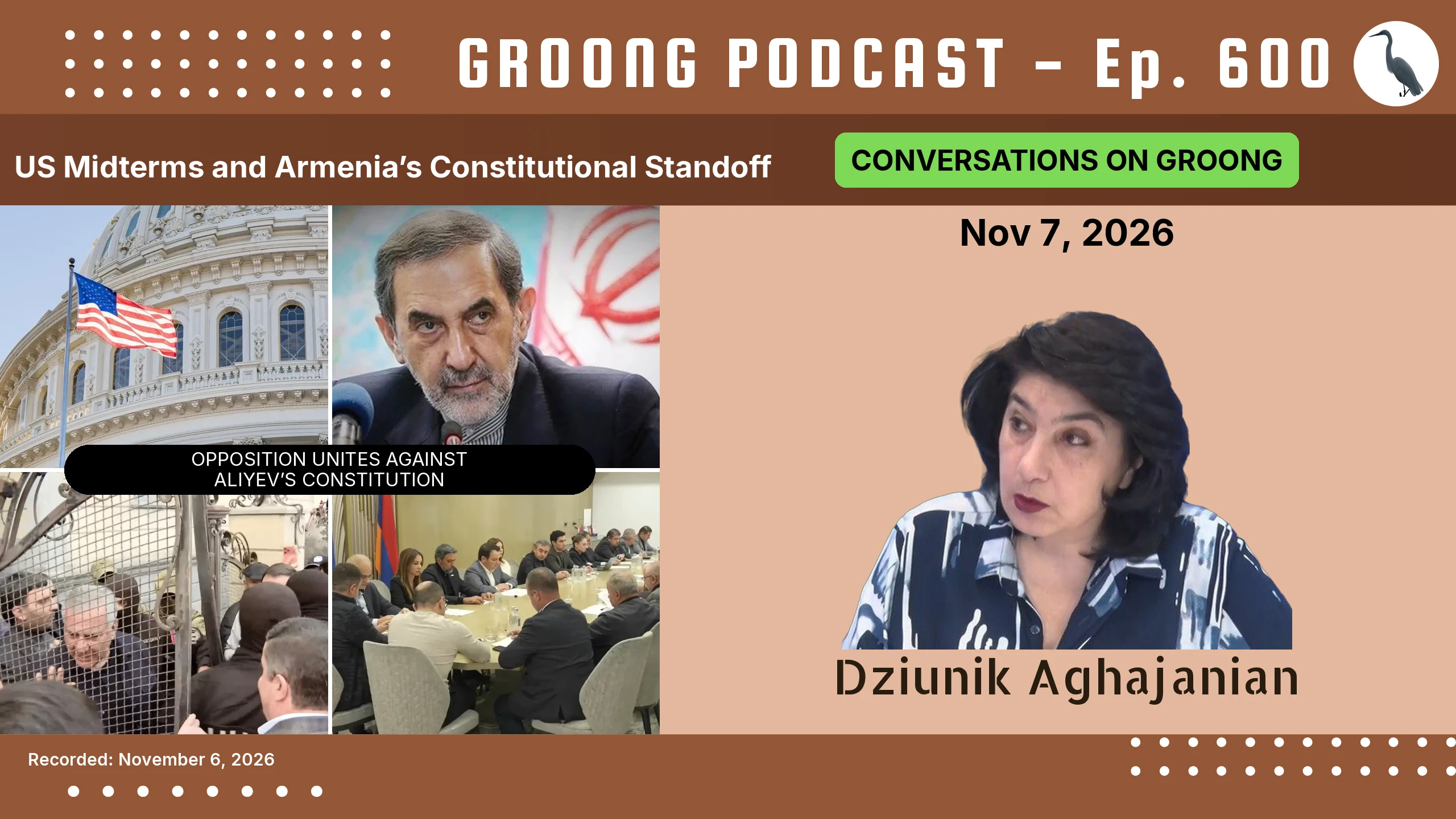
Groong Links:
Guest(s):
Topics:
- US Midterms and Iran War Risks
- Congressional Influence on TRIPP
- Iran’s Red Lines and Armenia’s Choices
- Constitutional Referendum and Voter Residency Restrictions
- Opposition Consolidation and Joint Action
- Political Pressure and Coalition Durability
Episode 600 | Recorded: November 6, 2026
#Armenia #DziunikAghajanian #USMidterms #Iran #TRIPP #ArmenianConstitution #OppositionUnity #VotingRights
Show Notes
Summary
In this episode of Conversations on Groong, we speak with Dziunik Aghajanian about the 2026 US midterm elections, Iran’s red lines, and Armenia’s constitutional crisis. We discuss how Democratic gains in Congress may affect TRIPP, Iran’s opposition to transit corridors near its borders, Pashinyan’s push for a new constitution without sufficient parliamentary support, and the opposition’s consolidation against what they view as an Azerbaijani-imposed constitutional framework.Main Topics Addressed
- US Midterm Elections and Iran: Democratic gains in Congress, the limits of congressional opposition to Trump’s foreign policy, and the possibility of political bargaining over military operations against Iran and support for Ukraine.
- Risk of Renewed War Against Iran: Aghajanian’s assessment that future operations could involve ground forces, regional states, Kurdish groups, and internal unrest, with renewed hostilities potentially emerging in spring 2027.
- TRIPP and Iran’s Red Lines: Iranian adviser Ali Akbar Velayati’s renewed warnings, Tehran’s concerns about foreign involvement along its northern border, and the conditions under which Iran might accept an Armenian-controlled transport route.
- TRIPP’s Strategic and Military Implications: Aghajanian’s argument that TRIPP could facilitate military logistics between Turkey and Azerbaijan, including potential operations against Iran, rather than serving Armenia’s economic and national interests.
- Armenian Sovereignty and the TRIPP Framework: Questions about the project’s ownership structure, Armenian jurisdiction, security and customs control, possible third-party participation, and the absence of publicly available operational details.
- TRIPP After the US Elections: Whether congressional changes could delay or alter the project and why Aghajanian expects continuity across Republican and Democratic administrations.
- Armenia’s Constitutional Standoff: Pashinyan’s push for a new constitution, Azerbaijan’s demands concerning Armenia’s Declaration of Independence, the unpublished constitutional text, and the ruling party’s lack of the parliamentary supermajority needed to submit it to a referendum.
- Pressure on Opposition Leaders: Legal action against Samvel Karapetyan , Robert Kocharyan, and Gagik Tsarukyan, alongside concerns about political coercion and the government’s efforts to secure parliamentary support.
- Opposition Consolidation: The November 4 joint declaration by representatives of 13 political groups, their decision to set aside political differences, and the prospects for sustained joint action.
- The Armenian Church and National Identity: Concerns that constitutional changes could affect the Church’s position, Armenia’s national identity, military institutions, and relations with Russia.
- Public Mobilization and Political Change: The opposition’s ability to resist government pressure, Pashinyan’s threats of street mobilization, and the need to build broader public support beyond parliamentary politics.
- Economic and Regional Pressures: The possible impact of Eurasian Economic Union decisions and economic hardship on public attitudes toward the government and opposition.
Key Questions Discussed
- How is Iran interpreting the results of the 2026 US midterm elections, and have those results changed the risk of renewed military conflict?
- Could congressional Democrats seek greater US support for Ukraine in exchange for accepting Trump’s military plans in the Middle East?
- What role might Turkey, Azerbaijan, and other neighboring states play in a future ground operation against Iran?
- Could TRIPP serve as a military supply route, and what implications would that have for Armenia’s security and relations with Iran?
- What specific guarantees of Armenian sovereignty, customs authority, border security, and jurisdiction would address Tehran’s objections to TRIPP?
- What remains unknown about TRIPP’s ownership, financing, physical route, and potential transfer of project interests to third parties?
- Can the new US Congress influence TRIPP’s implementation, or is the project part of a broader policy that will continue regardless of changes in Washington?
- Why is Pashinyan pressing for a new constitution before its full text has been made public?
- How are Azerbaijan’s demands, the proposed peace agreement , and the reopening of the Armenia-Turkey border connected to the constitutional debate?
- Why did major Armenian opposition groups fail to unite before the June 2026 elections , and what has changed since then?
- Can the November 4 opposition declaration become an effective alliance capable of joint parliamentary action and public mobilization?
- Does Pashinyan retain enough public support to organize street protests against the parliamentary opposition?
- How can opposition parties protect their members from political pressure while preventing constitutional changes they oppose?
- What role could public education, economic hardship, and coordinated political action play in Armenia’s future?
Links Referenced
US Elections, Iran, and TRIPP
- Velayati Warns Against Crossing Iran’s Red Lines in TRIPP Project, Tasnim News, November 5, 2026
- Mirzoyan: Democrats Would Not Oppose Swift TRIPP Implementation, NEWS.am, November 5, 2026
- Government Proposes November 12 Sitting on TRIPP Legislation, Armenpress, November 5, 2026
- Official Armenia-US TRIPP Framework Agreement, Armenian Embassy
- Understanding the War Powers Resolution, Congressional Research Service
Armenia’s Constitutional Crisis and Opposition
- Armenia’s Constitutional Referendum Stalled as Opposition Forces Unite Against an Unpublished Constitution, Zartonk Media, November 5, 2026
- Constitution of the Republic of Armenia, Articles 202 and 207, Constitutional Court
- Voter Residency Restrictions, Hraparak, November 6, 2026
Wrap-up
Links and Resources
That’s our show , we hope you found it helpful. We invite your feedback and your suggestions, you can find us on most social media and podcast platforms.
Thanks to Laura Osborn for the music on our podcasts.
Guests

Dziunik Aghajanian
Ms. Dziunik Aghajanian has served Armenia through the ranks of the Ministry of Foreign Affairs, and most recently as a diplomat, as Armenia’s Ambassador to such countries as the Netherlands, Malaysia, and Indonesia. She received her education at Yerevan State University, Columbia University in NY, and Uppsala University in Sweden.
Hosts

Hovik Manucharyan
Hovik Manucharyan is an information security engineer who moved from Seattle to Armenia in 2022. He co-founded the ANN/Groong podcast in 2020 and has been a contributor to Groong News since the late 1990s.
Disclaimer: The views expressed by Hovik Manucharyan on the ANN/Groong podcast are his own and do not necessarily reflect the opinions of his employer or any other organization.

Asbed Bedrossian
Asbed Bedrossian is an IT professional, and for years oversaw the central IT enterprise infrastructure and services at USC. His decades of experience spanned across IT strategy, enterprise architecture, infrastructure, cybersecurity, enterprise applications, data center operations, high performance computing, ITSM, ITPM, and more.
Asbed founded the Armenian News Network Groong circa 1989/1990, and co-founded the ANN/Groong podcast in 2020.