Regional Fault Lines, Domestic Confrontation | Ep 599, Nov 1, 2026 [EP599]
Posted on Monday, Nov 2, 2026 | Category: Armenia, Politics, Geopolitics | Series: wir, video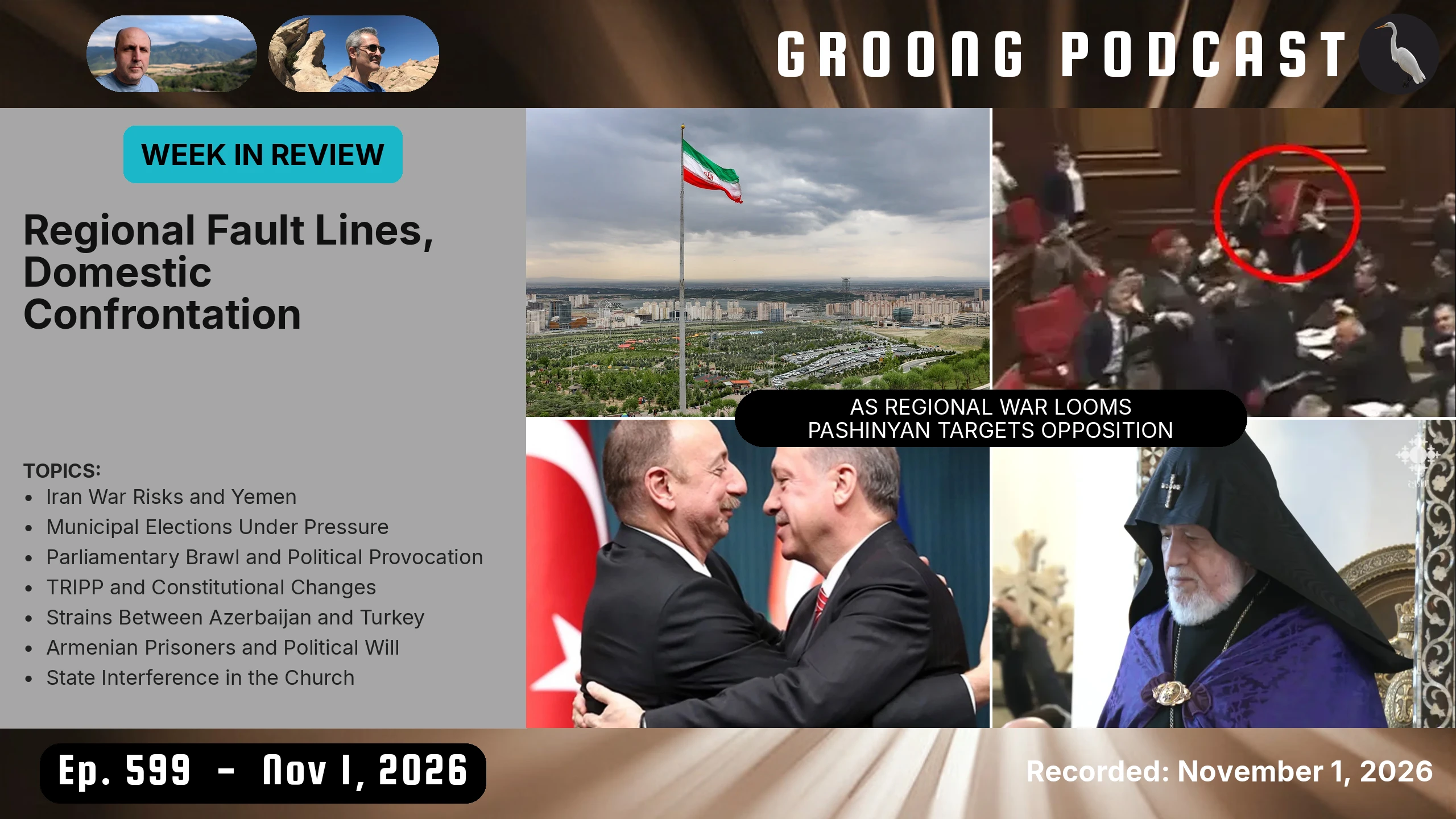
Groong Links:
Topics:
- Iran War Risks and Yemen
- Municipal Elections Under Pressure
- Parliamentary Brawl and Political Provocation
- TRIPP and Constitutional Changes
- Strains Between Azerbaijan and Turkey
- Armenian Prisoners and Political Will
- State Interference in the Church
Episode 599 | Recorded: November 1, 2026
#Armenia #IranWar #ArmenianPolitics #TRIPP #TurkeyAzerbaijan #ArmenianPrisoners #ArmenianChurch
Show Notes
Summary
In this episode of Groong Week in Review for November 1, 2026, we examine regional escalation risks and domestic political turmoil in Armenia. We discuss renewed Iran War threats alongside the Armenia-Azerbaijan Peace Process stalemate, municipal elections under government pressure, parliamentary violence endorsed by leadership, TRIPP and constitutional changes, widening strains between Azerbaijan and Turkey, Armenian Prisoners of War dossiers, and state interference in the Armenian Church—exposing a government prioritizing domestic confrontation over serious preparation for regional conflict.Main Topics Addressed
Renewed Threat of War Against Iran
- Reports of possible US military strikes against Iran following the November 3 elections, alongside ongoing diplomatic negotiations .
- Iran’s warnings of retaliation without geographic limits and the risks of drawing additional countries into the conflict.
- The strategic calculations behind Iran’s restraint and the danger of pushing Gulf states closer to Israel.
- Renewed Saudi-Houthi fighting in Yemen and reports alleging UAE support for Ansarallah.
- The Mecca Pact involving Saudi Arabia, Pakistan, and Turkey, and the complications posed by competing regional interests.
Azerbaijan and Iran’s Northern Front
- Reports of Israeli intelligence and military operations inside Azerbaijan, including near Iran’s northern border.
- The strategic depth of Israeli-Azerbaijani cooperation and its implications for regional security.
- The possibility of Iranian retaliation against Azerbaijan and the resulting risks for Armenia.
- Turkey’s obligations toward Azerbaijan under the Shusha Declaration and the potential for wider escalation.
- Questions about Armenia’s preparedness for regional war, border disruptions, and possible Azerbaijani military action.
Municipal Elections and Armenia’s Political Opposition
- Reports of Civil Contract and allied electoral lists receiving 100 percent of the vote in selected polling stations and settlements.
- The role of ruling-party alliances with established local political figures.
- Allegations of political pressure, arrests, and obstacles facing opposition candidates.
- Pashinyan ’s statements about Armenia’s need for a viable opposition.
- The hosts’ assessment of the government’s record since 2018, focusing on Artsakh , corruption, and electoral competition.
Parliamentary Violence and Political Accountability
- The October 29 confrontation between Civil Contract and Strong Armenia lawmakers.
- Taron Chakhoyan’s remarks involving Narek Karapetyan’s relatives and the escalation into physical violence.
- Speaker Ruben Rubinyan’s decision to allow proceedings to continue during the confrontation.
- Pashinyan’s public defense of the ruling party’s actions.
- The hosts’ discussion of whether the confrontation was provoked and whether it diverted attention from major parliamentary decisions.
TRIPP : Sovereignty, Concessions, and Unanswered Questions
- Parliament’s October 28 ratification of the US-Armenia TRIPP framework agreement.
- Establishment of the TRIPP Development Company, with a proposed 74 percent US and 26 percent Armenian ownership structure.
- The 49-year exclusive concession and the role of special purpose vehicles in transport, energy, and communications infrastructure.
- The proposed front-office/back-office model for border management and its implications for Armenian control.
- Tax exemptions, uncertain economic returns, and the absence of detailed public feasibility studies.
- Unresolved questions concerning road alignments, land-use rights, access to Iran, and the geographic scope of TRIPP.
- The hosts’ concerns that the project could restrict Armenia’s practical sovereignty in Syunik and primarily serve Azerbaijani and Turkish strategic interests.
- The lack of reciprocal transit guarantees or a signed peace treaty with Azerbaijan.
Growing Friction Between Azerbaijan and Turkey
- The dispute over Azerbaijan’s school dress-code rules and criticism from Turkish political and religious circles.
- Erdoğan’s removal of adviser Oktay Saral following his criticism of Azerbaijan.
- Ilham Aliyev ’s absence from the October 30 meeting in Ankara, despite Erdoğan’s invitation.
- Azerbaijan’s growing confidence in its relationship with Israel and its willingness to challenge Turkish influence.
- Competing interpretations of the tensions and whether they represent a temporary dispute or a deeper shift in regional power.
- The potential implications for the Organization of Turkic States and Armenia’s regional position.
Armenian Prisoners Held in Azerbaijan
- The Armenian Cause International dossier documenting 20 Armenians held in Azerbaijan, including former Artsakh leaders, civilians, and prisoners of war .
- Prison sentences ranging from 15 years to life, concerns about trial procedures, and restrictions on independent humanitarian access.
- Foreign Minister Ararat Mirzoyan’s acknowledgment that third-country diplomatic efforts have failed to secure access.
- The hosts’ criticism of Armenia’s handling of international legal and diplomatic efforts concerning the prisoners.
- The decision to proceed with TRIPP and the peace process without conditioning them on the prisoners’ release.
- Questions about the political consequences of a possible return of former Artsakh leaders, including Ruben Vardanyan.
Government Confrontation with the Armenian Apostolic Church
- Civil Contract’s parliamentary commission on Church affairs and objections from the Mother See and opposition parties.
- Legal proceedings involving Catholicos Karekin II and defrocked bishop Gevorg Saroyan.
- Disciplinary proceedings initiated against Judge Hakob Manukyan following his recusal from a case involving the Catholicos.
- Court decisions involving Saroyan and disputes over ecclesiastical authority.
- The role of state institutions and law enforcement in disputes involving clergy who challenge the Church hierarchy.
- The hosts’ concerns over the independence of the judiciary, the separation of Church and state, and the future of the Armenian Apostolic Church.
Key Questions Discussed
- Are US threats against Iran intended to secure diplomatic concessions, or is another round of military conflict approaching?
- Could Iran’s retaliation against Azerbaijan trigger a broader regional war involving Turkey and other powers?
- What evidence is there that Armenia is preparing for the security and economic consequences of renewed regional fighting?
- What do the municipal election results reveal about the state of political competition and opposition activity in Armenia?
- Was the parliamentary confrontation deliberately provoked, and did it divert public attention from the TRIPP agreement?
- What sovereign powers will Armenia retain under TRIPP, and how will those powers work in practice?
- What economic and strategic benefits does Armenia receive in exchange for a long-term concession over infrastructure in Syunik?
- Why did Armenia ratify TRIPP without securing reciprocal guarantees, a signed peace treaty, or the release of Armenian prisoners?
- Are the tensions between Azerbaijan and Turkey temporary, or do they reveal deeper disagreements over regional influence and relations with Israel?
- What additional steps could Armenia take to secure the release of Armenians held in Azerbaijan?
- What do recent court proceedings and disciplinary actions against judges reveal about the government’s confrontation with the Armenian Church?
- How should Armenia protect its sovereignty and state institutions amid mounting external pressures and domestic political conflict?
Links Referenced
Iran, Yemen, and Regional Security
- NEWS.am: Reported US Warning to Gulf Allies
- Al Jazeera: Iran and US Explore Diplomacy Amid Rising Threats of War
- Trita Parsi: Israel Breached Iranian Airspace, but Iran Did Not Respond
- Trita Parsi: Can Trump and Iran Ever Reach a Deal Again?
- Drop Site News: Report on UAE, Yemen, and Ansarallah
- Kyiv Post: Report Concerning Israeli Operations in Azerbaijan
- Responsible Statecraft: Israel and Azerbaijan
Municipal Elections and Parliamentary Confrontation
- ArmLur: Municipal Election Results
- Azatutyun: Municipal Elections and Pre-election Arrests
- Azatutyun: Opposition Participation and Government Response
- Azatutyun: Parliamentary Brawl
- Armenpress: Ruben Rubinyan Responds to the Confrontation
- Armenpress: Pashinyan Comments on Parliamentary Violence
- NEWS.am: Allegations of a Planned Parliamentary Provocation
TRIPP and Armenian Sovereignty
- Verelq: Parliament Ratifies TRIPP Framework
- Asbarez: ARF Bureau Member Warns of Risks to Armenia’s Sovereignty
- Azatutyun: Yerevan Ready for Private Security Service Along US-run Corridor
Azerbaijan–Turkey Relations
- Reuters: Aliyev’s Summit Absence Highlights Azerbaijan–Turkey Tensions
- Agos: Oktay Saral Resigns
- NEWS.am: Iran–Azerbaijan Education Dispute
- Nouvelles d’Arménie: Former Turkish Diplomat on Relations with Baku
Armenian Prisoners in Azerbaijan
- Armenian Weekly: Armenian Cause International Publishes Dossier on Armenian Hostages
- Armenian Cause International: Full Prisoner Dossier (PDF)
- NEWS.am: Mirzoyan on Unsuccessful Third-country Mediation
- 168.am: Mirzoyan on Negotiations Concerning Armenian Prisoners
- 168.am: Pashinyan’s Earlier Remarks About Ruben Vardanyan
Armenian Apostolic Church
- Azatutyun: Parliamentary Commission on Church Affairs Holds First Meeting
- Azatutyun: Disciplinary Proceedings Against Judge Hakob Manukyan
- Azatutyun: Court Decision in Gevorg Saroyan Case
Wrap-up
Links and Resources
That’s our show , we hope you found it helpful. We invite your feedback and your suggestions, you can find us on most social media and podcast platforms.
Thanks to Laura Osborn for the music on our podcasts.
Hosts

Hovik Manucharyan
Hovik Manucharyan is an information security engineer who moved from Seattle to Armenia in 2022. He co-founded the ANN/Groong podcast in 2020 and has been a contributor to Groong News since the late 1990s.
Disclaimer: The views expressed by Hovik Manucharyan on the ANN/Groong podcast are his own and do not necessarily reflect the opinions of his employer or any other organization.

Asbed Bedrossian
Asbed Bedrossian is an IT professional, and for years oversaw the central IT enterprise infrastructure and services at USC. His decades of experience spanned across IT strategy, enterprise architecture, infrastructure, cybersecurity, enterprise applications, data center operations, high performance computing, ITSM, ITPM, and more.
Asbed founded the Armenian News Network Groong circa 1989/1990, and co-founded the ANN/Groong podcast in 2020.