Vache Gabrielyan - Is the Growth Model Running Out of Steam? | Ep 596, Oct 25, 2026 [EP596]
Posted on Sunday, Oct 25, 2026 | Category: Armenia, Politics, Geopolitics | Series: cog, video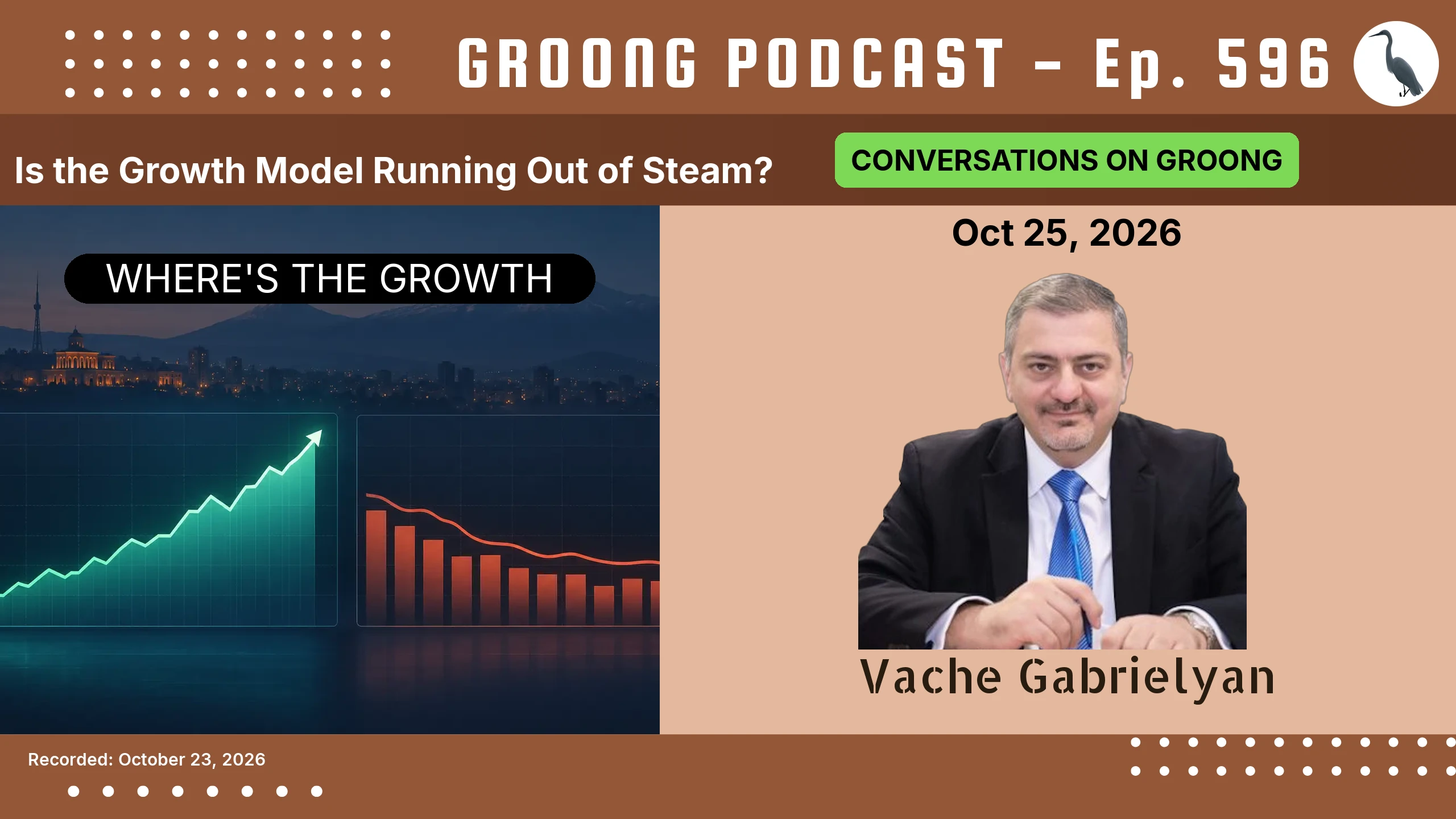
Groong Links:
Guest(s):
Topics:
- Armenia’s 2026 economic performance and structural imbalances
- Construction boom and housing market risks
- Consumer credit growth and weak industrial productivity
- Systemic failures in government budget execution
- Armenia’s 2027 budget priorities and fiscal risks
- Rising public debt and debt servicing costs
- Defense spending and competing budget priorities
- High-tech investments, AI, and economic sustainability
Episode 596 | Recorded: October 23, 2026
#ArmenianEconomy #EconomicGrowth #Armenia2026 #Armenia2027Budget #PublicDebt #GovernmentSpending #EconomicPolicy #ArmenianNews
Show Notes
Summary
In this episode of Conversations on Groong, we speak with Dr. Vache Gabrielyan about Armenia’s 2026 economic performance and fiscal challenges. We discuss structural imbalances in the economy, banking sector stability, government budget execution failures, rising public debt, and competing priorities for defense spending and economic development heading into 2027.Episode 596: Armenia’s Economy, Growth, Debt, and the 2027 Budget
Conversations on Groong | October 23, 2026
Guest: Dr. Vache Gabrielyan , Dean of the Manoogian Simone College of Business and Economics at the American University of Armenia, former Deputy Prime Minister and Minister of Finance.
Hosts: Hovik Manucharyan and Asbed Bedrossian
Summary
Armenia’s economy continues to grow, but is that growth sustainable, and is it building the country’s long-term productive capacity? Dr. Vache Gabrielyan joins Groong to examine Armenia’s economic performance in 2026, the construction boom, weak export competitiveness, and chronic under-execution of government budgets. He explains how inflows linked to the Russia-Ukraine war have fueled services, banking, IT, and real estate, while agriculture and export-oriented industries face mounting challenges. The discussion also examines Armenia’s 2027 state budget, rising debt servicing costs, increased social spending, and the economic risks of a possible rupture with the Eurasian Economic Union. Gabrielyan assesses the Firebird AI data center project, questions its broader economic impact, and considers whether Armenia’s fiscal priorities reflect long-term development needs or short-term political choices.
Main Topics
- Armenia’s 2026 economic performance: Strong headline growth, declining momentum, construction and service-sector expansion, and weaknesses in agriculture and export-oriented production.
- Construction boom and real estate risks: High apartment prices, diaspora-driven demand, property purchases as savings, possible overvaluation, and safeguards against a systemic housing crash.
- IT, mining, and foreign inflows: The impact of Russian business relocations, growth in IT services, rising copper prices, and dependence on external economic conditions.
- Chronic government budget under-execution: Unspent capital allocations, delayed infrastructure projects, weak project management, and the impact of risk aversion among public officials.
- Armenia’s 2027 budget: Fiscal inertia, spending priorities, universal healthcare, pensions, defense allocations, and the limited room for new investments.
- Eurasian Economic Union risks: Potential membership restrictions, higher Russian gas prices, agricultural export losses, inflation, and the absence of contingency planning.
- Public debt and fiscal sustainability: Rising interest payments, debt servicing compared with Georgia and other countries, and the trade-off between social commitments and productive investment.
- High-tech, Firebird AI, and future growth: The Ministry of High-Tech Industry’s mandate, weak R&D execution, data center financing, AI investment risks, and limited local economic spillovers.
Key Questions Discussed
- Is Armenia’s economic growth producing lasting gains in productivity, or does it depend on external inflows and non-tradable sectors?
- Who is buying Yerevan’s expensive new apartments, and could the housing boom lead to a damaging market correction?
- Why does the government continue to fall short in executing capital and infrastructure programs despite increased spending and higher public-sector compensation?
- Does the 2027 budget provide the flexibility Armenia needs to withstand geopolitical and economic shocks?
- What would happen to Armenia’s economy if its Eurasian Economic Union membership were frozen and Russian gas prices increased?
- Is Armenia’s public debt sustainable, and how much does debt servicing limit investment in infrastructure, education, and economic development?
- Are universal healthcare and pension increases sound long-term priorities, or do they reflect election-year spending?
- Is the Ministry of High-Tech Industry structured to support Armenia’s technological and defense needs?
- Can the Firebird AI project deliver broad economic benefits, or is it mainly a profitable investment for its owners and lenders?
- What do the 2026 budget and 2027 spending priorities reveal about the government’s economic policy?
Referenced Articles & Sources
Economic performance and budget execution
Luys Foundation: Analysis of Armenia’s First-Half 2026 State Budget Execution . Analysis of economic activity, agricultural contraction, budget under-execution, capital spending, and fiscal performance.
Luys Foundation: Economic and Fiscal Publications . Additional economic reports, including analysis of Armenia’s medium-term expenditure framework.
Public administration and government execution
OECD/SIGMA: Public Administration in Armenia 2025 . Assessment of Armenia’s public administration, policy implementation, accountability, and public financial management, discussed by Gabrielyan.
SIGMA
+1
sigmaweb.org
Artificial intelligence and investment risks
- Ray Dalio Warns That the AI Bubble Could Burst, Inc. . Background article from the episode outline on risks of an AI investment bubble.
Additional source note: Gabrielyan discusses a recent expert report examining the economic effects of freezing Armenia’s Eurasian Economic Union membership, including potential changes in Russian gas pricing. The transcript does not identify the report by title or provide its URL, so it is not linked here.
Wrap-up
Links and Resources
That’s our show , we hope you found it helpful. We invite your feedback and your suggestions, you can find us on most social media and podcast platforms.
Thanks to Laura Osborn for the music on our podcasts.
Guests

Vache Gabrielyan
Dr. Vache Gabrielyan who is the Dean of the Manoogian Simone College of Business and Economics at the American University of Armenia and specializes in public administration and economics. Since 2008, he has served as Vice-Governor of the Central Bank of Armenia, Minister of Finance, Minister-Chief of the Government Staff, Chief Advisor to the Prime Minister, as well as the Deputy Prime Minister of Armenia, and the Minister of International Economic Integration and Reforms.
Hosts

Hovik Manucharyan
Hovik Manucharyan is an information security engineer who moved from Seattle to Armenia in 2022. He co-founded the ANN/Groong podcast in 2020 and has been a contributor to Groong News since the late 1990s.
Disclaimer: The views expressed by Hovik Manucharyan on the ANN/Groong podcast are his own and do not necessarily reflect the opinions of his employer or any other organization.

Asbed Bedrossian
Asbed Bedrossian is an IT professional, and for years oversaw the central IT enterprise infrastructure and services at USC. His decades of experience spanned across IT strategy, enterprise architecture, infrastructure, cybersecurity, enterprise applications, data center operations, high performance computing, ITSM, ITPM, and more.
Asbed founded the Armenian News Network Groong circa 1989/1990, and co-founded the ANN/Groong podcast in 2020.