Arthur Martirosyan - Armenia at a Crossroads: Railways, Reactors, and Security | Ep 594, Oct 17, 2026 [EP594]
Posted on Saturday, Oct 17, 2026 | Category: Armenia, Politics, Geopolitics | Series: cog, video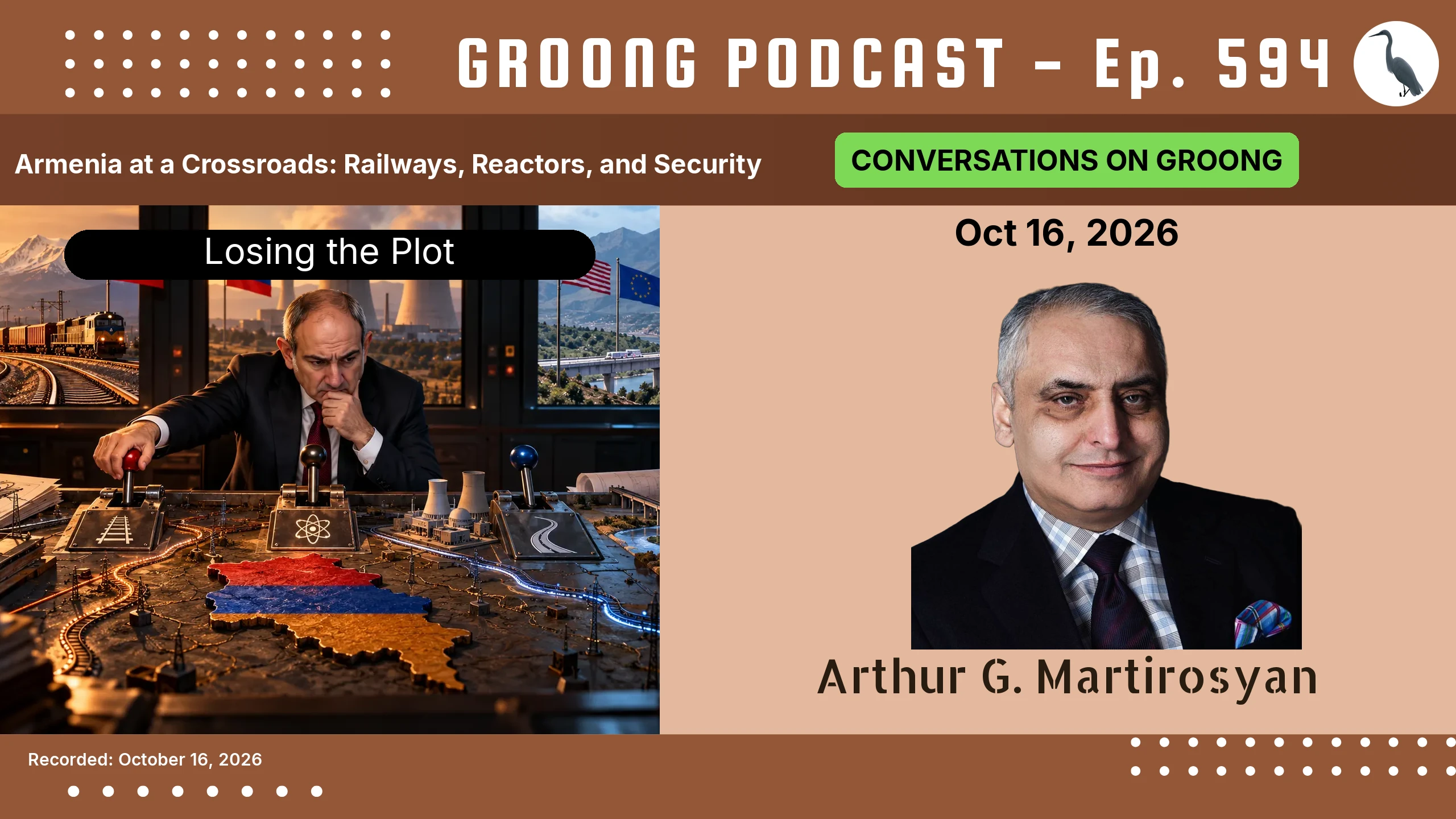
Groong Links:
Guest(s):
Topics:
- Azeri Soldier Infiltration and Shaki Shooting
- Government Accountability and Border Security Failures
- Russian Railways and Armenia’s Strategic Options
- Nuclear Power: Russian Reactors vs. Western SMRs
- TRIPP and Armenia’s Geopolitical Balancing Act
- COP17, Environmental Destruction, and Appeasing Azerbaijan
Episode 594 | Recorded: October 16, 2026
#ArmenianElections #Armenia #NikolPashinyan #CivilContract #StrongArmenia #ArmenianOpposition
Show Notes
Summary
In this episode of Conversations on Groong, we speak with Arthur G. Martirosyan about Armenia at a crossroads in politics and security. We discuss the Shaki infiltration incident and government accountability, Pashinyan’s standoff with Russian Railways over the rail concession, nuclear energy options including Western SMRs versus Russian reactors, TRIPP’s implications for Armenian geopolitics, and environmental destruction at COP17.Main Topics
1. Shaki Shooting: Border Security and Government Accountability
- The infiltration of an armed Azerbaijani serviceman approximately 20 kilometers into Armenian territory and the shooting of a mother in her home in Shaki.
- Conflicting accounts of the soldier’s conduct, including whether he was a deserter seeking refuge or posed a direct threat to the family.
- The government’s failure, in Martirosyan’s assessment, to locate the soldier and warn residents despite receiving information about his disappearance.
- Pashinyan ’s response to the injured mother and his handling of questions about responsibility and public safety.
- The legal and diplomatic implications of prosecuting the soldier in Armenia versus returning him to Azerbaijan.
- Martirosyan’s comparison with earlier border incidents and his argument that peace requires enforceable agreements, accountability, and justice.
2. Pashinyan’s Peace Agenda and Azerbaijan’s Demands
- Pashinyan’s proposal for resolving the status of enclaves and exclaves, including territorial exchanges, and his proposed 2031 timeline for a formal peace agreement.
- The lack of clear Azerbaijani reciprocity to Armenia’s public peace proposals.
- The legacy of the 2022 European-mediated negotiations, the Alma-Ata Declaration, and Armenia’s recognition of Azerbaijan’s territorial integrity.
- Azerbaijan’s “Western Azerbaijan” narrative and Martirosyan’s concerns about its implications for Armenian sovereignty.
- The possible role of constitutional amendments, minority rights, and additional Azerbaijani demands in future negotiations.
- The risks of negotiating under military threats and the ability of Azerbaijan to extract concessions without resorting to open warfare.
- Pashinyan’s domestic political constraints, including the absence of a constitutional majority and uncertainty over a future referendum.
3. Russian Railways and Armenia’s Strategic Dependence
- Pashinyan’s earlier threats of international arbitration against Russian Railways, which operates Armenia’s railway network under a concession extending to 2038.
- Russia’s demand for compensation tied to its reported $400 million in railway investments if the concession were changed or terminated.
- Pashinyan’s meeting with Russian Railways CEO Oleg Belozyorov and the establishment of a three-month working group to improve competitiveness.
- Discussion of a potential $3 billion Russian investment in Armenia’s rail infrastructure.
- Martirosyan’s assessment of bargaining power, credible alternatives, and the danger of bluffing in negotiations with a stronger economic partner.
- Whether the apparent de-escalation represents a genuine policy adjustment or a temporary arrangement designed to buy political time.
4. Armenia’s Nuclear Power Choices and Energy Security
- Pashinyan’s apparent shift from Western small modular reactors (SMRs) toward a possible 1,000 MW Russian Rosatom reactor.
- Questions about the availability and operational track record of American SMR technology.
- The growing electricity needs of proposed data centers and their implications for Armenia’s power grid.
- Concerns about committing to major technology and infrastructure projects without credible alternatives or a clear energy strategy.
- Martirosyan’s argument that Armenia must account for its existing economic and energy dependencies when negotiating with Russia.
5. TRIPP, Russian Interests, and the Geopolitical Balance
- The relationship between Russian Railways’ existing concession and the proposed US-Armenia TRIPP transport project.
- Russia’s concerns about losing economic and strategic influence in the South Caucasus.
- Iran’s opposition to an American presence near its northern border and its concerns about potential Israeli involvement.
- Turkey’s and Azerbaijan’s interests in advancing regional transit connections.
- The contrast between the Armenian government’s Crossroads of Peace narrative and the conflicting strategic interests of regional powers.
- Whether railway concessions, Russian nuclear investments, and TRIPP can coexist within a workable regional arrangement.
- Martirosyan’s skepticism about the pace of implementation and the gap between diplomatic announcements and developments on the ground.
6. COP17, Environmental Protection, and Armenian National Interests
- Armenia’s hosting of COP17, the UN Biodiversity Conference, and its potential diplomatic and economic benefits.
- Reports of Azerbaijani military activity and forest destruction affecting Armenian protected areas.
- The Armenian government’s position that raising these issues during COP17 would conflict with the principles of its presidency.
- Contrasts with Aliyev’s public criticism of Armenia and the imprisoned Artsakh leadership at international forums.
- Martirosyan’s skepticism about whether large UN conferences produce tangible results for smaller states.
- Armenia’s domestic environmental challenges, including the Amulsar mining controversy.
- The distinction between international visibility, short-term economic gains, and meaningful protection of national interests.
7. Historical Memory, National Identity, and Sovereignty
- Pashinyan’s conception of “Real Armenia” and his emphasis on shaping the present and future rather than focusing on historical grievances.
- Martirosyan’s criticism of efforts to distance Armenia’s political identity from its historical memory.
- The Armenian Genocide , the Diaspora, and the role of shared historical experience in maintaining Armenian national identity.
- The Armenian Apostolic Church as an institution connecting Armenians across national borders.
- The government’s confrontation with the Church and Martirosyan’s concerns about its implications for national cohesion.
- Armenia’s long-term choice between maintaining substantive sovereignty and becoming increasingly dependent on the agendas of external powers.
Key Questions Discussed
- What does the Shaki incident reveal about Armenia’s border security, and why was the armed Azerbaijani soldier not located before the shooting?
- Did the Armenian government adequately protect and inform the local population?
- Can Armenia establish a lasting peace without reciprocal commitments, border agreements, and accountability?
- How should Armenia interpret Azerbaijan’s territorial and political demands, including the “Western Azerbaijan” agenda?
- Is Pashinyan’s 2031 peace timeline a realistic negotiating framework or an attempt to delay difficult decisions?
- Why has Pashinyan softened his stance toward Russian Railways and Russian nuclear technology?
- Does Armenia possess credible alternatives when negotiating its railway and energy arrangements with Moscow?
- Can Russia’s railway concession and nuclear interests coexist with the US-backed TRIPP project?
- What do Russia and Iran stand to lose from the emerging regional transport arrangements?
- Will COP17 produce tangible environmental and diplomatic benefits for Armenia, or mainly international publicity?
- Why is the Armenian government reluctant to raise reported Azerbaijani environmental destruction at an international biodiversity conference?
- What role should the Armenian Diaspora , historical memory, and the Armenian Apostolic Church play in preserving national identity and sovereignty?
Wrap-up
Links and Resources
That’s our show , we hope you found it helpful. We invite your feedback and your suggestions, you can find us on most social media and podcast platforms.
Thanks to Laura Osborn for the music on our podcasts.
Guests

Arthur G. Martirosyan
Arthur G. Martirosyan is a Senior Consultant with CM Partners. In 1994, after graduating from Yale University, he joined Conflict Management Group and Harvard Negotiation Project, and has since worked on conflicts in the former Soviet Union, the Middle East, the Balkans, Africa, and Latin America.
Hosts
Hovik Manucharyan
Hovik Manucharyan is an information security engineer who moved from Seattle to Armenia in 2022. He co-founded the ANN/Groong podcast in 2020 and has been a contributor to Groong News since the late 1990s.
Disclaimer: The views expressed by Hovik Manucharyan on the ANN/Groong podcast are his own and do not necessarily reflect the opinions of his employer or any other organization.

Asbed Bedrossian
Asbed Bedrossian is an IT professional, and for years oversaw the central IT enterprise infrastructure and services at USC. His decades of experience spanned across IT strategy, enterprise architecture, infrastructure, cybersecurity, enterprise applications, data center operations, high performance computing, ITSM, ITPM, and more.
Asbed founded the Armenian News Network Groong circa 1989/1990, and co-founded the ANN/Groong podcast in 2020.