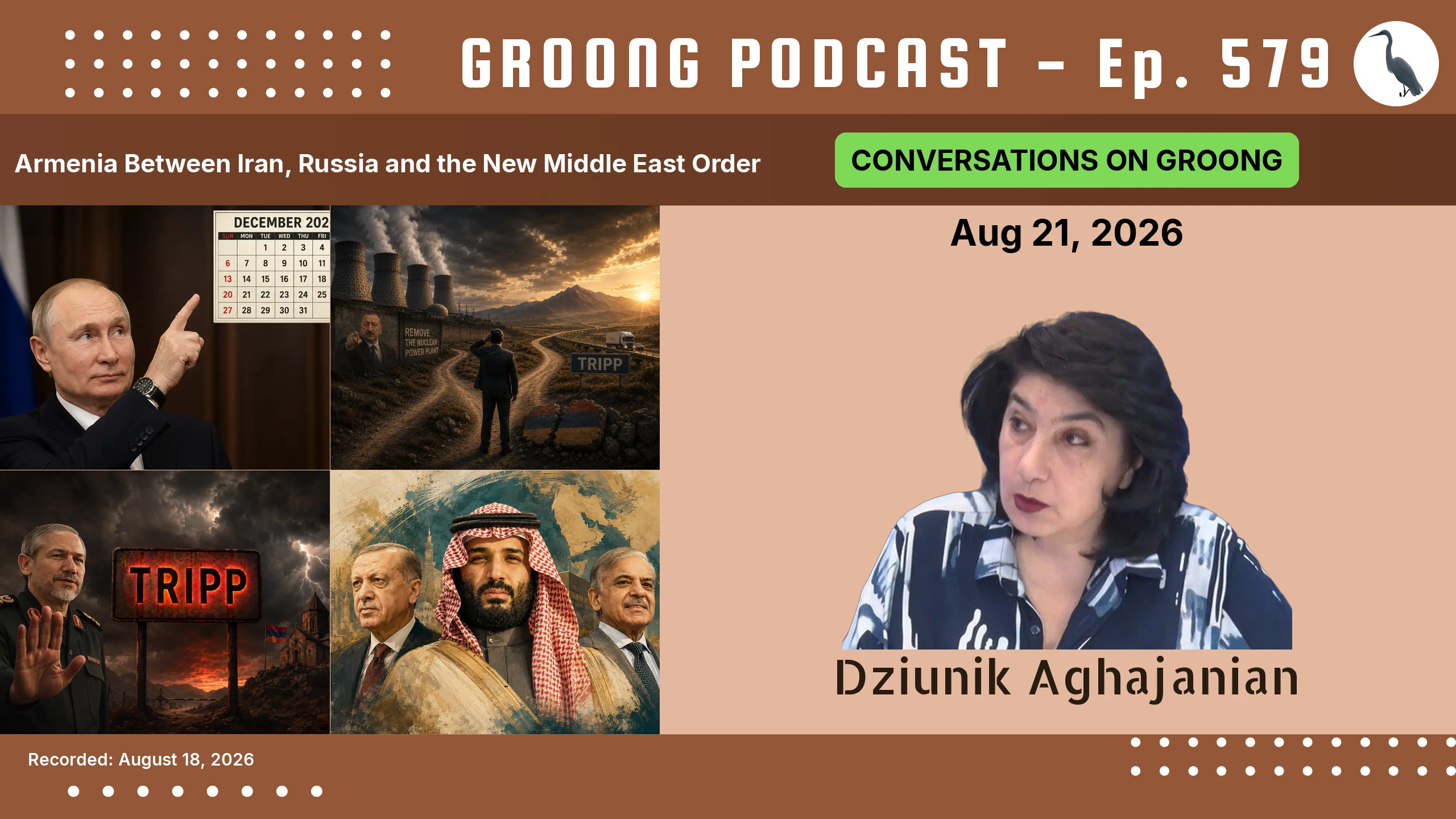
Dziunik Aghajanian - From Moscow to Riyadh: New Fault Lines Around Armenia | Ep 590, Sep 25, 2026 [EP590]
Posted on Friday, Sep 25, 2026 | Category: Armenia, Politics, Geopolitics | Series: cog, video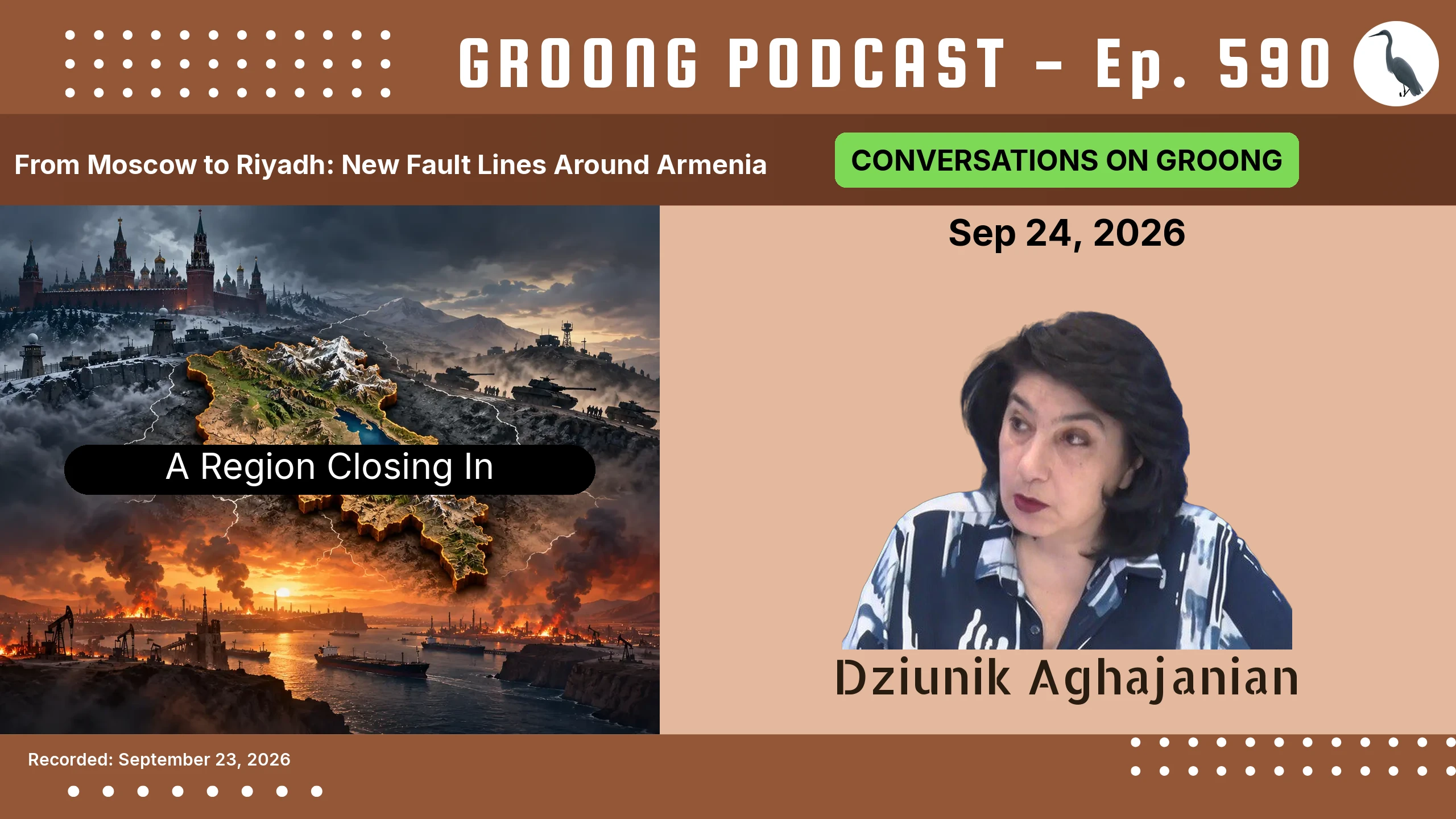
Groong Links:
Guest(s):
Topics:
- Russian parliamentary election outcome
- Middle East escalation and the Houthis
- Armenia-Russia confrontation, including the 102nd base
- Asset confiscation, anti-corruption, and Russian interests
- Azerbaijan-Armenia “durable peace” tensions
- Armenian opposition strategy
Episode 590 | Recorded: September 23, 2026
#Armenia #Russia #SouthCaucasus #Azerbaijan #MiddleEast #UkraineWar #ArmenianPolitics #Geopolitics
Show Notes
Summary
In this episode of Conversations on Groong, we speak with Dziunik Aghajanian about shifting geopolitical pressures on Armenia following Russia’s September 2026 parliamentary elections. We discuss Putin’s strengthened domestic position, the Armenia-Russia confrontation over the 102nd base, asset confiscation and anti-corruption efforts targeting Russian interests, and how Middle East escalation and the Iran War reshape Armenia’s strategic environment amid ongoing Armenia-Azerbaijan Peace Process tensions.Main Topics
Russia’s parliamentary elections
Aghajanian discusses United Russia’s strengthened position in the State Duma and what she sees as the political meaning of the result inside Russia. The discussion also considers whether the new parliament may bring a generational shift, including figures shaped by the war in Ukraine.Ukraine war and Putin succession
The hosts ask whether the election result changes Putin’s room for maneuver in Ukraine and whether a leadership transition is possible before Russia’s 2028 presidential election. Aghajanian argues that succession will depend in part on Russia’s security environment and the broader international order.Houthis, Saudi Arabia, and Middle East escalation
The conversation examines Houthi attacks on Saudi targets, the Bab el-Mandeb Strait, Iran’s role in the regional conflict, and the prospect of wider military escalation. Aghajanian argues that a larger confrontation could spread beyond the Middle East and affect the South Caucasus.Risks for Armenia, TRIPP , and regional corridors
Aghajanian connects the regional military situation to southern Armenia, the TRIPP project, the Zangezur Corridor debate, and possible Turkish and Azerbaijani roles in a wider conflict involving Iran. She also discusses Armenian-Azerbaijani disputes over enclaves and territorial claims.Russia’s 102nd Military Base in Gyumri
The hosts ask why Vladimir Putin publicly raised the possibility of removing the Russian base and why neither Moscow nor Yerevan appears eager to take the initiative. Aghajanian argues that the base still matters to Armenia’s security, especially in relation to Turkey, while also discussing Russia’s strategic interest in maintaining a South Caucasus presence.Jermuk, CSTO, and the “second front” argument
Aghajanian advances the claim that the September 2022 fighting around Jermuk was connected to an effort to draw Russia into another military front. The hosts press her on Azerbaijan’s actions, Armenian resistance, Russian support, and the CSTO ’s role. These claims are presented in the episode as Aghajanian’s analysis.Asset confiscation and Armenia-Russia tensions
The discussion covers the Armenian government’s campaign to recover allegedly illicit assets from former officials and political figures, including Gagik Khachatryan, Gagik Tsarukyan , and members of Robert Kocharyan’s family. The hosts ask whether the campaign is becoming part of a broader de-Russification process.Gandzasar, cultural heritage, and “durable peace”
The hosts revisit Hikmet Hajiyev’s visit to Gandzasar, the suspension of an Armenian-Azerbaijani civil-society visit, and Azerbaijani rhetoric concerning Armenian khachkars and other cultural artifacts. The discussion asks what these developments mean for claims of a durable Armenia-Azerbaijan peace.Opposition strategy in Armenia
The final section asks when street action becomes effective, whether Armenia’s opposition has a clear strategy, and whether it can prepare the public rather than simply wait for spontaneous protest. Aghajanian argues that the opposition must organize continuously while also being ready to act when public anger reaches a critical point.
Key Questions Discussed
- What does United Russia’s election result mean for Russian policy?
- Does Putin now have more room to negotiate or escalate in Ukraine?
- What might Russia’s eventual leadership succession look like?
- Could the Middle East conflict spread into the South Caucasus?
- What strategic role does southern Armenia play in a wider regional conflict?
- Why did Putin publicly raise the future of the 102nd Military Base?
- Does Armenia still need the Russian base more than Russia does?
- Are Armenia’s asset-confiscation cases becoming part of Armenia-Russia confrontation?
- What does the Gandzasar controversy suggest about Armenia-Azerbaijan relations?
- When should Armenia’s opposition move from parliamentary politics to street action?
- Can an opposition movement prepare public mobilization without exhausting it prematurely?
Referenced Articles & Sources
Russian Parliamentary Elections
Parrhesia News:
https://parrhesianews.co.uk/en/newsroom/united-russia-5783-percent-duma-majorityYahoo News:
https://ca.news.yahoo.com/putins-party-wins-record-duma-191703852.htmlBig News Network:
https://www.bignewsnetwork.com/news/279320802/1st-ld-writethru-russian-ruling-party-wins-state-duma-election-preliminary-resultsOSCE/ODIHR:
https://odihr.osce.org/odihr/elections/russia/265071
Middle East Conflict
BBC, Houthi strike on Riyadh:
https://www.bbc.com/news/articles/cwly5d9v7r43oMiddle East Eye, Houthi claims of strikes on Riyadh and Yanbu:
https://www.middleeasteye.net/news/houthis-claim-strikes-riyadh-yanbu-while-saudi-coalition-says-attacks-thwartedCouncil on Foreign Relations, Bab el-Mandeb and the Red Sea:
https://www.cfr.org/articles/another-hormuz-the-red-seas-threat-to-the-global-economy
Armenia-Russia Relations and Asset Confiscation
Armenpress:
https://armenpress.am/en/article/1260599Armenpress:
https://armenpress.am/en/article/1260600Azatutyun:
https://www.azatutyun.am/a/33858868.htmlAzatutyun:
https://www.azatutyun.am/a/33860270.htmlAzatutyun:
https://www.azatutyun.am/a/33858237.htmlArmenpress:
https://armenpress.am/en/article/1260590
Armenia-Azerbaijan Civil Society Track
- OC Media:
https://oc-media.org/azerbaijan-postponed-civil-society-visit-to-armenia-until-tensions-subside/
Wrap-up
Links and Resources
That’s our show , we hope you found it helpful. We invite your feedback and your suggestions, you can find us on most social media and podcast platforms.
Thanks to Laura Osborn for the music on our podcasts.
Guests
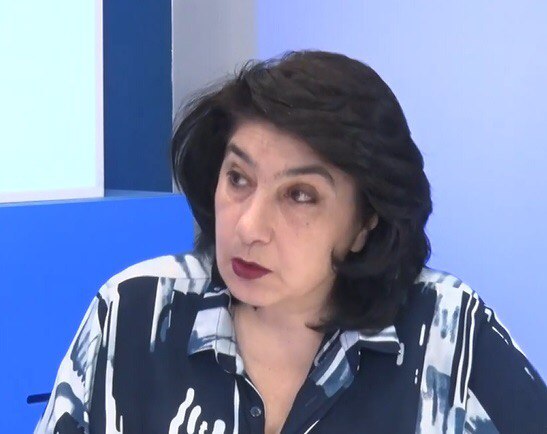
Dziunik Aghajanian
Ms. Dziunik Aghajanian has served Armenia through the ranks of the Ministry of Foreign Affairs, and most recently as a diplomat, as Armenia’s Ambassador to such countries as the Netherlands, Malaysia, and Indonesia. She received her education at Yerevan State University, Columbia University in NY, and Uppsala University in Sweden.
Hosts
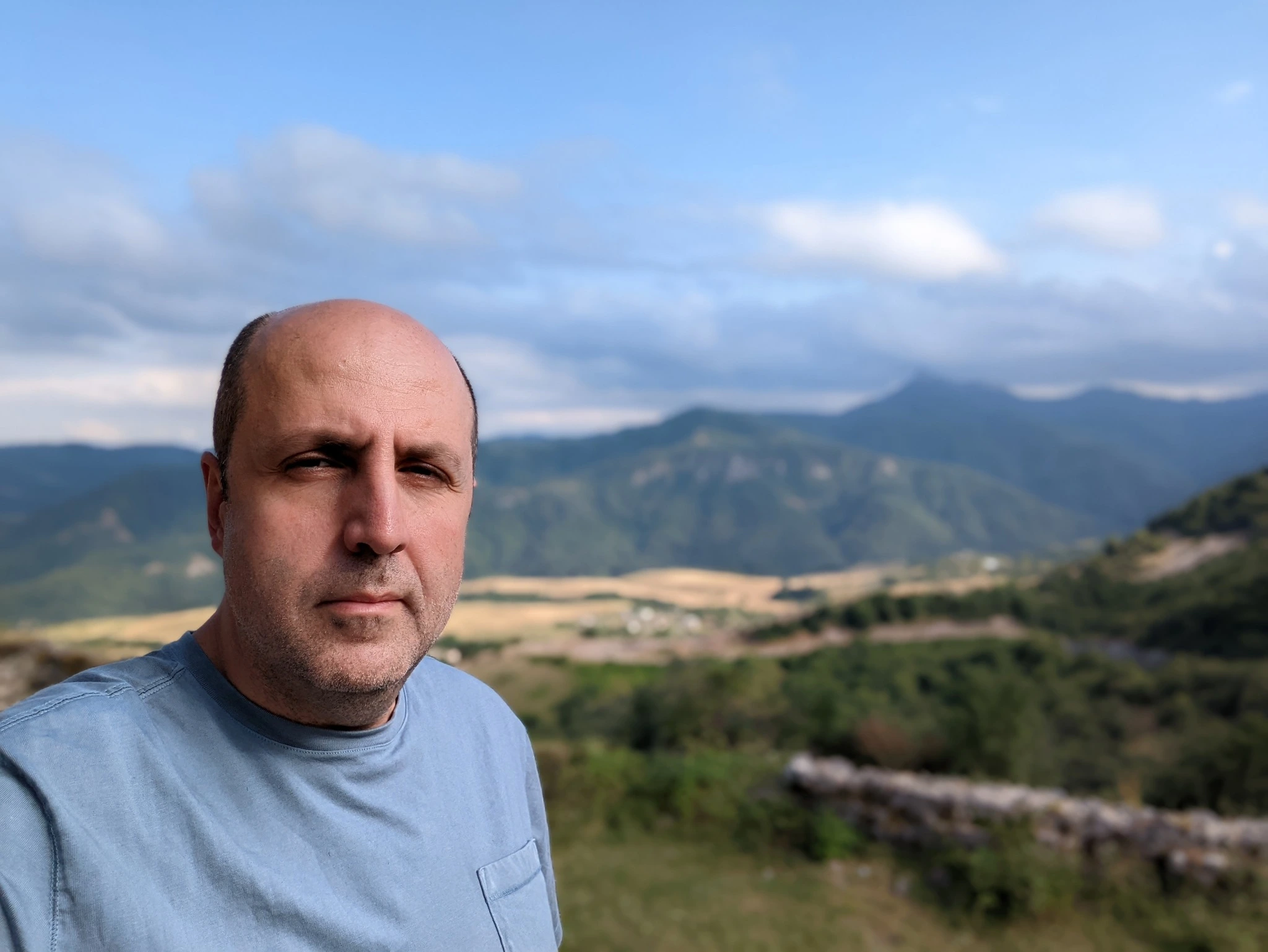
Hovik Manucharyan
Hovik Manucharyan is an information security engineer who moved from Seattle to Armenia in 2022. He co-founded the ANN/Groong podcast in 2020 and has been a contributor to Groong News since the late 1990s.
Disclaimer: The views expressed by Hovik Manucharyan on the ANN/Groong podcast are his own and do not necessarily reflect the opinions of his employer or any other organization.

Asbed Bedrossian
Asbed Bedrossian is an IT professional, and for years oversaw the central IT enterprise infrastructure and services at USC. His decades of experience spanned across IT strategy, enterprise architecture, infrastructure, cybersecurity, enterprise applications, data center operations, high performance computing, ITSM, ITPM, and more.
Asbed founded the Armenian News Network Groong circa 1989/1990, and co-founded the ANN/Groong podcast in 2020.