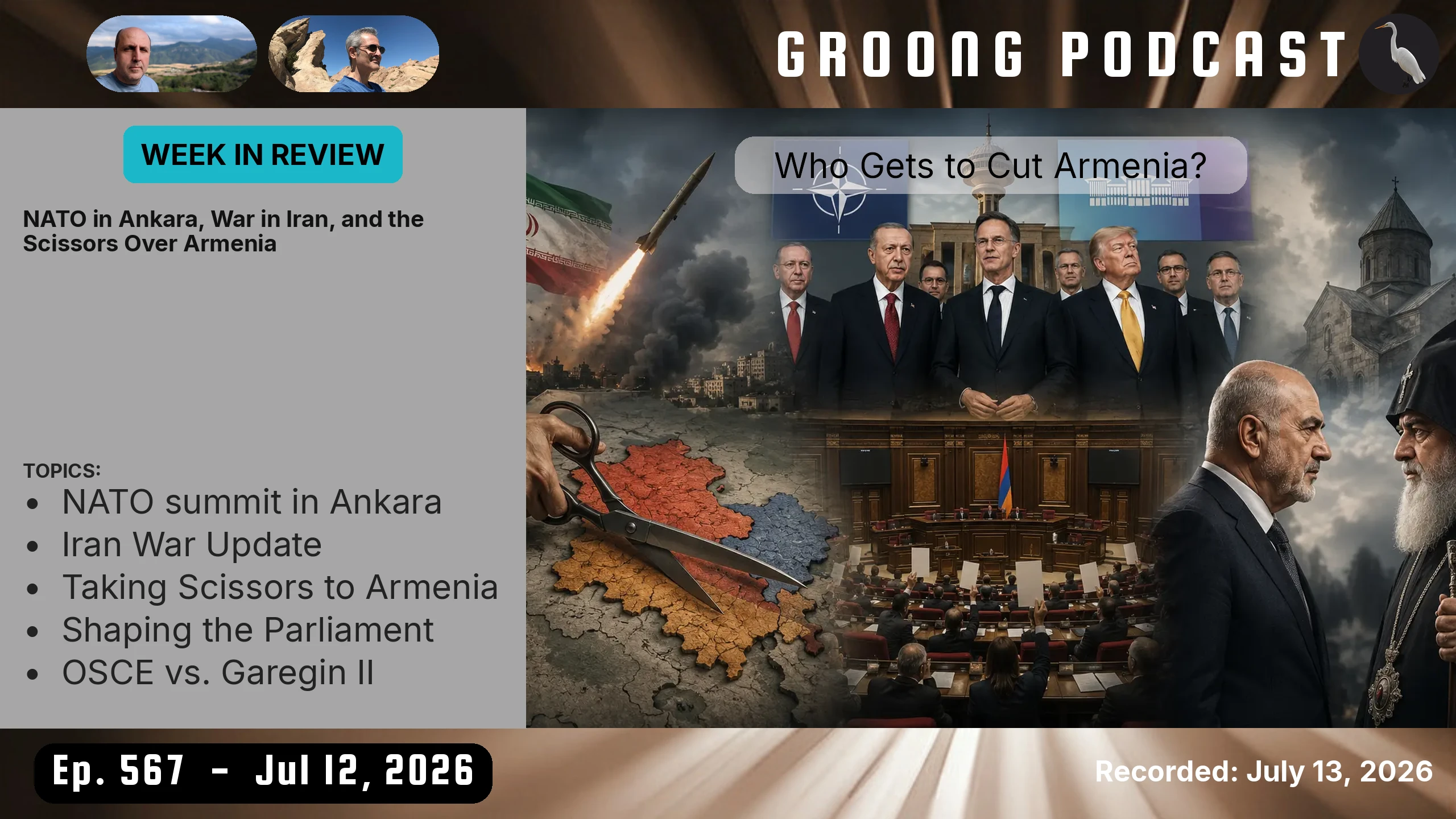
Gandzasar Erasure, Chips for Territory, Russian Money & Pashinyan in Space | Ep 585, Sep 13, 2026 [EP585]
Posted on Wednesday, Sep 16, 2026 | Category: Armenia, Politics, Geopolitics | Series: wir, video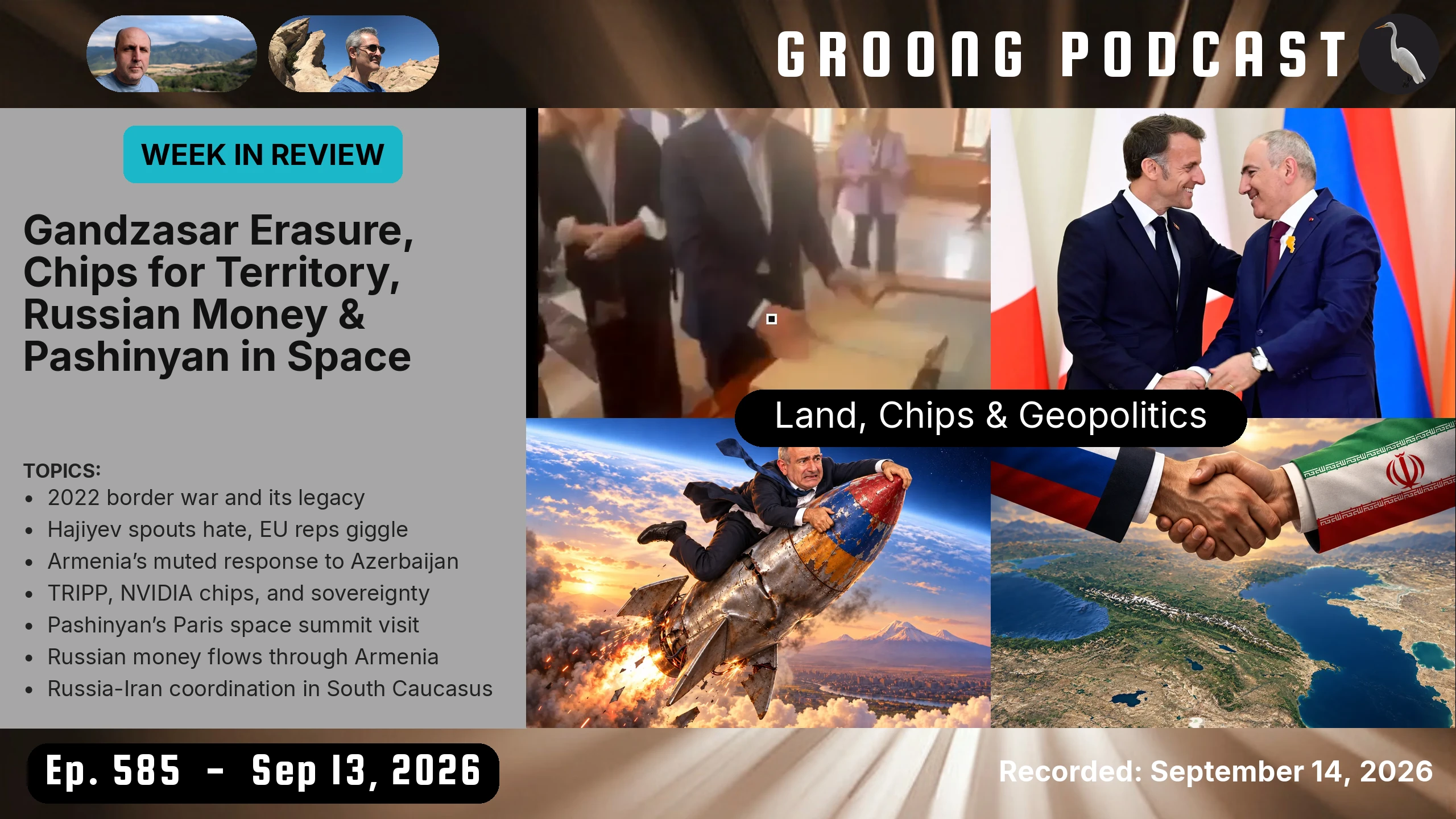
Groong Links:
Topics:
- 2022 border war and its legacy
- Hajiyev spouts hate, EU reps giggle
- Armenia’s muted response to Azerbaijan
- TRIPP, NVIDIA chips, and sovereignty
- Pashinyan’s Paris space summit visit
- Russian money flows through Armenia
- Russia-Iran coordination in South Caucasus
- Political prosecutions and Grigoryan reshuffle
Episode 585 | Recorded: September 14, 2026
#Armenia #Artsakh #Gandzasar #TRIPP #SouthCaucasus #Azerbaijan #Russia #Iran
Show Notes
Summary
In this Groong Week in Review episode, Hovik and Asbed examine the fourth anniversary of the September 2022 border war, Azerbaijan’s ongoing occupation of Armenian territory, and Pashinyan’s political trajectory toward recognizing Artsakh’s loss. We discuss Hajiyev’s inflammatory rhetoric, Armenia’s muted diplomatic response, TRIPP and semiconductor sovereignty, Pashinyan’s attendance at a Paris space summit, Russian financial flows through Armenia, and Russia-Iran coordination in the South Caucasus.Show Notes
In this Week in Review, Hovik Manucharyan and Asbed Bedrossian revisit the September 2022 Azerbaijani attack on Armenia and its place in the political trajectory that led to Yerevan’s recognition of Azerbaijan’s territorial integrity. They examine Azerbaijan’s diplomatic tour of Artsakh , where Hikmet Hajiyev presented Gandzasar through a revisionist “Caucasian Albanian” narrative while foreign diplomats looked on, and discuss the Armenian government’s muted response and the EU’s framing of competing historical “narratives.” The hosts also look at reporting that U.S. authorization of NVIDIA AI chips was used as leverage in the TRIPP negotiations, Pashinyan ’s trip to the Paris Space Summit and meeting with Emmanuel Macron , the surge of Russia-linked financial flows through Armenia, growing Russia-Iran coordination in the South Caucasus, the unexplained dismissal of Armen Grigoryan, and recent cases involving political detention and prosecution.
Topics This Week
Fourth anniversary of the September 2022 war The hosts recall Azerbaijan’s September 13, 2022 attack on Armenia, Armenian military casualties, alleged war crimes against Armenian servicemen and women, and Azerbaijani forces’ continued control of Armenian territory. They connect the attack to Pashinyan’s September 14 parliamentary remarks and the October 2022 Prague declaration recognizing territorial integrity under the Alma-Ata framework.
Gandzasar, Hajiyev and cultural erasure Hikmet Hajiyev presents Gandzasar and Dadivank as “Caucasian Albanian” during a large diplomatic tour of Artsakh, disputes the Armenian identity of Hasan Jalalyan, and mocks a museum reproduction of an Armenian manuscript. The hosts place the episode in the wider context of demolished churches, cemeteries, memorials, and Azerbaijani efforts to reclassify Armenian heritage.
EU diplomats, Magdalena Grono and Yerevan’s response The hosts criticize the reaction of foreign diplomats during Hajiyev’s presentation and examine EU Special Representative Magdalena Grono’s later reference to “deeply diverging views and narratives.” They argue that Yerevan’s response, including Ruben Rubinyan calling the claims merely “baseless” and “not useful,” fell far short of an unequivocal condemnation.
NVIDIA chips and the TRIPP bargain A Wall Street Journal report is discussed in which U.S. authorization of advanced NVIDIA chips for Armenia is linked to negotiations over the TRIPP /Zangezur Corridor . The hosts question the strategic value and durability of the chip access compared with the long-term geopolitical significance of the corridor arrangement.
Pashinyan’s Paris “space” visit Armenia’s small and currently inactive satellite presence prompts questions about why Pashinyan personally attended the International Space Summit. The hosts focus instead on his bilateral meeting with Emmanuel Macron, where strategic partnership, economic diversification, infrastructure, regional affairs, peace, and only then space cooperation were discussed.
Foreign money flooding through Armenia Roughly $900 million entered Armenian individual bank accounts from abroad in July, with Russia accounting for about three-quarters. The hosts discuss Armenia’s emerging role as a financial junction for Russia-connected capital, including investment, business settlements, trade, re-exports and onward flows, while also considering the benefits and sanctions, banking, currency and geopolitical risks.
Russia-Iran coordination in the South Caucasus Russian Deputy Foreign Minister Mikhail Galuzin and Iranian Deputy Foreign Minister Mehdi Sobhani discuss the South Caucasus, the 3+3 platform and infrastructure connectivity. The hosts consider whether closer Moscow-Tehran coordination could affect TRIPP, Syunik and the future regional balance.
Armen Grigoryan reshuffle and political prosecutions The hosts examine the still-unexplained dismissal of Armen Grigoryan and his replacement by Alen Simonyan , reviewing the timeline around the election, Hikmet Hajiyev’s June visit, Simonyan’s parliamentary exit, Grigoryan’s August dismissal and the September Hajiyev-Simonyan meeting. They close with Gagik Tsarukyan’s extended detention and the termination of the criminal case against analyst Alen Ghevondyan.
Key Questions Discussed
- Why should the September 2022 war remain part of Armenia’s public memory?
- Was September 2022 part of the political sequence that culminated in the Prague declaration?
- Does Azerbaijan’s presentation of Gandzasar reflect an isolated historical dispute or a broader policy of cultural erasure?
- What does the reaction of foreign diplomats say about international normalization of Azerbaijani revisionism?
- Why did Armenia not issue a stronger state-level condemnation?
- Is the EU’s “diverging narratives” language creating false equivalence between documented history and state revisionism?
- Is Azerbaijani conduct compatible with Pashinyan’s description of a “durable and dignified peace”?
- What did Armenia receive in exchange for accepting the TRIPP framework, and how durable is access to advanced U.S. AI technology?
- Was Pashinyan’s Paris visit really about space, or primarily about foreign policy and his meeting with Macron?
- How much of the enormous Russia-linked financial flow remains in Armenia, and how much simply passes through?
- What risks would Armenia face if sanctions, Russian capital controls or deteriorating Armenia-Russia relations disrupted those flows?
- Does growing Russia-Iran coordination signal a joint effort to influence TRIPP and regional infrastructure?
- Why was Armen Grigoryan abruptly removed after eight years, and was the decision driven by internal politics or outside geopolitical pressure?
- Are pretrial detention and broad national-security charges being used to pressure critics and opposition figures?
Referenced Articles & Sources
September 2022 War
- Pashinyan issues contradictory statements on new agreement with Azerbaijan, Armenian Weekly
- Pashinyan falsely claims former leaders recognized Artsakh as part of Azerbaijan, Armenian Weekly
Gandzasar and Azerbaijani Historical Revisionism
- EU Special Representative post on the Artsakh visit
- Azerbaijani Official Mocks Armenian Christian Heritage at Gandzasar, The Armenian Report
- Azatutyun coverage
- Armenpress coverage
NVIDIA Chips and TRIPP
- Vzglyad coverage
- U.S. Used Promise of Nvidia Chips to Broker Armenia-Azerbaijan Peace Deal, Wall Street Journal
- Hovik’s interview with AlphaNews on AI
Pashinyan in Paris
- Pashinyan addresses International Space Summit
- Pashinyan-Macron meeting
- Armenpress coverage
- Pashinyan announces Paris visit
- 168.am coverage
Foreign Financial Flows
Russia-Iran Coordination
- Alpha News post on a Russia-Iran coordination center
- Golos Armenii: Russia may create problems for TRIPP implementation
- News.am coverage
Armen Grigoryan Reshuffle
Political Detentions and Prosecutions
Wrap-up
Links and Resources
That’s our show , we hope you found it helpful. We invite your feedback and your suggestions, you can find us on most social media and podcast platforms.
Thanks to Laura Osborn for the music on our podcasts.
Hosts
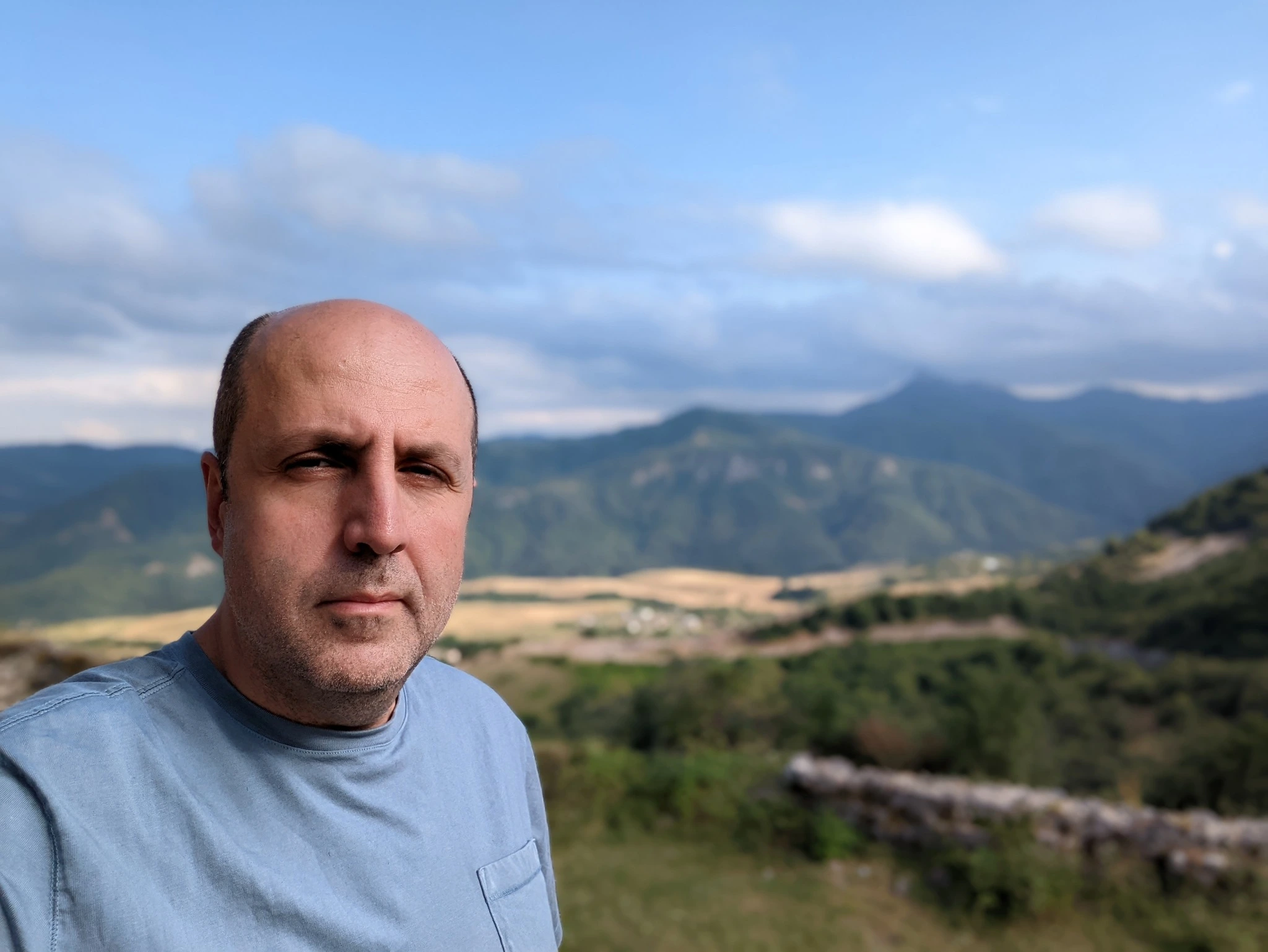
Hovik Manucharyan
Hovik Manucharyan is an information security engineer who moved from Seattle to Armenia in 2022. He co-founded the ANN/Groong podcast in 2020 and has been a contributor to Groong News since the late 1990s.
Disclaimer: The views expressed by Hovik Manucharyan on the ANN/Groong podcast are his own and do not necessarily reflect the opinions of his employer or any other organization.
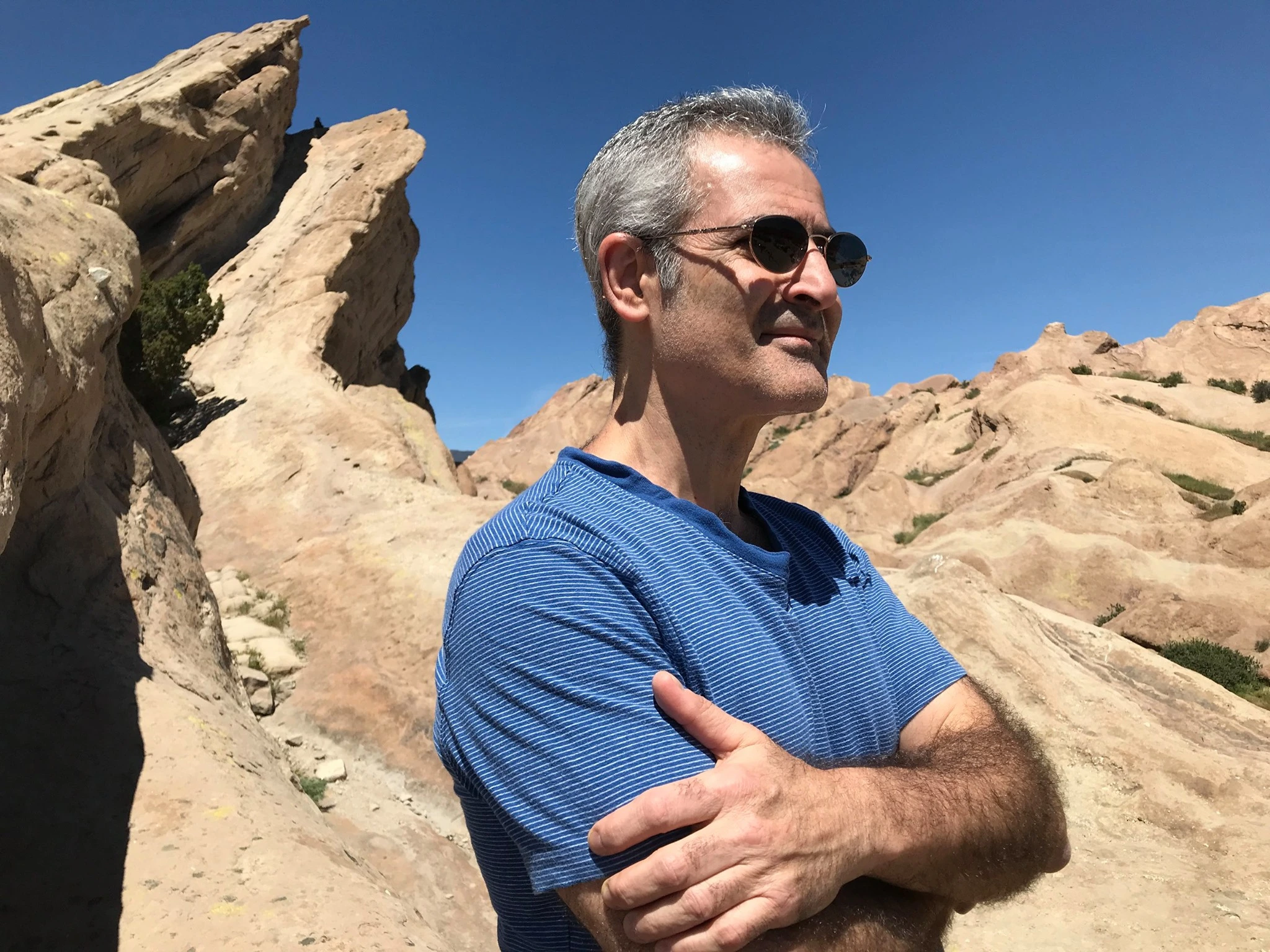
Asbed Bedrossian
Asbed Bedrossian is an IT professional, and for years oversaw the central IT enterprise infrastructure and services at USC. His decades of experience spanned across IT strategy, enterprise architecture, infrastructure, cybersecurity, enterprise applications, data center operations, high performance computing, ITSM, ITPM, and more.
Asbed founded the Armenian News Network Groong circa 1989/1990, and co-founded the ANN/Groong podcast in 2020.