Suren Sargsyan - Central Asia, TRIPP, Iran, and Armenia in the New Great Game | Ep 583, Sep 5, 2026 [EP583]
Posted on Saturday, Sep 5, 2026 | Category: Armenia, Geopolitics | Series: cog, video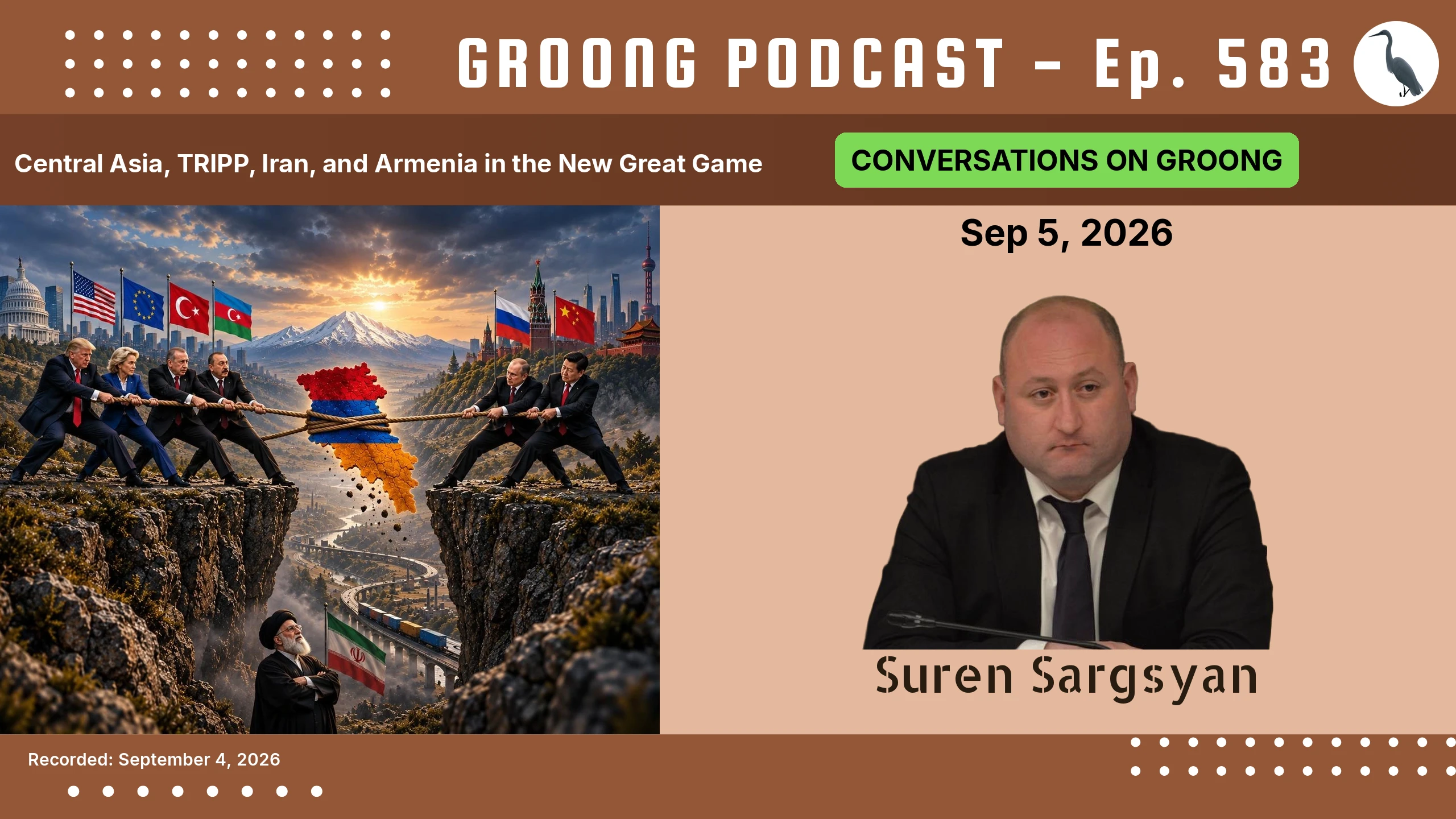
Groong Links:
Guest(s):
Topics:
- U.S. objectives in the Iran war
- Russia’s 102nd base in Armenia
- Pashinyan’s sovereignty policy contradictions
- Great-power rivalry across Central Asia
- U.S. and EU interests in TRIPP
- Armenia’s place in Eurasian competition
Episode 583 | Recorded: Sep 4, 2026
#Armenia #IranWar #TRIPP #CentralAsia #Russia #UnitedStates #Geopolitics #SouthCaucasus
Show Notes
Summary
In this episode of Conversations on Groong, we speak with Suren Sargsyan about the Iran War and great power competition for Armenia’s strategic position. We discuss Washington’s unclear endgame in the conflict with Iran, the future of Russia’s military presence in Armenia and CSTO membership, and competing U.S. and European interests in new east-west transit routes through Armenia and Central Asia amid broader geopolitical rivalries.Topics Covered
Iran War and Washington’s Endgame
- Renewed U.S.-Iran military exchanges after a month-long lull.
- Whether the Trump administration has a clear strategy or exit plan for the war.
- The gap between claims that Iran has been militarily defeated and Iran’s continuing ability to retaliate.
- The possible effect of U.S. domestic politics and the 2026 midterm elections on Washington’s decisions.
- Whether regime change remains a realistic U.S. objective.
- What an achievable definition of U.S. victory might look like.
Russia’s 102nd Military Base in Armenia
- Putin and Pashinyan ’s unusual public exchange over the future of the Russian base in Gyumri.
- Why neither Moscow nor Yerevan appears willing to take responsibility for deciding whether the base stays or leaves.
- Suren’s view that the base currently carries greater strategic value for Russia because of its location near NATO member Turkey.
- Armenia’s effort to avoid choosing outright between Russia and the West.
- The contradiction between strong anti-Russian rhetoric and Armenia’s continued participation in the CSTO and Eurasian Economic Union , along with the continued Russian military and border presence.
- Whether Pashinyan can maintain this ambiguous posture as pressure grows from both sides.
- The possibility that Russia may push for a referendum on Armenia’s future relationship with Russian-led institutions.
Nuclear Energy and Armenia-Russia Negotiations
- What may be discussed at a future Putin-Pashinyan meeting in Russia.
- Russia’s possible role in building or operating Armenia’s next nuclear power plant.
- U.S.-backed small modular reactors as another possible option.
- Questions over the maturity, safety, and readiness of SMR technology.
- How nuclear energy could become part of a broader geopolitical negotiation involving Russia, the United States, Turkey, and Azerbaijan.
Russia, Iran, and the South Caucasus
- Whether a weakened or distracted Russia could increasingly rely on Iran to protect overlapping interests in the South Caucasus .
- The limits on Iran’s ability to replace Russia as the dominant regional power.
- Iran’s need to balance Turkey and Azerbaijan while fighting a wider confrontation with the United States.
- Russia’s interest in preserving even weakened positions rather than surrendering them to another power.
- The wider struggle involving Russia, Iran, Turkey, Azerbaijan, China, the EU, and the United States.
The Battle for Central Asia
- Central Asia as a major arena of competition among Russia, China, the United States, Europe, and Turkey.
- Differences between current U.S. and EU priorities in the region.
- U.S. interest in Central Asian oil, gas, minerals, and strategic resources.
- China’s large economic footprint and demand for Central Asian resources.
- The role of transport infrastructure in controlling how those resources reach European markets.
- Turkey’s growing role through its own regional strategy and the Organization of Turkic States.
- Suren’s argument that Turkey often acts as an independent power rather than simply as a Western proxy.
TRIPP and the Middle Corridor
- TRIPP ’s place within the larger east-west Middle Corridor connecting Central Asia to Europe.
- Why a short route through southern Armenia has attracted intense interest from major powers.
- The U.S. role in spearheading the current TRIPP framework.
- European interest in routes that bypass Russia.
- Pashinyan’s promotion of TRIPP at the SCO summit in Bishkek.
- Senator Steve Daines and Konstantin Sokolov’s presence in Bishkek and their connections to the project.
- Suren’s view that Daines was not the originator of the corridor idea, which has roots going back to earlier Armenia-Azerbaijan negotiations and the Goble Plan.
- Steve Witkoff and his team as important figures in developing the current U.S. initiative.
- Sokolov’s Armenian business interests and his ability to communicate directly with senior U.S. officials.
- TRIPP as a possible first sustained U.S. strategic presence in the South Caucasus.
- Why Suren considers Washington a larger strategic beneficiary of TRIPP than Brussels.
Russian Railways, Iran, and TRIPP’s Plan B
- Russia’s concession over Armenia’s railway system and its importance to any functioning east-west rail corridor.
- Russian claims of roughly $400 million in railway investments and the question of whether that investment could become Russia’s stake in TRIPP.
- Whether Washington and Moscow, rather than Yerevan and Baku, may ultimately decide Russia’s role in the project.
- Iran’s opposition to a major American strategic presence close to its northern border.
- Iran’s loss of its previous role as the main connection between Azerbaijan and Nakhichevan.
- Possible alternatives if TRIPP fails, including renewed Azerbaijani demands for a Zangezur Corridor or Russian efforts to invoke the November 9 arrangements.
- Suren’s concern that Armenia has no clear Plan B if the U.S.-backed project does not survive.
- Whether Iran could eventually participate in regional connectivity if U.S.-Iran relations improve.
Key Questions Discussed
- What is Washington actually trying to achieve in the Iran war ?
- Does the Trump administration have an exit strategy?
- What would U.S. victory over Iran mean in practical terms?
- Why are Putin and Pashinyan both avoiding a clear decision on the 102nd Russian Military Base?
- Who needs the Russian base more today, Armenia or Russia?
- Can Armenia avoid choosing between Russia and the West?
- What might Putin and Pashinyan negotiate at their next meeting?
- Could Russia increasingly rely on Iran to protect its South Caucasus interests?
- What does the United States want from Central Asia?
- Are U.S. and EU interests in Central Asia aligned or increasingly different?
- Is Turkey acting as a Western proxy or pursuing its own independent strategy?
- Who developed the current TRIPP proposal, and what roles did Steve Daines, Steve Witkoff, and Konstantin Sokolov play?
- Does TRIPP give Washington a strategic foothold in the South Caucasus?
- Who benefits more from TRIPP, the United States or the European Union?
- How would Russian control of Armenia’s railways affect TRIPP?
- What happens if TRIPP fails?
- Does Armenia have a viable Plan B?
- Could Iran eventually benefit from or participate in the project?
Links Referenced During The Show
- Day 185: U.S. and Iran Trade Strikes for First Time in Month
- Day 186: Trump Rules Out Using Nukes Against Iran
- Day 188: Iran Launches More Retaliatory Strikes, Defying Trump
- Pashinyan on Russian Military Base and Nuclear Power Plant Options
- Discussion of U.S. Small Modular Reactors for Armenia
- Pashinyan Meeting with Steve Daines and Konstantin Sokolov in Bishkek
Wrap-up
Links and Resources
That’s our show , we hope you found it helpful. We invite your feedback and your suggestions, you can find us on most social media and podcast platforms.
Thanks to Laura Osborn for the music on our podcasts.
Guests
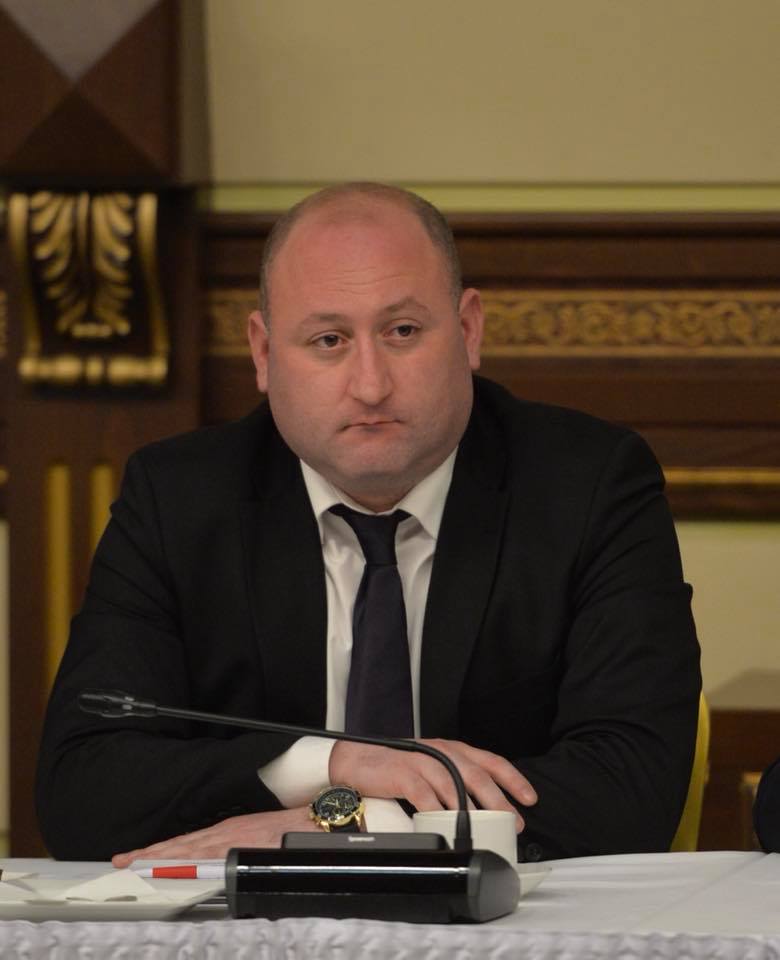
Suren Sargsyan
Suren Sargsyan is the founder and President at the Armenian Center for American Studies, a research center based in Yerevan.
Hosts
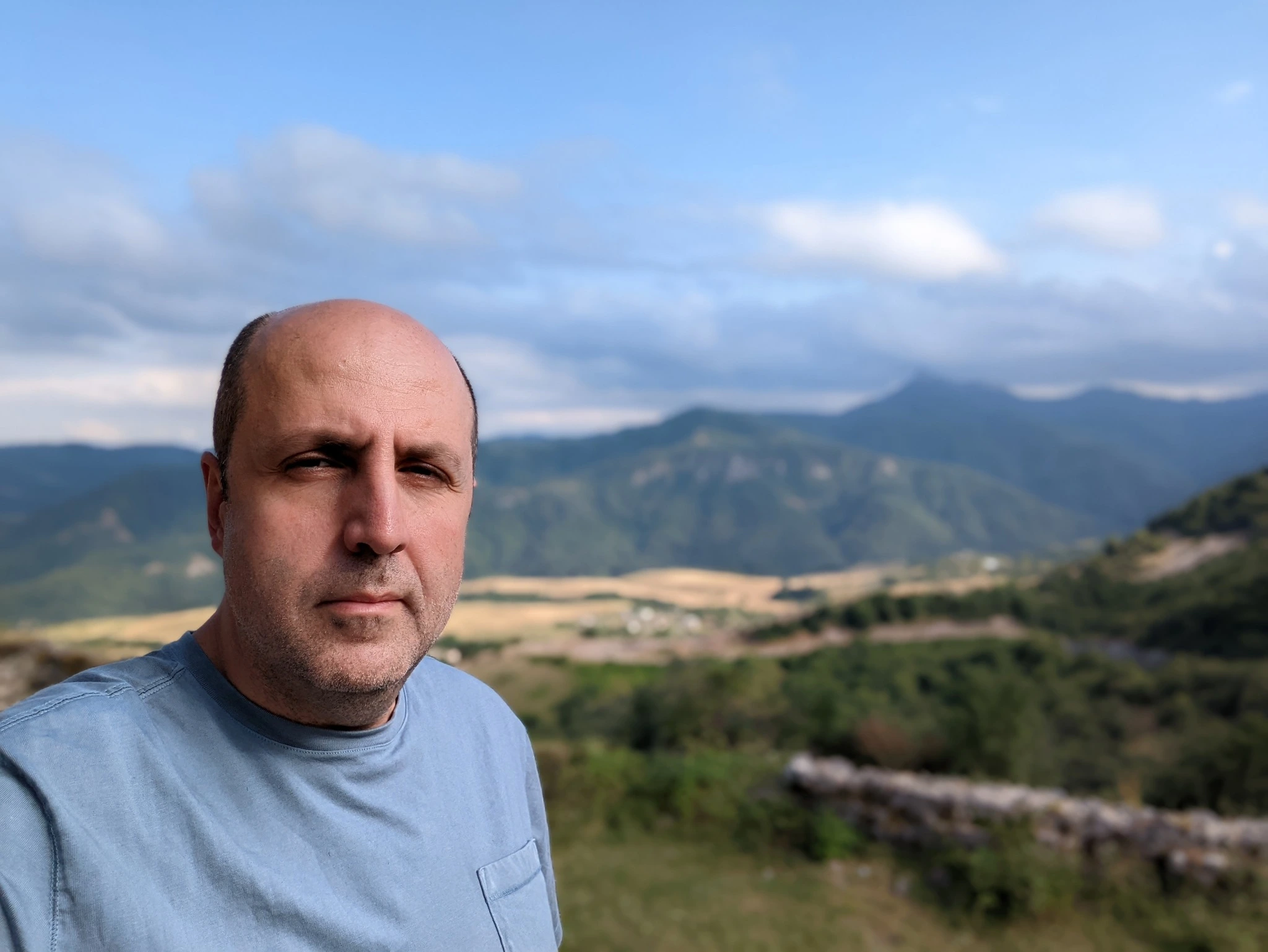
Hovik Manucharyan
Hovik Manucharyan is an information security engineer who moved from Seattle to Armenia in 2022. He co-founded the ANN/Groong podcast in 2020 and has been a contributor to Groong News since the late 1990s.
Disclaimer: The views expressed by Hovik Manucharyan on the ANN/Groong podcast are his own and do not necessarily reflect the opinions of his employer or any other organization.

Asbed Bedrossian
Asbed Bedrossian is an IT professional, and for years oversaw the central IT enterprise infrastructure and services at USC. His decades of experience spanned across IT strategy, enterprise architecture, infrastructure, cybersecurity, enterprise applications, data center operations, high performance computing, ITSM, ITPM, and more.
Asbed founded the Armenian News Network Groong circa 1989/1990, and co-founded the ANN/Groong podcast in 2020.
Related Episodes

Clips from this episode
 Trump Has No Exit Strategy in Iran War
 Armenia Has No Plan B if TRIPP Fails
 Why Putin and Pashinyan Both Avoid Deciding on Russian Military Base
 Why Russia Might Outsource South Caucasus Control to Iran
 TRIPP: Who Developed the Corridor Deal and Why Steve Witkoff Matters
 Can Armenia Avoid Choosing Sides Between Russia and the West?