Richard Campbell - The AI Infrastructure Race and Armenia’s High-Stakes Bet | Ep 577, Aug 16, 2026 [EP577]
Posted on Sunday, Aug 16, 2026 | Category: Armenia, Geopolitics, Technology | Series: cog, video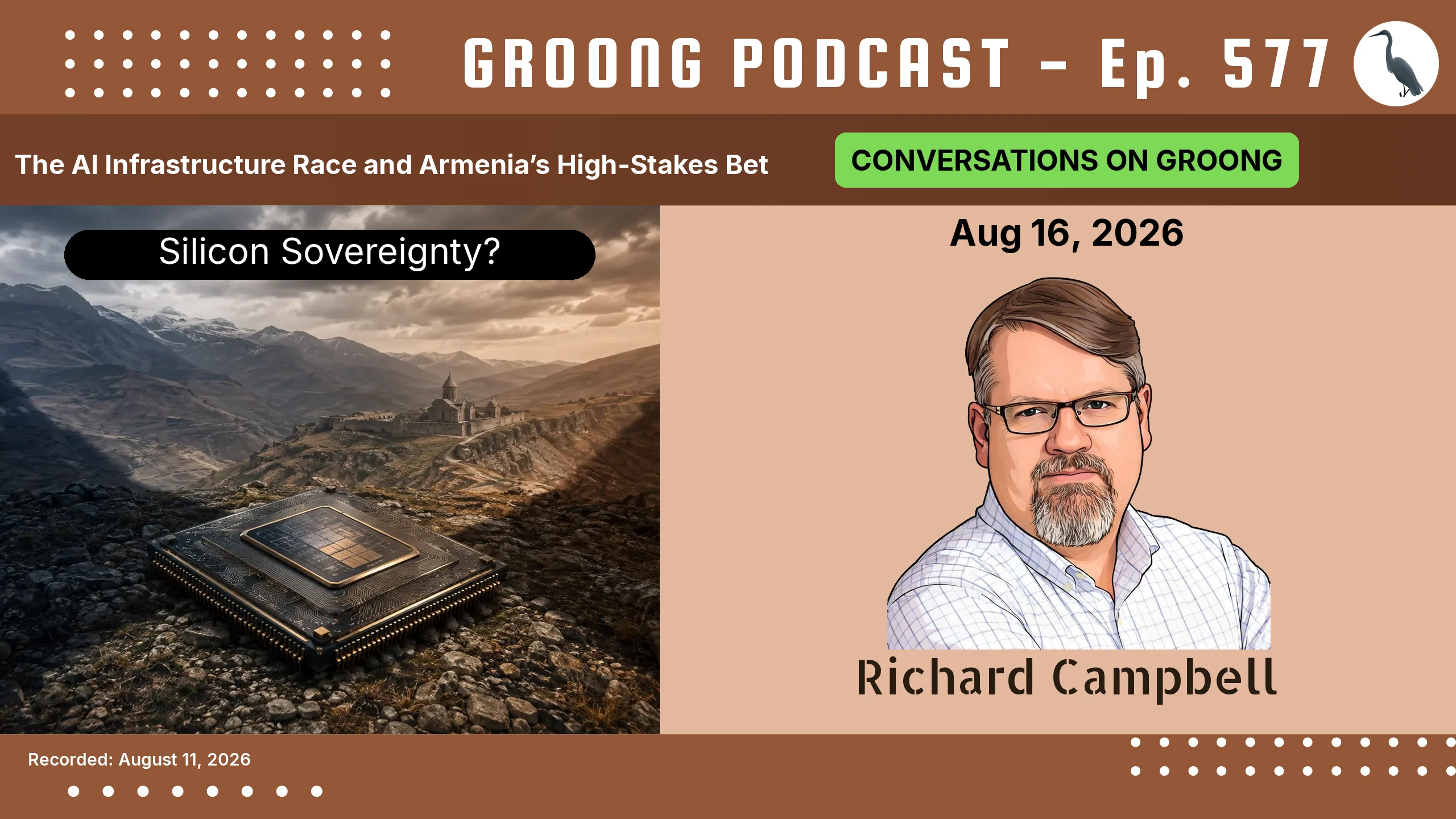
Groong Links:
Guest(s):
Topics:
- Global AI race and hype
- Economics of AI data centers
- Energy limits and infrastructure demands
- Armenia’s Firebird AI project
- Jobs, innovation, and local benefits
- AI sovereignty and export controls
- Military value and security risks
Episode 577 | Recorded: August 11, 2026
#ArtificialIntelligence #Armenia #FirebirdAI #AIDataCenters #SovereignAI #EnergySecurity #TechGeopolitics #NationalSecurity
Show Notes
Summary
In this episode of Conversations on Groong, we speak with Richard Campbell about artificial intelligence infrastructure and Armenia’s Firebird project. We discuss the global AI race, the economics and energy demands of data centers, whether current AI valuations align with physical and economic realities, and what sovereign AI capacity means for Armenia’s strategic positioning.Topics Covered
- The AI boom, AGI, and the hype cycle
- U.S.-China competition in AI and energy
- Physical limits of large data centers
- Economics and depreciation of AI hardware
- Local models versus frontier AI
- AI sovereignty for smaller countries
- Armenia’s Firebird AI project
- Firebird’s 300 MW expansion ambitions
- Armenia’s electricity and cooling requirements
- Hrazdan and Armenia’s existing power infrastructure
- Metsamor and Armenia’s nuclear future
- Large reactors versus small modular reactors
- Data-center jobs and the local technology ecosystem
- Armenia’s fiber connectivity and regional links
- U.S. export controls and technological dependence
- AI compute and possible defense applications
- Data centers as strategic infrastructure
- Firebird as a possible catalyst for Armenia
Key Questions Discussed
Is the current AI race comparable to a Manhattan Project, or is the push toward AGI driven in part by hype and investment incentives?
If AI clusters continue growing, will the main constraints be GPUs, electricity generation, transmission, cooling, construction, or connectivity?
Does China’s ability to expand industrial and energy capacity give it an advantage over the United States?
What does a profitable modern data center actually look like once power costs, hardware replacement, utilization, and depreciation are included?
As AI services move toward real per-token pricing, which workloads will remain in large cloud models and which will move to smaller or local models?
For a smaller country, what does AI sovereignty mean? Is it about owning GPUs, or about maintaining data, talent, infrastructure, software, and the skills needed during a crisis?
Does Firebird’s planned scale make sense for Armenia, and can the project expand without creating pressure on the country’s existing electricity supply?
Should a large data-center operator be responsible for developing its own power generation rather than relying on the existing grid?
What mix of solar, natural gas, nuclear power, and other generation could support Armenia’s future electricity needs?
What should Armenia do about Metsamor as the existing reactor ages, and how should it weigh proven large reactors against still-developing small modular reactor designs?
How should Armenia regulate water use and cooling so that a large data center does not compete unfairly with households and other users?
What advantage does having compute physically located in Armenia provide if Armenian companies can already purchase cloud resources elsewhere?
How many permanent jobs does a data center itself create, and can Firebird instead act as a catalyst for universities, startups, construction, research, and new technology companies?
Could Armenia’s landlocked position make connectivity a bottleneck, or could new fiber routes turn the country into a regional data crossroads?
How much technological sovereignty does Armenia gain if Firebird relies on U.S.-controlled hardware, software, upgrades, and export approvals?
Can Firebird’s resources be used for Armenian defense needs, or will U.S. export rules limit sensitive military applications?
Does hosting strategic computing infrastructure make Armenia safer by increasing its value to partners and neighbors, or does it create another high-value target?
If Campbell were advising Armenia, what would he prioritize? His central answer is to treat Firebird as an infrastructure and human-capital project, not merely as a data center.
Links Referenced During The Show
Global AI Race and Data Center Economics
Leopold Aschenbrenner, Situational Awareness: The Decade Ahead https://situational-awareness.ai/wp-content/uploads/2024/06/situationalawareness.pdf
Richard Campbell, After the AI Hype: What’s Real, and What’s Next https://www.youtube.com/watch?v=uWnUnMphmPM
Big Tech’s estimated $650 billion AI infrastructure spending in 2026 https://www.bloomberg.com/news/articles/2026-02-06/how-much-is-big-tech-spending-on-ai-computing-a-staggering-650-billion-in-2026
There’s a Stunning Financial Problem With AI Data Centers https://futurism.com/future-society/ai-data-centers-finances
AI’s Economic Winners, Council on Foreign Relations https://www.cfr.org/articles/ais-economic-winners
Warwick Powell on Iran, AI, and Thermoeconomic Power, Groong Ep. 533 https://youtu.be/8upbRV0lzjE
Richard Campbell on Infrastructure
The Undersea Cable Network, Richard Campbell https://www.youtube.com/watch?v=RMveiKaXtQw
Above the Cloud: Building Data Centers in Space, Richard Campbell https://www.youtube.com/watch?v=F0OqVvWdY7c
Armenia and Firebird
Firebird Launches CIS Region’s Largest AI Factory in Armenia, NVIDIA https://blogs.nvidia.com/blog/firebird-ai-factory-armenia-blackwell-rubin-dsx/
Firebird launches AI factory in Armenia with 300 MW expansion plans https://w.media/firebird-launches-ai-factory-in-armenia-with-300-mw-expansion-plans/
Armenia’s reported $25 million commitment to Firebird compute https://news.am/en/news/1050130
Jobs, Energy, Water, and Environment
Data center subsidies and permanent employment concerns https://futurism.com/artificial-intelligence/orangeburg-data-center-tax-subsidy
Singapore’s Data Center Strategy: Water Scarcity and Coordinated Capital https://www.aseanrising.com/articles/singapore-s-next-data-center-evolution-coordinated-capital-and-water-scarcity-o588r
AI Data Centers Are Causing Unfathomable Amounts of Air Pollution https://futurism.com/future-society/ai-data-centers-air-pollution-generators-worse
AI Sovereignty, Export Controls, and Security
U.S. Framework for Artificial Intelligence Diffusion https://www.federalregister.gov/documents/2025/01/15/2025-00636/framework-for-artificial-intelligence-diffusion
RAND: Understanding the Artificial Intelligence Diffusion Framework https://www.rand.org/pubs/perspectives/PEA3776-1.html
U.S. Commerce Department, Validated End User Program for Data Centers https://www.bis.gov/press-release/commerce-updates-validated-end-user-veu-program-eligible-data-centers-bolster-u.s.-national-security
Brookings: National Security Implications of Building Frontier AI Data Centers Overseas https://www.brookings.edu/articles/the-national-security-implications-of-building-frontier-ai-data-centers-overseas/
Pax Silica https://www.state.gov/pax-silica
Wrap-up
Links and Resources
That’s our show , we hope you found it helpful. We invite your feedback and your suggestions, you can find us on most social media and podcast platforms.
Thanks to Laura Osborn for the music on our podcasts.
Guests

Richard Campbell
Richard Campbell has been playing with computers since the 1970s. He has done almost every job you can think of in computing, including manufacturing, sales, software development, helping to scale websites during the DotComBoom, and teaching software development all over the world.
Along the way, he has been a part of several different technology companies: He was one of the founders of Strangeloop Networks, acquired by Radware in 2013, and a board member of Telerik, which Progress Software acquired in 2014. He makes the podcasts .NET Rocks, RunAs Radio, and a special series called the Geek Outs, where he explores science subjects, including space and the energy revolution. He has been a keynote speaker and guest lecturer at conferences worldwide, including a lecture on building bases on the Moon for NASA Ames in California.
Today Richard serves as the chairperson of Cloud Army, a consumer neuroscience company, as well as chair of the Humanitarian Toolbox, a charity focused on building open-source software for disaster relief and preparedness.
Hosts

Hovik Manucharyan
Hovik Manucharyan is an information security engineer who moved from Seattle to Armenia in 2022. He co-founded the ANN/Groong podcast in 2020 and has been a contributor to Groong News since the late 1990s.
Disclaimer: The views expressed by Hovik Manucharyan on the ANN/Groong podcast are his own and do not necessarily reflect the opinions of his employer or any other organization.

Asbed Bedrossian
Asbed Bedrossian is an IT professional, and for years oversaw the central IT enterprise infrastructure and services at USC. His decades of experience spanned across IT strategy, enterprise architecture, infrastructure, cybersecurity, enterprise applications, data center operations, high performance computing, ITSM, ITPM, and more.
Asbed founded the Armenian News Network Groong circa 1989/1990, and co-founded the ANN/Groong podcast in 2020.



Clips from this episode
 Why the AI Race Isn't a Manhattan Project
 Armenia's Real Competitive Edge Isn't the Data Center-It's the Ecosystem Around It
 AI Data Centers Will Need Solar, Gas, and Maybe Nuclear-But Not in 2027
 Data Centers Don't Need Military Weapons to Create Value
 Invest in People, Not Just Machines-That's How You Build Real Technological Sovereignty
 Armenia Could Be a Data Bridge Connecting Its Neighbors-If It Chooses Peace