Tigranashen Unanswered, Russia’s Railways Challenged | Ep 574, Aug 2, 2026 [EP574]
Posted on Tuesday, Aug 4, 2026 | Category: Armenia, Politics, Geopolitics | Series: wir, video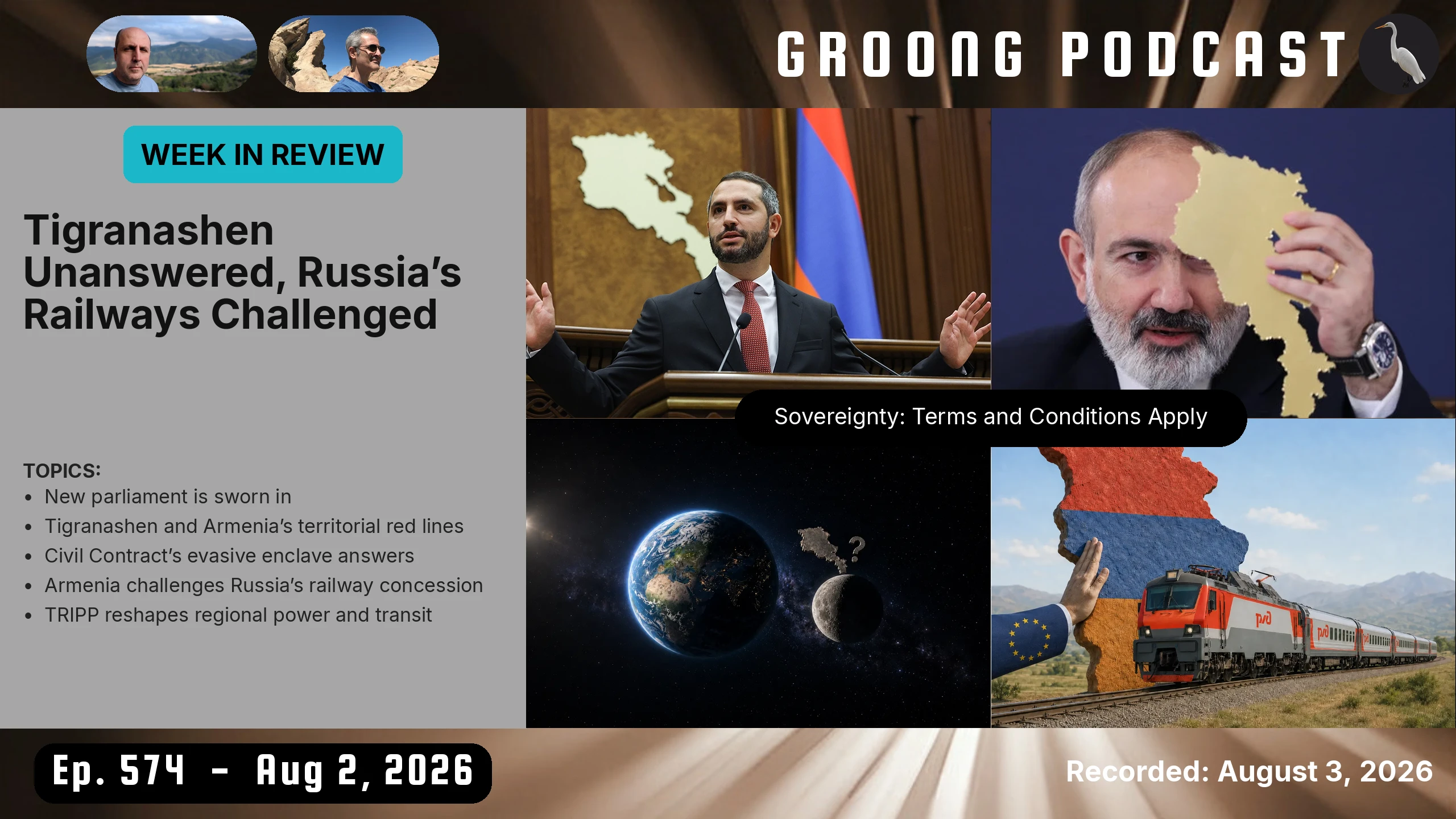
Groong Links:
Topics:
- New parliament is sworn in
- Tigranashen and Armenia’s territorial red lines
- Civil Contract’s evasive enclave answers
- Armenia challenges Russia’s railway concession
- TRIPP reshapes regional power and transit
Episode 574 | Recorded: August 3, 2026
#ArmenianNews #Tigranashen #ArmenianRailways #TRIPP #SouthCaucasus #ArmeniaRussia #ZangezurCorridor #Geopolitics
Show Notes
Summary
In this week’s Groong Week in Review, Hovik and Asbed discuss Armenia’s new parliament sworn in on August 2, 2026, and the Armenia Alliance’s direct challenge to Civil Contract over Tigranashen. We examine the government’s evasive responses on territorial red lines, Armenia’s challenge to Russia’s railway concession, and how TRIPP reshapes regional power dynamics in the South Caucasus.Topics This Week
Tigranashen and Armenia’s Undefined Borders
- Ruben Rubinyan becomes speaker of the Ninth National Assembly.
- Ishkhan Saghatelyan asks whether the government can guarantee that it will not surrender Tigranashen.
- Rubinyan cites Armenia’s internationally recognized area of 29,743 square kilometers.
- The government leaves open the possibility of territorial “optimization” through demarcation.
- The strategic importance of Tigranashen for Armenia’s north-south transportation and defense.
- The uncertainty over which maps and legal documents guide the border process.
- The government’s refusal to state clearly whether Tigranashen lies within the borders it recognizes.
- Opposition MPs take up their mandates while rejecting the June 7 election results.
- Former Groong guests enter the new parliament.
Armenia’s Conflict with Russian Railways
- The 30-year railway concession signed in 2008 and scheduled to run through 2038.
- Government threats of international arbitration and claims of Russian mismanagement.
- Proposals to buy out the concession or transfer railway management to another country.
- Russia’s claim that it invested hundreds of millions of dollars in Armenia’s rail system.
- The financial cost Armenia could face for ending the agreement early.
- The risk that Armenia may borrow more money to remove Russian control.
- The role of Kazakhstan, Qatar, and the United Arab Emirates as possible alternative managers.
- The connection between the railway dispute and Armenia’s Western pivot.
- EU investment in regional transport infrastructure and interest in TRIPP .
- Turkey and Azerbaijan’s interest in reducing Russian involvement in regional transit.
- The United States’ role in the proposed TRIPP arrangement.
- Russia’s claim to a role in regional transit under Point 9 of the November 2020 trilateral statement.
- Competing railway routes involving Yeraskh, Nakhichevan , Gyumri, Kars, and Syunik .
- The wider contest over who will control Armenia’s strategic infrastructure.
Key Questions Discussed
- Is Tigranashen included within the Armenian government’s stated 29,743 square kilometers?
- Why did Ruben Rubinyan avoid giving a direct answer?
- What does “optimization” of territory mean in the demarcation process?
- Which maps or legal documents are being used to define Armenia’s borders?
- Could transferring Tigranashen threaten Armenia’s north-south transport route and defensive position?
- Why has the railway concession become a major government issue now?
- Has Russian Railways mismanaged Armenia’s network, or is the dispute driven by geopolitics?
- How much would Armenia have to pay if it ended the concession before 2038?
- Would Armenia finance a railway buyout through new European loans?
- Does Armenia have the institutional capacity to manage its railway network itself?
- Which outside power is pushing hardest to remove Russia from Armenia’s rail system?
- How does control of the railway network affect TRIPP and transit through Syunik?
- Can the November 2020 trilateral statement coexist with the later US-backed transit plan?
- Are Armenia’s railway and transit policies serving Armenian interests or those of outside powers?
Groong Guests in the Ninth National Assembly
- Arthur Khachatryan , Armenia Alliance
- Anna Grigoryan , Armenia Alliance faction leader
- Arega Hovsepyan, Strong Armenia
- Aram Vardevanyan, Strong Armenia and deputy-speaker nominee
- Edgar Ghazaryan , Strong Armenia
Links Referenced During the Show
Tigranashen and the National Assembly
Special Groong episode on Border Demarcation Challenges: Armenia-Azerbaijan Border Demarcations
Armenpress report on the Rubinyan-Saghatelyan exchange: https://armenpress.am/en/article/1256969
168.am report on the exchange: https://168.am/2026/08/02/2458124.html
Armenia’s Railway Concession and Russia
IntelliNews, Armenia and Russia clash over railway concession: https://www.intellinews.com/armenia-and-russia-clash-over-railway-concession-458407/
Stratfor, Pashinyan raises arbitration threat over railway concession: https://worldview.stratfor.com/situation-report/armenia-russia-pashinyan-raises-arbitration-threat-over-russian-railway-concession
JAMnews, Armenia’s railways and ending the Russian concession: https://jam-news.net/armenias-railways-ending-the-russian-concession/
Asbarez, Pashinyan demands Russia cede control of railways: https://asbarez.com/pashinyan-demands-russia-cede-control-of-railways/
ARKA, Russian response to proposed additional railway payments: https://arka.am/en/news/economy/russia-has-called-armenia-s-possible-demands-for-additional-payments-on-the-south-caucasus-railway-g/
PanARMENIAN.Net report on the railway dispute: https://panarmenian.net/m/eng/news/335083
ARKA, Russia and arbitration over failed weapons supplies: https://arka.am/en/news/politics/zakharova_russia_welcomes_armenia_s_intention_to_resolve_the_issue_of_failed_weapons_supplies_throug/
Armenia News-Pravda report: https://armenia.news-pravda.com/en/russia/2026/07/30/38046.html
UA News report on Armenia’s response to the Russian trade conflict: https://ua.news/en/world/virmeniia-pidgotuvala-vidpovid-na-rosiisku-torgovelnu-viinu
TRIPP, the EU, and Regional Connectivity
Hague Research Institute, from Global Gateway to TRIPP: https://hagueresearch.org/from-the-global-gateway-to-the-tripp-how-the-eu-is-navigating-regional-connectivity-in-the-south-caucasus/
Indian Council of World Affairs analysis: https://www.icwa.in/show_content.php?lang=1&level=3&ls_id=14404&lid=8814
Steptoe, Armenia-Azerbaijan peace and infrastructure connectivity: https://www.steptoe.com/en/news-publications/stepwise-risk-outlook/unpacking-armenia-azerbaijan-peace-infrastructure-connectivity-at-the-center-of-us-diplomacy.html
European Relations, EU-Armenia summit and Western realignment: https://europeanrelations.com/briefing/first-eu-armenia-summit-yerevan-anchors-its-western-realignment/
SpecialEurasia, EU-Armenia summit and European companies: https://www.specialeurasia.com/2026/05/12/eu-armenia-summit-companies/
Wrap-up
Links and Resources
That’s our show , we hope you found it helpful. We invite your feedback and your suggestions, you can find us on most social media and podcast platforms.
Thanks to Laura Osborn for the music on our podcasts.
Hosts

Hovik Manucharyan
Hovik Manucharyan is an information security engineer who moved from Seattle to Armenia in 2022. He co-founded the ANN/Groong podcast in 2020 and has been a contributor to Groong News since the late 1990s.
Disclaimer: The views expressed by Hovik Manucharyan on the ANN/Groong podcast are his own and do not necessarily reflect the opinions of his employer or any other organization.

Asbed Bedrossian
Asbed Bedrossian is an IT professional, and for years oversaw the central IT enterprise infrastructure and services at USC. His decades of experience spanned across IT strategy, enterprise architecture, infrastructure, cybersecurity, enterprise applications, data center operations, high performance computing, ITSM, ITPM, and more.
Asbed founded the Armenian News Network Groong circa 1989/1990, and co-founded the ANN/Groong podcast in 2020.