Christine Arakelian - Forever Wars, NATO 3.0, Armenia's High-Stakes Western Pivot | Ep 572, Jul 31, 2026 [EP572]
Posted on Saturday, Aug 1, 2026 | Category: Armenia, USA, European Union, Politics, Geopolitics, Diaspora | Series: cog, video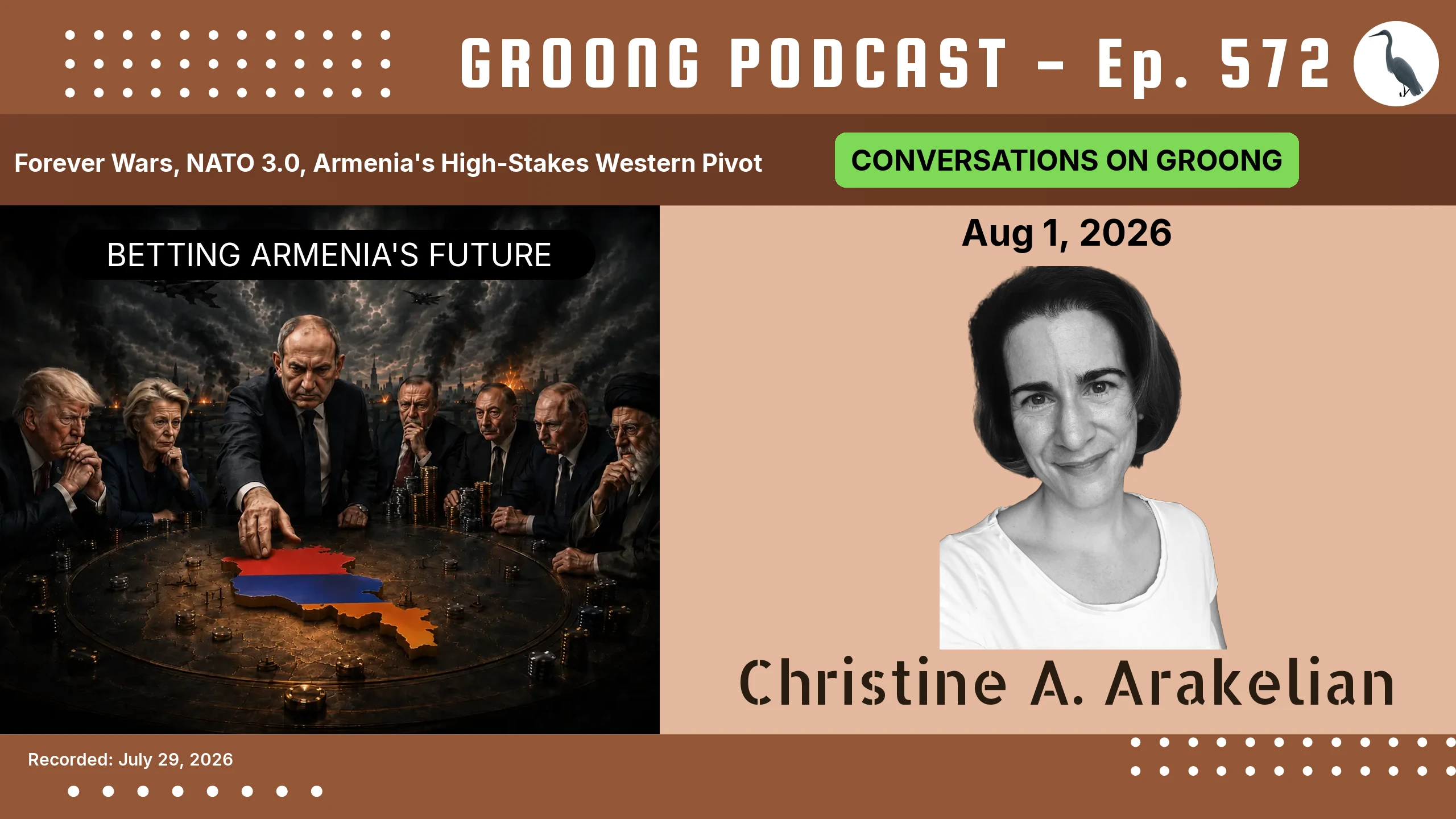
Groong Links:
Guest(s):
Topics:
- US Foreign Policy & the Fracture of MAGA
- Iran and the Risk of Forever Wars
- NATO 3.0 and Europe’s Militarization
- Post-2026 Election Armenia
- TRIPP and Pashinyan’s Pivot to the West
Episode 572 | Recorded: July 29, 2026
#ForeverWars #NATO #IranWar #Armenia #TRIPP #MAGA #USForeignPolicy #SouthCaucasus
Show Notes
Summary
In this episode of Conversations on Groong, we speak with Christine Arakelian about American foreign policy fractures, Iran war risks, and Armenia’s pivot to the West. We discuss whether the United States has coherent foreign policy, the collapse of the MAGA coalition over Forever Wars, NATO 3.0 and Europe’s militarization, and how Pashinyan’s post-2026 Armenian Parliamentary Election government is navigating TRIPP amid global instability.Main Topics Addressed
Coherence of American Foreign Policy
- Competing institutions and interests in Washington
- The difference between democratic disagreement and strategic incoherence
- U.S. tensions with the United Kingdom, Canada, and Australia
- U.S. interference in European political debates
- Relations with Germany and France
- The decline of a unified Anglo or Western political framework
- Why the United States struggles to end wars
America First and the Fracture of MAGA
- Whether America First ever had a coherent foreign policy
- Trump’s strength as a critic rather than a strategist
- Divisions between interventionists and non-interventionists
- Muslim American and Orthodox Christian support for Trump
- Middle Eastern diaspora communities
- The political role of JD Vance
- Marco Rubio’s lack of negotiating experience
- The influence of Steve Witkoff and Jared Kushner
- Possible Republican losses in the midterms
- The effects of Democratic control of Congress
- AIPAC spending and the Thomas Massie controversy
The War with Iran
- Iranian, American, and Israeli definitions of victory
- Iran’s demand for Israeli withdrawal from Lebanon
- Iranian control of the Strait of Hormuz
- U.S. military bases in the Middle East
- The failure to define a stable U.S. war aim
- Regime change and nuclear enrichment
- Oil prices and OPEC spare capacity
- Chinese oil purchases
- The U.S. Strategic Petroleum Reserve
- The limits of naval escorts
- Drone warfare and asymmetric costs
- Patriot interceptor shortages
- U.S. casualties
- Israel’s preference for weak neighboring states
- Israel’s relations with the UAE and other regional powers
Ukraine and the Caspian Sea
- Ukraine’s strike on an Iranian vessel
- Ukrainian strikes in the Caspian Sea, Sea of Azov, and Black Sea
- The possible merging of the Ukraine and Iran wars
- U.S. intelligence and Ukrainian operational freedom
- Competition for Patriot interceptors
- Caspian Pipeline Consortium infrastructure
- Kazakhstan’s oil exports
- Black Sea shipping
- Odessa and Ukrainian trade
- Ukraine’s permanent wartime economy
Elections and Escalation
- Trump’s need for a visible foreign-policy success
- Oil and gas prices before the midterms
- U.S. military casualties
- Netanyahu’s political incentives
- The timing of Israeli and U.S. elections
- The possibility of a rally-around-the-flag effect
- Iranian attempts to influence political timing
- Diverging interests between Trump and Netanyahu
NATO 3.0
- Burden shifting from the United States to Europe
- European defense spending
- European defense contractors
- Reduced U.S. conventional forces in Europe
- The Pentagon’s force posture review
- Greater European strategic independence
- U.S. bilateral relations with European states
- Tensions inside the European Union
- The future roles of France and Germany
Turkey and the Changing Alliance System
- Turkey as a major winner from the Ankara summit
- Trump’s relationship with Recep Tayyip Erdoğan
- The imprisonment of Istanbul’s opposition mayor
- Turkey’s role inside NATO
- Turkey’s ties with Pakistan, Saudi Arabia, and Egypt
- The Saudi-Pakistan defense relationship
- The F-35 and S-400 dispute
- Turkey’s other strategic alliances
- The U.S. ambassador to Turkey and Syria policy
- Turkey’s growing regional and international influence
Armenia’s Parliamentary Election
- Civil Contract ’s 64 seats
- The three-fifths parliamentary majority
- Election irregularities
- The OSCE preliminary findings
- The constitutional amendment demanded by Azerbaijan
- Arrested bishops, priests, and politicians
- Opposition participation in parliament
- The exclusion of Prosperous Armenia
- Strong Armenia ’s electoral position
- Armenia as a managed democracy
- Restrictions on political speech and debate
TRIPP and Armenia’s Western Pivot
- Whether Armenia is pivoting toward the United States or the European Union
- The difference between U.S. and EU funding models
- TRIPP ’s dependence on the executive branch
- The U.S. International Development Finance Corporation
- The lack of required congressional authorization
- The absence of guaranteed minimum funding for Armenia
- Weak congressional support
- ANCA opposition to TRIPP
- The Armenian government’s relationship with the diaspora
- The risks of relying on one U.S. administration
- Private investment and the seizure of companies
- The Lobito Corridor comparison
- The limits of the proposed funding
- TRIPP as a transport corridor
- TRIPP as a possible land-based Suez Canal
- The potential roles of India and Egypt
- Data, logistics, and trade volume
- Russian and Iranian concerns
- NATO standards and the Organization of Turkic States
Key Questions Discussed
- Does the United States have a coherent foreign policy?
- Is current U.S. policy merely inconsistent, or strategically incoherent?
- Is the United States still the leader of the West or the Anglo world?
- Why does Washington find it easier to enter wars than to end them?
- Was America First a foreign-policy doctrine or a reaction against the old consensus?
- Can Trump retain both interventionists and anti-war voters?
- How have Gaza, Lebanon, and Iran affected the MAGA coalition?
- What would Democratic control of the House or Senate change?
- What does victory mean for Iran?
- What does victory mean for the United States?
- What outcome does Israel seek?
- Can the Strait of Hormuz be reopened through military force?
- Can expensive U.S. systems defeat low-cost drone warfare?
- Is the Iran war becoming permanent?
- Did Ukraine widen the conflict by striking in the Caspian Sea?
- Is Ukraine trying to merge the Ukraine and Iran wars?
- How could the U.S. and Israeli elections affect escalation?
- What is NATO 3.0?
- Will higher European defense spending reduce U.S. influence?
- Is Turkey becoming the most important power inside NATO’s changing structure?
- Were Armenia’s parliamentary elections democratic?
- Was the opposition right to accept its parliamentary mandates?
- Is Armenia becoming a managed democracy?
- Is Armenia pivoting toward the United States, the EU, or an undefined West?
- Does TRIPP have enough support in Congress?
- Can TRIPP survive a change of administration in Washington?
- Has Armenia’s government weakened the project by alienating the diaspora?
- Is the proposed funding enough?
- Is TRIPP only a railway and road project, or a larger strategic corridor?
Wrap-up
Links and Resources
That’s our show , we hope you found it helpful. We invite your feedback and your suggestions, you can find us on most social media and podcast platforms.
Thanks to Laura Osborn for the music on our podcasts.
Guests

Christine A. Arakelian
Christine Arakelian is an attorney in private practice and currently advises Reina Trust Building as its Outside General Counsel. Her corporate and legal experience encompasses corporate financings, mergers and acquisitions, partnerships, civil litigation and constitutional law litigation. She was awarded a Fulbright Fellowship to Saudi Arabia, an iGorts Fellowship to the Republic of Armenia, a Global Health Law Fellowship by Georgetown Law and an Adjunct Fellowship to the University of Pennsylvania School of Medicine. During law school, Ms. Arakelian worked for the Central Intelligence Agency’s Office of General Counsel and had a TS/SCI clearance. Ms. Arakelian has extensive international experience and expertise and consults globally on matters pertaining to national security, technology, cybersecurity, healthcare, law and finance. She has a B.A. with honors from the University of Pennsylvania and a J.D. from the University of Virginia School of Law.
Hosts

Hovik Manucharyan
Hovik Manucharyan is an information security engineer who moved from Seattle to Armenia in 2022. He co-founded the ANN/Groong podcast in 2020 and has been a contributor to Groong News since the late 1990s.
Disclaimer: The views expressed by Hovik Manucharyan on the ANN/Groong podcast are his own and do not necessarily reflect the opinions of his employer or any other organization.

Asbed Bedrossian
Asbed Bedrossian is an IT professional, and for years oversaw the central IT enterprise infrastructure and services at USC. His decades of experience spanned across IT strategy, enterprise architecture, infrastructure, cybersecurity, enterprise applications, data center operations, high performance computing, ITSM, ITPM, and more.
Asbed founded the Armenian News Network Groong circa 1989/1990, and co-founded the ANN/Groong podcast in 2020.
Related Episodes

Clips from this episode
 Gaza, Lebanon, Iran: How Wars Shattered MAGA Coalition
 US Lost Coherence With Its Closest Allies
 Israel's Real War Aim: Surround Itself With Weak States
 TRIPP Is Starved of Real Money-$400M Won't Cut It
 Why America Can't Get Out of Wars
 Pashinyan's Western Pivot Is All Optics, No Congressional Buy-In
 NATO 3.0: Why Europe Will Call the Shots as US Withdraws
 Turkey's NATO Victory: Why Erdogan Is Winning While US Looks Away