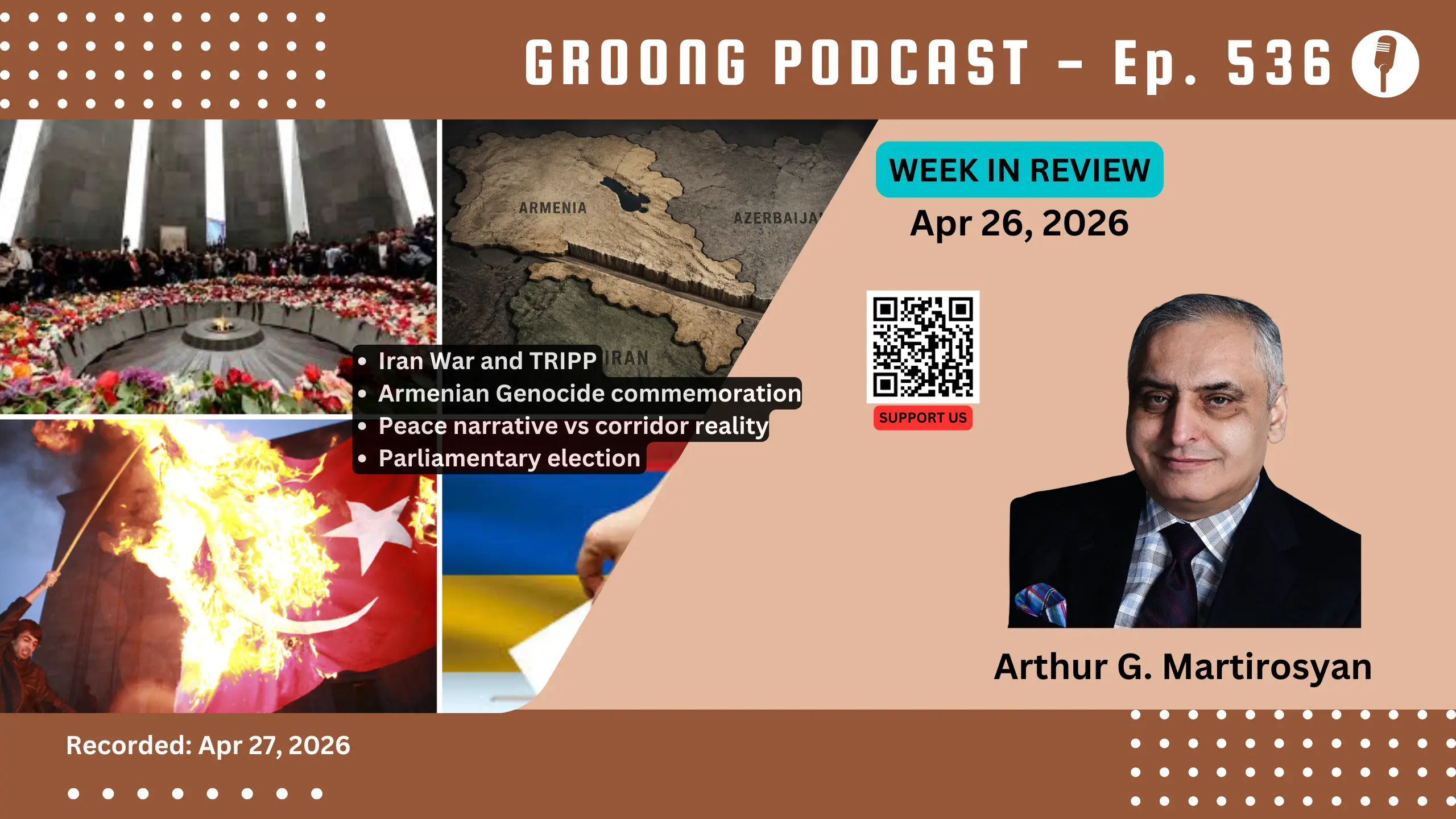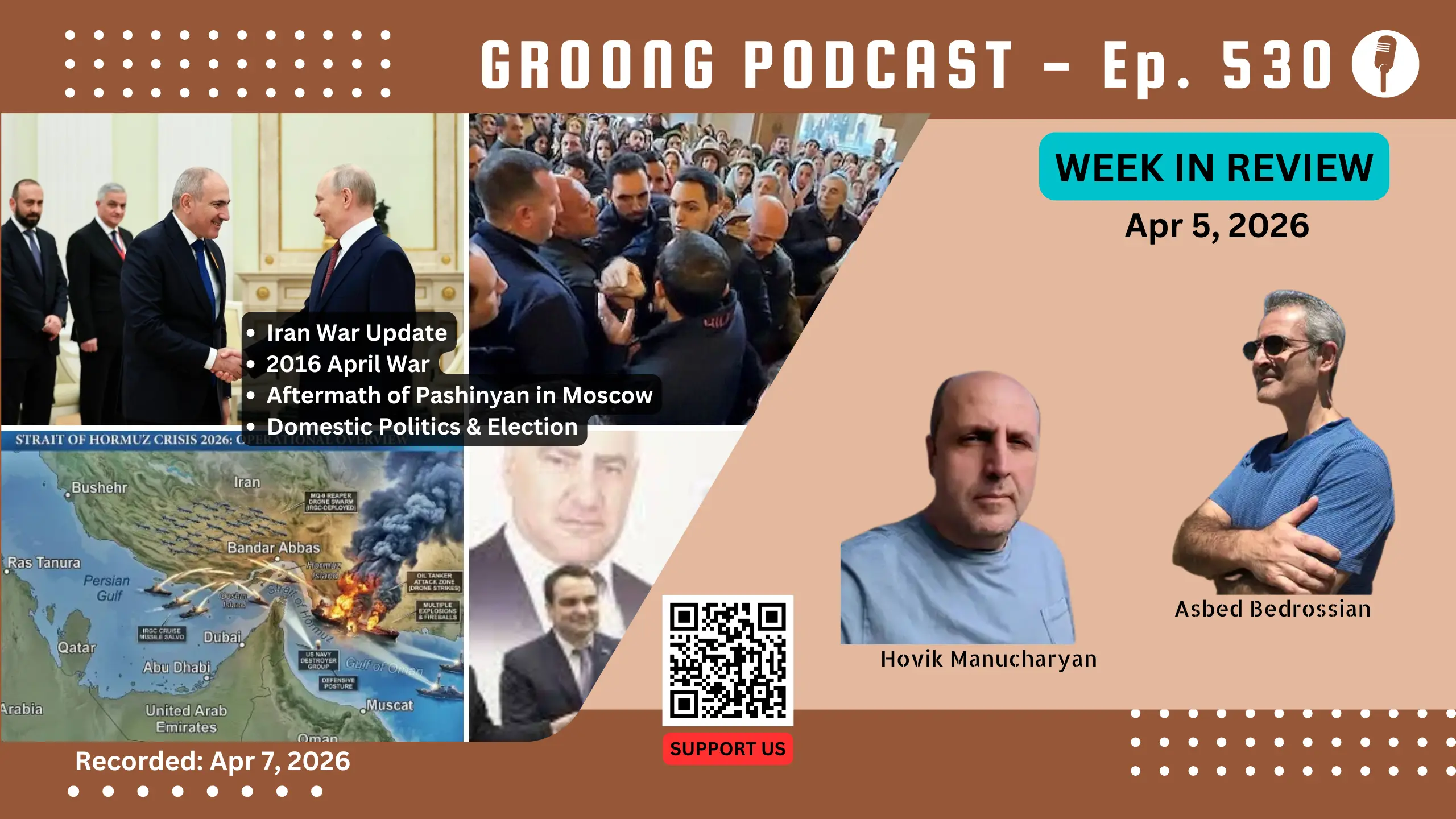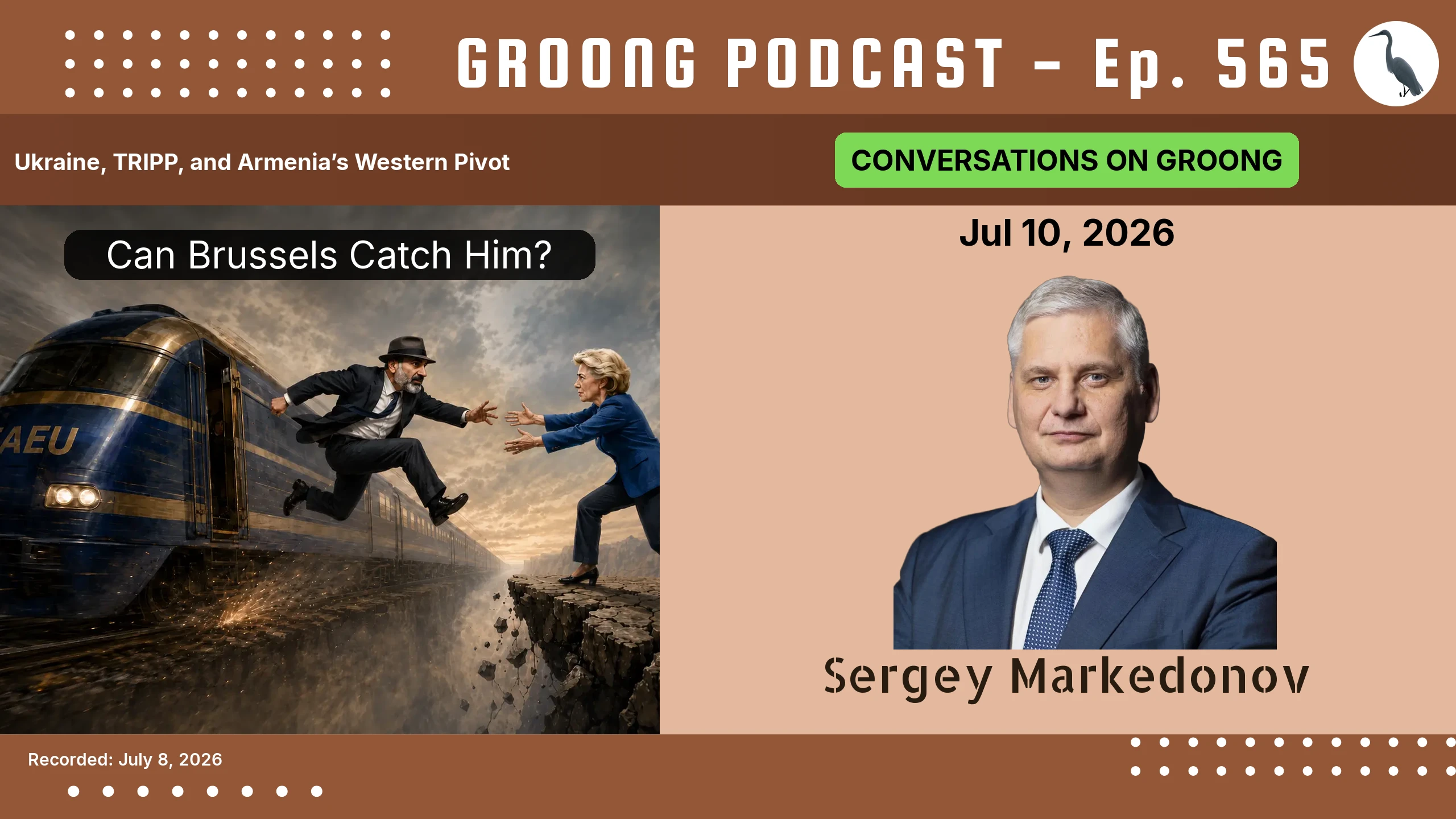
Groong Links:
Guest(s):
Topics:
- Ukraine’s war of attrition
- Russia’s strategic bandwidth problem
- TRIPP and Iran’s red lines
- Israel’s Armenian Genocide move
- Armenia’s Western pivot after elections
Episode 565 | Recorded: July 8, 2026
#ArmenianNews #SouthCaucasus #UkraineWar #Russia #Armenia #EAEU #TRIPP #Geopolitics
Show Notes
Summary
In this episode of Conversations on Groong, we speak with Dr. Sergey Markedonov about Russia’s strategic position amid the Ukraine War and its implications for Armenia. We discuss why Moscow remains bogged down in Ukraine despite its military superiority, how the war of attrition shapes Russian bandwidth for the South Caucasus, the geopolitical role of the Trump Route for International Peace and Prosperity, and Pashinyan’s Western pivot following the June 2026 Armenian Parliamentary Election.Show Notes
Dr. Sergey Markedonov joins Groong to discuss Russia’s view of the war in Ukraine, the geopolitical meaning of TRIPP, and Armenia’s post-election Western pivot. The conversation begins with the question of why Russia has not been able, or willing, to rapidly conclude the war in Ukraine, and whether the conflict is now best understood as a Russia-Ukraine war or as a wider Russia-NATO confrontation. The discussion then turns to TRIPP and Syunik , where transport infrastructure is analyzed as a strategic corridor tied to Iran, Turkey, Azerbaijan, the United States, and Russia’s role in the South Caucasus. The episode closes with Armenia’s June 2026 parliamentary election results, the rise of Samvel Karapetyan ’s Strong Armenia , Pashinyan’s confrontation with the opposition, and Moscow’s effort to define a new normal in relations with Armenia.
Main Topics Addressed
Why the Ukraine War Continues
- Russia’s explanation for the prolonged war in Ukraine
- Whether the war is a bilateral Russia-Ukraine conflict or a broader Russia-NATO confrontation
- Ukraine’s military burden and NATO support
- Western military aid, intelligence sharing, and deep strikes inside Russia
- Russia’s miscalculations after the 2014 Crimea precedent
- The future status of Ukraine and the question of NATO membership
- Why Russia rejects a ceasefire that does not settle the political causes of the war
- Russia’s view of Ukraine as a test of its role in European and global decision-making
Russia, NATO, and the Wider Strategic Contest
- NATO’s role in Ukraine’s war effort
- Russia’s opposition to NATO-centrism and American hegemony
- Western narratives about Russia as both weak and threatening
- The problem of European security after the collapse of the USSR
- Russia’s criticism of Western intervention in the Balkans, Georgia, and the post-Soviet space
- The debate in Russia over escalation and tactical nuclear weapons
- Sergey Karaganov’s nuclear argument and Russian criticism of that view
- Russia’s strategic concern with escalation control
Ukraine’s Territorial Endgame
- Whether Russian goals now include Novorossiya
- The status of Donbas, Lugansk, Donetsk, and buffer zones
- Why Markedonov argues that territory is a means to negotiation, not necessarily an end in itself
- Belgorod, Kursk, Rostov, and Russian concerns about border security
- Why Russia sees a return to Ukraine’s 1991 borders as a Russian defeat
- The possibility of neutral status or “Finlandization” for Ukraine
- The danger of a recurring cycle of unresolved war
TRIPP and the South Caucasus
- TRIPP as political economy, not just transport infrastructure
- Why Markedonov doubts the project’s immediate logistical value
- The Baku-Akhalkalaki-Tbilisi-Kars railway as a comparison
- The significance of Syunik’s terrain and missing rail infrastructure
- Why Russia sees TRIPP as a potential problem for the North-South corridor
- Why Iran views TRIPP as a direct isolation threat
- Differences between Russian and Iranian views of the South Caucasus
- Whether the United States seeks to replace Russia as the main regional mediator
Russia’s Red Lines in the South Caucasus
- Whether Russia has a red line similar to Iran’s regarding Syunik
- Russia’s concern about being pushed out of the region
- The role of the United States and European Union in Armenia-Azerbaijan mediation
- Russia’s view that a stronger American security presence in the South Caucasus would cross a serious threshold
- Why Moscow still sees itself as a necessary actor in any Armenia-Azerbaijan peace process
- Russian interest in participating in TRIPP if the project is not directed against Russia
Israel, Iran, and the Armenian Genocide Recognition Issue
- Israel’s move toward recognizing the Armenian Genocide
- Whether the decision reflects moral concern or geopolitical calculation
- The relationship between Israel, Turkey, Azerbaijan, and the United States
- Why Markedonov believes the recognition issue is unlikely to change the regional balance by itself
- Armenia’s muted reaction to Israel’s move
- Pashinyan’s “Real Armenia” framework and his discomfort with internationalized genocide politics
Armenia’s June 2026 Election Aftermath
- Civil Contract’s continued hold on power
- Armenia’s split political society
- The ruling party’s loss of seats and lack of a constitutional majority
- The importance of a possible constitutional referendum
- Azerbaijan’s demand for constitutional changes in Armenia
- Strong Armenia’s rise as a new opposition force
- Samvel Karapetyan’s shift from businessman and philanthropist to major political actor
- The demand for a “third way” in Armenian politics
Strong Armenia and the Opposition
- Samvel Karapetyan as a different type of opposition figure
- The difference between Karapetyan’s business-networked profile and the older Karabakh-war political class
- Robert Kocharyan , Gagik Tsarukyan , and the opposition figures Pashinyan identifies as pro-Russian
- Whether the opposition is truly pro-Russian, pro-Armenian, or divided by different visions of Armenia
- Karapetyan’s comments on possible withdrawal from the CSTO
- Armenia’s political split between “Real Armenia” and historical Armenia
Pashinyan’s Western Pivot
- Pashinyan’s post-election move toward Europe
- Ursula von der Leyen’s promises of assistance and market access
- Markedonov’s skepticism about whether EU financial support can replace Russian economic ties
- The gap between symbolic EU support and Armenia’s structural dependence on Russia
- Western support for Pashinyan despite opposition arrests and pressure on the Church
- The EU’s silence on Armenian POWs and Armenian heritage issues
Russia-Armenia Relations: A New Normal
- Putin ’s birthday greeting to Pashinyan before the election
- Pashinyan’s meeting with Prime Minister Mikhail Mishustin in Yekaterinburg
- Russia’s attempt to preserve room for maneuver
- Moscow’s use of both pressure and dialogue
- Russian concern over Armenia replacing security contacts with Western and EU structures
- The EU border mission as a challenge to Russia’s former exclusive security role
- Why Markedonov expects a reconfiguration, not a return to the old alliance
- The search for a new modus vivendi between Moscow and Yerevan
Key Questions Discussed
- Why has Russia not been able or willing to rapidly conclude the war in Ukraine?
- Is the war in Ukraine best understood as a Russia-Ukraine conflict, or as a Russia-NATO conflict?
- Did Russia miscalculate Ukraine’s military strength and NATO’s level of support?
- Is the current pace of the war a calculated Russian strategy or a reflection of battlefield limits?
- What political settlement would Russia accept in Ukraine?
- Is Novorossiya now part of Russia’s official strategic goal, or mostly a public debate outside formal policy?
- Could a neutral Ukraine or “Finlandization” end the war?
- How does Russia view NATO’s expansion and Europe’s security order after 1991?
- Is nuclear escalation a serious Russian policy option or part of a wider strategic debate?
- Does TRIPP function as transport infrastructure, or as a strategic corridor aimed at Iran and Russia?
- What are Russia’s red lines in Syunik and the South Caucasus?
- Can Russia accept a U.S.-led Armenia-Azerbaijan peace process that excludes Moscow?
- Why does Iran view TRIPP more sharply than Russia does?
- What role does Russia want in TRIPP?
- Is Israel’s Armenian Genocide recognition move moral, strategic, or both?
- How does Moscow view Armenia’s June 2026 election results?
- What does Strong Armenia’s rise mean for Armenian politics?
- Does Moscow see Samvel Karapetyan as a new type of partner?
- Why is Pashinyan moving Armenia toward the West while Armenia remains economically tied to Russia?
- Can EU aid and tariff relief replace Armenia’s deep economic links with Russia and the EAEU ?
- Has Armenia entered a new phase of political “Sanation” against opposition forces?
- Why has Putin not formally congratulated Pashinyan on the election result?
- What does Russia expect from Armenia over the next three to four months?
- Is a new Russia-Armenia modus vivendi possible?
Wrap-up
Links and Resources
That’s our show , we hope you found it helpful. We invite your feedback and your suggestions, you can find us on most social media and podcast platforms.
Thanks to Laura Osborn for the music on our podcasts.
Guests
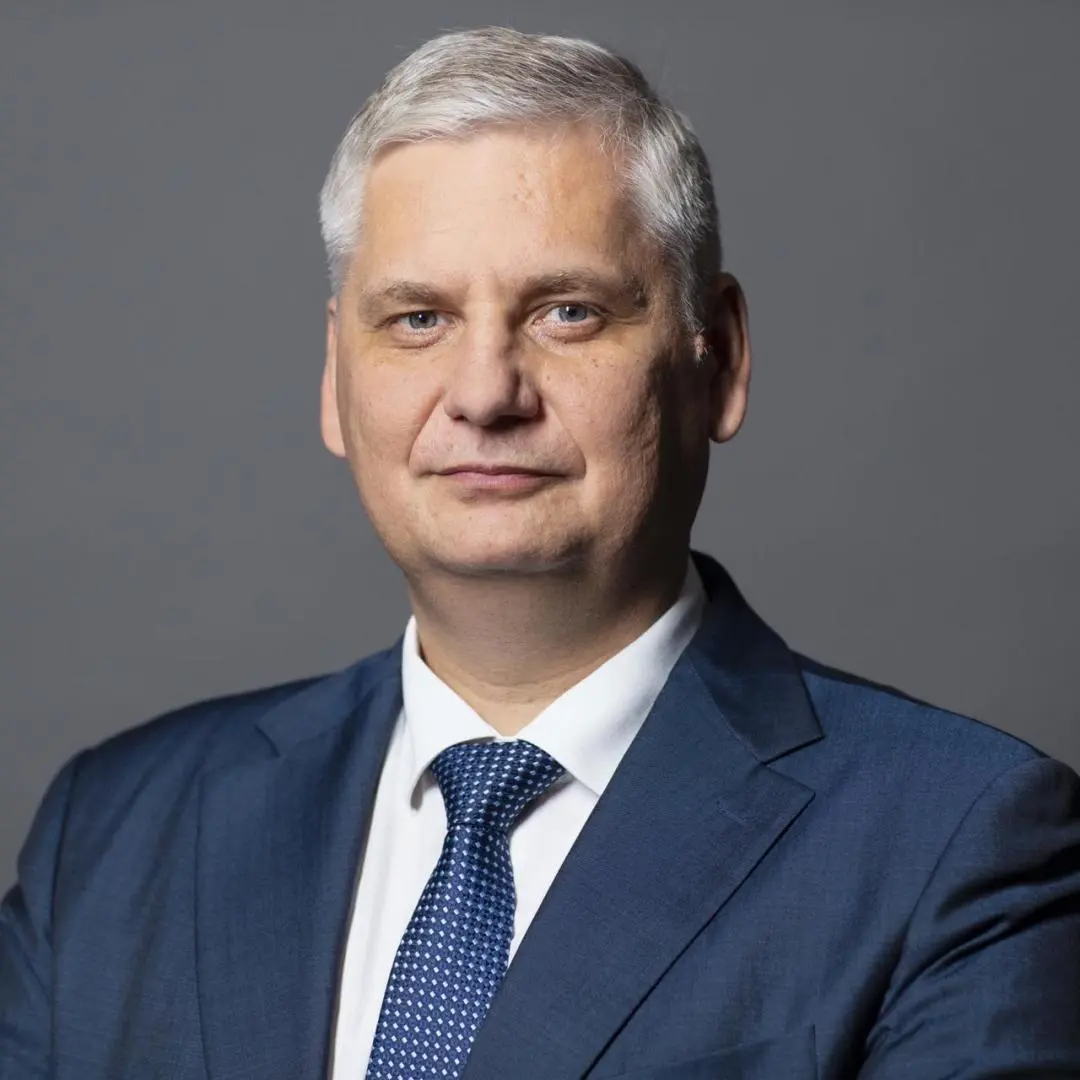
Sergey Markedonov
Dr. Sergey Markedonov is a historian and analyst specializing in Russia’s foreign policy, the South Caucasus, and post-Soviet conflict regions. He is a Leading Research Fellow at MGIMO University’s Institute for International Studies and Editor-in-Chief of International Analytics. He also served as Director of the Department for Problems of Ethnic Relations at the Institute for Political and Military Analysis in Moscow in 2001-2011.
Dr. Markedonov has written and commented widely for international policy forums and expert publications, including the Minsk Dialogue Council on International Relations, the Russian International Affairs Council, and Russia in Global Affairs. His analysis often examines the intersection of domestic politics, identity, and geopolitics in countries such as Armenia, Georgia, Azerbaijan, Ukraine, and Moldova.
Hosts
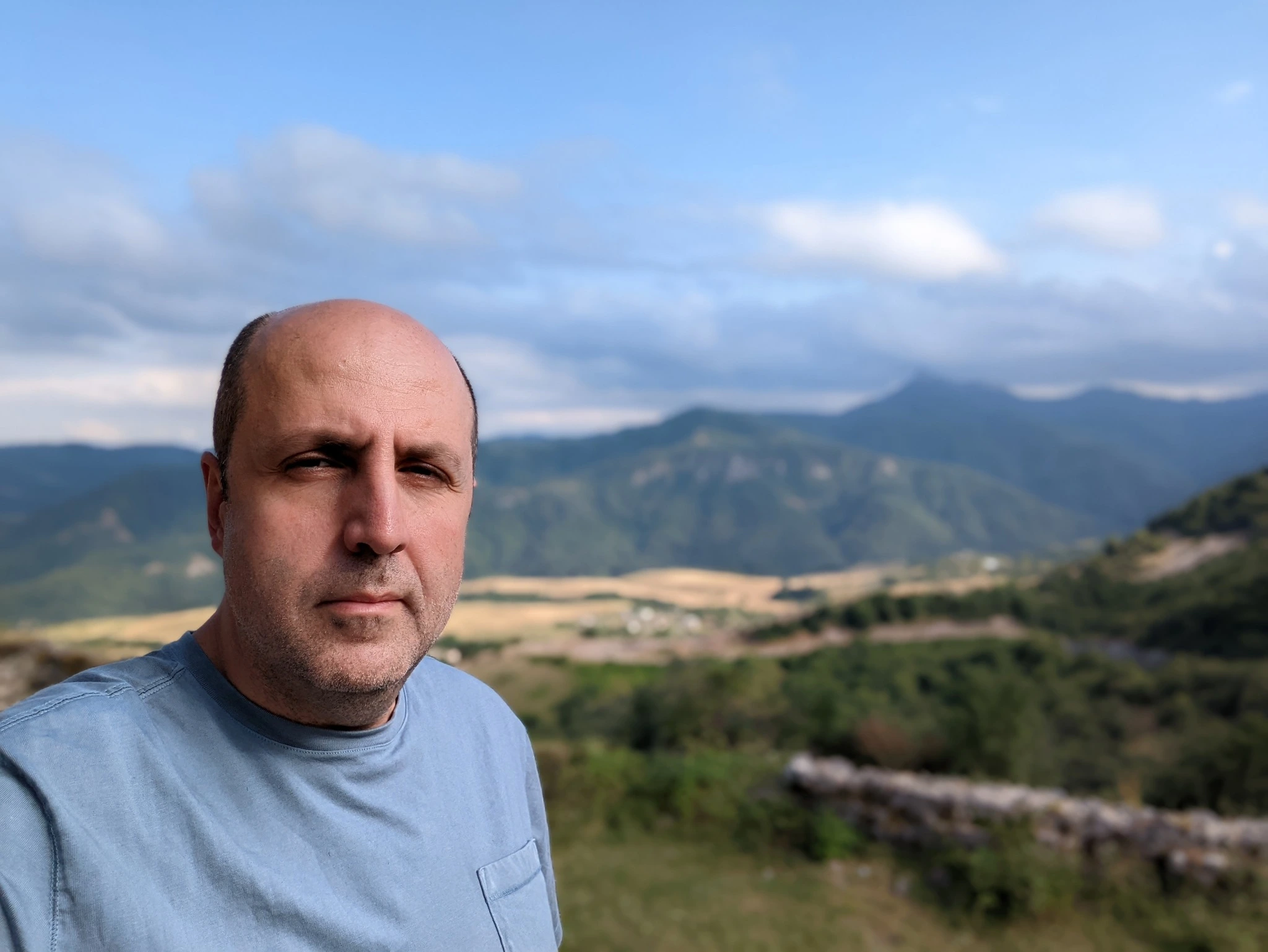
Hovik Manucharyan
Hovik Manucharyan is an information security engineer who moved from Seattle to Armenia in 2022. He co-founded the ANN/Groong podcast in 2020 and has been a contributor to Groong News since the late 1990s.
Disclaimer: The views expressed by Hovik Manucharyan on the ANN/Groong podcast are his own and do not necessarily reflect the opinions of his employer or any other organization.

Asbed Bedrossian
Asbed Bedrossian is an IT professional, and for years oversaw the central IT enterprise infrastructure and services at USC. His decades of experience spanned across IT strategy, enterprise architecture, infrastructure, cybersecurity, enterprise applications, data center operations, high performance computing, ITSM, ITPM, and more.
Asbed founded the Armenian News Network Groong circa 1989/1990, and co-founded the ANN/Groong podcast in 2020.