Groong Links:
Guest(s):
Topics:
- US-Iran MoU
- Election Aftermath
- Russian Warnings to Armenia
- Israeli Recognizes the Armenian Genocide
Episode 563 | Recorded: July 1, 2026
#ArmenianNews #IranWar #DziunikAghajanian #ArmenianElections #RussiaArmenia #SouthCaucasus #ArmenianGenocide
Show Notes
Summary
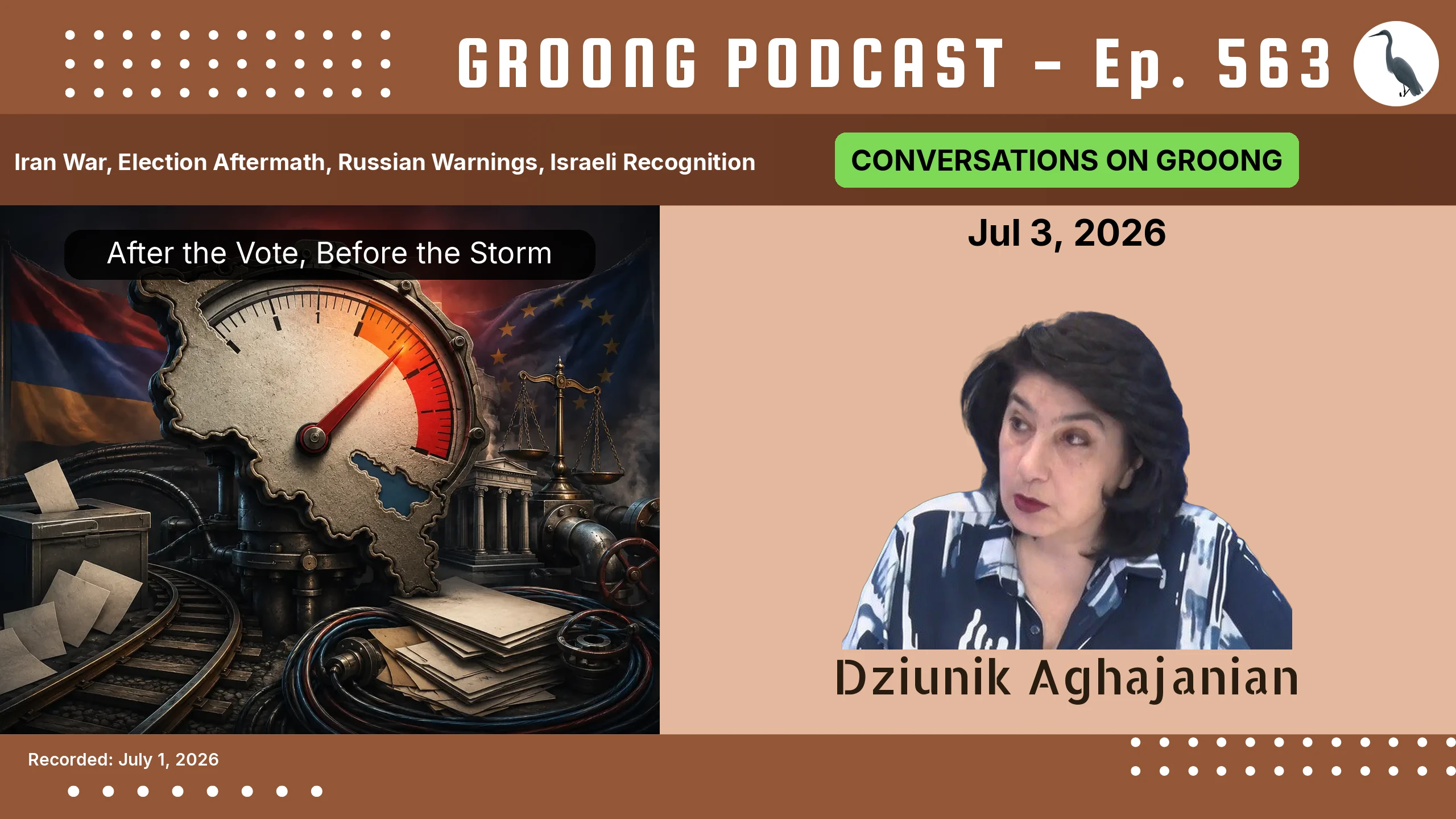
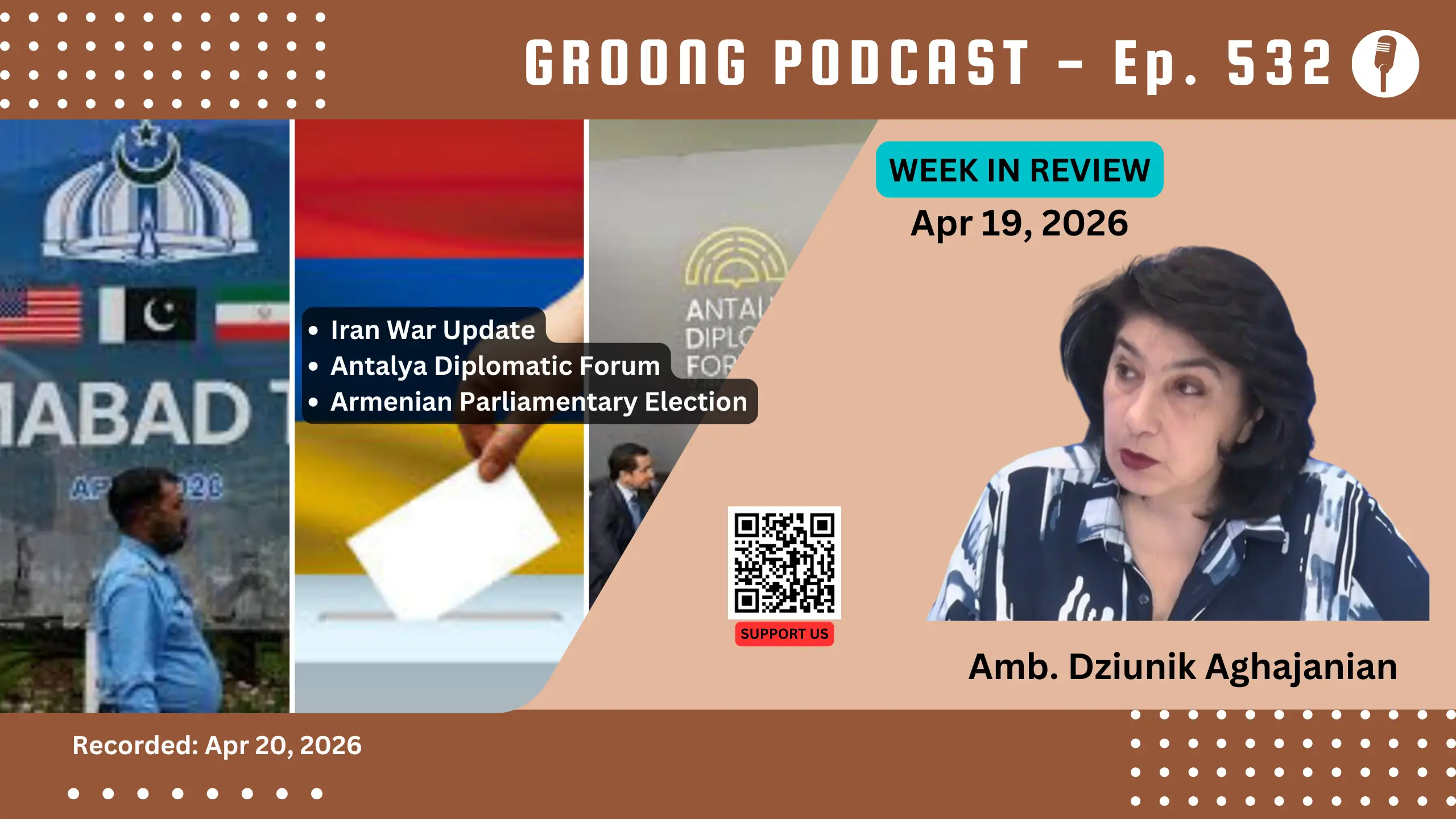
In this episode of Conversations on Groong, we speak with Amb. Dziunik Aghajanian about the Iran-Israel conflict, Armenia’s 2026 Armenian Parliamentary Election aftermath, and Israeli recognition of the Armenian Genocide. We discuss whether the US-Iran MOU represents genuine de-escalation or a tactical pause before renewed confrontation, the Constitutional Court’s review of election fraud allegations against the Civil Contract regime, and Russia’s warnings to Armenia amid regional instability.Main Topics Addressed
Iran-US MOU and the Risk of Renewed War
- Trita Parsi’s argument that Iran may see the new MOU as a pause rather than a path to peace
- Whether Tehran accepted a diplomatic off-ramp or bought time before the next phase of war
- Israel’s possible interest in reopening the conflict before its October elections
- The role of southern Lebanon, Hezbollah, Syria, and US-Israel coordination
- Iran’s preparations for a possible third phase of conflict
- Iran’s red lines around its northern frontier with Armenia and Azerbaijan
- Azerbaijan’s possible role as a launchpad or logistical space in any future escalation against Iran
Armenia’s Parliamentary Election Aftermath
- The Constitutional Court hearings on appeals from seven political forces
- Whether the June 7 parliamentary election was free and fair
- The invalidation of three precincts and the effect on Prosperous Armenia ’s entry into parliament
- The CEC’s refusal to hold revotes in the invalidated precincts
- Allegations of pressure, selective justice, arrests, and unequal campaign conditions
- Whether the Constitutional Court can deliver a legal ruling or will deliver a political one
- The opposition’s readiness for the next phase after the court ruling
- Whether opposition parties should take their parliamentary mandates despite viewing the vote as fraudulent
- The concern that Civil Contract may seek constitutional changes with a strengthened parliamentary position
Opposition Strategy After the Election
- Whether the opposition has a clear plan beyond reacting to Pashinyan
- The need for a common national vision
- Relations with Russia, the EU, Azerbaijan, Turkey, and Iran
- The role of parliamentary mandates as a political tool
- The risks of street action if the government seeks to provoke and decapitate opposition movements
- Public discontent as economic pressure grows
- The need to prepare for political, legal, and civic action when conditions shift
Surveillance, Public Reaction, and State Control
- Armenia’s planned IMEI registration system for mobile phones
- Concerns about surveillance, privacy, and the role of private companies
- The public’s delayed reaction to state control when repression first targets opposition figures
- The broader pattern of fear, control, and pressure ahead of possible constitutional changes
Russian Warnings and the Armenia-Russia Rift
- Russia’s restrictions on Armenian exports, including fish and agricultural products
- Mikhail Galuzin’s warning that Armenia cannot deepen EU ties while enjoying EAEU benefits
- Dmitry Medvedev’s warning about consequences if Armenia breaks with Russia
- Whether Pashinyan has crossed Russian red lines
- Russia’s view that Armenia is being turned into an anti-Russian platform
- Moscow’s concern over NATO presence and Western influence in Armenia
- Armenia’s exposure if Russia escalates pressure through gas pricing, remittances, labor migration, banking, or EAEU access
- Whether Armenia has viable alternatives to the Russian market
- The danger of deeper dependence on Azerbaijan and Turkey
Ursula von der Leyen’s Visit to the South Caucasus
- The timing of Ursula von der Leyen’s visit to Azerbaijan and Armenia
- Whether Baku is the real focus of the EU’s South Caucasus policy
- Europe’s interest in Azerbaijani gas and regional connectivity
- The view that Armenia is being used to support a wider European geopolitical posture
- The risk that demands made by Azerbaijan and Turkey will be paid for by Armenia
2013, the EAEU, and Foreign Policy Complementarity
- Serzh Sargsyan’s 2013 decision to join the Eurasian Customs Union
- The later creation of the Eurasian Economic Union
- Armenia’s CEPA agreement with the EU in 2017
- Whether today’s crisis is comparable to the 2013 shift
- The difference between complementarity and a hard geopolitical pivot
- Whether Armenia can still balance relations with Russia, Iran, the EU, the US, and others
- The role of the Armenian diaspora in rebuilding Armenia’s diplomatic leverage
Israel’s Recognition of the Armenian Genocide
- Israel’s cabinet vote to recognize the Armenian Genocide
- Foreign Minister Gideon Sa’ar’s statement on historical truth and moral duty
- Whether the Knesset will actually approve recognition
- Why Israel is acting now
- The use of Armenian Genocide recognition as a pressure tool against Turkey
- The possible effect on Israel-Turkey and Israel-Azerbaijan relations
- Pashinyan’s response that the Armenian government does not need to comment
- His warning against “weaponizing the Armenian Genocide”
- The charge that Pashinyan has adopted language close to Turkish denialist narratives
- Whether Armenia can use this moment diplomatically, or whether the current government will avoid doing so
Key Questions Discussed
- Is the Iran-US MOU a real path to peace, or a pause before the next phase of war?
- Did Iran gain anything from the agreement, or did Israel and the US gain time?
- How is Iran preparing militarily, politically, and economically for renewed conflict?
- Has Iran changed its red lines around its northern frontier with Armenia and Azerbaijan?
- What should be expected from Armenia’s Constitutional Court: a legal ruling or a political one?
- Which part of the opposition’s election case is strongest?
- Did invalidating three precincts without revotes change the composition of Armenia’s parliament?
- Does Prosperous Armenia have a realistic chance of getting its votes restored?
- Is the opposition ready for the next political phase after the court ruling?
- Should opposition parties take their parliamentary mandates if they believe the election was fraudulent?
- Can the opposition form a shared national vision for Armenia?
- Is the Armenian public waking up only when government policy hits their daily life and pocketbook?
- Is the IMEI registration plan a surveillance measure?
- Has Pashinyan crossed Russian red lines?
- What are Armenia’s options if Russia escalates economic pressure?
- Has Armenia secured real alternative markets before moving away from Russia?
- What does Ursula von der Leyen want in the South Caucasus?
- Is the Armenian public being told the real cost of the current geopolitical shift?
- Was Serzh Sargsyan’s 2013 EAEU decision comparable to Pashinyan’s current Western pivot?
- Is complementarity still possible for Armenia?
- What should a responsible Armenian foreign policy look like after the loss of Artsakh ?
- Why is Israel moving toward recognition of the Armenian Genocide now?
- Is Israel’s move moral, geopolitical, or both?
- What should Armenia’s government have said in response?
- What does Pashinyan mean by “weaponizing the Armenian Genocide”?
- Can Armenia use this moment to increase its diplomatic weight?
Referenced Articles & Sources
Trita Parsi, “Why Iran Believes Israel Will Attack” https://tritaparsi.substack.com/p/why-iran-believes-israel-will-attack
Constitutional Court and election appeal coverage, Verelq https://verelq.am/hy/node/174884
Constitutional Court hearing and judge impartiality discussion, Verelq https://verelq.am/hy/node/174882
Armenia Alliance recount and election appeal discussion, Armenpress https://armenpress.am/en/article/1254248
Post-election political statements, Verelq https://verelq.am/hy/node/174857
Vartan Oskanian on election aftermath, Verelq https://verelq.am/hy/node/174843
Avetik Chalabian arrest and post-election pressure, Azatutyun https://www.azatutyun.am/a/33787953.html
Case against ARF leader Ishkhan Saghatelyan, Asbarez https://asbarez.com/saghatelyans-lawyers-say-case-against-arf-leader-is-a-political-order/
Armenia election aftermath coverage, 168.am https://168.am/2026/06/24/2436860.html
Russia-Armenia tensions and export restrictions, Azatutyun https://www.azatutyun.am/a/33791414.html
Russian restrictions on Armenian fish exports, Azatutyun https://www.azatutyun.am/a/33789708.html
Galuzin comments on Armenia, EU, and EAEU, Armenpress https://armenpress.am/en/article/1254269
Armenia-Russia relations coverage, Armenpress https://armenpress.am/en/article/1254264
Galuzin warning on EU and EAEU path, Armenpress https://armenpress.am/en/article/1254258
Armenia-Russia rift and economic pressure, 168.am https://168.am/2026/06/29/2439873.html
Medvedev warns of Armenia-Russia split, Eurasia Review https://www.eurasiareview.com/29062026-medvedev-warns-of-armenia-russia-split/
Medvedev comments on Armenia-Russia relations, TASS https://tass.com/politics/2152611
Medvedev warning on Armenia and Russia ties, Caliber https://caliber.az/en/post/medvedev-warns-armenia-of-severe-consequences-over-russia-ties-rupture
Wrap-up
Links and Resources
That’s our show , we hope you found it helpful. We invite your feedback and your suggestions, you can find us on most social media and podcast platforms.
Thanks to Laura Osborn for the music on our podcasts.
Guests

Dziunik Aghajanian
Ms. Dziunik Aghajanian has served Armenia through the ranks of the Ministry of Foreign Affairs, and most recently as a diplomat, as Armenia’s Ambassador to such countries as the Netherlands, Malaysia, and Indonesia. She received her education at Yerevan State University, Columbia University in NY, and Uppsala University in Sweden.
Hosts
Hovik Manucharyan
Hovik Manucharyan is an information security engineer who moved from Seattle to Armenia in 2022. He co-founded the ANN/Groong podcast in 2020 and has been a contributor to Groong News since the late 1990s.
Disclaimer: The views expressed by Hovik Manucharyan on the ANN/Groong podcast are his own and do not necessarily reflect the opinions of his employer or any other organization.

Asbed Bedrossian
Asbed Bedrossian is an IT professional, and for years oversaw the central IT enterprise infrastructure and services at USC. His decades of experience spanned across IT strategy, enterprise architecture, infrastructure, cybersecurity, enterprise applications, data center operations, high performance computing, ITSM, ITPM, and more.
Asbed founded the Armenian News Network Groong circa 1989/1990, and co-founded the ANN/Groong podcast in 2020.
Related Episodes
Clips from this episode
 Armenia Has Crossed Red Lines with Russia, Pashinyan Miscalculated Timing
 Constitutional Court Will Deliver Political Ruling, Not Legal Justice
 Israel's Armenian Genocide Recognition Is a Bargaining Chip Against Turkey
 Iran Preparing for Phase 3 War Against Israel and the US
 Opposition Should Take Parliamentary Mandates Despite Fraudulent Election
 Pashinyan Adopted Denialist Language When Responding to Israeli Recognition