Groong Links:
Topics:
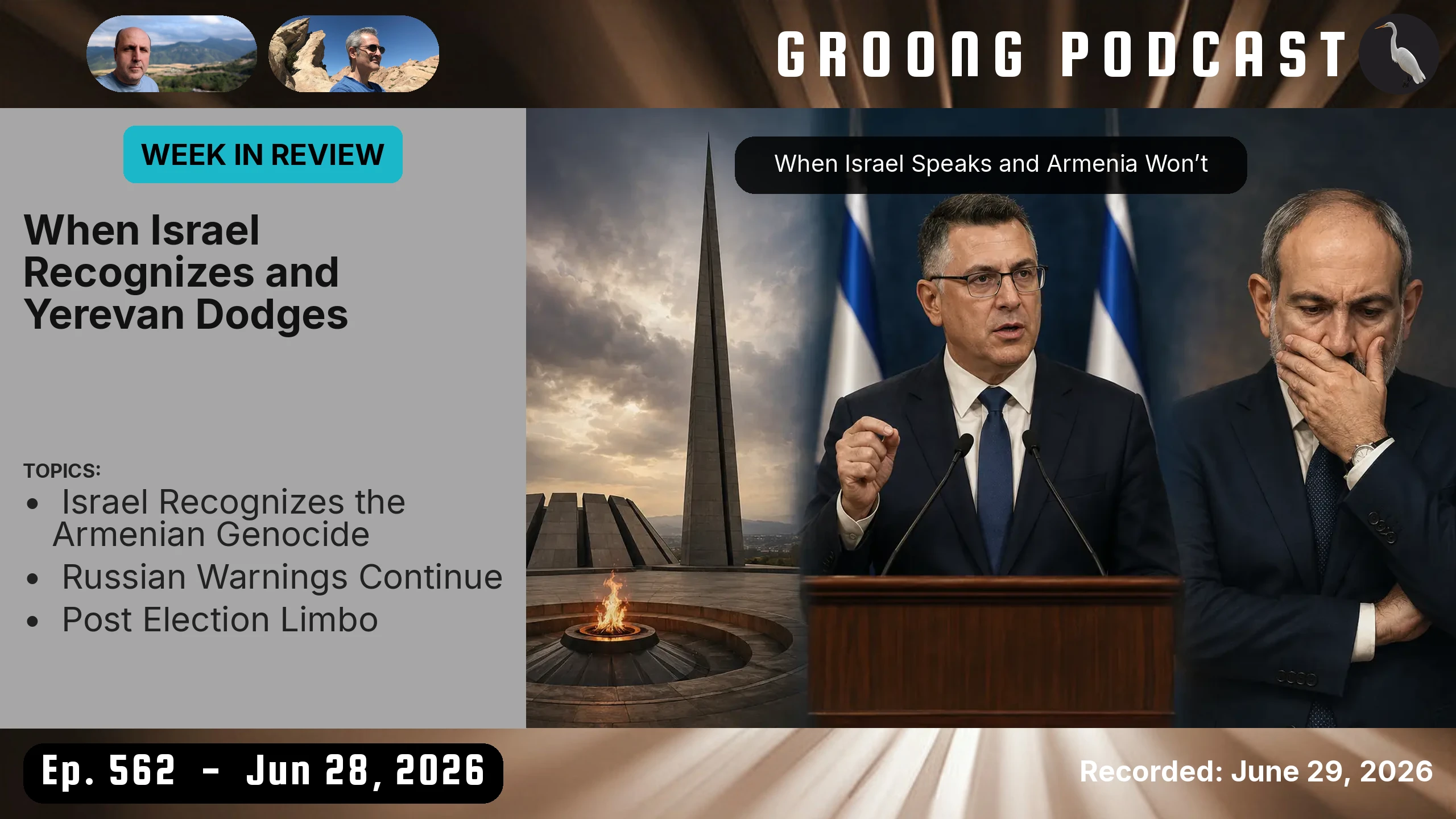
- Israel Recognizes the Armenian Genocide
- Russian Warnings Continue
- Post Election Limbo
Episode 562 | Recorded: June 29, 2026
#ArmenianGenocide #Armenia #Israel #Pashinyan #RussiaArmenia #SouthCaucasus
Show Notes
Summary
In this week’s Groong Week in Review, Hovik and Asbed discuss Israel’s historic recognition of the Armenian Genocide, Russia’s ongoing warnings toward Armenia, and the political uncertainty following the 2026 Armenian Parliamentary Election. We examine the geopolitical context behind Israel’s decision, Pashinyan’s measured response, and what these developments signal about Armenia’s regional position amid shifting US-Turkey relations and broader Middle East tensions.Main Topics Addressed
Israel Recognizes the Armenian Genocide
- Israel’s cabinet voted to recognize the Armenian Genocide .
- Foreign Minister Gideon Sa’ar framed recognition as a moral duty and said the facts of the Armenian Genocide are not up for debate.
- The hosts discuss why Israel waited so long, given the historic role of figures such as Henry Morgenthau and Raphael Lemkin.
- Hovik argues that Israel’s decision should be understood in the current geopolitical context, especially as a signal against Turkey.
- Asbed argues that Armenia’s government should have responded clearly, and that Pashinyan ’s silence gives new space to Turkey’s denial campaign.
- The discussion turns to whether recognition carries moral, legal, or political obligations.
- The hosts disagree over whether Israel’s recognition should be welcomed, given Israel’s role in Azerbaijan’s military power, the ethnic cleansing of Artsakh , Gaza, and pressures on Armenians in Jerusalem.
Russian Warnings Continue
- Dmitry Medvedev accused the West of turning Armenia into an anti-Russian tool.
- Medvedev also criticized what he described as a purge of opposition forces that support normal ties with Russia.
- The hosts discuss the political signal behind Armen Grigoryan’s attendance at a Ukraine reconstruction conference in Gdansk.
- The episode examines Russian concerns over the possible use of frozen Russian assets, Armenia’s western pivot, and Yerevan’s continued EAEU membership.
- Hovik and Asbed discuss what Russia’s red lines may be, including Armenia’s EAEU benefits, the Russian military base in Gyumri, Russian investments, railway concessions, and trade ties.
- The hosts also discuss the possible economic impact of Russian pressure, including restrictions on Armenian exports and the role of remittances from Armenians working in Russia.
- The conversation raises the question of whether Armenia can afford to lose Russian economic support without becoming dependent on Western aid.
Post-Election Limbo
- Armenia’s Constitutional Court is expected to rule on election appeals by July 4.
- Six opposition parties and alliances have asked for the election to be annulled.
- The hosts describe the current period as a tense “quiet before the storm.”
- The government continues to push vote-buying allegations against opposition forces.
- The hosts discuss arrests and pressure against opposition figures and supporters, including Ishkhan Saghatelyan, Avetik Chalabyan, and Gagik Tsarukyan.
- The discussion covers the revocation of Tsarukyan’s casino license and the possible redistribution of business interests toward government-linked figures.
- The hosts discuss the firing of Lilit Ghazaryan, sister of Edgar Ghazaryan , and the dismissal of a 31-year career teacher who was on the Strong Armenia party list.
- The episode also covers pressure on the Armenian Church , including the drafting of priests into military service after the cancellation of the army chaplaincy arrangement.
- The hosts argue that many arrests, court cases, and restrictions are meant to disable opposition activity in the present, even if cases later collapse.
- Civil Contract ’s choice of Ruben Rubinyan as the next National Assembly speaker is discussed in the context of Armenia-Turkey normalization and Turkey’s demands through Azerbaijan.
- The episode closes with expectations from the Constitutional Court, including possible outcomes for Prosperous Armenia, possible new elections, or no meaningful change.
Key Questions Discussed
- Why did Israel recognize the Armenian Genocide now?
- Is Israel’s recognition a moral act, a geopolitical signal against Turkey, or both?
- Should Armenia’s government have issued a formal response?
- Does Pashinyan’s silence weaken Armenia’s position on genocide recognition?
- Can Israel claim moral authority while supporting Azerbaijan and facing accusations over Gaza?
- What obligations should follow recognition of the Armenian Genocide?
- Has Armenia crossed Russian red lines?
- Why did Armen Grigoryan attend a Ukraine reconstruction conference in Poland?
- Is Russia reading Armenia’s western pivot as a threat to its assets, presence, and influence?
- Can Armenia remain in the EAEU while moving toward the EU?
- What would happen if Russia restricted remittances, trade, or labor migration?
- Is the EU willing or able to replace the economic benefits Armenia receives through Russia?
- What should be expected from Armenia’s Constitutional Court?
- Is the opposition prepared for a negative ruling?
- Could the court restore votes for Prosperous Armenia?
- Could the ruling party use the court process to justify new elections under tighter restrictions?
- Is the post-election crackdown aimed at punishing opponents or preventing future opposition activity?
Referenced Articles & Sources
- Israel Recognizes the Armenian Genocide
- Israeli Government Recognizes Armenian Genocide
- Medvedev: West Is Turning Armenia into Tool to Confront Russia
- Medvedev Describes Western Interference in Armenian Election Campaign as Unprecedented
- Moscow reiterates objection to Armenia’s EU course while maintaining EAEU benefits
- Russia claims TRIPP project would benefit from its participation
- High Court Questions Parties as Armenia Election Challenge Hearings Continue
- A History of Armenian Critical Thought, Part VII: The Early Armenian Bolsheviks, by Eddie Arnavoudian, with a foreword by Dr. Pietro Shakarian
Wrap-up
Links and Resources
That’s our show , we hope you found it helpful. We invite your feedback and your suggestions, you can find us on most social media and podcast platforms.
Thanks to Laura Osborn for the music on our podcasts.
Hosts
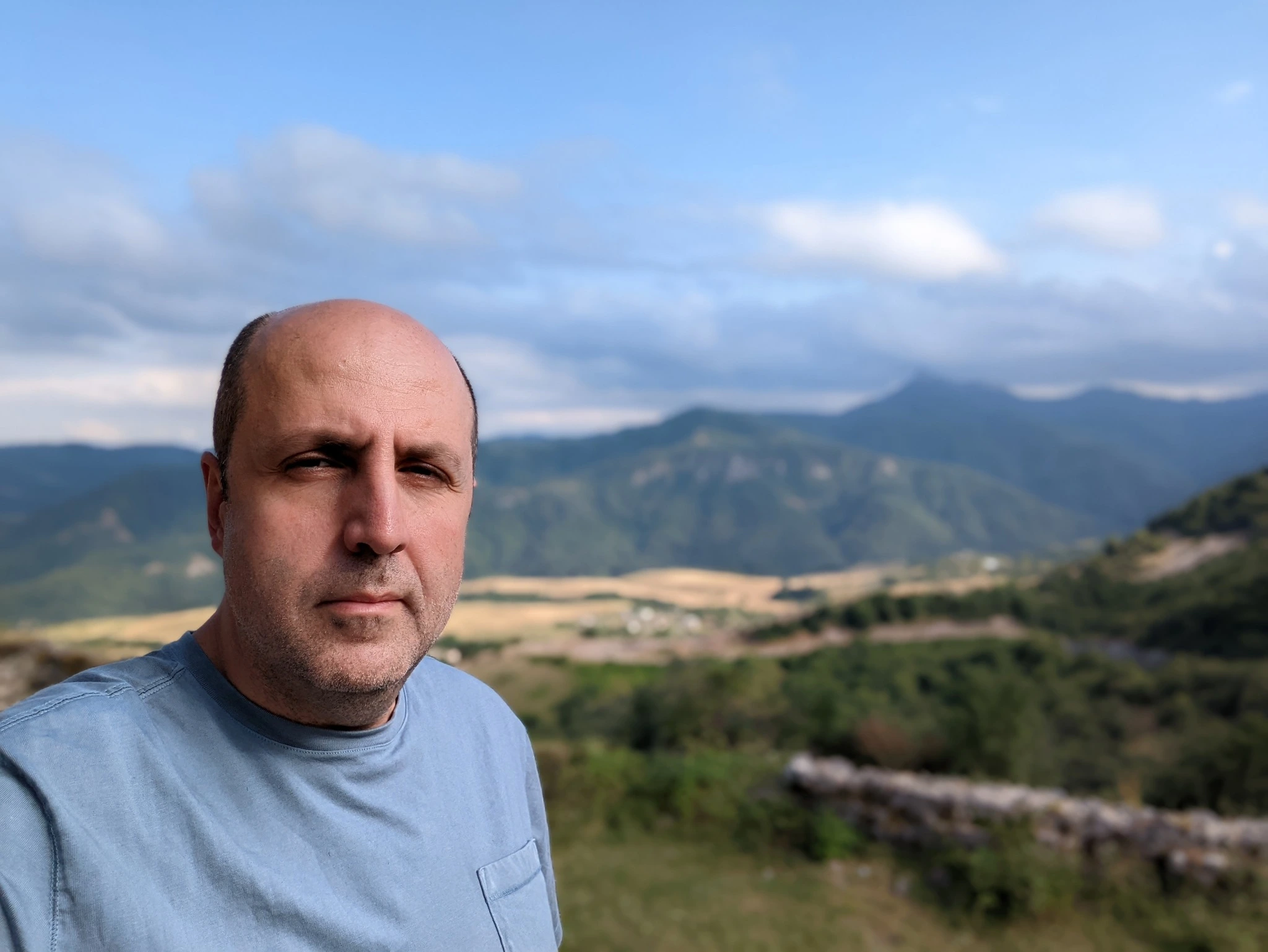
Hovik Manucharyan
Hovik Manucharyan is an information security engineer who moved from Seattle to Armenia in 2022. He co-founded the ANN/Groong podcast in 2020 and has been a contributor to Groong News since the late 1990s.
Disclaimer: The views expressed by Hovik Manucharyan on the ANN/Groong podcast are his own and do not necessarily reflect the opinions of his employer or any other organization.

Asbed Bedrossian
Asbed Bedrossian is an IT professional, and for years oversaw the central IT enterprise infrastructure and services at USC. His decades of experience spanned across IT strategy, enterprise architecture, infrastructure, cybersecurity, enterprise applications, data center operations, high performance computing, ITSM, ITPM, and more.
Asbed founded the Armenian News Network Groong circa 1989/1990, and co-founded the ANN/Groong podcast in 2020.
Related Episodes

Clips from this episode
 Israel's Genocide Recognition: A Geopolitical Signal Against Turkey, Not a Moral Awakening
 Post-Election Crackdown: Stalinist Purge Disabling Opposition Today, Not Tomorrow
 Pashinyan's Silence on Israeli Genocide Recognition Gives Turkey New Ammunition
 Russia's Remittance Threat: $3-4 Billion That Keeps Armenia's Economy Afloat
 Armen Grigoryan in Gdańsk: Russia Reads Ukraine Conference Attendance as Frozen Asset Threat
 Constitutional Court Will Likely Rule for Pashinyan: 60% Chance Nothing Changes, 20% for New Elections