Groong Links:
Topics:
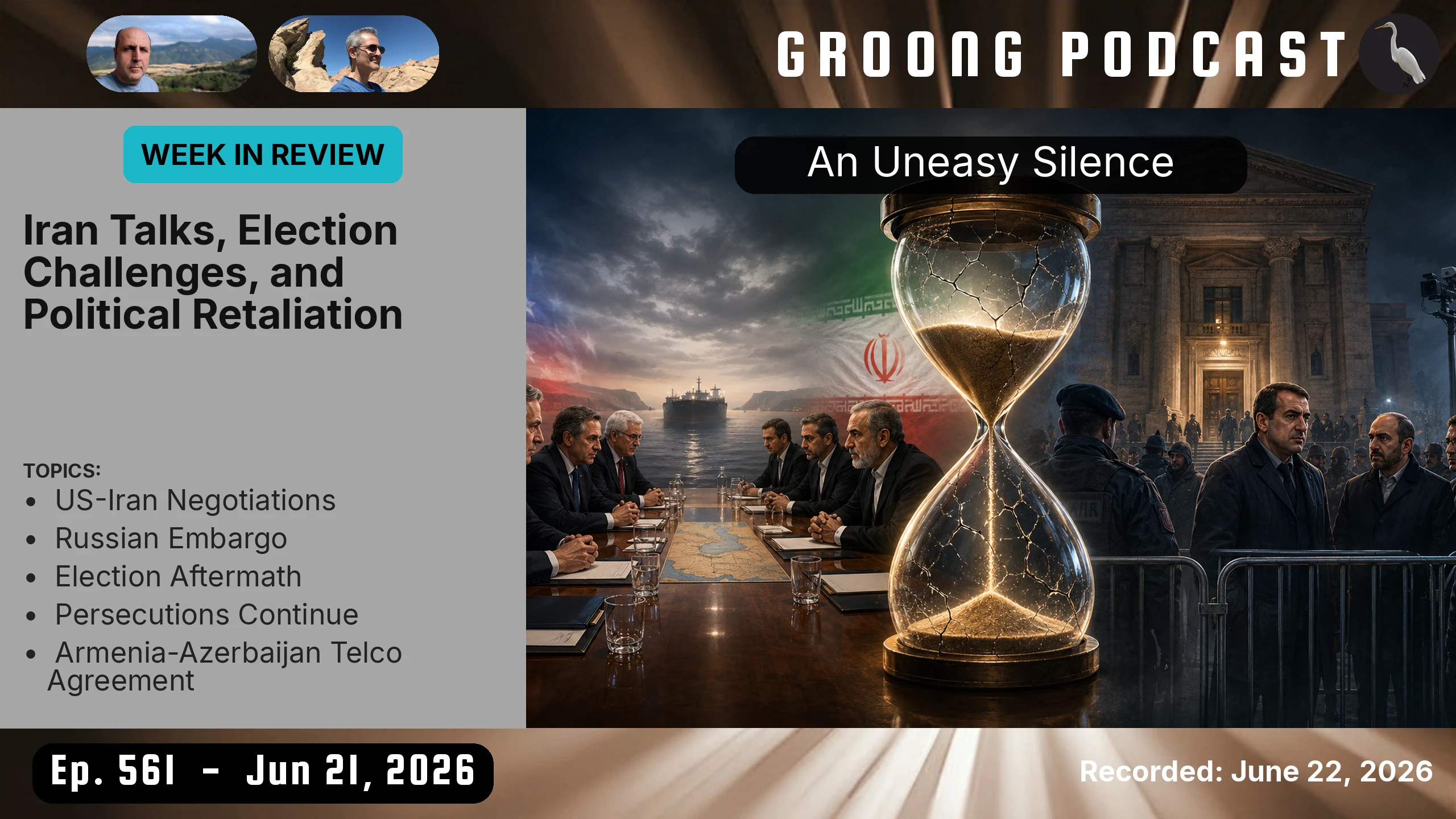
- US-Iran Negotiations
- Russian Embargo
- Election Aftermath
- Persecutions Continue
- Armenia-Azerbaijan Telco Agreement
Episode 561 | Recorded: June 22, 2026
#ArmenianNews #Armenia #Iran #USIranTalks #ArmenianElections #SouthCaucasus #NikolPashinyan #TRIPP
Show Notes
Summary
In this Groong Week in Review episode, Hovik and Asbed examine the fallout from Armenia’s 2026 Armenian Parliamentary Elections, the ongoing US-Iran War ceasefire negotiations and their regional implications, and escalating political persecutions following the vote. We discuss how six opposition parties—including Strong Armenia, Armenia Alliance, Prosperous Armenia, and others—have challenged the election results at the Constitutional Court, Russia’s continued criticism of Pashinyan’s government amid an economic embargo, and Armenia-Azerbaijan telecommunications developments amid broader geopolitical uncertainty in the South Caucasus.US-Iran Negotiations
The US-Iran talks in Switzerland ended with an agreement to extend the ceasefire for another 60 days.
The reported framework includes the release of some frozen Iranian assets, reduced restrictions on Iranian oil and gas trade, and possible support for reconstruction.
The reopening of the Strait of Hormuz may help stabilize global energy prices and financial markets.
Both Iran and the United States appear to be using the ceasefire to recover from recent military and economic pressure.
The hosts discuss whether the negotiations can produce a lasting agreement when major regional actors remain outside the process.
Trita Parsi highlighted several changes in the US position:
- Washington described a regional ceasefire as an American objective.
- Iran was brought into efforts to manage the crisis in Lebanon.
- US Vice President JD Vance acknowledged the right of all regional states to self-defense.
Iran’s threat to close the Strait of Hormuz again appears to have strengthened its leverage over events in Lebanon.
Russian Embargo and Pressure on Armenia
- Moscow has continued its public criticism of the Armenian government.
- The hosts examine reported Russian trade restrictions and pressure on Armenian exports.
- The discussion considers whether these measures are temporary warnings or part of a wider breakdown in Armenia-Russia relations.
- The episode also asks how much economic risk Armenia faces as its relations with Russia continue to deteriorate.
Election Results Challenged in Court
Six opposition forces asked the Constitutional Court to annul the parliamentary election results:
- Strong Armenia
- Armenia Alliance
- Prosperous Armenia
- Wings of Unity
- DOK
- Defenders of Democracy for the Republic
- New Force
The Constitutional Court combined the petitions into one case and scheduled a hearing for June 26.
Edgar Shatiryan was appointed as the presiding judge.
Judges Artak Zeynalyan and Vladimir Vardanyan were removed from the case over concerns about possible bias.
Armenia Alliance also requested the removal of Judge Seda Safaryan.
The court asked several state bodies to submit information, including:
- The Central Electoral Commission
- The Prosecutor General’s Office
- The National Security Service
- The Anti-Corruption Committee
- The Ministry of Internal Affairs
- The Commission on Television and Radio
The hosts examine the political histories of the judges and whether the opposition has grounds to expect a fair hearing.
Political and Legal Pressure Continues
The government has continued to target opposition-linked political and business figures.
Public statements and legal actions have focused on:
- Electric Networks of Armenia
- The Ararat Cement factory
- Gagik Tsarukyan ’s casino interests
- Robert Kocharyan
- Alleged vote-buying by opposition parties
Civil Contract lawmakers have introduced proposals that could prevent parties accused of electoral crimes from entering parliament.
The hosts discuss whether these measures represent law enforcement or a coordinated effort to remove political rivals.
Robert Kocharyan Travel Ban and Criminal Cases
- Robert Kocharyan was stopped at the airport before a planned three-day trip.
- Video of the incident was leaked and used by pro-government media to suggest he was trying to flee Armenia.
- At the time he was stopped, no public criminal case appeared to explain the travel restriction.
- The government later asked the Central Electoral Commission to lift Kocharyan’s immunity as a parliamentary candidate.
- The request was linked to three criminal allegations, including a government property decision made more than 20 years ago.
- The hosts note that the alleged offenses appear to fall outside the statute of limitations.
- The discussion examines the government’s practice of filing cases that may not result in conviction but can still impose years of legal and political pressure.
Armenia-Azerbaijan Telecommunications Agreement
- Team Telecom Armenia and Azertelecom signed a commercial agreement for mutual internet transit.
- The agreement aims to diversify regional telecommunications routes.
- Connections are expected to be established near Kornidzor and Yeraskh.
- The route may help Azerbaijan connect its mainland territory with Nakhichevan through Armenian infrastructure.
- Team Telecom is owned by Hayk and Alexander Yesayan and was formerly known as Beeline Armenia.
- Azertelecom is controlled by NEQSOL Holding, which also owns Caucasus Online.
- Caucasus Online operates a major fiber-optic route linking Armenia to international networks through Georgia and the Black Sea.
- The agreement may support NEQSOL’s wider Digital Silk Way project.
- The hosts ask what practical and strategic benefit Armenia receives in exchange.
Key Questions Discussed
- Can the US-Iran ceasefire lead to a lasting regional agreement?
- Are the negotiations reducing the risk of war, or only delaying another round of conflict?
- Has Iran gained greater influence over US policy in Lebanon?
- Can the Strait of Hormuz remain open without a broader political settlement?
- Is Russia using trade restrictions to punish Armenia’s foreign policy shift?
- How serious is the economic risk from a wider Russian embargo?
- Who is Edgar Shatiryan, and how has he handled election-related cases?
- Why were Artak Zeynalyan and Vladimir Vardanyan removed from the case?
- Should Seda Safaryan also be recused?
- Is it normal for the Constitutional Court to request information from so many state bodies?
- Does the opposition have a realistic chance of overturning the election results?
- Are new election laws being designed to exclude opposition parties from parliament?
- Was Robert Kocharyan’s travel restriction based on law or political pressure?
- Why pursue charges that appear to fall outside the statute of limitations?
- Does the telecommunications agreement create equal benefits for Armenia and Azerbaijan?
- Could the agreement become part of the wider TRIPP infrastructure?
- What internet transit or strategic benefit will Armenia receive through Azerbaijan?
Thoughts from the Participants
- The US-Iran ceasefire may reduce immediate tensions, but it does not resolve the deeper regional conflict.
- Iran appears to have gained leverage by tying the Strait of Hormuz to events in Lebanon.
- The inclusion of Iran in regional talks may mark a change in Washington’s approach.
- The Constitutional Court case will test whether Armenia’s institutions can act independently in a highly politicized environment.
- The removal of judges with direct political links is necessary, but it does not guarantee a fair process.
- The government’s legal campaign against opposition leaders appears aimed at weakening or removing rivals after the election.
- Cases involving expired statutes of limitations may still serve as tools of harassment.
- The telecommunications agreement appears to offer Azerbaijan a clear route to Nakhichevan, while Armenia’s reciprocal benefit remains unclear.
- Regional integration agreements should be judged by what Armenia receives, not only by claims of peace or connectivity.
Referenced Articles & Sources
- Trita Parsi: Key Points from the US-Iran Talks
- Moscow Keeps Up Criticism of Yerevan
- Edgar Shatiryan Appointed Presiding Judge
- Constitutional Court Appoints Judge in Election Case
- Two Judges Recused from Election Dispute
- Constitutional Court to Hear Opposition Election Petitions
- Team Telecom and Azertelecom Sign Transit Agreement
- Armenia-Azerbaijan Telecom Operators Sign Internet Transit Agreement
- Armenpress Report on the Telecommunications Agreement
Wrap-up
Links and Resources
That’s our show , we hope you found it helpful. We invite your feedback and your suggestions, you can find us on most social media and podcast platforms.
Thanks to Laura Osborn for the music on our podcasts.
Hosts

Hovik Manucharyan
Hovik Manucharyan is an information security engineer who moved from Seattle to Armenia in 2022. He co-founded the ANN/Groong podcast in 2020 and has been a contributor to Groong News since the late 1990s.
Disclaimer: The views expressed by Hovik Manucharyan on the ANN/Groong podcast are his own and do not necessarily reflect the opinions of his employer or any other organization.

Asbed Bedrossian
Asbed Bedrossian is an IT professional, and for years oversaw the central IT enterprise infrastructure and services at USC. His decades of experience spanned across IT strategy, enterprise architecture, infrastructure, cybersecurity, enterprise applications, data center operations, high performance computing, ITSM, ITPM, and more.
Asbed founded the Armenian News Network Groong circa 1989/1990, and co-founded the ANN/Groong podcast in 2020.

Clips from this episode
 Kocharyan Stopped at Airport, Then Hit With 20-Year-Old Cases
 The Minsk Trap: Why Iran Should Fear the US Ceasefire Deal
 Team Telecom Routes Armenian Internet Through Azerbaijan: A Strategic Trap
 Constitutional Court Stacked Entirely With Pashinyan Appointees
 The Opposition Hopes the Court Will Act Fairly. Hovik Thinks That's Unfounded Optimism.
 Russia's Embargo Will Hit Armenia Hardest in August and September