Groong Links:
Guest(s):
Topics:
- Election aftermath and disputed legitimacy
- Threats against opposition parties
- Armenia-Russia tensions after vote
- EU lifeline for Armenian exports
- Polling failures and hidden votes
Episode 559 | Recorded: June 18, 2026
#Armenia #ArmenianElections #HrantMikaelian #NikolPashinyan #CivilContract #ArmeniaRussia #Polling
Show Notes
Summary
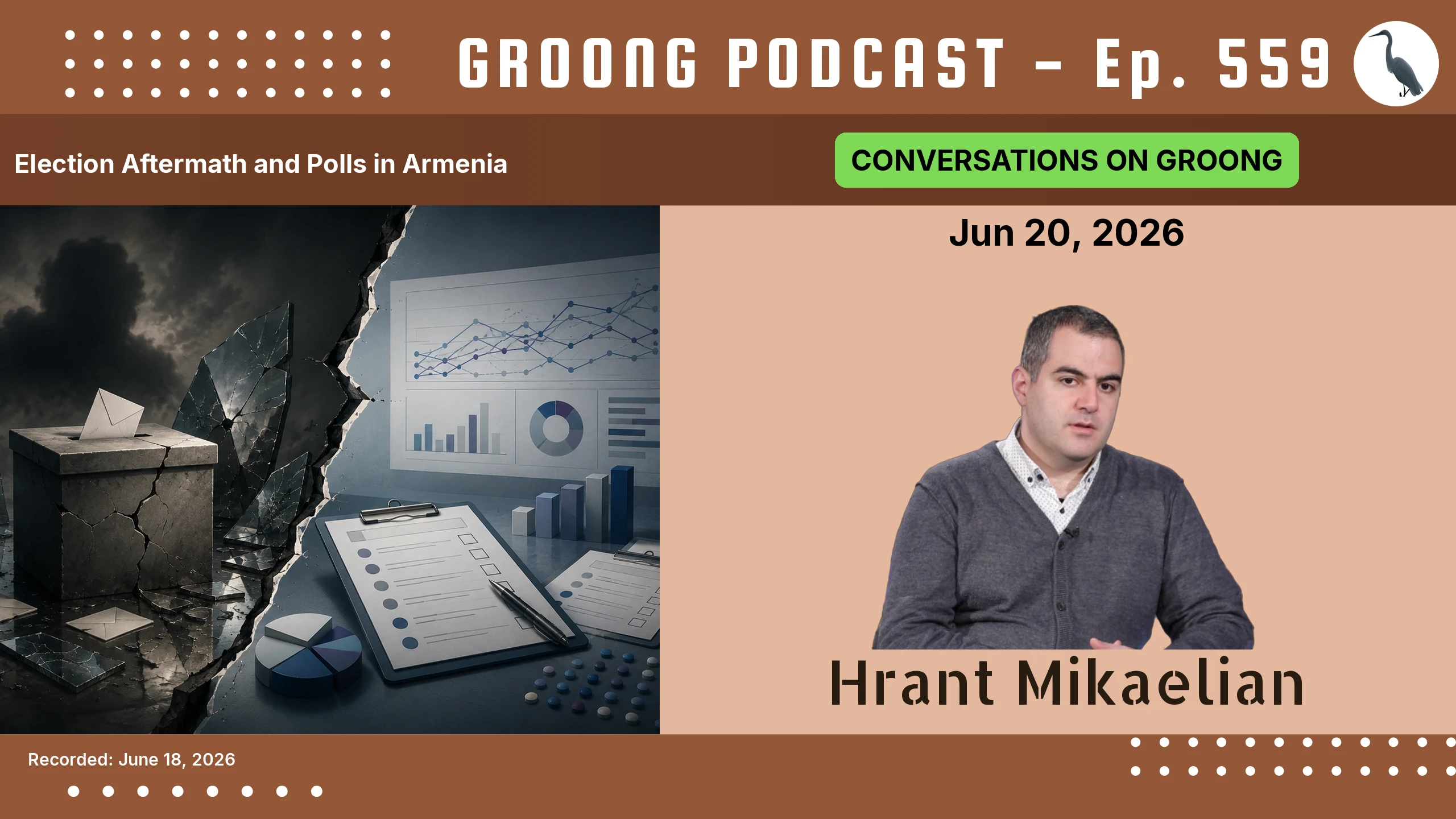
In this episode of Conversations on Groong, we speak with Hrant Mikaelian about the disputed aftermath of Armenia’s June 7, 2026 parliamentary election. We discuss allegations of electoral fraud, threats against opposition parties, the Anti-Corruption Committee’s proposed ban on opposition groups, Armenia-Russia tensions following the vote, and the EU’s financial support for Armenian agricultural exports amid Russian sanctions.Show Notes
In this episode of Conversations on Groong, Hovik and Asbed are joined by political scientist and researcher Hrant Mikaelian to discuss the aftermath of Armenia’s June 7 parliamentary elections , the government’s pressure on opposition parties, Armenia’s worsening relations with Russia, and the poor record of political polling in Armenia. The conversation focuses on why Pashinyan’s government appears dissatisfied even after claiming victory, how the fight over Prosperous Armenia ’s votes could affect the new parliament, whether the opposition should accept its mandates, and how the demand for a constitutional referendum may shape the next stage of political conflict. The episode also examines Russia’s export pressure on Armenia, the EU’s offer of support, Putin ’s decision not to congratulate Pashinyan , and why Armenian polls failed to predict the final election result.
Main Topics Addressed
Election Aftermath
- Pashinyan’s post-election rhetoric and threats against the opposition
- Claims that opposition votes were illegitimate or obtained through bribery
- The Anti-Corruption Committee’s draft law to ban political parties
- Prosperous Armenia’s exclusion from parliament after results were cancelled in three precincts
- The opposition’s path to the Constitutional Court
- Whether new elections could be called under harsher conditions
- The role of Samvel Karapetyan and Strong Armenia
- Why Pashinyan may prefer Robert Kocharyan as the main opposition figure
- The opposition’s failure to fully consolidate before the election
- Whether opposition parties should accept parliamentary mandates
- The coming local elections and their importance for Armenia’s political landscape
Constitutional Referendum and Azerbaijan’s Demands
- Azerbaijan’s continued demand for constitutional change in Armenia
- The political importance of Civil Contract falling short of a two-thirds majority
- Why a three-fifths majority may not be enough for Pashinyan’s full agenda
- The role of a possible referendum in the Armenia-Azerbaijan process
- How opposition mandates could constrain Pashinyan in parliament
- Why the government may want to weaken or remove parts of the opposition before the next stage
Armenia-Russia Relations
- Russia’s pressure on Armenian exports, including agricultural products
- The EU’s announced $50 million credit line for Armenia
- Claims that EU markets may open to Armenian agricultural goods
- The Netherlands and possible market access for Armenian flowers
- The limits of replacing the Russian market with EU demand
- Logistical problems facing Armenian exports to Europe
- Russia’s decision not to fully normalize relations after the election
- Putin’s refusal, so far, to congratulate Pashinyan
- Sergey Naryshkin’s statement that Armenia’s elections were questionable
- Whether Russia may deal with Pashinyan as the effective ruler without recognizing the election
Polling in Armenia
- Why Armenian political polling has become less reliable since 2018
- The failure of EVN Report, IRI, and MPG polls to capture Civil Contract’s final result
- High refusal rates and hidden vote problems
- Why political fear may distort poll responses
- The difference between vote-share accuracy and balance accuracy
- Why unpublished polls may be closer, but are not available to the public
- The importance of metadata, weighting, and interpretation
- Whether Groong or another independent organization could support more transparent public polling
Key Questions Discussed
- How should the outcome of the June 7 election be evaluated?
- Why is Pashinyan escalating his rhetoric after claiming victory?
- Is the government preparing more arrests or criminal cases against the opposition?
- Why would the government want to remove Strong Armenia from the political field?
- Did the opposition make a strategic mistake by failing to unify?
- Should the opposition accept its mandates or reject the legitimacy of the new parliament?
- Can Prosperous Armenia regain parliamentary representation through the Constitutional Court?
- Is the constitutional referendum the key reason Pashinyan wants more control?
- Can the EU realistically replace Russia as a market for Armenian agricultural exports?
- What does Putin’s refusal to congratulate Pashinyan signal?
- Will Russia begin working more directly with Armenian opposition forces?
- Do Armenian polls still have value if they fail to predict election results?
- Are polling errors driven by fear, non-response, poor methodology, or data processing?
- Could a transparent, independent Groong poll fill a gap in Armenia’s public information space?
Polling Accuracy Table
| Data | Civil Contract | Main Opposition (SA, HD, PAP, WU) | Forecast Accuracy Score (RMSE), lower is better | Balance Accuracy Score, lower is better |
|---|---|---|---|---|
| Election Results | 49.80% | 39.50% | ||
| EVN, 2026-03-31 | 33.60% | 20.50% | 17.66% | 2.80% |
| IRI, 2026-03-13 | 24.00% | 17.00% | 24.21% | 3.30% |
| MPG, 2026-04-03 | 24.30% | 33.30% | 18.56% | 19.30% |
| EVN, 2026-05-02 | 32.50% | 17.90% | 19.57% | 4.30% |
| IRI, 2026-05-11 | 32.00% | 11.00% | 23.76% | 10.70% |
| MPG, 2026-05-21 | 28.80% | 44.90% | 15.33% | 26.40% |
| MPG, 2026-06-03 | 32.40% | 49.80% | 14.30% | 27.70% |
Notes on the Polling Table
- Forecast Accuracy Score (RMSE): Measures how close a poll’s predicted vote shares were to the final reported election results for both Civil Contract and the main opposition. Lower is better. A score of 0 would be a perfect forecast.
- Balance Accuracy Score: Measures how well a poll captured the final balance between the government and the opposition, regardless of whether it overestimated or underestimated both sides.
- The table does not account for hidden vote, which was very high in some polls.
- The main opposition total includes Strong Armenia, Hayastan Dashinq , Prosperous Armenia, and Wings of Unity where listed.
Main Polling Observations
- No poll came close to Civil Contract’s final reported result.
- Every poll underestimated the ruling party.
- MPG had the best forecast accuracy by RMSE.
- EVN and IRI had the best balance accuracy.
- The “best” poll depends on which metric is used.
- MPG was closer on vote shares.
- EVN and IRI were closer on the government-opposition balance.
- MPG improved as election day approached.
- EVN and IRI did not improve over time.
- Opposition support was easier to estimate than Civil Contract support.
- The largest miss was Civil Contract’s final reported surge.
- Hrant argued that public polls are shaped by who funds them, when they are released, how data is processed, and whether people are afraid to respond.
- Hrant also noted that polls on less divisive issues may still be useful, even if vote-intention polls are now highly problematic.
Comparison of Polling With Official Election Results
The table below compares several public polls with the official election results reported after Armenia’s June 7 parliamentary election. A caution is necessary: the election was not free or fair according to the opposition, so the official results should not be treated as a clean democratic outcome. They are still useful as a reference point for comparing how far the public polls were from the reported result, but there are risks in interpreting the gap as a normal polling error.
| Data | Civil Contract | Main Opposition (SA, HD, PAP, WU) | Forecast Accuracy Score (RMSE), lower is better | Balance Accuracy Score, lower is better |
|---|---|---|---|---|
| Election Results | 49.80% | 39.50% | ||
| EVN 2026-03-31 | 33.60% | 20.50% | 17.66% | 2.80% |
| IRI 2026-03-13 | 24.00% | 17.00% | 24.21% | 3.30% |
| MPG 2026-04-03 | 24.30% | 33.30% | 18.56% | 19.30% |
| EVN 2026-05-02 | 32.50% | 17.90% | 19.57% | 4.30% |
| IRI 2026-05-11 | 32.00% | 11.00% | 23.76% | 10.70% |
| MPG 2026-05-21 | 28.80% | 44.90% | 15.33% | 26.40% |
| EVN 2026-05-31 | 36.30% | 21.40% | 15.97% | 4.60% |
| MPG 2026-06-03 | 32.40% | 49.80% | 14.30% | 27.70% |
Notes:
- Forecast Accuracy Score (RMSE): Measures how close a poll’s predicted vote shares were to the official election results for both Civil Contract and the main opposition. Lower is better. A score of 0 would be a perfect forecast.
- Balance Accuracy Score: Measures how well a poll captured the official balance between the government and the opposition, regardless of whether it overestimated or underestimated both sides.
- The “Main Opposition” total includes Strong Armenia, Hayastan Dashinq, Prosperous Armenia, and Wings of Unity where listed.
- The table does not account for hidden vote, high refusal rates, administrative pressure, or other election-day and pre-election distortions discussed in the episode.
Referenced Articles & Sources
- CEC announces final results of Armenia’s parliamentary elections
- Armenia’s elections regulator confirms victory for PM’s party in poll closely watched by Russia
- Armenian opposition party files petition to annul June election results
- Armenia’s opposition faces arrests as it contests the ruling party’s election win
- Law enforcement body seeks to ban parties linked to vote-buying from electoral processes
- Aliyev Aide Visits Armenia
- Pashinyan says Armenian constitutional referendum to take place after 2026 elections
- EU preparing economic support package for Armenia after Russian pressure on it
- Von der Leyen: EU prepares €50 million for Armenia following Russia’s export restrictions
- Yerevan Seeking Faster EU Aid Against Russian Sanctions
- EU readies trade relief for Armenia after Russian import bans
- Russia calls Armenian elections “questionable”
- Naryshkin calls Armenia election results “questionable”
- Incumbent Improves, Opposition Fragments: Armenia’s Parliamentary Elections Take Shape
- Opposition Remains Fragmented, While Incumbent Strengthens: Armenia Heads Into Election Day
- IRI Pre-Election Assessment Mission to Armenia’s 2026 Parliamentary Elections
- Lead of Pashinyan’s Civil Contract party widens in new poll
- Armenians reveal voting preferences in latest poll
Wrap-up
Links and Resources
That’s our show , we hope you found it helpful. We invite your feedback and your suggestions, you can find us on most social media and podcast platforms.
Thanks to Laura Osborn for the music on our podcasts.
Guests

Hrant Mikaelian
Hrant Mikaelian is a political scientist and multidisciplinary researcher in social sciences based in Yerevan.
Hosts

Hovik Manucharyan
Hovik Manucharyan is an information security engineer who moved from Seattle to Armenia in 2022. He co-founded the ANN/Groong podcast in 2020 and has been a contributor to Groong News since the late 1990s.
Disclaimer: The views expressed by Hovik Manucharyan on the ANN/Groong podcast are his own and do not necessarily reflect the opinions of his employer or any other organization.

Asbed Bedrossian
Asbed Bedrossian is an IT professional, and for years oversaw the central IT enterprise infrastructure and services at USC. His decades of experience spanned across IT strategy, enterprise architecture, infrastructure, cybersecurity, enterprise applications, data center operations, high performance computing, ITSM, ITPM, and more.
Asbed founded the Armenian News Network Groong circa 1989/1990, and co-founded the ANN/Groong podcast in 2020.
Related Episodes


Clips from this episode
 Why Pashinyan is terrified even after winning the election
 Prosperous Armenia robbed of parliament through cancelled precinct results
 How Western intelligence shaped Armenia's 2026 election
 Why all Armenian polls failed spectacularly: garbage in, garbage out
 The opposition's only remaining path: Constitutional Court and local elections
 Armenia faces impossible choice: replace Russia with EU markets overnight or collapse