Groong Links:
Topics:
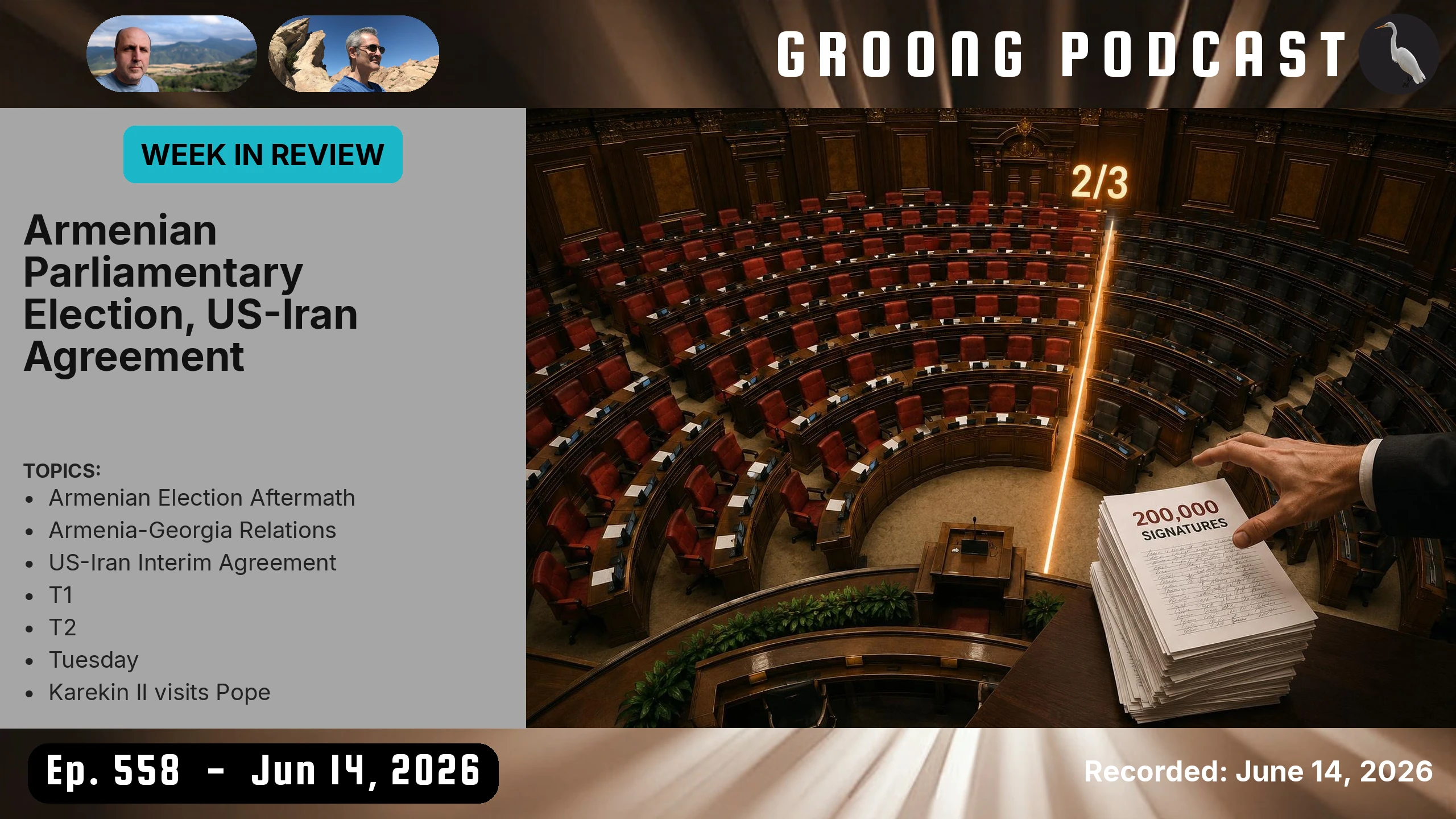
- Armenian Election Aftermath
- Armenia-Georgia Relations
- US-Iran Interim Agreement
Episode 558 | Recorded: June 15, 2026
#Armenia #ArmenianNews #ArmenianElections #CivilContract #Pashinyan #ArmenianConstitution #Referendum #ProsperousArmenia #SouthCaucasus #CEC
Show Notes
Summary
In this episode of Groong Week in Review for June 14, 2026, hosts Hovik Manucharyan and Asbed Bedrossian analyze the aftermath of Armenia’s 2026 Armenian Parliamentary Election, shifting Armenia-Georgia relations, and a landmark interim US-Iran agreement that reshapes regional stability. We discuss the ceasefire framework, sanctions relief, and how the Iran war’s resolution affects Armenian security, energy markets, and the broader South Caucasus landscape.Main Topics Addressed
U.S.-Iran Interim Agreement
- The U.S. and Iran reportedly reached a digitally signed interim framework to halt direct fighting.
- The deal is expected to stop hostilities for a 60-day negotiation window.
- Core reported terms include reopening the Strait of Hormuz, easing immediate U.S. pressure, and deferring harder issues.
- Unresolved issues include sanctions, frozen funds, uranium stockpiles, Iran’s nuclear program, and ballistic missiles.
- Hovik argues that the agreement may be fragile because Israel and Lebanon remain outside the clean terms of the deal.
- Iran has insisted that the fighting must stop on all fronts, including Lebanon.
- Israel has said it will not withdraw from south Lebanon and does not appear bound by the U.S.-Iran framework.
- The hosts warn that Israel, Hezbollah, or Iran could each become a spoiler if the Lebanon issue remains unresolved.
- Asbed argues that Washington may be using the pause to reload and stabilize markets, not necessarily to settle the conflict.
Armenian Election Aftermath
- The hosts revisit the suspicious drop in Prosperous Armenia’s vote share below the 4% threshold.
- Prosperous Armenia had appeared to be at or near the threshold, but was later pushed below it.
- The disputed margin amounted to roughly 60 to 70 votes.
- Recounts returned some votes to Prosperous Armenia, but the CEC then invalidated results in precincts where Prosperous Armenia had performed strongly.
- Two key invalidated precincts cost Prosperous Armenia 213 votes.
- The CEC refused to hold a re-vote in those precincts, saying it wanted to avoid new distortions.
- Hovik argues that Armenian law required a re-vote in those precincts if the irregularities could affect the final result.
- The hosts argue that the CEC’s actions pushed Prosperous Armenia out of parliament.
- The final allocation gave Civil Contract 64 seats out of 105, enough for a three-fifths majority.
- Strong Armenia and Armenia Alliance entered parliament as the two opposition blocs.
- Prosperous Armenia, Bright Armenia, ANC, National Democratic Pole, and others remain outside parliament.
Three-Fifths Majority and Opposition Strategy
- Civil Contract’s 64 seats give it the ability to pass key decisions and appointments without meaningful opposition veto power.
- The opposition faces a difficult choice over whether to accept mandates.
- Hovik argues that accepting mandates alone would repeat the weak opposition model of the 2021 parliament.
- Asbed argues that Strong Armenia and Armenia Alliance should take their mandates, appeal to the Constitutional Court, and organize street pressure in parallel.
- The hosts discuss whether rejecting mandates would allow Pashinyan to replace the opposition with a more compliant force.
- Hovik expects Civil Contract to use pressure, kompromat, arrests, or other tools to seek defectors.
- Six opposition parties issued a joint statement saying the election results cannot serve as a basis for a legitimate government.
Constitutional Change and Referendum Route
- Justice Minister Srbuhi Galyan suggested that the people have a direct right to initiate constitutional change.
- The hosts reject the claim that 200,000 signatures alone can bypass parliament.
- Hovik says parliament remains the gatekeeper for any referendum on a new Constitution.
- A two-thirds parliamentary vote is still required to send a new Constitution to referendum.
- Civil Contract has a three-fifths majority, but not a two-thirds majority.
- The hosts argue that this gives the opposition one major blocking tool, if it remains united.
- Hovik warns that Civil Contract may try to pressure or flip opposition MPs to reach the needed threshold.
Post-Election Pressure and Political Repression
- The hosts discuss Robert Kocharyan being stopped at the airport after the election.
- Hovik links this to Pashinyan’s broader threats against the opposition.
- Pashinyan has claimed that opposition votes were obtained through bribery.
- The hosts discuss pre-election arrests tied to alleged vote buying, mostly aimed at Strong Armenia and Armenia Alliance circles.
- Asbed contrasts this with what he describes as Civil Contract’s own systematic use of state spending to influence voters.
Pre-Election Spending and Post-Election Taxes
- The hosts discuss pension increases and healthcare benefits introduced near the election.
- Hovik argues that these measures were unfunded or irresponsibly timed.
- The hosts describe them as a form of state-funded voter inducement.
- After the election, the government moved to raise excise taxes on cigarettes, vaping products, fuel, and other goods.
- Hovik argues that the bill for pre-election spending is now being passed on to ordinary consumers.
- The hosts reject the idea that tobacco taxes are only about healthcare, arguing that they are also a revenue measure.
- They warn that Armenia’s debt and new annual spending commitments create future fiscal pressure.
Hikmet Hajiyev Visit to Armenia
- The first major foreign visitor to Armenia after the election was Hikmet Hajiyev, aide to Azerbaijani President Ilham Aliyev .
- Hajiyev met with Armen Grigoryan and visited Dilijan.
- Hovik frames the visit as Azerbaijan presenting the post-election “invoice” to Pashinyan.
- The hosts argue that Pashinyan is now under pressure to deliver on commitments tied to Azerbaijan and regional corridors.
Armenia-Georgia Relations and Regional Corridors
- The hosts discuss analysis by Hakob Badalyan about possible EU efforts to create competition between Armenia and Georgia.
- Georgia is currently the established land communication route between Central Asia, Azerbaijan, Turkey, and Europe.
- The Baku-Tbilisi-Kars railway already serves as a regional transport corridor.
- The EU has emphasized Armenia as a possible shorter route through the Middle Corridor, including the Zangezur Corridor / TRIPP concept.
- Hovik says this could create competition between Armenia and Georgia.
- Georgia’s Prime Minister Irakli Kobakhidze has warned that some Europeans may be trying to create tension between Armenia and Georgia.
- The hosts argue that Azerbaijan could exploit such competition and present itself as the regional broker.
- They also discuss EU and U.S. moves that may strengthen Azerbaijan’s role as a regional hegemon.
- Turkey and Azerbaijan are positioned to benefit whether the West’s TRIPP project succeeds or Russia returns to the region.
Artsakh and Regional Balance
- Asbed identifies the right of return for Artsakhtsis as a key vulnerable issue.
- Hovik argues that right of return must include security guarantees and self-determination.
- The hosts warn that Azerbaijani and Turkish hegemony would harm Armenia, Georgia, Iran, and Russia.
- They conclude that Armenia and Georgia must preserve a strong partnership to resist external manipulation.
Key Questions Discussed
- Is the U.S.-Iran interim agreement a real peace framework or a temporary pause?
- What does Iran gain from the agreement?
- What does the U.S. gain from the agreement?
- Can the deal survive if Israel refuses to withdraw from south Lebanon?
- Does Lebanon remain the main spoiler in the U.S.-Iran framework?
- Why did Prosperous Armenia fall below the 4% threshold?
- Did the CEC’s invalidation of precinct results change the parliamentary outcome?
- Was the refusal to hold a re-vote in the invalidated precincts legal?
- Who benefited from Prosperous Armenia being kept out of parliament?
- Should Strong Armenia and Armenia Alliance accept their parliamentary mandates?
- Can the opposition resist Civil Contract’s three-fifths majority?
- Can Civil Contract pursue constitutional change without a two-thirds majority?
- Does the 200,000-signature referendum path bypass parliament?
- Will Pashinyan use arrests, pressure, or defections to gain the votes needed for constitutional change?
- Were pre-election pension and healthcare benefits a form of state-funded vote buying?
- Are new excise taxes the first bill for pre-election spending?
- What did Hikmet Hajiyev’s post-election visit signal?
- Is the EU trying to turn Armenia into a corridor competitor against Georgia?
- Can Azerbaijan use Armenia-Georgia competition to expand its regional influence?
- What happens to Artsakh ’s right of return under a regional order dominated by Azerbaijan and Turkey?
Referenced Articles & Sources
Reuters: U.S.-Iran interim deal and reported Geneva signing https://www.reuters.com/world/middle-east/trump-iran-text-iran-deal-be-released-after-friday-2026-06-15/
Reuters: U.S.-Iran halt to war, Hormuz reopening, and oil market reaction https://www.reuters.com/world/asia-pacific/iran-us-agree-halt-war-reopen-hormuz-sending-oil-prices-tumbling-2026-06-15/
The Guardian: Israel says it will not withdraw from south Lebanon https://www.theguardian.com/world/2026/jun/15/israel-territory-lebanon-defence-minister-israel-katz
Armenpress: Final results of Armenia’s 2026 parliamentary election https://armenpress.am/en/article/1252978
Armenpress: Final mandate allocation after the election https://armenpress.am/en/article/1252983
Armenpress: CEC decision on invalidated precinct results and no re-vote https://armenpress.am/en/article/1252997
Elections.am: Official CEC parliamentary election page https://www.elections.am/Elections/Parliamentary
Azatutyun: Debate over constitutional referendum path and parliamentary gatekeeping https://www.azatutyun.am/a/inchpe-s-e-pashinyany-hanrakvei-dnelou-nor-sahmanadroutyan-nakhagitsy-hnaravo-r-e-shrjantsel-khorhrdarany/33777533.html
Azatutyun: Justice Minister Srbuhi Galyan comments on referendum route https://www.azatutyun.am/a/33777630.html
Armenpress: Srbuhi Galyan on assessing public demand for constitutional change https://armenpress.am/en/article/1252612
Aravot / Hakob Badalyan: Daily analysis on Armenia-Georgia relations and regional corridor competition https://www.youtube.com/@aravotam
Wrap-up
Links and Resources
That’s our show , we hope you found it helpful. We invite your feedback and your suggestions, you can find us on most social media and podcast platforms.
Thanks to Laura Osborn for the music on our podcasts.
Hosts

Hovik Manucharyan
Hovik Manucharyan is an information security engineer who moved from Seattle to Armenia in 2022. He co-founded the ANN/Groong podcast in 2020 and has been a contributor to Groong News since the late 1990s.
Disclaimer: The views expressed by Hovik Manucharyan on the ANN/Groong podcast are his own and do not necessarily reflect the opinions of his employer or any other organization.

Asbed Bedrossian
Asbed Bedrossian is an IT professional, and for years oversaw the central IT enterprise infrastructure and services at USC. His decades of experience spanned across IT strategy, enterprise architecture, infrastructure, cybersecurity, enterprise applications, data center operations, high performance computing, ITSM, ITPM, and more.
Asbed founded the Armenian News Network Groong circa 1989/1990, and co-founded the ANN/Groong podcast in 2020.
Related Episodes


Clips from this episode
 CEC Invalidated 213 Votes to Push Prosperous Armenia Below 4% Threshold
 Why Armenia and Georgia Must Stay United or Face Azerbaijan Hegemony
 Pashinyan's Pre-Election Spending Was Vote-Buying, Now Comes the Bill
 Israel Won't Commit to the U.S.-Iran Deal, Which Could Destroy the Whole Agreement
 Opposition Must Take Parliamentary Mandates AND Protest in the Streets
 The Right of Return for Artsakh Armenians Remains Unresolved and Vulnerable