Groong Links:
Guest(s):
Topics:
- Contested results and thresholds
- Pashinyan’s post-election crackdown
- Western backing and interference
- Russia’s delayed pressure campaign
- Opposition choices after the vote
Episode 557 | Recorded: June 9, 2026
#ArmenianElections #Armenia #NikolPashinyan #CivilContract #StrongArmenia #ArmenianOpposition
Show Notes
Summary
In this episode of Conversations on Groong, we speak with Arthur G. Martirosyan about Armenia’s contested 2026 Armenian Parliamentary Election and Pashinyan’s path to a third term. We discuss whether the vote was free and fair, how state pressure and Western backing shaped the outcome, the razor-thin thresholds that determine parliamentary representation, Pashinyan’s post-election crackdown against the Established Opposition, and what a Civil Contract supermajority would mean for Armenia’s governance and the Armenia-Azerbaijan Peace Process.Main Topics Addressed
Armenia’s Post-Election Results
The episode opens with the preliminary election results reported by the Central Electoral Commission:
- Civil Contract : 49.825%
- Strong Armenia : 23.281%
- Armenia Alliance : 9.934%
- Prosperous Armenia : 3.996%
- Wings of Unity : 2.303%
The discussion focuses on why the three-digit precision matters. Prosperous Armenia appears to be only 0.004% short of the 4% threshold needed to enter parliament. That small gap could decide whether Prosperous Armenia receives mandates, whether opposition votes are reallocated, and whether Pashinyan ’s Civil Contract can reach a 3/5th majority.
Was the Election Free and Fair?
Arthur Martirosyan argues that a free and fair election cannot be judged only by what happened on voting day. It must include:
- The pre-election environment
- Arrests and pressure on opposition figures
- The role of public television
- Wiretaps and leaked recordings
- The post-election recount and court process
- Whether the opposition has real legal recourse
He argues that the promise of 2018, that power in Armenia could be changed through elections, has now been severely damaged. In his view, the ruling party showed that it intends to remain in power and that the institutions of the state are not independent enough to check it.
The Role of the CEC and Invalid Ballots
The discussion highlights concern over the Central Electoral Commission, chaired by Vahagn Hovakimyan, a long-time associate of Nikol Pashinyan.
The hosts and guest discuss the unusually high number of invalid ballots, roughly 17,000, compared to much lower numbers in prior elections. This is especially important because Prosperous Armenia’s reported shortfall is only around 50 to 75 votes. The episode argues that recounts are not only justified, but essential.
Martirosyan also notes that recounts alone may not be enough if the process is controlled by institutions loyal to the ruling party.
Civil Contract’s Majority Problem
The episode examines whether Pashinyan achieved his goals. Martirosyan argues that he did not fully achieve them.
Pashinyan wanted a constitutional majority, which would allow him to push through major changes, including constitutional changes demanded by Azerbaijan as part of a possible peace agreement . Civil Contract’s reported result does not give him that majority outright.
The discussion then turns to the 3/5th majority. If Prosperous Armenia remains outside parliament, Civil Contract may have a stronger position through mandate reallocation. But even then, Martirosyan argues that Pashinyan may still need to pressure or co-opt individual opposition MPs to achieve his larger goals.
Prosperous Armenia and the 0.004% Fight
The episode covers Prosperous Armenia’s effort to recover the small number of votes needed to clear the parliamentary threshold. The hosts note that the party has identified precinct-level reporting problems and is focusing on recounts.
The discussion also covers the timing of a criminal case against Gagik Tsarukyan, the head of Prosperous Armenia. The timing is treated as politically significant because Tsarukyan’s party is fighting to enter parliament and could affect the balance of power.
Opposition Strategy and Fragmentation
Martirosyan criticizes the opposition for entering the election in a fragmented form. He argues that the 2026 election was not a normal competition of party programs, but a decision point over whether Armenia would continue under Pashinyan’s current path.
Key points include:
- Too many small parties entered the race.
- Several parties had little chance of clearing the threshold.
- Some anti-Pashinyan votes were wasted.
- The ruling party benefited from fragmentation.
- The opposition failed to unite before the election.
The hosts also raise a paradox: turnout was high, the “vaporized vote” was lower than in 2021, yet a large number of people still reportedly voted for Pashinyan. Martirosyan explains this through administrative pressure, patron-client networks, public sector dependence, and the incumbent’s structural advantage.
Why Did So Many Still Vote for Pashinyan?
Martirosyan argues that the incumbent in Armenia starts with a major built-in advantage. He estimates that a large bloc of voters is tied to the state through jobs, public institutions, personal networks, family ties, and patronage.
He says this includes:
- Government officials
- Police and security-linked circles
- Public sector employees
- Teachers and doctors
- Local officials
- Relatives and dependents of ruling party networks
In his view, Pashinyan’s real competitive vote was much smaller than the full Civil Contract total suggests, because a large part of the vote came from administrative and network-based pressure.
Pashinyan’s Threats and Post-Election Repression
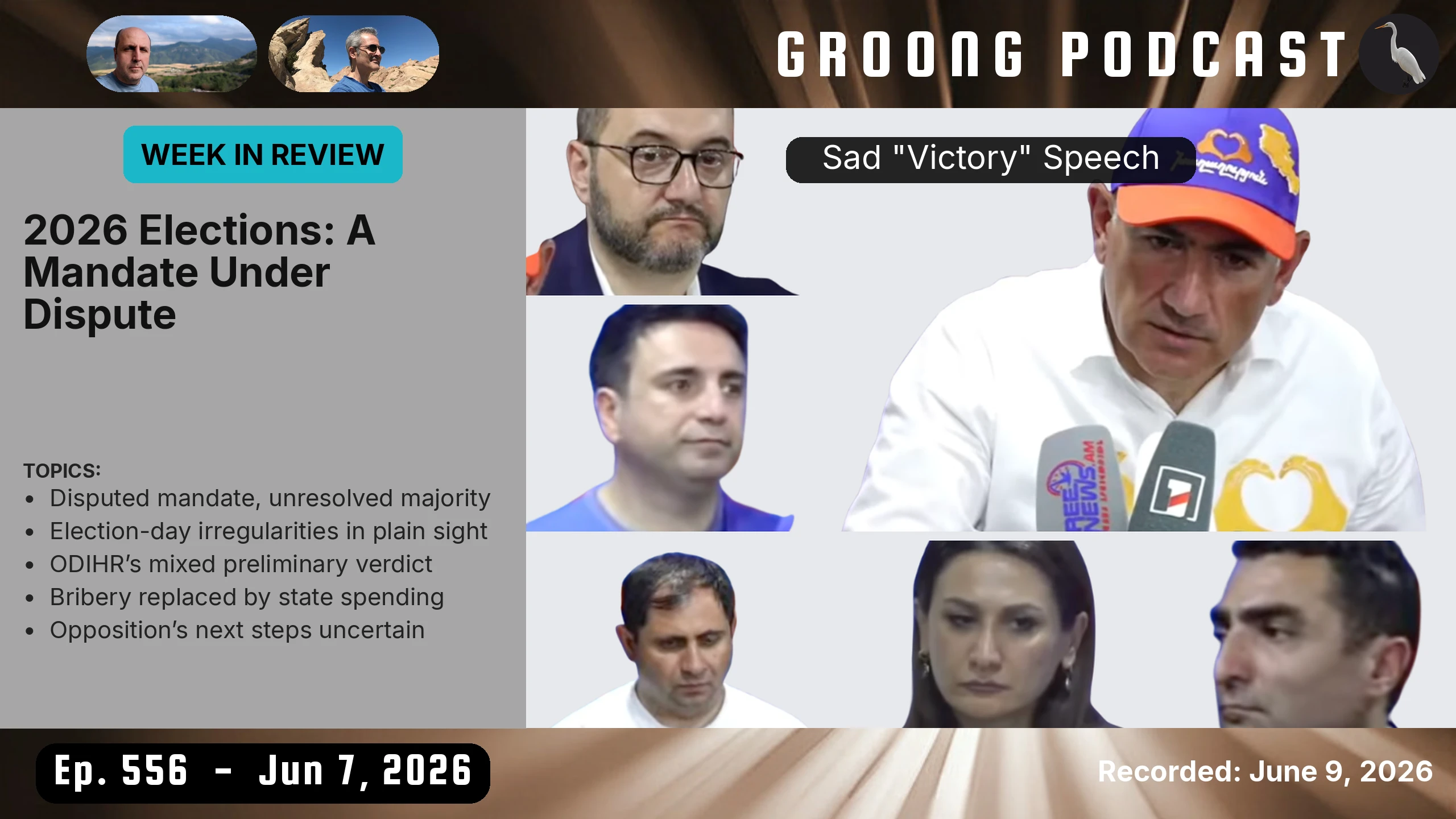
The discussion then turns to Pashinyan’s victory speech and post-election rhetoric. The hosts note that he claimed victory when only a small share of precincts had reported. Rather than call for unity, he repeated threats against opponents and referred back to his Arabkir speech, where he had threatened to “kill” political opponents.
The episode also discusses Pashinyan’s demand that anyone accused of election bribery be kept in jail until the next elections in 2031. Martirosyan frames this as a serious problem in a republic, because the head of the executive branch should not act as prosecutor, judge, and executioner.
The broader concern is that arrests and criminal cases may become a normal governing tool during Pashinyan’s next term.
Courts, Rule of Law, and the Constitutional Court
The episode questions whether court challenges can change the outcome. Martirosyan is skeptical.
He points to the 2021 election challenge, when the opposition went to the Constitutional Court and did not receive meaningful relief. He expects a similar outcome in 2026, with the court likely to say that violations existed but did not affect the final result.
The hosts also note that Armenia’s Constitutional Court is now largely made up of judges seen as loyal to Pashinyan, raising doubts about whether it can serve as an independent arbiter.
Western Support for Pashinyan
The episode argues that Western support was a major factor in the election. Martirosyan says that Western actors framed the election as a choice between Pashinyan and “pro-Russian” forces. In his view, this frame helped protect Pashinyan from serious criticism over repression, arrests, and electoral violations.
The discussion covers:
- Western political support for Pashinyan
- The framing of the opposition as pro-Russian
- Western media coverage of the election
- Macron’s statement that democracy won in Armenia
- U.S. and European interest in pushing Russia out of the region
- The role of security and intelligence cooperation
Martirosyan argues that Western actors are willing to overlook Pashinyan’s conduct because they see him as useful for weakening Russia’s role in Armenia and the South Caucasus .
Russia’s Late Reaction
The episode examines why Russia remained relatively passive during 2023, 2024, and 2025, but began applying sharper pressure in 2026.
Martirosyan offers several explanations:
- Russia believed it still had strong leverage over Armenia.
- Moscow assumed Armenia’s economic dependence would restrain Pashinyan.
- Russia’s foreign policy tools are often blunt rather than subtle.
- Moscow hesitated to use harsh tools until late in the process.
- The Zelensky visit to Yerevan and anti-Russian messaging may have pushed Moscow further.
The Russian Foreign Ministry criticized the election, citing pressure on the opposition and Western interference. Putin had not congratulated Pashinyan at the time of the recording. Martirosyan suggests Moscow may wait until recounts and legal challenges are complete before deciding how to respond.
Armenia, Russia, Europe, and the EAEU
The discussion also covers Armenia’s possible move away from Russia and toward Europe.
Martirosyan argues that Russia’s message is becoming more transactional: if Armenia wants to move toward the European Union, Moscow may say that Armenia cannot do so while still benefiting from Russian subsidies, preferential gas prices, market access, and other advantages.
The episode raises the question of whether Pashinyan has a real mandate to leave the Eurasian Economic Union or pursue EU integration. Martirosyan notes that this issue was not clearly put to voters, and that many Armenian citizens abroad were unable to vote.
Diaspora Voting and Disenfranchisement
Martirosyan argues that Armenia’s voting system excludes hundreds of thousands of Armenian citizens who live outside the country. He says this distorts turnout and weakens the rights of citizens who still hold Armenian passports.
The discussion notes that the government has used fears of “organized” diaspora voting, especially from Russia, to justify restrictions. The hosts argue that claims about mass voter inflows from Russia were exaggerated or false.
The Opposition’s Next Steps
The final section focuses on what the opposition should do next.
Options discussed include:
- Demand recounts
- Participate directly in recounts
- Challenge the results in court
- Accept parliamentary mandates
- Refuse mandates
- Organize street protests
- Coordinate among opposition parties
Martirosyan argues that a party ready for street action does not wait for the courts. If there were enough readiness for mass mobilization, the opposition would already be acting. He suggests the ruling party’s strategy is to drag the process into the courts, delay through the summer, reduce public momentum, and then rely on the Constitutional Court to uphold the results.
He is skeptical that legal challenges will change the outcome, but says the opposition must still seek as much justice as possible through recounts and public pressure.
Key Questions Discussed
Was the June 7, 2026 election free and fair?
How did Armenia reach this post-election crisis?
Did Pashinyan achieve his goal of securing long-term control?
What happens if Civil Contract obtains a 3/5th majority?
What changes if Prosperous Armenia clears the 4% threshold?
Why were there so many invalid ballots?
Can the recount process be trusted?
Did the opposition miscalculate by entering the election divided?
Why did high turnout not produce an opposition victory?
How much of Civil Contract’s vote came from administrative pressure?
What do Pashinyan’s threats against opponents signal for the next five years?
Is Pashinyan using arrests and criminal cases as a tool of rule?
How important was Western support in helping Pashinyan?
Why did Western actors frame the election as Pashinyan versus Russia?
Why did Russia react so late?
Will Putin eventually congratulate Pashinyan?
Will Russian pressure against Armenia increase?
Does Pashinyan have a mandate to move Armenia toward the EU and away from Russia?
Should the opposition accept its mandates?
Can Armenia’s courts or Constitutional Court change the result?
Referenced Articles & Sources
Russian Foreign Ministry statement on Armenia’s election and Western interference: https://mid.ru/en/foreign_policy/news/2115743/
Groong Podcast app beta: https://app.groong.org
Wrap-up
Links and Resources
That’s our show , we hope you found it helpful. We invite your feedback and your suggestions, you can find us on most social media and podcast platforms.
Thanks to Laura Osborn for the music on our podcasts.
Guests
Arthur G. Martirosyan
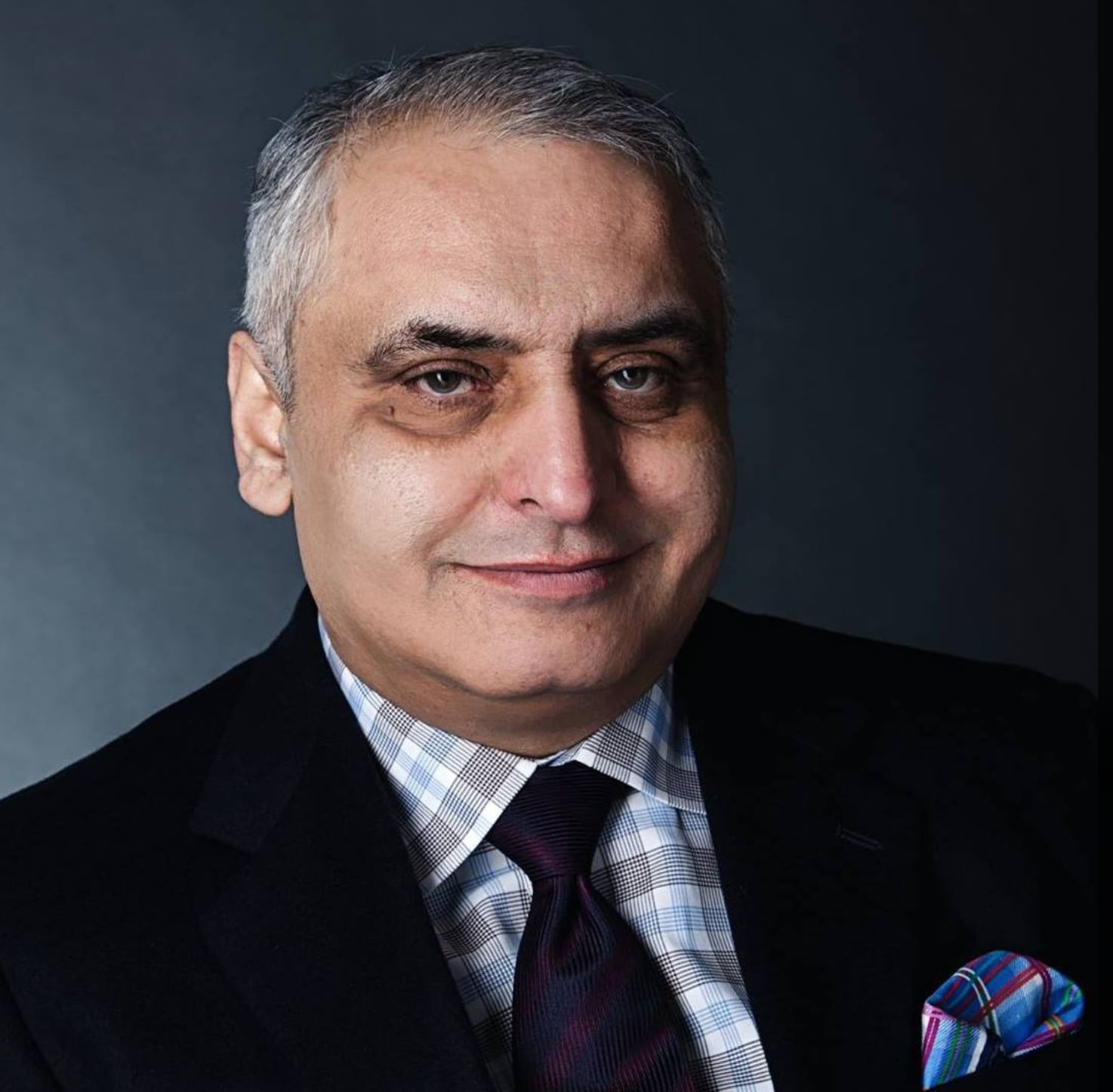
Arthur G. Martirosyan is a Senior Consultant with CM Partners. In 1994, after graduating from Yale University, he joined Conflict Management Group and Harvard Negotiation Project, and has since worked on conflicts in the former Soviet Union, the Middle East, the Balkans, Africa, and Latin America.
Hosts

Hovik Manucharyan
Hovik Manucharyan is an information security engineer who moved from Seattle to Armenia in 2022. He co-founded the ANN/Groong podcast in 2020 and has been a contributor to Groong News since the late 1990s.
Disclaimer: The views expressed by Hovik Manucharyan on the ANN/Groong podcast are his own and do not necessarily reflect the opinions of his employer or any other organization.

Asbed Bedrossian
Asbed Bedrossian is an IT professional, and for years oversaw the central IT enterprise infrastructure and services at USC. His decades of experience spanned across IT strategy, enterprise architecture, infrastructure, cybersecurity, enterprise applications, data center operations, high performance computing, ITSM, ITPM, and more.
Asbed founded the Armenian News Network Groong circa 1989/1990, and co-founded the ANN/Groong podcast in 2020.