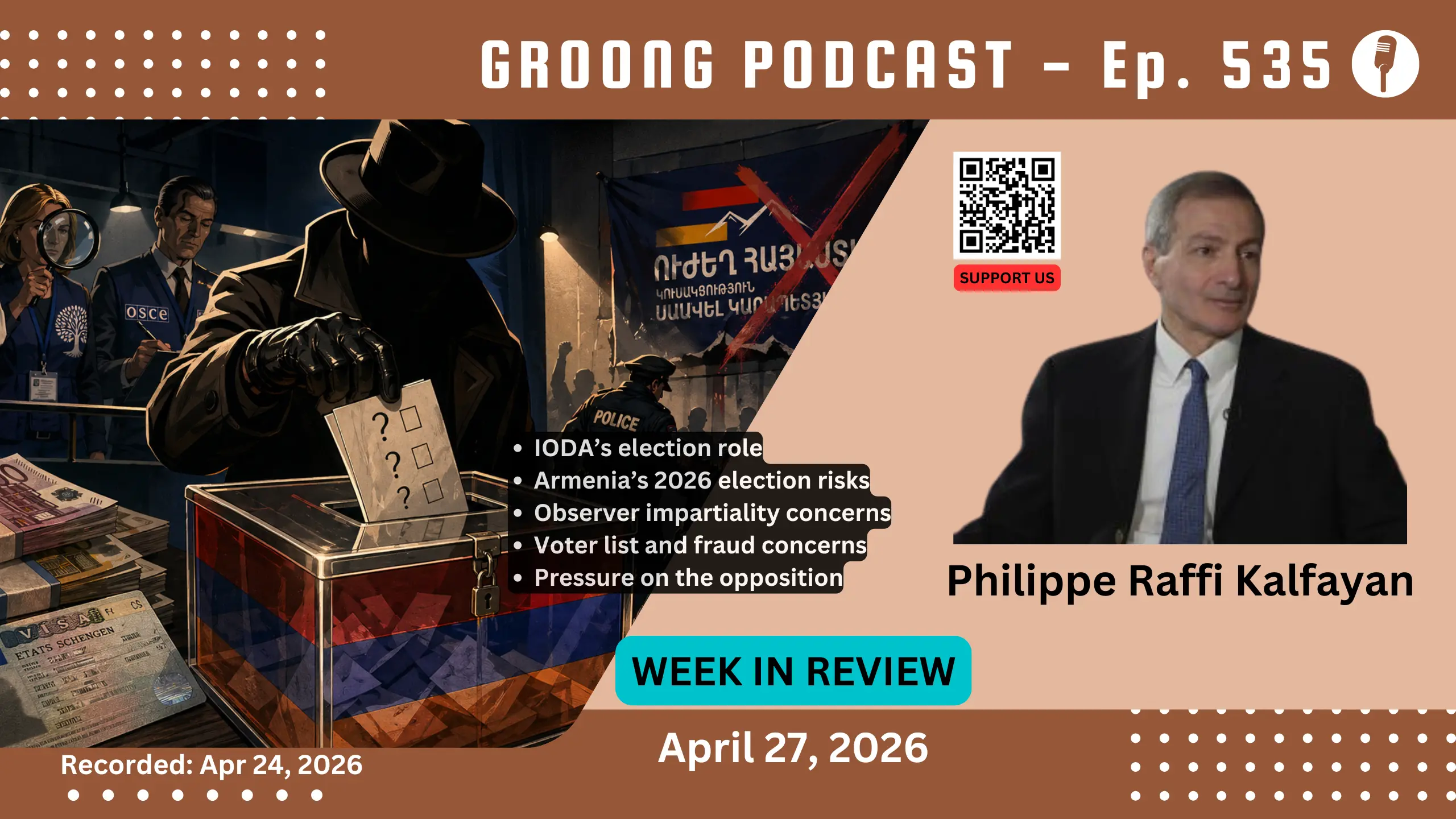
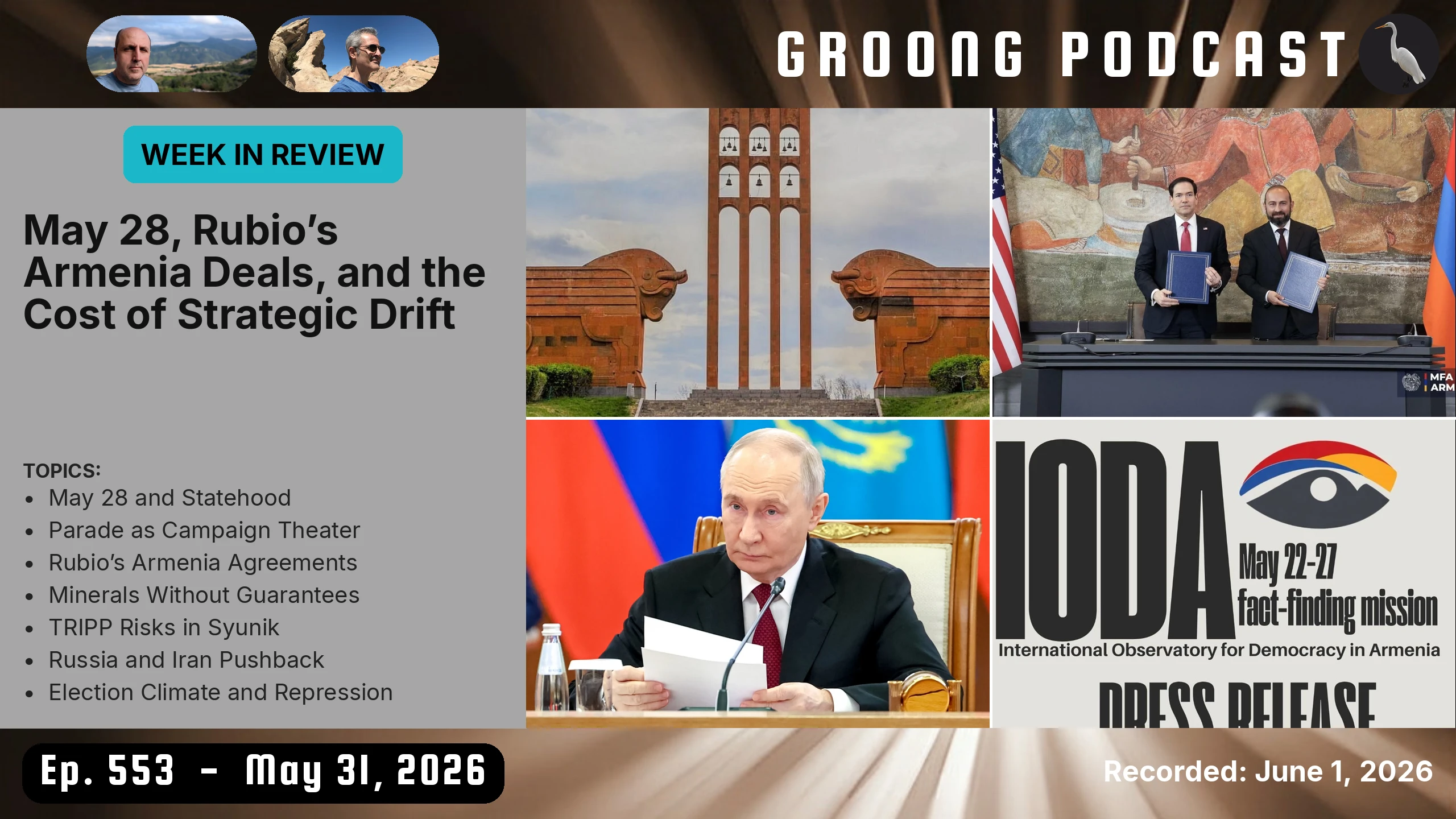
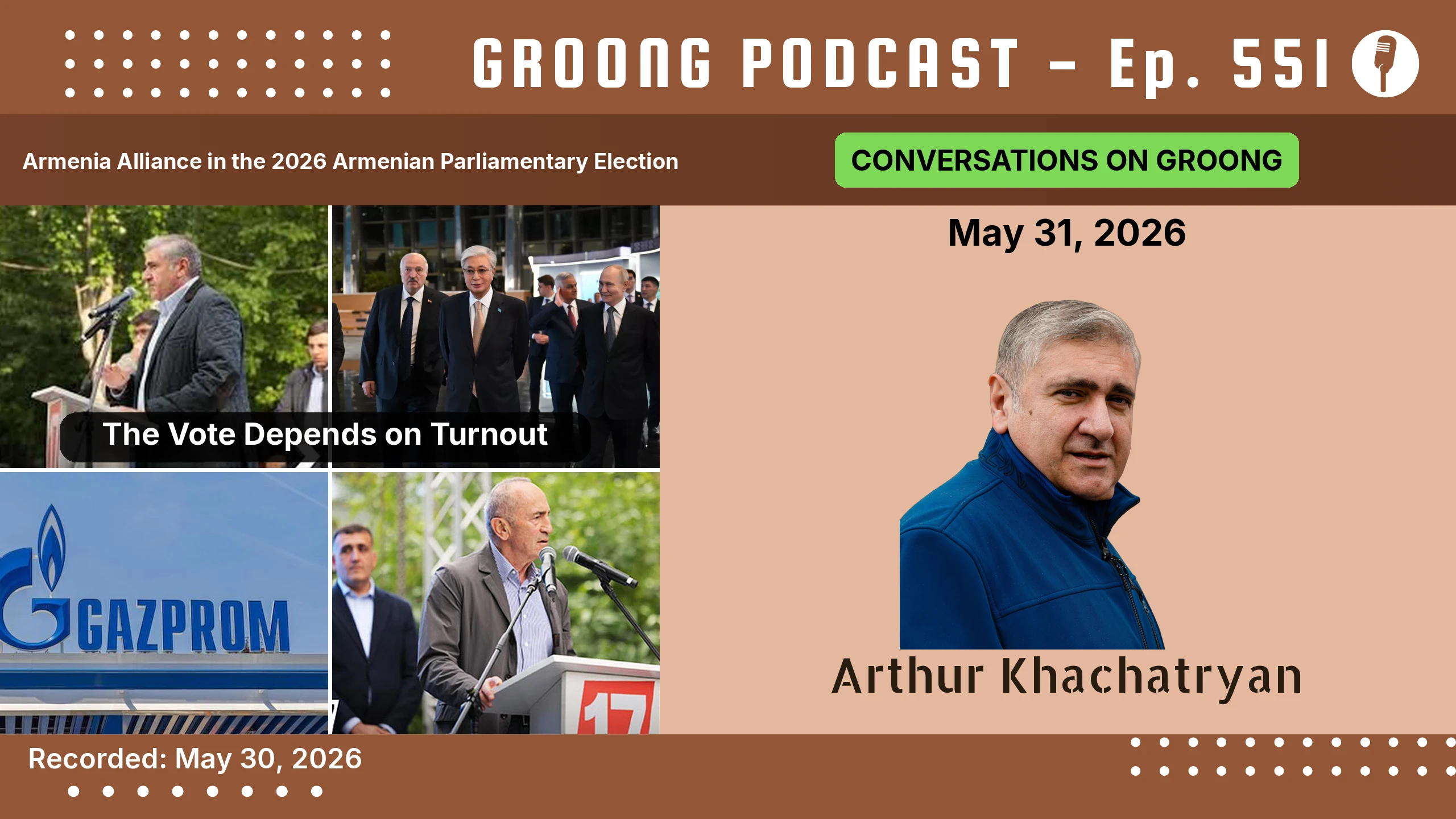
Philippe Raffi Kalfayan - IODA's Second Mission and Armenia's Dire Election Climate | Ep 554, Jun 4, 2026 [EP554]
Posted on Thursday, Jun 4, 2026 | Category: Armenia, Politics, Nagorno Karabakh, Human Rights, Artsakh | Series: cog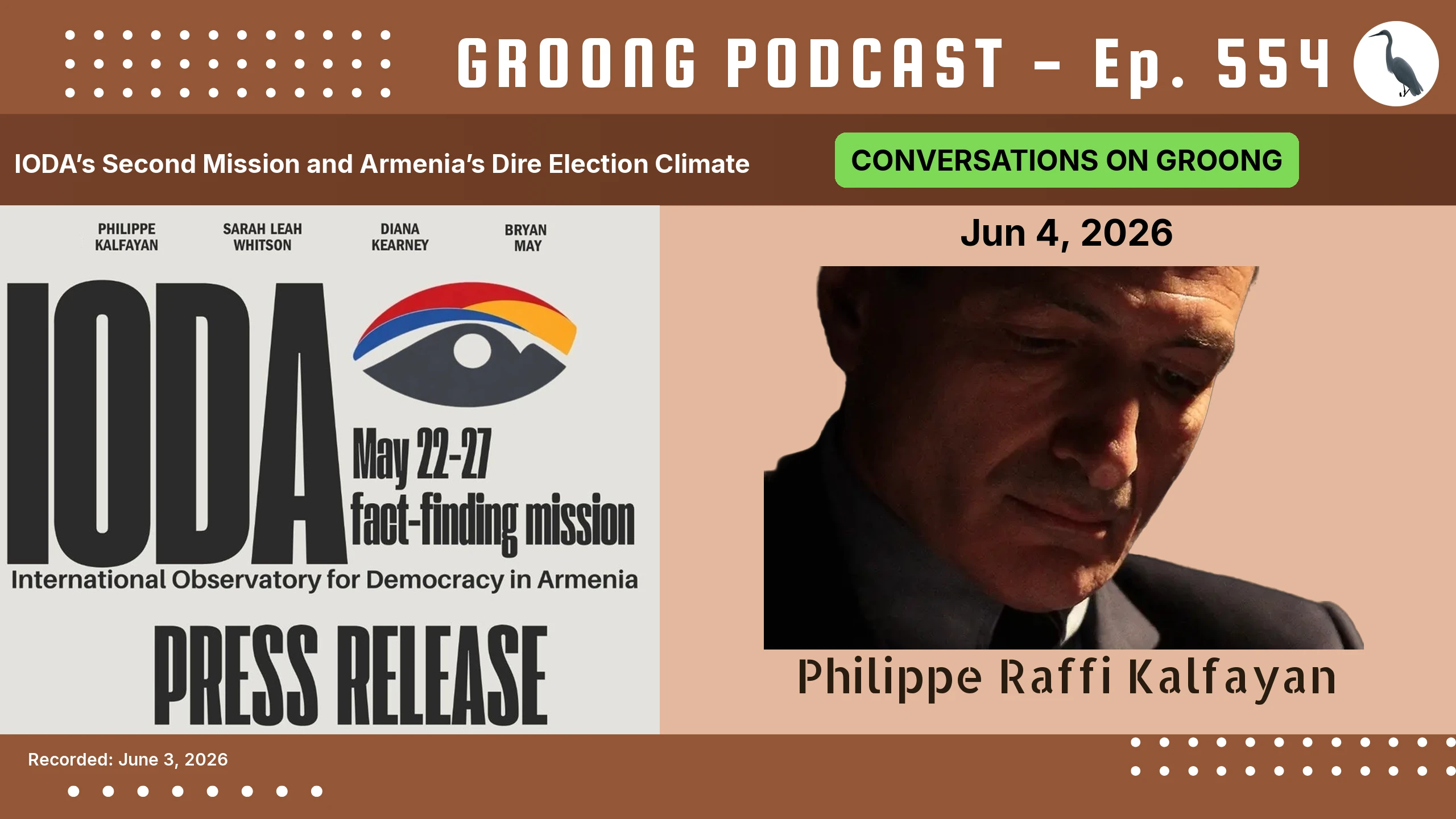
Groong Links:
Guest(s):
Topics:
- Arrests of government critics
- State pressure on voters
- Public resources used for campaigns
- Selective prosecution before elections
- Election legitimacy under serious doubt
Episode 554 | Recorded: June 3, 2026
#Armenia #ArmenianElections #Election2026 #IODA #OSCE #ODIHR #Geopolitics #Democracy
Show Notes
Summary
In this episode of Conversations on Groong, we speak with Dr. Philippe Raffi Kalfayan about Armenia’s deteriorating democratic conditions ahead of the 2026 Armenian Parliamentary Election. We discuss IODA’s second election observation mission, widespread arrests of opposition figures, state intimidation of voters, selective prosecution, and the serious threats to electoral legitimacy and civil rights under the Civil Contract regime.Show Notes
In this episode of Conversations on Groong, Dr. Philippe Raffi Kalfayan returns to discuss IODA’s second mission to Armenia ahead of the June 7 parliamentary elections. Kalfayan describes a worsening pre-election climate marked by arrests of opposition figures, intimidation in the regions, misuse of state resources, fear among public-sector workers, selective prosecution, pressure on Artsakh refugees, and competing foreign-interference narratives. The discussion also covers the limits of international election observation, the role of OSCE/ODIHR, Western backing for Pashinyan, Russian economic pressure, and the broader question of whether Armenia’s election can still be described as free and fair.
Main Topics Addressed
IODA’s Second Mission to Armenia
- Why IODA returned to Armenia after its first mission
- What changed between the first and second missions
- Why the second mission focused on the regions outside Yerevan
- Reports of intimidation in smaller towns and villages
- Civil Contract ’s refusal to meet with IODA
- Tense meetings with some civil society election-observation groups
Regional Intimidation and Political Pressure
- How local officials and village leaders can influence voters
- Reports that opposition supporters are watched when visiting party offices
- Fear of retaliation in daily life for supporting opposition parties
- Reports of physical attacks on opposition supporters
- The role of local power structures in shaping voter behavior
- Why fear before election day can matter as much as fraud on election day
Misuse of State Resources
- Reports of teachers, medical workers, students, and public-sector employees being drawn into Civil Contract events
- The use of schools, cultural institutions, and public-sector networks in campaign activity
- Fear among public employees and their relatives
- Polling reluctance and public fear of stating political views
- Lack of serious investigation into ruling-party abuses
- The reactivation of older patterns of state pressure during elections
State Power Against Government Critics
- Arrests and prosecutions tied to criticism of Pashinyan and the government
- Cases involving the Minasyan brothers and other opposition-linked figures
- The use of charges such as hooliganism, incitement, and obstruction of campaigning
- Whether political speech is being criminalized
- The lack of equal treatment between pro-government and anti-government actors
- Kalfayan’s discussion of European Court of Human Rights standards on political speech
Artsakh Refugees and Campaign Rhetoric
- Pashinyan’s confrontations with displaced Artsakh Armenians
- Why rhetoric against refugees is especially dangerous
- The vulnerability of Artsakh Armenians after ethnic cleansing and displacement
- The use of Artsakh as a political wedge issue
- Claims that opposition forces would return the issue of Artsakh rights to the agenda
- The danger of fanning internal hostility toward displaced Armenians
Foreign-Interference Narratives
- Claims of Russian meddling in Armenia’s election
- IODA’s finding that there was no direct evidence tying alleged voter-mobilization schemes to Russian authorities
- The difference between speculation, hearsay, and evidence
- Western support for Pashinyan and the role of European programs
- Russian economic pressure on Armenia
- Whether foreign-interference claims are being used to discredit domestic opposition
International Election Observation
- The difference between long-term and short-term election observers
- Why election-day observation can miss pre-election coercion
- Kalfayan’s view that short-term observers often see little of the real pressure
- OSCE/ODIHR’s likely approach to election findings
- The political role of intergovernmental organizations
- Whether international observers will fully report the climate around the vote
Election Legitimacy and What Comes Next
- Whether Armenia’s election can be called free and fair
- What may happen if Pashinyan cannot form a governing majority
- IODA’s possible post-election role
- The risk of deeper political crisis after election day
- What outside actors may or may not do if abuses continue
- Why democratic legitimacy remains the central issue
TRIPP and Armenian Sovereignty
- Kalfayan’s legal reading of the TRIPP-related document signed by Marco Rubio and Ararat Mirzoyan
- Concerns about the TRIPP Development Company
- Claims that the arrangement places key authority under U.S. or New York law
- Whether a commercial contract can override Armenian law
- The link between election legitimacy and decisions affecting Armenia’s sovereignty
Key Questions Discussed
- What did IODA see during its second mission that it did not see during the first?
- Why are the regions more vulnerable to intimidation than Yerevan?
- Is voter fear now shaping Armenia’s election before election day even arrives?
- Are public-sector workers being pressured to support Civil Contract?
- Are vague criminal charges being used to silence government critics?
- Do government supporters and opposition figures face the same legal standards?
- Why is rhetoric against Artsakh refugees so dangerous?
- Is the foreign-interference narrative being used to delegitimize domestic opposition?
- Can short-term election observers detect the real pressure voters face?
- Will OSCE/ODIHR fully report the political climate around the election?
- Can the election still be called free and fair under these conditions?
- What should IODA and others do after election day?
- What does the TRIPP agreement suggest about Armenia’s sovereignty?
Referenced Articles & Sources
- IODA: Increased Arrests of Government Critics Ahead of June Parliamentary Elections https://armeniaobservatory.org/NewsArticle?id=6a19bf1a84306964dedda40c
Wrap-up
Links and Resources
That’s our show , we hope you found it helpful. We invite your feedback and your suggestions, you can find us on most social media and podcast platforms.
Thanks to Laura Osborn for the music on our podcasts.
Guests
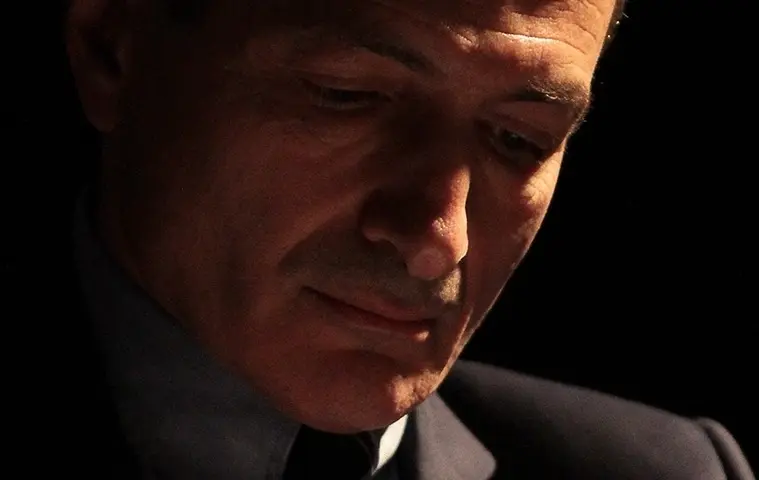
Philippe Raffi Kalfayan
Dr. Philippe Kalfayan is Legal Counsel and lecturer/researcher at the Paris Pantheon Assas Univ./Paris Human Rights Center. He is Assistant Judge HCR at the National Court for Asylum Rights. He served as secretary general of the International Federation for Human Rights (FIDH) and as Legal Expert for the Council of Europe’s Directorate General for Human Rights and Rule of Law. He has authored La France et l’Imprescriptibilité des Crimes Internationaux (Pedone 2015) and La Réparation des Préjudices en Lien avec les Crimes Historiques (TBR Pedone April 2026). He has been involved in institutional reforms and strategic projects in the Republic of Armenian for the last 30 years.
Hosts
Hovik Manucharyan
Hovik Manucharyan is an information security engineer who moved from Seattle to Armenia in 2022. He co-founded the ANN/Groong podcast in 2020 and has been a contributor to Groong News since the late 1990s.
Disclaimer: The views expressed by Hovik Manucharyan on the ANN/Groong podcast are his own and do not necessarily reflect the opinions of his employer or any other organization.
Asbed Bedrossian
Asbed Bedrossian is an IT professional, and for years oversaw the central IT enterprise infrastructure and services at USC. His decades of experience spanned across IT strategy, enterprise architecture, infrastructure, cybersecurity, enterprise applications, data center operations, high performance computing, ITSM, ITPM, and more.
Asbed founded the Armenian News Network Groong circa 1989/1990, and co-founded the ANN/Groong podcast in 2020.