Groong Links:
Topics:
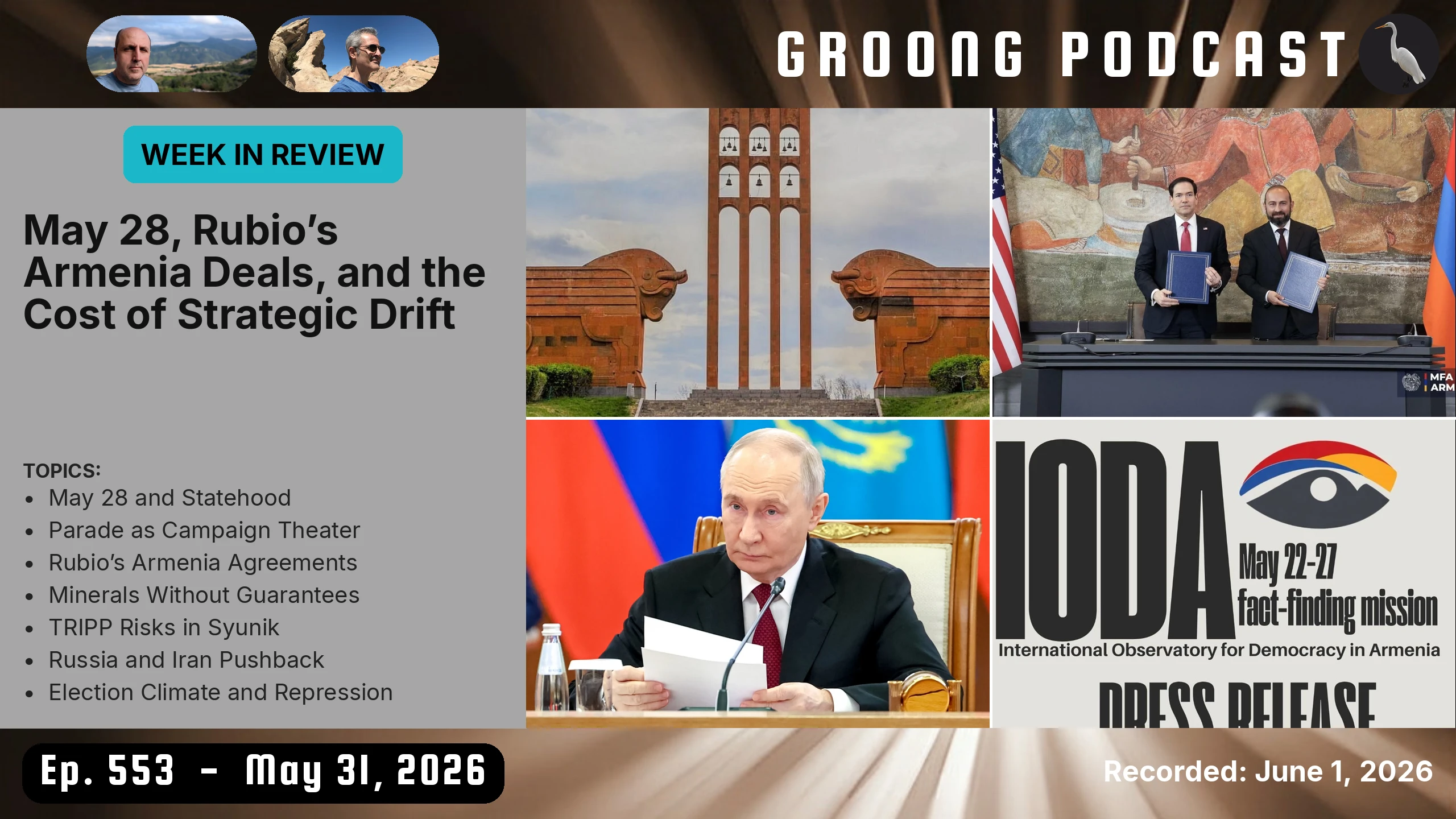
- May 28 and Statehood
- Parade as Campaign Theater
- Rubio’s Armenia Agreements
- Minerals Without Guarantees
- TRIPP Risks in Syunik
- Russia and Iran Pushback
- Election Climate and Repression
Episode 553 | Recorded: June 1, 2026
#Armenia #May28 #MarcoRubio #TRIPP #Syunik #CriticalMinerals #ElectionFraud #RussiaArmenia
Show Notes
Summary
In this episode of Groong’s Week in Review, hosts Hovik and Asbed examine Armenia’s May 28 Independence Day parade as campaign theater, Marco Rubio’s push for critical minerals deals, and the strategic risks of TRIPP in Syunik. We discuss how Pashinyan’s military parade coincides with Armenian prisoners of war held hostage in Baku, the questionable financing of weapons through $8 billion in external debt, and the broader geopolitical pressures from Russia and Iran as Armenia heads into the 2026 Armenian Parliamentary Election.Main Topics Addressed
First Republic Independence Day and May 28
- The meaning of May 28 in Armenian history
- The battles that made modern Armenia possible
- The contrast between national commemoration and state spectacle
- Why May 28 remains central to Armenian statehood
Pashinyan’s Military Parade
- The parade as a campaign event
- Pashinyan and Suren Papikyan asking Azerbaijan not to view the parade as hostile
- Whether the parade proves major military renewal
- Questions about Pashinyan’s claim that Armenia’s added debt funded defense
- Concerns over weapons compatibility, replenishment, and readiness
- Lack of large-scale military exercises under Pashinyan
Rubio’s Armenia Visit
(FOR MORE DETAILS SEE EXPANDED VERSION BELOW)
Marco Rubio’s short May 26 visit to Yerevan
The three documents signed or initialed:
- TRIPP framework
- Critical minerals and Rare Earths memorandum
- Comprehensive Strategic Partnership Charter
The gap between public messaging and Armenia’s concrete gains
Trump’s political endorsement of Pashinyan before the election
Critical Minerals and Rare Earths
- Armenia’s copper, molybdenum, zinc, and related mining assets
- The non-binding nature of the minerals memorandum
- No enforceable requirement that refining or metallurgy happen in Armenia
- Risk of Armenia becoming a raw-material platform
- Comparison with the U.S.-Ukraine minerals deal
- Need for Armenian control over processing, data, taxes, and environmental safeguards
TRIPP and Syunik
- The proposed TRIPP Development Company structure
- U.S. majority control and Armenia’s minority stake
- Armenia’s long-term land and sovereignty risks
- Tax exemptions and legal carve-outs
- Possibility of third-party contractors
- Concerns that TRIPP gives Azerbaijan and Turkey the main regional benefit
- Lack of hard guarantees for Armenia
Russia and Iran’s Reaction
- Russia’s opposition to a U.S.-anchored route through Syunik
- Iran’s concern over a U.S.-linked project near its border
- TRIPP as a challenge to Russia’s regional role and Iran’s northern security
- Mineral rights as part of the wider U.S.-China strategic competition
- Armenia’s risk of becoming a battlefield for larger powers
Electoral Violations and Pre-Election Pressure
- Police searches in Tashir during Strong Armenia’s campaign visit
- Reports of pressure against opposition supporters
- IODA’s statement on arrests, state-resource abuse, voter intimidation, and fear
- Concerns over foreign observer silence
- The role of OSCE/ODIHR, CIS observers, and smaller missions like IODA
- Pashinyan’s rhetoric and treatment of critics
Russia-Armenia Economic Pressure
- Russia’s warning over cheap gas and preferential trade
- Possible costs to Armenia if gas prices rise
- Threats to Armenian exports, seasonal workers, petroleum, and diamonds
- Pashinyan’s claim that TRIPP could compensate through new gas routes
- The likelihood that any alternative gas would still be Russian gas, possibly routed through Azerbaijan
A Tale of Two Festivals
- Armenia’s wine festival during election weekend
- Azerbaijan’s “Return to Western Azerbaijan” festival in Nakhichevan
- Azerbaijan’s long-term repopulation narrative aimed at Armenia
- Arsen Torosyan’s comments on immigration and mono-ethnicity
- “Real Armenia” as a possible domestic cover for Azerbaijani narratives
Key Questions Discussed
- Why does May 28 still matter for Armenia’s statehood?
- Was Pashinyan’s military parade a genuine defense display or campaign theater?
- Did Armenia’s new debt actually go toward military renewal?
- Can Armenia sustain French, Indian, Iranian, or other imported weapons during war?
- What did Marco Rubio’s visit actually deliver?
- Do the U.S.-Armenia agreements give Armenia enforceable gains?
- Does the minerals memorandum keep value in Armenia or expose Armenia to extraction?
- Does TRIPP strengthen Armenian sovereignty or weaken it?
- Who benefits most from TRIPP: Armenia, Azerbaijan, Turkey, or the United States?
- What will Russia and Iran do in response to a U.S.-anchored route through Syunik?
- Are Western observer missions missing or downplaying serious election violations?
- How serious are the allegations in the IODA pre-election report?
- What would happen if Russia ends cheap gas and preferential trade terms for Armenia?
- Is Pashinyan’s claim about future TRIPP gas realistic?
- What does Azerbaijan’s “Western Azerbaijan” campaign mean for Armenia’s future?
Rubio’s Armenia Visit (EXPANDED)
Marco Rubio’s May 26 sudden visit to Yerevan yielded three key documents:
- A TRIPP framework
- A minerals memorandum
- A Strategic Partnership Charter
While these align Armenia with U.S. connectivity and security goals, the domestic implications remain questionable. The package supports U.S. regional strategy, but fails to provide Armenia with hard security guarantees, stronger borders, or sovereign control over the risks it now inherits. The strategic trade-off continues to appear lopsided, heavily favoring Azerbaijan, Turkey, and the United States.
Critical Minerals and Rare Earths Memorandum
The minerals MoU outlines a framework for mining, separation, processing, financing, mapping, data sharing, workforce development, and supply-chain security. It says both sides “intend to support” raw and processed critical minerals needed for their commercial and defense industries.
The strongest Armenia-facing clause gives priority to projects that place separation, refining, value-added processing, and site restoration inside Armenia. But the text does not require refining, metallurgy, or processing to occur in Armenia. The framework is also non-binding and creates no legal obligations. Either side can discontinue participation with notice, leaving Armenia without guaranteed investment, market access, defense support, or guaranteed purchase volumes.
The benefit for Armenia depends on whether this becomes more than extraction. If Armenia only supplies ore or geological access, it takes environmental, political, and security risks while others capture most of the value. If Armenia gets processing, refining, technology transfer, workforce training, data control, and local ownership, then the deal could create real industrial value.
This is not automatically “Armenia gave Rare Earths to the U.S.,” because the published text does not transfer ownership or legal control over subsoil. But the concern is not baseless. The agreement opens the door to U.S.-preferred access, project selection, financing, data work, asset-sale review, and supply-chain alignment. Without Armenian red lines on ownership, environmental rules, local processing, and export value capture, Armenia could become a resource platform rather than an industrial beneficiary.
What Mineral Rights?
The agreement text does not name specific Armenian deposits or a fixed list of minerals. It uses the broad terms “critical minerals” and “rare earths,” a heavily politicized term in recent years, and says the goal is mining, separation, refining, processing, recycling, mapping, and secure supply chains for advanced technology, commercial use, and defense industry needs. It also links TRIPP to the transit of critical minerals from the South Caucasus and Central Asia.
A practical list for Armenia would be:
- Copper and molybdenum, Armenia’s most obvious hard-mineral assets
- Zinc, iron, and related industrial minerals, already tied to Armenia’s mining sector
Anything else is unspecified and probably fluff in the near and medium term. Rare earth elements are the strategic prize, but the public text does not define which ones. Battery and semiconductor minerals are likely tied to U.S. supply-chain strategy and TRIPP transit, not necessarily Armenian reserves.
For Armenia, the danger is becoming a raw-material and transit node. The benefit comes only if Armenia gets processing plants, Armenian-controlled geological data, tax revenue, local skilled jobs, and enforceable terms. Otherwise, the upside flows outward while Armenia carries the risk.
TRIPP Framework
The TRIPP framework establishes a joint venture, the TRIPP Development Company (TDC), in which a U.S.-owned entity holds a 74% stake while Armenia holds only 26% for an initial 49-year term. This term can be extended by another 49 years, and Armenia could own as much as 49% of the company in that second term.
Although the agreement says repeatedly that Armenia retains sovereignty and border control, it places a significant financial and sovereign burden on Armenia, which must provide encumbrance-free land for exclusive TDC use.
The arrangement raises serious legal and economic concerns. The framework takes precedence over any Armenian laws that might conflict with it, and it grants generous tax exemptions to the U.S. entity, undermining Armenia’s revenue potential. Armenia remains the formal grantor of concessions, but the U.S.-controlled TDC effectively shapes the project pipeline and selects third-party operators. There is no serious guardrail on who these operators might be. They could include Turkey and/or Azerbaijan, creating a de facto foreign-controlled presence inside Armenia.
Ultimately, Armenia provides the essential land and assumes the primary risks, while the strategic benefits go to Azerbaijan, Turkey, and the United States. Armenian gains are left as speculative expectations rather than firm guarantees.
The whole thing comes across as a naive and desperate project. You can’t hope for revenues to pan out. In geopolitics, you need firm guarantees and methods of enforcement. None of that is in these agreements. We can assume the worst outcome will happen.
Comprehensive Strategic Partnership Charter
The Charter is broad. It covers sovereignty, democracy, economic ties, energy, critical minerals, AI, semiconductors, space, defense, border security, cyber, education, and cultural heritage. The strongest Armenia-facing language says a strong, independent, sovereign, technologically advanced, prosperous, and defense-capable Armenia is essential for regional security. It also supports infrastructure based on respect for Armenia’s sovereignty, territorial integrity, and jurisdiction.
There is language about Foreign Military Sales, IMET, defense consultations, interoperability, defense industry cooperation, border-guard work, cyber help, sensitive information sharing, and support for Armenian border agencies to take full responsibility for Armenia’s borders.
But again, there is no U.S. security guarantee at all. The Charter does not say the U.S. will defend Armenia if Azerbaijan attacks. It does not reverse the occupation of Armenian territory. It does not impose costs on Azerbaijan for coercion. It does not secure Artsakh Armenian rights. It ties Armenia into U.S. strategic priorities, while leaving Armenia exposed.
Bottom Line from Armenia’s Perspective
The agreements create the potential for U.S. investment, mining technology, logistics revenue, energy cooperation, AI and semiconductor ties, border modernization, and defense procurement. For a small country like Armenia, that is not nothing.
But the risks are large.
Armenia gives strategic access to its territory, minerals, transport routes, and border-adjacent infrastructure. There is no U.S. defense guarantee for Armenia. There is, however, a U.S.-controlled TRIPP company with long-term rights in Armenia. The regional beneficiary of TRIPP is Azerbaijan’s connection to Nakhichevan . The global beneficiary is the United States, which gains leverage over critical minerals, east-west transit, Iran’s northern frontier, and the Middle Corridor.
For Armenia, the deal is beneficial only if several conditions are met:
- Armenia must keep full border control in practice, not just on paper.
- Armenia must receive enforceable revenue and procurement rights.
- Minerals must be processed in Armenia, not just extracted.
- Environmental liabilities must stay with operators, not the public.
- No private security regime can dilute Armenian authority in Syunik.
- Any TRIPP implementation must strengthen, not weaken, Armenia’s border with Iran.
Armenia is the weakest link in all of these areas, so there is a very low probability that these conditions will all pan out. Without guarantees, it looks like Armenia is accepting huge sovereign risks it cannot manage while Washington, Ankara, Baku, and transit investors capture much of the upside.
Russia and Iran’s TRIPP Concerns
From Russia’s and Iran’s point of view, these agreements are not mainly about Armenia’s economy. They look like a U.S. strategic move into the South Caucasus, with Armenia as the platform.
Russia’s View
For Russia, the package threatens three core interests.
- It weakens Russia’s role as Armenia’s security manager. Armenia has already frozen its CSTO participation, has moved closer to the EU, and now has a U.S.-Armenia strategic partnership, at least on paper, with defense, border, cyber, and military education language. Russia will read that as a direct challenge to its post-Soviet security space.
- TRIPP undercuts Russia’s leverage over regional transport. Moscow has long wanted any Armenia-Azerbaijan route to be policed or managed in part by Russian FSB border forces, based on the 2020 ceasefire logic. A U.S.-backed TRIPP vehicle removes that role and inserts Washington instead.
- The minerals agreement pushes Armenia into U.S.-aligned supply chains. That matters because critical minerals, Rare Earths, AI, semiconductors, and defense inputs are now strategic sectors. Russia will see this as part of a wider Western effort to pull Armenia away from the Eurasian Economic Union and Russia-linked industrial networks.
Iran’s View
Iran’s concern is sharper and more geographic. Iran opposes any “corridor” that weakens Armenian sovereignty, changes borders, or gives Azerbaijan and Turkey a privileged route across Syunik.
From Tehran’s point of view, TRIPP has four problems.
- It may reduce Iran’s role as the natural north-south and east-west transit outlet. If Azerbaijan gets a U.S.-backed route through southern Armenia to Nakhichevan and Turkey, then Iran’s Araz route becomes less central.
- it places a U.S.-linked project near Iran’s northern border. Even if Armenia says sovereignty remains Armenian, Tehran will worry about U.S. intelligence, logistics, security contractors, customs systems, data flows, and commercial infrastructure close to Iran.
- it strengthens the Azerbaijan-Turkey axis. Iran sees a direct Turkic land connection from Azerbaijan to Nakhichevan and Turkey as a strategic problem, even if it is formally under Armenian law.
- it links the South Caucasus to U.S. critical minerals strategy and may turn TRIPP into a channel for moving critical minerals to Western markets.
Where Russia and Iran Overlap
Russia and Iran do not have identical interests in Armenia, but on TRIPP they overlap.
- They both dislike a U.S.-anchored route across Syunik. They both dislike being bypassed by a Turkey-Azerbaijan-U.S.-linked transport system. They both see the minerals and transit pieces as part of a wider U.S. regional strategy. They both prefer to pressure Armenia without fully breaking with it, because Armenia is still useful to both.
- The Russia-Iran strategic partnership also matters here. Their 2025 treaty aimed to deepen economic, military, and political coordination and reduce the impact of U.S. sanctions. A U.S.-backed TRIPP and minerals route through Armenia cuts against that shared agenda, especially as Armenia is the only land border between Iran and the EAEU.
From Russia’s and Iran’s viewpoint, these agreements are a strategic loss.
What This Means for Armenia
The danger for Armenia is that it becomes the place where larger powers test each other.
If Armenia extracts hard benefits, then this can be a balancing strategy: U.S. investment, better border systems, defense support, mineral processing, and stronger sovereignty over Syunik.
But if the benefits stay vague while the risks become real, Armenia could face pressure from Russia, suspicion from Iran, expectations from the United States, demands from Azerbaijan, and pressure from Turkey, all at once.
So Armenia’s minimum red lines should be clear:
- Armenian border control must remain real, not symbolic.
- No foreign security force or contractor should control any part of Syunik.
- TRIPP must not cut or weaken the Armenia-Iran border.
- Minerals must be processed in Armenia where possible, with Armenian tax and labor benefits.
- Any U.S. partnership must include concrete security support, not just political language.
From Armenia’s viewpoint, the key test is whether the United States compensates Armenia for the risk it is asking Armenia to carry.
Referenced Articles & Sources
Ishkhanyan: Armenian authorities do not want us back https://www.aysor.am/en/news/2026/05/27/%D0%98%D1%88%D1%85%D0%B0%D0%BD%D1%8F%D0%BD/2423437
Armen Ashotyan analysis https://youtu.be/wNRmoBthrF4?si=5L7BGkS7w12VhHaa
Hakob Badalyan analysis https://youtu.be/WPF4zZVW4AQ?si=EXJ6ZOffHvIGeYei
Tatoyan statement on TRIPP https://x.com/i/status/2059128042132238651
Police search 100 locations in Tashir during Strong Armenia campaign visit https://hraparak.am/am/post/66fe917d377ced36c41abec00bb1097c
IODA report on Armenia’s pre-election climate https://armeniaobservatory.org/NewsArticle?id=6a19bf1a84306964dedda40c
Russia warning Armenia over cheap fuel supplies https://www.reuters.com/business/energy/russia-warns-armenia-it-could-end-cheap-fuel-supplies-if-yerevan-continues-eu-2026-05-27/
Russia-led Eurasian Economic Union urges Armenian referendum https://www.euronews.com/2026/05/29/russia-led-eurasian-economic-union-urges-armenian-referendum
Russia threatens Armenia with gas price hike as Trump endorses Pashinyan https://mirrorspectator.com/2026/05/28/russia-threatens-armenia-with-gas-price-hike-as-us-president-endorses-pashinyan/
Overchuk on Armenia’s gas options https://panarmenian.net/m/eng/news/333760
Wrap-up
Links and Resources
That’s our show , we hope you found it helpful. We invite your feedback and your suggestions, you can find us on most social media and podcast platforms.
Thanks to Laura Osborn for the music on our podcasts.
Hosts

Hovik Manucharyan
Hovik Manucharyan is an information security engineer who moved from Seattle to Armenia in 2022. He co-founded the ANN/Groong podcast in 2020 and has been a contributor to Groong News since the late 1990s.
Disclaimer: The views expressed by Hovik Manucharyan on the ANN/Groong podcast are his own and do not necessarily reflect the opinions of his employer or any other organization.

Asbed Bedrossian
Asbed Bedrossian is an IT professional, and for years oversaw the central IT enterprise infrastructure and services at USC. His decades of experience spanned across IT strategy, enterprise architecture, infrastructure, cybersecurity, enterprise applications, data center operations, high performance computing, ITSM, ITPM, and more.
Asbed founded the Armenian News Network Groong circa 1989/1990, and co-founded the ANN/Groong podcast in 2020.