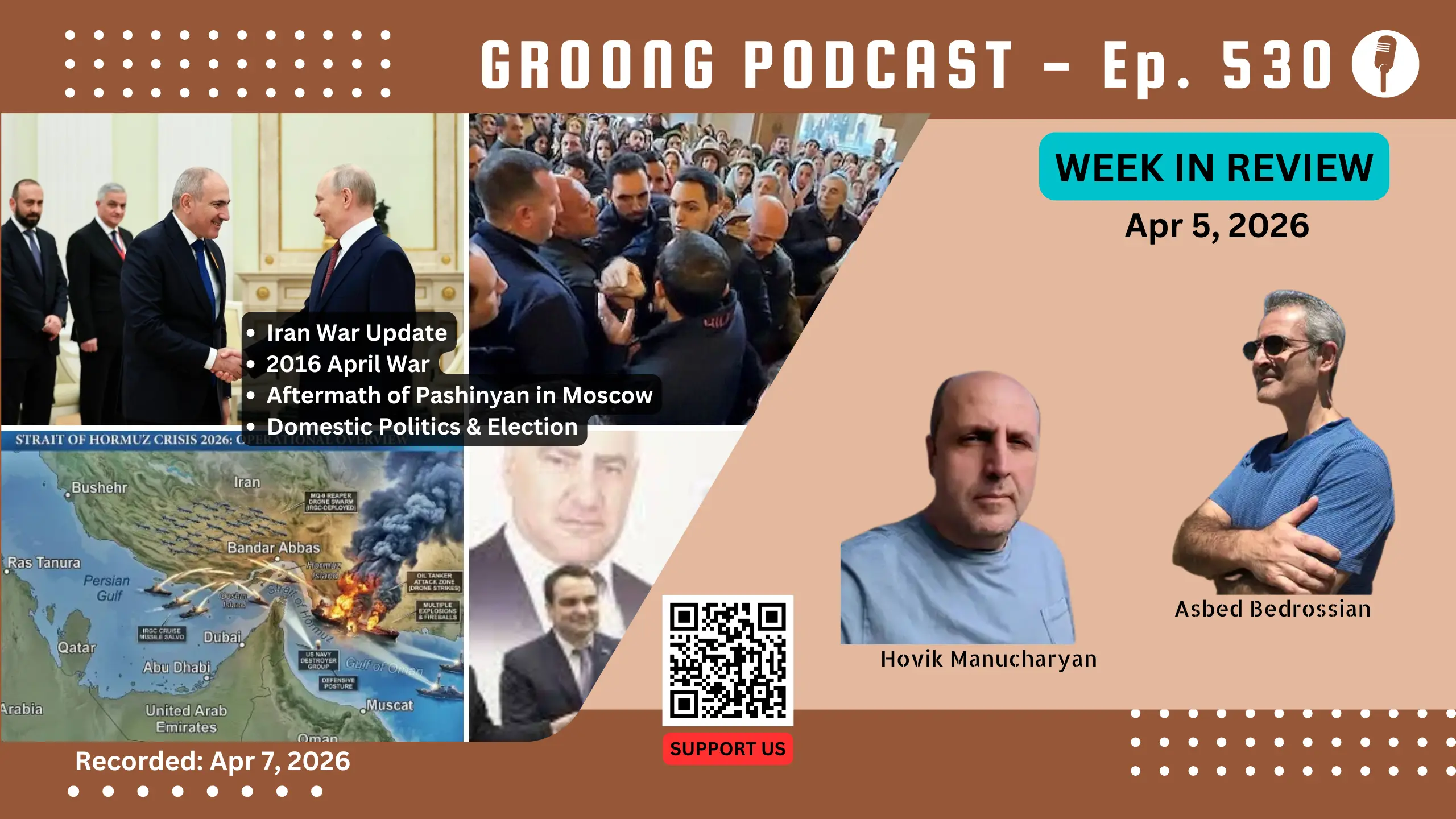
Week in Review - EPC in Armenia, Russia, Parliamentary Election, Swiss Peace Initiative | Ep 545, May 10, 2026 [EP545]
Posted on Wednesday, May 13, 2026 | Category: Armenia, Politics, Nagorno Karabakh, Artsakh Blockade, Azerbaijan, Russia, Ukraine, NATO, European Union, Human Rights | Series: wir
Groong Links:
Topics:
- EPC fallout and Russia response
- Armenia-EU declaration controversies
- Pashinyan’s Artsakh campaign narrative
- Aliyev-Pashinyan tag-team messaging
- Swiss Peace Initiative
- Pollsters diverge on election forecasts
Episode 545 | Recorded: May 12, 2026
#WeekInReview #Armenia #SwissPeaceInitiative #NagornoKarabakh #Artsakh
Show Notes
Summary
In this Week in Review, Asbed and Hovik discuss the fallout from the EPC summit in Yerevan, Armenia’s role as a platform for anti-Russian messaging, and Putin’s warning about a possible “separation” if Armenia moves toward the EU. They examine the Armenia-EU declaration, focusing on TRIPP, Ukraine, hybrid threats, security cooperation, visa liberalization, and the Armenian Nuclear Power Plant. The episode then turns to Armenia’s election campaign, Pashinyan’s claim that Artsakh was “never ours,” Aliyev’s parallel messaging from occupied Artsakh, pressure on opposition figures, the Swiss Peace Initiative, and sharp divergence between election polls.Main Topics Addressed
- EPC fallout and Russia’s warning
- Armenia-EU declaration controversies
- Pashinyan reframes Artsakh ’s history
- Aliyev echoes Yerevan’s narratives
- Opposition pressure and campaign threats
- Swiss Peace Initiative for Artsakh
- Pollsters diverge on election forecasts
Key Questions Discussed
- Did the EPC summit turn Armenia into a platform for anti-Russian messaging?
- What did Putin mean by a “gentle, civilised, and mutually beneficial separation” from Armenia?
- Who would suffer more if Armenia’s trade ties with Russia and the EAEU were disrupted?
- What does Armenia gain from deeper EU alignment, and what does it risk losing?
- Why does the Armenia-EU declaration endorse TRIPP, and what does that mean for Syunik?
- Does the declaration’s language on the Armenian Nuclear Power Plant threaten Armenia’s energy security?
- Is visa liberalization being used as political messaging rather than a concrete policy result?
- Why did Pashinyan open his campaign by saying Artsakh was “never ours”?
- How does Aliyev’s rhetoric from occupied Artsakh reinforce Pashinyan’s campaign narrative?
- What are the political and legal risks of Armenia’s leadership accepting Azerbaijan’s framing of Artsakh?
- How should opposition parties treat the Swiss Peace Initiative?
- Why do Armenian election polls differ so sharply from one pollster to another?
- What does the high “refuse to answer” rate in the EVN Report poll suggest about voter sentiment and polling reliability?
Links Referenced During The Show
- Russian MFA statement on Zelensky’s remarks from Yerevan
- Radar.am: Tikhanovskaya received with high-level protocol in Armenia
- Euractiv: Putin says Armenia-EU membership referendum would be logical
- RFE/RL: Armenia-Azerbaijan trade and Russia’s role
- Armenpress: Russia proposed new high-capacity nuclear plant to Armenia
- Council of the EU: Armenia-EU Summit Joint Statement
- President.az: Aliyev remarks from occupied territories
- Armenpress: Vote-buying case report
- Azatutyun: Pro-Pashinyan mayor avoids vote-buying charge
- Hraparak: Pashinyan orders firing of contract soldier
- CSI: Armenian political parties unite behind Swiss Peace Initiative for Nagorno-Karabakh
- Armenpress: Strong Armenia campaign item
- Azatutyun: Narek Karapetyan talks about TRIPP from Meghri
- EVN Report: Armenian Election Study poll
Wrap-up
Links and Resources
That’s our show , we hope you found it helpful. We invite your feedback and your suggestions, you can find us on most social media and podcast platforms.
Thanks to Laura Osborn for the music on our podcasts.
Hosts
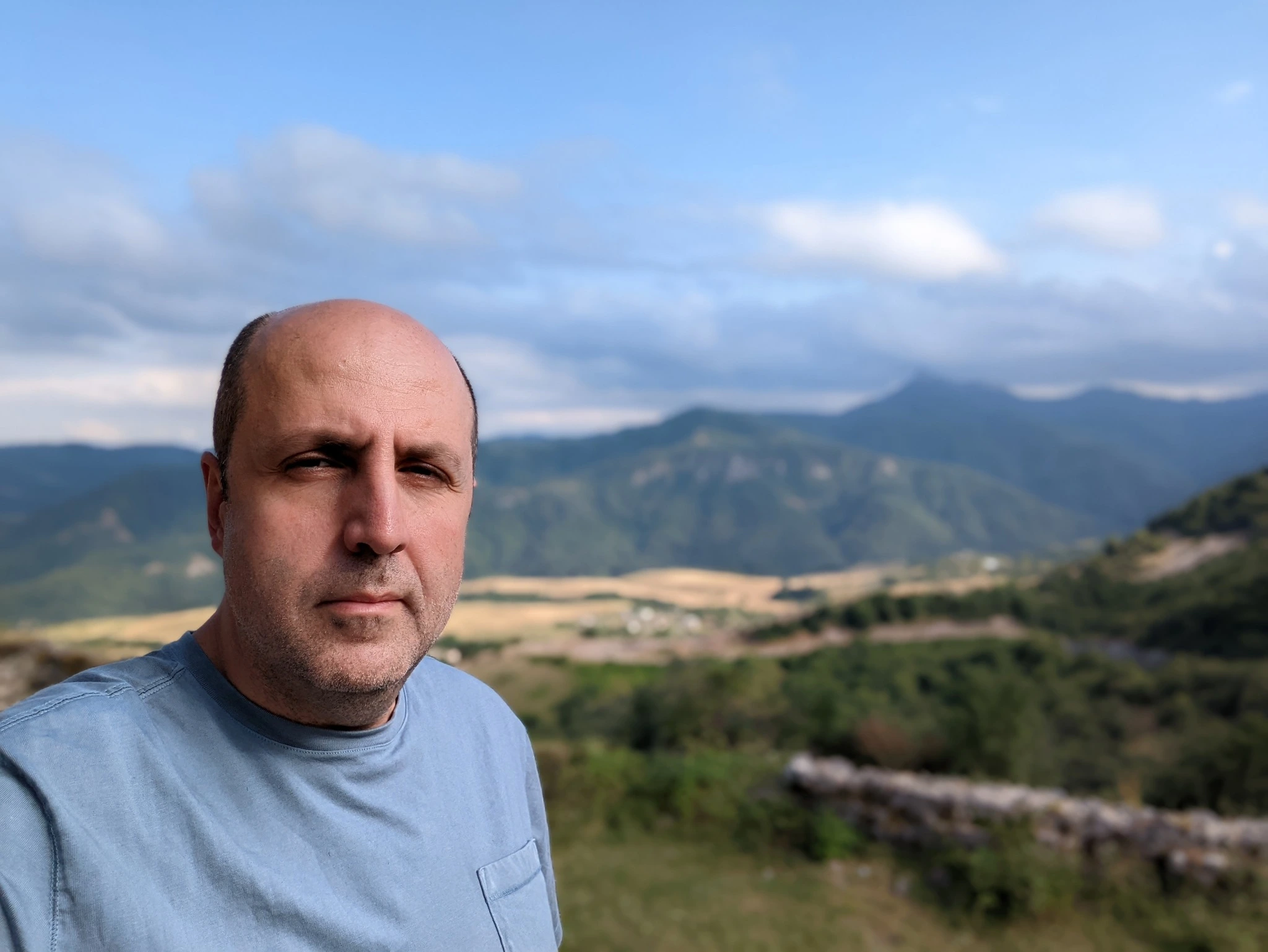
Hovik Manucharyan
Hovik Manucharyan is an information security engineer who moved from Seattle to Armenia in 2022. He co-founded the ANN/Groong podcast in 2020 and has been a contributor to Groong News since the late 1990s.
Disclaimer: The views expressed by Hovik Manucharyan on the ANN/Groong podcast are his own and do not necessarily reflect the opinions of his employer or any other organization.

Asbed Bedrossian
Asbed Bedrossian is an IT professional, and for years oversaw the central IT enterprise infrastructure and services at USC. His decades of experience spanned across IT strategy, enterprise architecture, infrastructure, cybersecurity, enterprise applications, data center operations, high performance computing, ITSM, ITPM, and more.
Asbed founded the Armenian News Network Groong circa 1989/1990, and co-founded the ANN/Groong podcast in 2020.