Groong Links:
Guest:
Topics:
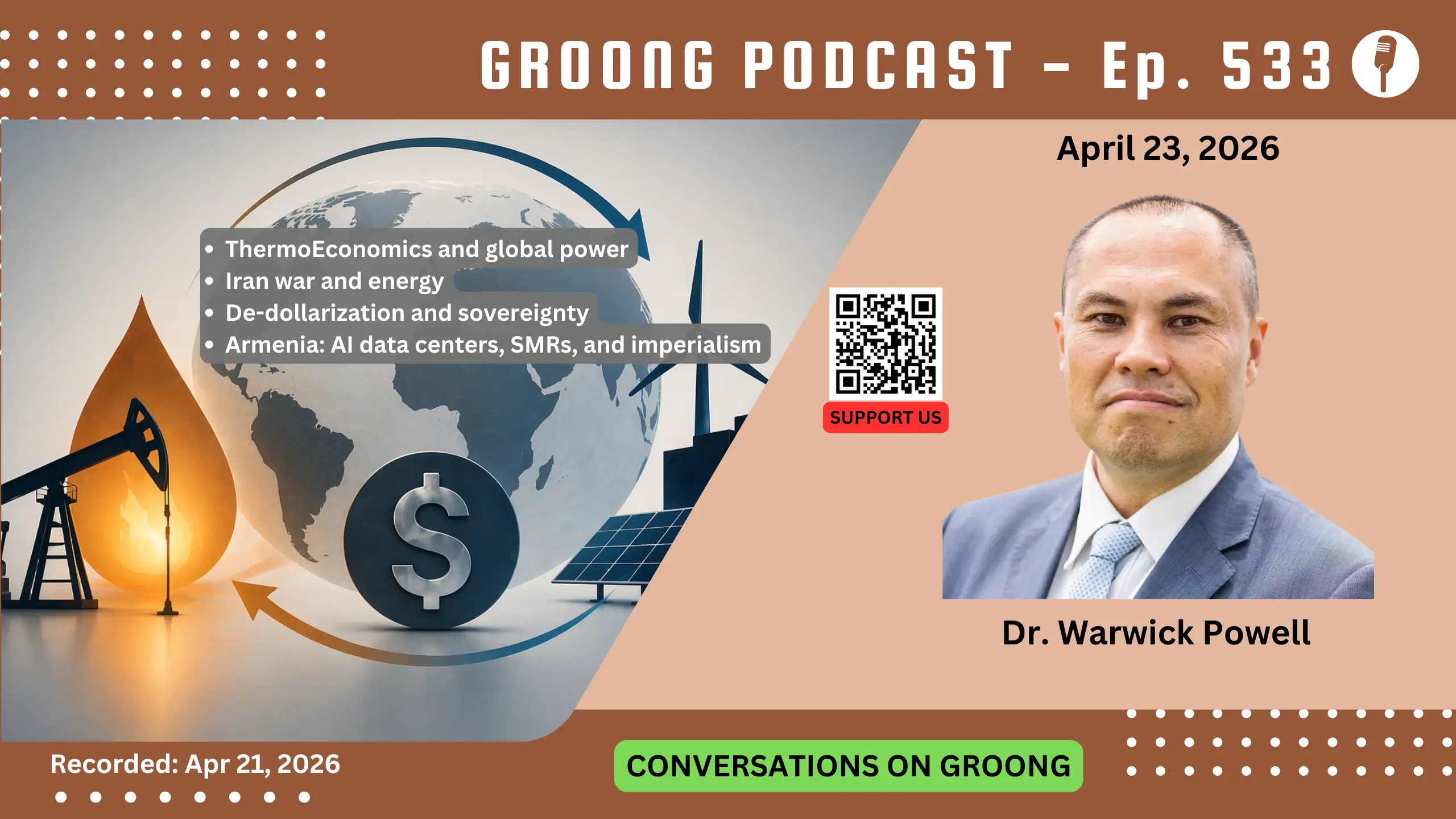
- ThermoEconomics and global power
- Iran war and energy
- De-dollarization and sovereignty
- Armenia: AI data centers, SMRs, and imperialism
Episode 533 | Recorded: April 21, 2026
Show Notes
Summary
Prof. Warwick Powell discusses his thermoeconomic view of world politics, where energy, money, and information form a single system. We connect the war on Iran to declining U.S. energy efficiency, the limits of airpower, de-dollarization, and the rise of alternative financial and information architectures. We also bring the conversation back to Armenia, asking what TRIPP, SMRs, and large AI data centers could mean for a small state trying to protect its energy and information sovereignty. We close by reflecting on considerations for Armenia in implementing centralized data infrastructure, more distributed computing, and focusing on larger nuclear power plants to generate the electricity needed for such information infrastructures.
Prof. Powell’s theory of a thermoeconomic world view is detailed in his new book Thermoeconomics in a Time of Monsters: Rethinking Theory, China and International Geopolitical Economy.
Main Topics Addressed
- Powell’s book and the idea of economics as a metabolic system shaped by energy, money, and information.
- Thermodynamics, entropy, and why viable societies need food for people and fuel for machines.
- The U.S. as a thermoeconomic empire facing declining energy return on energy invested.
- Why shale abundance does not mean lasting energy efficiency or real self-sufficiency.
- AI as an energy-intensive system that can become socially and economically entropic.
- Rising electricity costs, household stress, and social strain linked to data center expansion.
- Armenia’s position as a small state facing pressure around TRIPP, SMRs, and AI data centers.
- Energy sovereignty and information sovereignty as core policy goals for small countries.
- The risks of large centralized data centers as strategic liabilities and military targets.
- Powell’s case for more distributed, edge-based AI infrastructure.
- Chinese advances in 2D chips, graphene conductors, triboelectric nanogenerators, and storage.
- Why the U.S. and Israel misread Iranian resolve and military capability.
- The limits of regime-change assumptions and the failure of decapitation strategy.
- Damage to U.S. regional bases, munitions depletion, and the pressure toward escalation or exit.
- De-dollarization as a long-running trend driven by sanctions, cost, speed, and diversification of trade.
- The rise of currency multipolarity, barter, and alternative payment systems.
- The weakening dollar and the likely decline in U.S. living standards over time.
- The “Underground Empire” of U.S.-controlled digital infrastructure and its geopolitical uses.
- BRICS as an economic platform and the SCO as a growing Eurasian security and infrastructure framework.
- The hosts’ closing concerns about SMRs, centralized AI infrastructure, and Armenia’s vulnerability.
Key Questions Discussed
- How does thermoeconomics reframe the way we understand crisis, growth, and decline?
- Why does Powell argue that energy, not money alone, determines systemic survival?
- If the U.S. produces so much oil and gas, why does it still remain vulnerable?
- How does declining EROI shape U.S. behavior abroad?
- Is the current AI boom creating negentropic value, or mostly noise and new burdens on the grid?
- How should Armenia think about energy sovereignty and information sovereignty?
- Are large AI data centers assets, liabilities, or both for small countries?
- What alternatives exist to centralized data-center models?
- Why did Washington and Tel Aviv underestimate Iran’s resilience?
- What does the war reveal about U.S. force projection and industrial limits?
- Is de-dollarization now structural rather than temporary?
- Why are more countries seeking alternatives to the dollar system?
- How does control over digital infrastructure translate into geopolitical power?
- What role will BRICS and the SCO play in a more fragmented and multipolar world?
- What should Global South countries prioritize if they want more autonomy in the next phase of world order?
Referenced Articles & Sources
Wrap-up
Don’t forget to support us:
That’s our show ! We hope you found it useful. Please find us on Social Media and follow us everywhere you get your Armenian news .
Thanks to Laura Osborn for the music on our podcasts.
Guests

Warwick Powell
Prof. Warwick Powell is Adjunct Professor at Queensland University of Technology in Brisbane, Australia, and a Senior Fellow at Taihe Institute in Beijing. He is the author of “China, Trust and Digital Supply Chains”. “Dynamics of a Zero Trust World”. His work focuses on digital innovation, technologies, and international political economy.
Dr. Powell is the author of “Thermoeconomics in a Time of Monsters: Rethinking Theory, China and International Geopolitical Economy ”.
Hosts

Hovik Manucharyan
Hovik Manucharyan is an information security engineer who moved from Seattle to Armenia in 2022. He co-founded the ANN/Groong podcast in 2020 and has been a contributor to Groong News since the late 1990s.
Disclaimer: The views expressed by Hovik Manucharyan on the ANN/Groong podcast are his own and do not necessarily reflect the opinions of his employer or any other organization.

Asbed Bedrossian
Asbed Bedrossian is an IT professional, and for years oversaw the central IT enterprise infrastructure and services at USC. His decades of experience spanned across IT strategy, enterprise architecture, infrastructure, cybersecurity, enterprise applications, data center operations, high performance computing, ITSM, ITPM, and more.
Asbed founded the Armenian News Network Groong circa 1989/1990, and co-founded the ANN/Groong podcast in 2020.