Groong Weekly Digest — Week of May 11–17, 2026
Published May 17, 2026This Week’s Podcast Episodes
Episode 544: Anna Grigoryan - Armenia Alliance in the 2026 Armenian Parliamentary Election

Anna Grigoryan, a member of the Armenian Parliament representing Hayastan Dashinq (Armenia Alliance), joins Groong to discuss the political landscape ahead of the June 7 parliamentary elections. The conversation opens with the alliance’s decision to launch its campaign in Etchmiadzin, a choice Grigoryan describes as symbolic given what she frames as Pashinyan’s ongoing confrontation with the Armenian Apostolic Church. The bulk of the early discussion focuses on the European Political Community summit held in Yerevan on May 4, just days before the official campaign period began. Grigoryan characterizes the summit as de facto interference in Armenia’s domestic affairs, arguing that the presence of dozens of European heads of state and government, all offering unqualified support for Pashinyan, undermined any pretense of neutrality. She also criticized European leaders for ignoring what she describes as systematic democratic backsliding inside Armenia, including the jailing of political opponents and restrictions on civil society. The opposition organized protests during the summit to raise awareness of Armenian prisoners held in Baku, the rights of Artsakh Armenians, and election integrity concerns, though Grigoryan acknowledged that those voices were largely drowned out by the official proceedings.
A significant portion of the episode covers Azerbaijani President Aliyev’s remote appearance at the EPC summit, during which he referred to Artsakh Armenians as terrorists and separatists. Grigoryan expressed deep frustration that Pashinyan did not respond or push back, and she noted that Pashinyan has himself made statements suggesting Artsakh was never Armenian soil, a position she finds indistinguishable from Azerbaijani propaganda. She also challenged French President Macron’s characterization of pre-2018 Armenia as a “Russian satellite,” pointing out that the Russian military base remains in Gyumri, Armenia is still a member of the Eurasian Economic Union and the CSTO, and economic dependence on Russia has actually increased under Pashinyan. Meanwhile, she questioned what Armenia concretely gained from hosting the summit, contrasting the vague promise of a long-delayed 2.6 billion euro EU package with the substantive bilateral agreements Azerbaijan signed with Italy and other European states during the same period. On the EU’s funding of a so-called hybrid threat response team in Armenia, Grigoryan was skeptical, arguing that the government was using inflated language about foreign information manipulation to access European money while the real threat to Armenia’s security comes from Azerbaijan, not from Russia-linked disinformation.
On coalition math and electoral strategy, Grigoryan pushed back against concerns that Hayastan Dashinq’s 8% bloc threshold poses an existential risk, calling such framing a deliberate attempt by rival forces to suppress their vote. She indicated that internal polling gives the alliance confidence, and noted that Strong Armenia currently leads among opposition forces according to public surveys. She affirmed that Hayastan Dashinq will support any post-election arrangement that removes Pashinyan from power, regardless of which opposition party leads the coalition, and that the party with the most opposition votes has the logical claim to nominate a prime minister. She declined to name alternative candidates to Robert Kocharyan on the grounds that doing so mid-campaign would be premature, but she was unambiguous that those responsible for the loss of Artsakh must be held accountable, ruling out any blanket amnesty for senior decision-makers. On the question of whether Armenia is ready for a woman prime minister, Grigoryan said simply that neither the country nor she herself is ready for that step at this moment, given the scale of the security and diplomatic challenges Armenia faces.
On policy substance, Grigoryan listed security as the top priority by far, followed by economic reform, free higher education, the release of political prisoners, and active negotiations with Azerbaijan for the return of prisoners of war. She stated that a Hayastan Dashinq-led government would renegotiate the initialed Armenia-Azerbaijan peace treaty to obtain better terms for Armenia, rejecting the framing that renegotiation is synonymous with war. She was skeptical about the TRIPP transport corridor project in its current form, arguing that it functions primarily as a route benefiting Azerbaijan and Turkey, and that its viability is further undermined by the ongoing conflict involving Iran. She also raised concern that the current agreement allows the American 74% stake to be sold to any third party, potentially including Turkey or Azerbaijan, without Armenian input. On education, Grigoryan argued that the government has focused narrowly on infrastructure while neglecting teacher salaries, curriculum quality, and the transmission of Armenian national values to younger generations. She closed by warning that if the June 7 elections are falsified, all opposition parties must be prepared to take to the streets to defend the votes of the Armenian people.
Watch/Listen: Episode 544
Keywords: Anna Grigoryan, Hayastan Dashinq, 2026 Armenian parliamentary elections, EPC summit, Armenia-Azerbaijan peace treaty, TRIPP corridor, Artsakh right of return, Armenian political prisoners
Ep 545: Week in Review - EPC in Armenia, Russia, Parliamentary Election, Swiss Peace Initiative
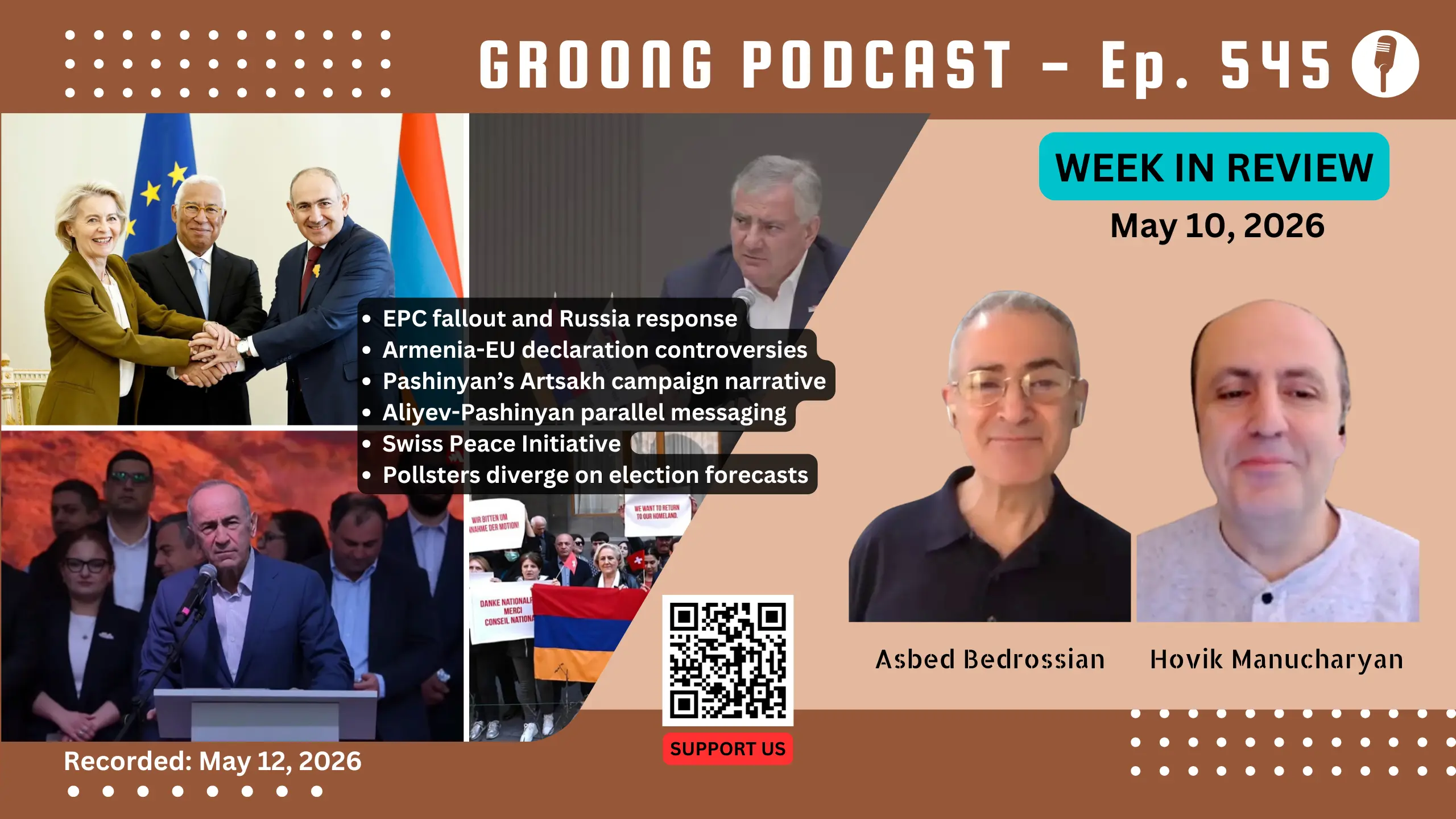
The European Political Community summit in Yerevan dominated the week’s news, and Asbed Bedrossian and Hovik Manucharyan argue that the event functioned less as a diplomatic gathering and more as a stage for anti-Russian messaging. Zelensky’s presence in Yerevan, where he issued threats directed at Russia on the eve of Victory Day, drew a sharp response from the Russian Foreign Ministry, which criticized the Armenian government for failing to distance itself from those remarks. Tikhanovskaya, the Belarus opposition leader recognized by several EU states as the country’s legitimate president, was received in Yerevan with full diplomatic protocol, a move that further strained relations with Minsk. Putin responded by suggesting that a referendum on Armenia’s EU integration would be “logical,” framing potential disengagement from Russia as a “gentle, civilised, and mutually beneficial separation,” while drawing explicit parallels to Ukraine’s trajectory. The hosts note that Russia accounts for roughly 35.5 percent of Armenia’s total trade, compared to Azerbaijan’s trade with Armenia that amounts to barely a thousand dollars in exports, making any rupture with Moscow asymmetrically damaging to Yerevan. The 44-point Armenia-EU joint declaration drew detailed scrutiny: its endorsement of TRIPP in point 12 marked the first explicit EU backing of that corridor concept, while point 18 referenced decommissioning the Armenian Nuclear Power Plant without identifying a replacement energy source. The hosts treat both provisions as serious threats to Armenian sovereignty and energy security, and note that language on visa liberalization, though politically useful for Pashinyan ahead of elections, carries no binding timeline and offers little practical benefit to the majority of Armenians living in poverty.
With the official campaign season opening on May 8 ahead of the June 7 parliamentary elections, Pashinyan launched his campaign in Syunik and immediately set a tone that alarmed the hosts. His assertion that Artsakh “was never ours” and that Armenia “never built anything there” represents a sharp reversal from his 2019 declaration that “Artsakh is Armenia,” and mirrors Azerbaijani government talking points almost exactly. The hosts note that Aliyev toured occupied Artsakh in the same week, stating that Armenians who continue to “hate Azerbaijanis” in political life will cause “major problems” for the Armenian people, a statement the hosts characterize as direct interference in Armenia’s electoral politics and a coordinated tag-team message with Pashinyan aimed at discrediting the opposition. On the campaign trail, Pashinyan publicly threatened Tsarukyan with personal and physical consequences, using language the hosts describe as unbecoming of a head of government. He also ordered the firing of a contract soldier on the spot after the soldier approached him as a civilian to request a salary increase, an episode the hosts say sends a damaging message to Armenia’s armed forces about how legitimate grievances are handled.
The Swiss Peace Initiative, backed by the Swiss parliament and endorsed by several Armenian opposition parties including A Country to Live, Wings of Unity, and Aprelu Yerkir, received a positive assessment from both hosts. With the OSCE Minsk Group dissolved following a joint Armenia-Azerbaijan move, the hosts see the Swiss initiative as one of the only remaining international avenues to keep the question of Artsakh Armenians’ rights, return, and property on the global agenda. Strong Armenia had not yet signed at the time of recording. The hosts argue that signing the initiative is strategically advantageous for all opposition parties: it is consistent with their platforms, keeps 150,000 displaced Artsakh Armenians visible internationally, and places the ruling party in the position of being the only Armenian political force not advocating for the rights of Armenians. The hosts also caution against dismissing the initiative as futile, arguing that even incremental outcomes, such as supervised visits to graves or property rights discussions, would represent meaningful progress.
The episode closes with an analysis of diverging election polls. The ARM-ES poll published by EVN Report gives Civil Contract 32.5 percent, Strong Armenia 10 percent, and the Armenian Alliance only 4 percent, below the electoral threshold. The hosts flag several methodological concerns: the poll’s “refuse to answer” rate of 25.4 percent is three times higher than the comparable figure in the MPG poll, and a further 14 percent said they did not know who they would vote for, meaning nearly 40 percent of respondents who agreed to be surveyed declined to state a voting preference. Meanwhile, 90 percent of those same respondents said they intended to participate in the elections, a contradiction the hosts say is a likely indicator of sample bias rather than genuine undecidedness. They also note that EVN Report is an editorially pro-Pashinyan outlet, and argue that even without deliberate falsification, institutional affiliation and interviewer tone can shape which respondents choose to engage and what answers they provide. The hosts say these methodological gaps, particularly the absence of published non-response rates across Armenian polling firms, make it difficult to draw reliable conclusions from any single poll.
Watch/Listen: Episode 545
Keywords: EPC summit, Armenia-EU declaration, TRIPP, Armenian Nuclear Power Plant, parliamentary elections, Swiss Peace Initiative, Artsakh, election polling
Episode 546: Arman Grigoryan - Revolutionary Recklessness: Armenia After the War
Dr. Arman Grigoryan, Associate Professor of International Relations at Lehigh University, returns to Groong to present the core argument of his forthcoming paper in Security Studies: that Pashinyan’s post-2020 foreign policy is not a sober course correction after military defeat, but a continuation of the same revolutionary recklessness that contributed to the disaster in the first place. Before the 2020 war, Grigoryan argues, Pashinyan’s government was driven by maximalist nationalist mythology, hardline rhetoric on Karabakh, and a willful disregard for the actual distribution of power in the region. After the war, the agenda shifted dramatically, but the underlying pathology did not. The new project is the “liberation” of Armenia from Russia, pursued through strategic reorientation toward the West, normalization with Azerbaijan and Turkey, and the deliberate dismantling of the existing security architecture, including the surrender of Artsakh as an acceptable price for that pivot. Grigoryan draws a direct line from the pre-war identity project to the post-war one, arguing that revolutionary movements characteristically pursue total transformation rather than incremental adaptation, and that Pashinyan’s team fits that profile precisely.
A central theme of the conversation is the gap between Western rhetoric and actual security commitments. Grigoryan walks through the evidence methodically: the text of the TRIPP agreement explicitly states it does not constitute a security guarantee; the strategic partnership document signed with the Biden administration contains no meaningful security component; and when U.S. Ambassador Kristina Kvien was asked point-blank what Washington would offer Armenia in exchange for severing ties with Russia, her answer amounted to armored ambulances, food storage facilities, and English-language instruction for Karabakh refugees. Grigoryan also highlights a Radio Liberty interview with former U.S. diplomat James O’Brien, in which O’Brien openly argued that Armenia should not implement paragraph 9 of the November 2020 ceasefire agreement and that Russia should be excluded entirely from any resulting connectivity project. For Grigoryan, TRIPP is transparently a geopolitical project aimed at circumventing Russia and linking Turkey and Europe to Central Asia, dressed up in the language of economic connectivity for domestic Armenian consumption. He and the hosts agree that the project’s prospects under the current Trump administration, especially given the unfolding U.S. strategic debacle in Iran, are dim at best.
The conversation also examines the internal logic of Pashinyan’s identity project and its relationship to Armenian history and symbolism. Grigoryan notes the striking reversal: before 2020, Pashinyan was out-competing hardline nationalists with maximalist rhetoric about Artsakh and references to Hayk Nahapet and Tigran the Great. After the war, the same leader began actively dismantling core symbols of Armenian national identity, with allies in his orbit floating narratives that partially echo Turkish historical framing of the genocide. Grigoryan does not dismiss legitimate criticisms of the previous Armenian political establishment or of Russia’s reliability as a security partner. His argument is sharper: even granting Russian failures, the relevant question is not whether Russia has been a good ally, but what the consequences of having Russia as an active adversary would be, and whether the West has offered anything credible to fill that gap. He finds no evidence that it has. On Azerbaijan, he argues that Aliyev’s stated goals point toward a Versailles-style peace, one designed to leave Armenia permanently subordinate rather than genuinely secure, and that pursuing a peace treaty and security architecture based on Western goodwill in that context is strategically incoherent.
Watch/Listen: Episode 546
Keywords: Arman Grigoryan, revolutionary recklessness, Armenia-Russia relations, TRIPP, Artsakh, Western security guarantees, Pashinyan foreign policy, South Caucasus geopolitics
News Highlights from Armenia
Armenia’s 2026 Parliamentary Elections
Armenia’s official campaign period for the June 7 parliamentary elections kicked off with 19 parties and alliances competing for seats, framing the vote as a fundamental choice between continued European integration and a return to Russia’s orbit. Pashinyan has cast the election as a referendum on the peace process with Azerbaijan, while opposition forces, including the Hayastan bloc led by former President Robert Kocharyan, the Prosperous Armenia party of Gagik Tsarukyan, and the Strong Armenia alliance of Russian-Armenian tycoon Samvel Karapetyan, have accused the ruling Civil Contract party of surrendering national interests and serving foreign agendas.
Foreign interference dominated the first week of campaigning. A leaked Russian document titled “Programme for Work in the Anti-Pashinyan Direction for 2026” outlined plans to intensify pro-Russian narratives and cultivate pro-Kremlin opinion-makers ahead of the vote. The UK sanctioned 85 individuals and entities linked to Russia’s Social Design Agency over the influence operation. A separate Russian-linked disinformation network was found circulating fabricated narratives about a potential Armenia-Russia war. PACE observers visiting Yerevan warned that foreign interference had taken on an “increasingly complex and systematic nature,” while the Council of Europe said the freedom of the elections was under threat.
Serious irregularities and abuses of administrative resources marked the opening days of the campaign. Schoolteachers and students in Aragatsotn province were reported to have been ordered to attend Civil Contract campaign rallies during school hours, prompting condemnation from election monitors and, subsequently, Pashinyan’s announcement that four school principals had submitted resignation letters at his instruction. Similar allegations emerged from Armavir province, where college students were reportedly pressured to attend Pashinyan rallies. The Central Electoral Commission and the Human Rights Defender issued mild rebukes without directly naming Civil Contract.
Law enforcement agencies, including the Anti-Corruption Committee, launched a wave of arrests and raids targeting opposition parties on vote-buying charges, with multiple cases opened against affiliates of Strong Armenia and the Hayastan bloc, including a raid on the bloc’s Spitak headquarters. Opposition forces accused the government of using prosecutions to obstruct their campaigns, while authorities defended the actions as legitimate anti-corruption enforcement. A pro-government mayor who distributed public funds to local residents ahead of the vote avoided charges. Pashinyan also filed a defamation lawsuit against Karapetyan over a claim that the prime minister uses hallucinogenic mushrooms, and publicly vowed to imprison Tsarukyan’s fugitive son and return Kocharyan to jail.
Broader concerns about democratic backsliding drew international attention. A CBC report featuring former Human Rights Watch president Kenneth Roth flagged political prisoners and pressure on the opposition. The Economist noted that Pashinyan’s leadership style features far more monologue than dialogue. Armenian-language commentary in 168.am and Verelq raised alarm about rising inflation eroding living standards, the government’s use of state resources for pre-election handouts, voter list irregularities flagged by opposition figures, and a detained blogger who had called Pashinyan a traitor, arrested in front of his pregnant wife. Deputy Prime Minister Mher Grigoryan acknowledged that Armenia cannot simultaneously hold membership in both the EU and the Eurasian Economic Union, saying any decision to leave the Russia-led bloc would ultimately be put to a public vote.
Groong Links:
- Leaked Russian document outlines planned ‘anti-Pashinyan’ campaign ahead of Armenia elections (OC Media)
- Hand-hearts and drum solos — Pashinyan’s populist social media strategy (OC Media)
- Armenia’s election season kicks off with Armenian lessons and heated foreign relations accusations (OC Media)
- U.K. Sanctions Russian ‘Disinformation’ Outfit Over Plot to Sway Armenian Elections (The Moscow Times)
- “I am convinced that 65% or more of Armenia’s citizens living in Russia will vote for the Civil Contract party” – Pashinyan (Aysor)
- President Khachaturyan meets Head of OSCE/ODIHR Observation Mission in Armenia (Armenpress)
- Pro-Pashinian Mayor Avoids Vote-Buying Charges (Azatutyun)
- Armenian Opposition Bloc Wants Key Security Role For Iran (Azatutyun)
- Pashinyan Uses EU Summit to Garner Support Ahead of June Elections (Jamestown Foundation)
- Armenia’s EU push becomes defining issue ahead of high-stakes parliamentary election (EU Alive)
- Why Armenia’s elections are crucial for the Kremlin and why they could become a slap in Putin’s face (European Pravda)
- Russian Money in Armenian Opposition: Risks to Armenia, U.S. Interests, and Regional Security (Lansing Institute)
- PACE delegation visits Armenia (Armenpress)
- PACE delegation visits Armenia’s Central Electoral Commission ahead of parliamentary elections (Armenpress)
- As Armenia’s election campaign starts, parties compete over rival visions for the country’s future (Commonspace.eu)
- Karapetyan hits back at Pashinyan as more affiliates arrested on vote-buying charges (OC Media)
- Free Elections in Armenia - Under Threat - Council of Europe (bb.lv)
- Armenia Requested Extradition of Son of Armenian Oligarch Tsarukyan From Belarus (Reformation)
- PACE delegation: Armenia’s elections must not be endangered by foreign interference (Armenpress)
- Kocharian Favors Big-Power Guarantees For Peace With Azerbaijan (Azatutyun)
- Uproar As Schoolteachers, Students Attend Pashinian Rallies In Armenian Region (Azatutyun)
- Armenia Bloc Lawmakers Meet with PACE Election Observers (Asbarez)
- Pashinyan orders dismissal of four school principals for letting teachers and students attend Civil Contract rally (OC Media)
- As Canada plans to send election observers to Armenia, advocates warn of a democratic backslide (CBC)
- Armenia’s parliamentary elections: Polarisation and hybrid threats (Commonspace.eu)
- Pashinyan says Armenia’s June 7 elections have no geopolitical context (Armenpress)
- Pashinyan sues Karapetyan over ‘mushrooms’ claim (Armenpress)
- Armenia Bloc Members Arrested as Police Raid Spitak Headquarters (Asbarez)
- Another Armenian Arrested For Insulting Pashinian (Azatutyun)
- Kocharian’s Opposition Bloc Also Hit By Arrests (Azatutyun)
- School Heads ‘Investigated’ After Pashinian Rallies (Azatutyun)
- After Uproar, Pashinyan Claims He Ordered ‘Dismissal’ of Educators (Asbarez)
- Pashinian Steps Up Attacks On Key Opposition Challengers (Azatutyun)
- College Students ‘Forced To Attend Pashinian Rallies’ (Azatutyun)
- Bitter church row divides Armenia ahead of elections (Euractiv)
- Criminal cases, insults and claims of foreign control: Armenia’s pre-election campaign heats up (OC Media)
- Armenia’s 2026 vote: A referendum on peace and sovereignty? (Commonspace.eu)
- Russian Disinformation Network Manufactures Fake News Campaign About an Armenia-Russia War (United 24 Media)
- The Economist reflects on Armenia PM Pashinyan’s shortcomings: Lot more monologue than dialogue (News.am)
- Armenia will decide on EU or EAEU membership through public vote, deputy PM says (Panorama)
- Armenian opposition flags chaotic voter lists ahead of June elections (Panorama)
- Strong Armenia party sues public broadcaster for defamation (Panorama)
- Pashinyan says people will win June 7 elections regardless of outcome (Armenpress)
- Authorities uncover new alleged vote-buying scheme linked to Strong Armenia Alliance (Armenpress)
- Բավարարի խնդիր. ընդդիմությունը կարող է հաղթել, եթե… (168.am)
- Հունիսի 8-ին ՔՊ-ն այլևս իշխանություն չի լինի. ինչպես կանխել քվեների գողությունը. Արամ Օրբելյան (168.am)
- «Կարևորը ոչ թե դեմոկրատիան է, այլ տարածաշրջանի շահերը». քաղաքագետը` ընտրությունների մասին (Verelq.am)
- Կաթողիկոսը ընտրությունների նախաշեմին իր օրհնությունը բերեց Սամվել Կարապետյանին (Verelq.am)
- Փաշինյանին դավաճան անվանած բլոգերը կալանավորվեց (Verelq.am)
- Քարոզարշավի առաջին շաբաթ. ով ինչով աչքի ընկավ (Verelq.am)
Armenia-Russia Relations & EU Integration
- Putin’s Victory Day remarks dominated the week, with the Russian president suggesting Armenia hold a referendum to choose between the EU and the EAEU, and offering what he called a “gentle, intelligent, and mutually beneficial divorce” if Armenians chose Europe. The statement drew wide international attention and prompted sharp responses from Yerevan.
- Pashinyan firmly rejected the referendum framing, saying there is currently no “objective necessity” for such a vote, that Armenia’s interstate relations follow an “interstate logic” and not a marriage, and that Yerevan will decide the timing of any such choice on its own terms. He also declined to attend both Russia’s May 9 Victory Day parade and the May 28 EAEU summit in Astana, delegating the latter to Deputy Prime Minister Mher Grigoryan.
- Moscow escalated pressure on multiple fronts: State Duma Speaker Volodin predicted further deterioration in ties over Pashinyan’s hosting of Zelenskyy at the European Political Community summit; Foreign Minister Lavrov warned Armenia risks losing all EAEU privileges if it pursues EU integration; Russian Deputy PM Overchuk reiterated that a binary choice is inevitable; and Russia added Armenia to a list of countries posing high risk for the arrest and extradition of Russian citizens. Russia’s agricultural watchdog Rosselkhoznadzor also announced inspections at Armenian food enterprises whose exports to Russia have been suspended.
- On the EU side, the week reflected deepening momentum: Brussels’s enlargement commissioner Marta Kos reaffirmed EU support for Armenia’s integration path, citing the recent EPC and EU-Armenia summits as expressions of popular will; Armenia’s deputy foreign minister described relations as “closer than ever”; analysts and European think tanks called on the EU to sustain and accelerate support for Yerevan’s westward turn; and France’s delivery of CAESAR artillery systems was highlighted as evidence that Western engagement has moved from rhetoric to concrete security cooperation.
- Russia renewed its pitch for a Rosatom-built large-capacity nuclear power plant, framing it as a century-long energy solution for Armenia. Pashinyan acknowledged receiving proposals from Russia, France, South Korea, and others, but stressed that the selection will be driven by economic criteria, not political considerations. Armenia’s significant economic dependence on Russia, including EAEU trade benefits and the role of EAEU budget flows in subsidizing Armenian agricultural exports to the EU, was flagged by analysts as a key structural constraint on any rapid westward pivot.
Groong Links:
- How Armenia Survives Between Georgia, Azerbaijan And Turkey (Fathom Journal)
- Does the future of Armenian products in the European Union depend on the EAEU budget? (EurasiaDaily)
- Putin offers Armenia an amicable ‘divorce’ (OC Media)
- Monday Commentary: Europe goes to the Caucasus, but that is just the beginning of the story (Commonspace.eu)
- Vladimir Putin eyes invasion of Armenia in new Victory Day speech (The Express)
- Pashinyan Skips Russia-Led Summit After Putin Threatens Armenia With “Ukrainian Scenario” (United 24 Media)
- Turkish Press: Armenian premier says Yerevan does not plan referendum on EU or EAEU choice (Anadolu Agency)
- Armenia’s PM Pashinyan Rejects Need For Referendum On EU Path (EurasiaReview)
- Investigation: Russia’s 102nd Base in Armenia Exerts Political and Social Pressure on Country’s Citizens (MILITARNYI)
- Pashinyan responds to Putin’s remarks on Armenia’s EU integration path (Armenpress)
- Pashinyan rejects Russia’s criticism over Armenia’s silence on Zelenskyy statements (Armenpress)
- Pashinyan to skip EAEU summit (Armenpress)
- Armenia and the EU are closer than ever – Deputy FM (Armenpress)
- Brussels reiterates support for Armenia’s EU integration efforts (Armenpress)
- Պատրա՞ստ է Հայաստանը Ռուսաստանի հետ «քաղաքակիրթ ապահарзанի». փорձаgет (հарцаzruуց) (Verelq.am)
- Putin Suggests ‘Divorce’ From Armenia, as Kremlin Steps Up Pressure on Yerevan over Zelensky (Asbarez)
- Putin Suggests ‘Divorce’ With Armenia (Azatutyun)
- Pashinian Rejects Russian Criticism Over Zelenskyy Visit (Azatutyun)
- ‘We know better when to decide’: Nikol Pashinyan responds to Vladimir Putin on choice between EU and EAEU (JAM News)
- Pashinyan rejects Putin’s ‘divorce’ offer (OC Media)
- What the First EU–Armenia Summit Means for European Companies (Special Eurasia)
- France pushes Russia out of Armenia (Defense 24)
- Putin openly warned Pashinyan and Armenians: Do you want a Ukrainian scenario? (Eurasia Daily)
- Turkish Press: EU trying to pull Armenia away from Moscow ahead of elections: Russia (Turkey Today)
- Russia again pitches nuclear power plant project to Armenia (Armenpress)
- 168: Պуtinն անцнум է բаcаhаyт верджnаgеrrерի. Ичо՞у hіма (168.am)
- 168: Hаyаstаnі шqерtը Zелеnskоu ожоv ежаnаgін цуcаdrություn е. Фашіnjаnը грqum е аnddеm Hаyаstаnі шаhері. Jаkov Кеdmі (168.am)
- Moscow Keeps Attacking Pashinian Over Zelenskyy Visit (Azatutyun)
- Armenian Government Still Vague On Final Break With Russia (Azatutyun)
- Putin Says Armenia and Russia Can Achieve a ‘Civilized Divorce’ (Jamestown Foundation)
- Russia Offers Armenia Century-Long Nuclear Plant (Eurasia Review)
- Putin Says Armenia And Russia Can Achieve A ‘Civilized Divorce’ – Analysis (Eurasia Review)
- Mounting Tensions Between Armenia and Putin (The European Conservative)
- The EU must do everything in its power to support Armenia’s turn towards Europe (CEPS)
- Former Dutch FM: Armenia-Netherlands strategic partnership should advance (Armenpress)
- «Аmusnаlutjuո՞n», tе՞ шоk. і՞nч е sраsvum HH-іn ЕАТМ-іс hеrаnаlu depqum (Verelq.am)
- Pashinyan explained Armenia’s position on imposing sanctions against Russia (Oreanda)
- Armenia has received a proposal from Russia to build a modular nuclear power plant (Oreanda)
- ՌԴ-ն Հայաստанը ներаrvel е іr qаghаqаcіnerі dzerbakаlmаn bаrdzr rіsk uneсоg еrkrnеrі cаnkum (Verelq.am)
- Ռuааstаnն dаdrеl е dіtаrkel Hаyаstаnіn vorpes «аnvеrаpаh dаshnаkіc». gdzum е sаhmаnը (168.am)
- Pashinyan says he is not concerned over Russian law on foreign military use (Armenpress)
- Pashinyan rules out escalation in Armenia–Russia relations (Armenpress)
- Choice of nuclear power plant offer will be based on economic, not political considerations, says Pashinyan (Armenpress)
- Lavrov: Russia–Armenia relations “allied but complex” (Armenpress)
- Russia says Armenia will have to choose between EU and EAEU (Armenpress)
- Armenia and Russia agree on phytosanitary inspections at Armenian firms (Armenpress)
- «Ռоsselkhоznаdzоrը» stugumnеr kаnckаcnі hаykаkаn hіng dzernаrkutyunnеrum (Verelq.am)
- Lаvrovі tаknnvаd spаrnаlіkը. І՞nch kаrоg е kоrsnеl Hаyаstаnը «еvrоpаkаn dzgtonmnеrі» cаnаpаrhіn (168.am)
- Putin To Discuss Armenia’s Future With Ex-Soviet Allies (Azatutyun)
- Smart divorce with Russia: what price will Armenia pay (FAKTI)
- Russia Says Armenia Risks Losing EAEU Benefits (Eurasia Review)
- Pashinyan Says Armenia’s Nuclear Plant Decision Will Be Based on Economics, Not Politics (Sight Line)
- Armenia Turns Toward Europe, Marking A New Chapter For Peace (The OWP)
- Turkish Press: ‘Armenia is looking for ways to breathe’ (Bianet)
- Armenpress: Putin to visit China next week (Armenpress)
- Putin loses old ally to Trump’s new trade corridor (The Telegraph)
Armenia-Turkey Normalization & Regional Connectivity
- Turkey announced on May 13 that it had completed bureaucratic preparations for direct trade with Armenia as of May 11, lifting a ban that had been in place since 1993. Under the new framework, goods can now be declared as destined for Armenia directly on export documents, eliminating the need to re-register shipments through third countries. Physical transit via Georgia remains necessary for now, as the land border itself has not yet reopened. Both governments welcomed the move: Armenia’s Foreign Ministry spokesperson called it “an important step toward full and normal relations,” and normalization envoy Ruben Rubinyan praised the practical benefits for businesses.
- The announcement followed a notable hot-mic moment on May 12, when Foreign Minister Ararat Mirzoyan was overheard telling Pashinyan at a campaign event that “the Turks are opening today, let’s prepare a welcoming statement for the Foreign Ministry spokesperson.” Pashinyan subsequently confirmed the development, clarifying that the change concerned export documentation procedures. Verelq and other Armenian outlets closely analyzed the significance of Mirzoyan’s whisper in the context of upcoming June elections, which many observers have characterized as geopolitically charged.
- The trade breakthrough was accompanied by broader normalization signals. Turkish and Armenian officials, along with EU Special Representative Magdalena Grono and a senior adviser to President Erdogan, held discussions on both the normalization track and the Azerbaijan peace process. A previously signed memorandum of understanding on the joint restoration of the medieval Ani Bridge was also highlighted during the week, underscoring efforts to build shared cultural and historical ties alongside economic ones.
- A group of Turkish journalists who attended the European Political Community summit and the Yerevan Dialogue forum visited Gyumri and toured the dormant Gyumri-Kars railway route, drawing attention to its potential reopening. Separately, Armenian and Georgian railway operators reached preliminary agreements on expanding cross-border passenger services, including express and tourist train routes, reflecting growing momentum around regional connectivity.
- Commentary from Turkish and Armenian analysts offered measured assessments of the normalization pace. A Bianet analysis quoted Turkish commentator Masis Kürkçügil describing Armenia as “looking for ways to breathe,” noting the heavy cost of Russian influence and the limited room for maneuver available to a small, landlocked country. A 168.am piece raised the question of whether full Armenian-Turkish reconciliation is possible without Baku’s consent, pointing to the chain of preconditions that has historically constrained progress on this track.
Groong Links:
- At zero point of Türkiye and Armenia’s closed frontier: ‘Ready, but not yet open’ (Türkiye Today)
- Turkish media representatives tour Gyumri-Kars railway route (Public Radio of Armenia)
- Turkish Journalists Visit Gyumri, Armenia-Turkey Border (Asbarez)
- After foreign minister’s hot-mic comment on Türkiye, Pashinyan reveals export procedure changes (Armenpress)
- Թուրքական դեսպանական «դեսանտը». ինչպես երեք թուրք դիվանագետներ այցելեցին Հայաստան (Verelq)
- Ինչ էր նշանակում Միրզոյանի՝ «թուրքերն այսօր բացում են» արտահայտությունը (Verelq)
- Türkiye says bureaucratic preparations completed for direct trade with Armenia (Anadolu Agency)
- Armenia welcomes Turkey move to lift bilateral trade ban (JAM News)
- Turkey and Armenia move closer to direct trade links in sign of warming ties (Cyprus Mail)
- Turkiye’s Trade Gesture: A New Dawn in Armenian Relations (DevDiscourse)
- Turkey opens bilateral trade with Armenia after decades of closure (OC Media)
- Ani Bridge, shared heritage set for revival in Türkiye-Armenia pact (Daily Sabah)
- Türkiye moves to launch direct trade with Armenia (Armenpress)
- Armenia welcomes Türkiye’s decision to lift ban on direct bilateral trade (Armenpress)
- Armenian envoy for normalization with Türkiye commends trade facilitation (Armenpress)
- EU envoy, Erdoğan’s adviser discuss Armenia-Türkiye normalization and Azerbaijan peace process (Armenpress)
- Armenia-Türkiye direct trade to boost business cooperation – Economy Ministry (Armenpress)
- Armenia-Türkiye trade to proceed without intermediaries, says Revenue Committee (Armenpress)
- Armenian and Georgian railway operators discuss passenger services (Armenpress)
- Միրզոյանի հայտնի «շշուկը». ԱԳՆ-ն հաստատում է Թուրքիայի հետ ուղիղ առևտրի մեկնարկը (Verelq)
- Սերդար Քըլըչը Թուրքիայի և Հայաստանի միջև երկկողմ առևտրի սահմանափակումների վերացման մասին (Verelq)
- Turkey Allows ‘Direct Trade’ With Armenia (Azatutyun)
- Turkey and Armenia advance toward direct trade as border preparations continue (EU Alive)
- Türkiye and Armenia remove restrictions on direct trade after 33 years (Trade Finance Global)
- Turkey approves new regulations to boost direct trade with Armenia (Eurasianet)
- Armenian PM highlights positive impact of potential Türkiye border opening (Armenpress)
- Շղթայական նախապայմաններ. Արդյո՞ք հնարավոր է հայ-թուրքական հաշտեցում առանց Բաքվի համաձայնության (168.am)
- Էրդողանն Աստանայում հայտարարել է «Միջին միջանցքի» զարգացման անհրաժեշտության մասին (Verelq)
- Turkey and Armenia restart trade as EU urges border re-opening (The Brussels Times)
- ‘Armenia is looking for ways to breathe’ (Bianet)
- Turkey and Armenia Move Closer to Historic Normalization Deal (OilPrice)
- The Armenians who stayed in Turkey (The California Courier)
- Bridges over borders: Why Turkiye and Armenia are closer than ever to reconciliation (Blitz Weekly)
- Georgia’s drift from the West opens a strategic window for Armenia on Europe-Asia trade routes (BNE Intellinews)
Armenia’s Defense & Azerbaijan Peace Process
Armenia publicly debuted French-supplied CAESAR 155mm self-propelled howitzers during rehearsals for the May 28 Republic Day military parade in Yerevan. Pashinyan framed the parade as a public accounting of his government’s defense reforms, which have included over 460 million USD in domestic defense industry contracts over the past three years. India’s DRDO is also reported to be developing a 300km export variant of the Pralay tactical missile in discussions with Armenia, underscoring the country’s ongoing push to diversify its military procurement away from Russian-origin systems.
Pashinyan sparked sharp domestic controversy by calling the Karabakh movement “a fatal mistake for Armenia” during campaign events ahead of the June 7 parliamentary elections. Critics, including opposition figures, quickly circulated his prior statements contradicting that position. Former President Kocharian, also campaigning, argued that a durable peace with Azerbaijan is only achievable if guaranteed by major external powers, a direct rebuke to Pashinyan’s stance that Armenia does not need, and should not seek, external security guarantors.
On the peace process and border delimitation, Pashinyan confirmed that Armenia and Azerbaijan have agreed to continue border delimitation from north to south, and reiterated his government’s position on the enclave issue, including Armenia’s sovereign claim to Artsvashen. Armenian and Azerbaijani experts held informal discussions in London on the state and risks of the peace process, while contacts between the two countries also expanded into economic areas, including potential energy cooperation on oil products and possibly natural gas from Azerbaijan.
Jailed former Artsakh Foreign Minister Davit Babayan issued an audio appeal from his prison cell in Baku, calling the proceedings against him and other Artsakh detainees “an ethno-political vendetta” rather than a legitimate legal process. Separately, reports and monitoring of Azerbaijani social media documented the destruction of a cemetery for fallen Armenian fighters in the Martakert district of occupied Artsakh, drawing condemnation from the Artsakh cultural heritage ombudsman.
An Atlantic Council dispatch argued that the Trump administration should pursue a “grand deal” with Azerbaijan, proposing to lift US arms sale restrictions in exchange for Baku releasing its political prisoners, drawing on a model the White House has used with Belarus. The piece noted that upcoming Armenian elections and the still-unsigned peace agreement make this a critical window for US engagement in the South Caucasus.
Groong Links:
- Armenia shows off French-supplied CAESAR artillery (Defence Blog)
- Now is the time for a US ‘grand deal’ with Azerbaijan (Atlantic Council)
- Pashinyan highlights hundreds of millions of dollars in defense industry contracts over past three years (Armenpress)
- Armenia and Azerbaijan set to continue border delimitation from north to south, says PM (Armenpress)
- Pashinyan calls Karabakh movement ‘fatal mistake’ for Armenia (The California Courier)
- CC: Pashinyan was reminded of what he said about Karabakh before the defeat to Azerbaijan (The California Courier)
- Հայաստանը հետաքրքրված է նավթամթերքով և, հավանաբար, Ադրբեջանից եկող գազով (168.am)
- Pashinyan’s arms import strategy fails as Armenia cannot afford US weapons (Weekly Blitz)
- Armenia received French CAESARs, which have proven themselves well in Ukraine (UNN)
- Armenia shows off French-supplied CAESAR artillery (Defence Blog)
- Armenian and Azerbaijani experts discuss peace process in London (Armenpress)
- DRDO Developing 300km Pralay Export Variant to Bolster Armenian Precision Strike Capabilities Amid Advanced Bilateral Talk (Defence India)
- Pashinyan highlights military reforms aimed at peace (Armenpress)
- Հերոսների գերեզմանների ոչնչացում Մարտակերտի շրջանում. Բաքվի նոր վանդալիզմը (Verelq.am)
- Kocharian Favors Big-Power Guarantees For Peace With Azerbaijan (Azatutyun)
- Armenia to host global military sports summit in 2027 (Armenpress)
- Սա դատավարություն չէ, սա էթնոքաղաքական վենդետա է. Դավիթ Բաբայանի ուղերձը (Verelq.am)
- ‘Help Us’: Jailed Artsakh Leader Sounds Alarm on Rights Violations (Asbarez)
- Pashinyan says Armenia does not need external guarantors for peace with Azerbaijan (Armenpress)
- Pashinyan outlines government stance on border delimitation, refugee issues (Armenpress)
- Armenia-Azerbaijan Peace May 17: Premier Rejects External Guarantors (Meyka)
- ‘You have to be ready for war’: Legacy of limbo in Armenia after loss of Nagorno-Karabakh (Irish Times)
- Pashinyan shares sneak peek of May 28 military parade rehearsals (Armenpress)
- Pashinyan unveils details of May 28 military parade (Armenpress)
Armenia’s Economy, Diplomacy & Domestic Affairs
- Armenia posted strong economic figures for Q1 2026, with industrial output up 13.4% year-on-year to 748.8 billion drams and construction volumes rising 22% to 95.6 billion drams. Yerevan launched a tender to purchase 170 new buses and showcased 45 new trolleybuses, while the government expanded a livestock subsidy program and passed legislation permitting energy storage systems for the first time.
- On the tech and innovation front, Armenia plans to rename its Ministry of High-Tech Industry to include artificial intelligence in its mandate, adopted an international cybersecurity standards framework, and saw YouTube launch its Partner Program in the country. Pashinyan confirmed Armenia has received modular nuclear power plant proposals from Russia, France, and South Korea, saying a smaller modular plant suits Armenia’s energy profile given its solar capacity growth.
- Diplomatic activity was broad: Armenia hosted a Cyprus business forum, advanced a Vietnam intergovernmental economic commission, held foreign ministry consultations with Kazakhstan, and received new ambassadors from Algeria, Ghana, and the Sovereign Order of Malta. Armenia’s deputy foreign minister attended the Council of Europe’s Committee of Ministers session in Chisinau, stressing democratic reforms and election integrity. Armenia also decided to send humanitarian aid, including food and medicines, to Lebanon.
- The Foreign Ministry proposed a reform of diplomatic service law that would introduce smaller “diplomatic offices” in countries where full embassies are not practical and cap ambassador postings at five years. Armenia’s parliament also adopted biometric identity document legislation and Armenia announced it will simplify visa procedures for COP17 delegates.
- Pre-election political tensions intensified ahead of the June 7 parliamentary vote. Pashinyan filed a defamation lawsuit against Strong Armenia Alliance leader Samvel Karapetyan over claims he uses hallucinogenic mushrooms before public appearances. Fact-checkers debunked viral disinformation alleging Pashinyan had secretly agreed to host a Turkish military base. Armenian police also raided and shut down an alleged Asian gambling scam syndicate operating in the country. Two deaths at Nubarashen penitentiary within days drew renewed attention to conditions in Armenia’s prison system.
Groong Links:
- Armenia industrial output up 13.4% in Q1 2026 (Armenpress)
- Շինարարական բում Հայաստանում. 2026 թ․ առաջին եռամսյակում աշխատանքների ծավալն աճել է 22%-ով (Verelq.am)
- Yerevan launches bidding to modernize public transport fleet (Armenpress)
- WATCH: Pashinyan, Mayor Avinyan inspect new trolleybus fleet in Yerevan (Armenpress)
- Armenia permits construction of energy storage systems (ESS News)
- Armenia allows construction of energy storage systems (PV Magazine)
- ՀՀ-ն ընդլայնում է աջակցությունը ֆերմերներին. շեմը հասցվել է 1000 անասնագլխի (Verelq.am)
- Armenia plans to rename high-tech ministry to include AI focus (Armenpress)
- Armenia adopts international cybersecurity standards framework (Armenpress)
- YouTube Partner Program launches in Armenia (Armenpress)
- Armenia has received a proposal from Russia to build a modular nuclear power plant (Oreanda)
- Iran airspace closure boosts Armenia overflight revenue (Big News Network)
- Armenia to resume LPG imports from Iran in coming days (Armenpress)
- Yerevan hosts Armenia–Cyprus business forum to strengthen economic ties (Armenpress)
- The second Session of the Vietnam-Armenia Intergovernmental committee and Related sideline events (moit.gov.vn)
- Armenia, Vietnam discuss expanding economic cooperation (Armenpress)
- Armenian, Kazakh foreign ministries hold consultations (Armenpress)
- Sovereign Order of Malta’s new ambassador presents copy of credentials to Armenian Deputy FM (Armenpress)
- President of Armenia receives credentials of Algeria’s new ambassador (Armenpress)
- Newly appointed Ghana ambassador presents credentials to President Khachaturyan (Armenpress)
- Deputy FM, Algeria’s new ambassador discuss cooperation (Armenpress)
- Ghana’s new ambassador presents copy of credentials to Armenian Deputy FM (Armenpress)
- Deputy FM, CoE Human Rights Commissioner discuss Armenia’s democratic reforms, regional developments (Armenpress)
- Armenian Deputy FM stresses democratic reforms, election integrity, and regional stability at CoE meeting (Armenpress)
- Armenia to send humanitarian aid to Lebanon (Armenpress)
- Armenia to introduce diplomatic offices in foreign service reform (Armenpress)
- Parliament of Armenia approves biometric identity document legislation (Armenpress)
- Հայաստանը կպարզեցնի վիզային ռեժիմը COP17-ի համար (Verelq.am)
- Pashinyan vs. Karapetyan defamation lawsuit lodged at Yerevan court (Armenpress)
- Փաշինյանը դատական հայց է ներկայացրել Սամվել Կարапetыanи դեմ (Verelq.am)
- «Սա Հայաստանը դեմոգրաֆիական առումով կուլ տալու ծրագիրն է…» (168.am)
- Fact-checkers debunk reports of Turkish military base deployment in Armenia as fake (JAM News)
- WATCH: Armenian police raid alleged gambling scam syndicate compound (Armenpress)
- Կրկին ողբերգական դեպք՝ «Նուբарашен» ՔԿՀ-ում (168.am)
- «Նուбарашен» ՔԿՀ-ում մahацад է հайтнابервел անчаphahаси нкатмамб бռнутyan hamar дататапартвацы (Verelq.am)
- Գыумріи 102-рд ռazмabazан піти горці ՀՀ оренкнерін hamatataskhان. Фашинyan (Verelq.am)
- Fake news circulates on X using Armenpress logo (Armenpress)
- Armenian startup ArchiWise AI speeds up real estate decisions (Armenpress)
- ‘Use longer and give new life’: introducing circular economy in Armenia (JAM News)
- Armenian grape farmers revive ancient vines on mountain slopes (The Cooldown)
- Amb. of Japan and UNDP Resident Representative visited Japan-funded projects in Gegharkunik and Kotayk regions (UNDP Armenia)
- Pashinyan: Over $200 million invested in Armavir Province since 2018 (Armenpress)
Diaspora, Culture & International
Ireland’s failure to formally recognize the Armenian Genocide created a diplomatic awkwardness during Irish Taoiseach Micheál Martin’s visit to Yerevan, with commentators noting the inconsistency between Dublin’s reluctance on Armenia and its clearer stance on Gaza. Separately, a Fowler, California mayor blocked an Armenian-American city councilman and genocide survivor descendant from speaking at a local genocide memorial, comparing the event to a quinceañera, triggering a public backlash at a subsequent council meeting. At UC Berkeley, an ASUC senator wrote in the student paper calling on the university to take a firmer stance on Armenian Genocide recognition, reflecting ongoing campus advocacy efforts.
Armenia did not advance to the Eurovision Song Contest 2026 final in Vienna, with representative SIMÓN performing sixth in the second semifinal but failing to qualify. The result drew additional attention after Israeli broadcaster Kan 11 mistakenly displayed the Azerbaijani flag to represent Armenia during its live coverage, sparking social media criticism.
Yerevan is set to host the Eurovision Young Musicians 2026 competition on June 6, the birthday of composer Aram Khachaturian, drawing participants from 11 countries. Armenia will also host the prestigious Concours Mondial de Bruxelles international wine competition from May 19–23, highlighting the country’s growing profile as a cultural and culinary destination. A National Geographic Traveller feature by a photography duo who spent six months in Armenia also drew international attention to the country’s cuisine, winemaking traditions, and agricultural heritage.
The Armenian Museum of America in Watertown, Massachusetts extended its landmark Arshile Gorky exhibition through September 27 due to strong public interest, and announced an upcoming debut of photographer Diana Markosian’s “Father” exhibit opening May 29. A documentary on Armenian Genocide restitution, “What’s Next?”, was screened at Fresno State, and new literary works including a memoir by Aram Saroyan and a genocide-era novel were highlighted in the Armenian-American press. The “Remain in Light” poetry anthology was featured in a virtual Literary Lights reading event co-sponsored by the Fowler Museum at UCLA.
Urgent preservation efforts are underway for the Sourp Magar monastery in Cyprus’s Pentadaktylos mountains, where roofs have already collapsed and walls are cracking. In Georgia’s Samtskhe-Javakheti region, the St. Mark Armenian Church in Akhaltsikhe was vandalized by unknown assailants who removed religious relics later found discarded in a trash bin. In Beirut, Armenian Catholic Patriarch Raphaël Bedros XXI Minassian received Egypt’s ambassador to Lebanon, reflecting continued engagement between Armenian church leadership and regional diplomatic figures.
Groong Links:
- Irish failure to recognise Armenian genocide creates awkward moment for Martin in Yerevan (Irish Times)
- Sardinia World Chess Festival 2026: Armenia’s Martirosyan wins silver medal (Armenpress)
- Saint Sophia Cathedral in Kyiv launches Armenian-language audio tour (Armenpress)
- Dr. Carolyn Kaloostian Announces Candidacy for Glendale City Council (Asbarez)
- L.A. County Sheriff Luna Visits Western Prelate (Asbarez)
- What six months in Armenia revealed to this photography duo (The California Courier)
- Fowler Mayor blocked Armenian councilman from speaking at genocide memorial, compared event to quinceañera (The California Courier)
- Beirut: Armenian Catholic Patriarch Raphaël Bedros XXI Minassian received Egyptian Ambassador to Lebanon (MTV Lebanon)
- Congratulations Armenian Studies Minors and Graduating Seniors of 2025-2026 (The Collegian, Fresno State)
- “What’s Next?” Documentary on Armenian Genocide Restitution Screened at Fresno State (The Collegian, Fresno State)
- Opera singer Alis Manukyan bid farewell (Bianet)
- Armenia: Where classical music unites — Yerevan to host Eurovision Young Musicians 2026 (Armenpress)
- America’s Oldest Armenian Church Seeks Descendants of Founding Families for 135th Anniversary (The California Courier)
- Recognizing the Armenian genocide matters at UC Berkeley (The Daily Californian)
- Landmark Gorky Exhibit Extended at Armenian Museum (Watertown News)
- Campaign underway to save Armenian Sourp Magar monastery from collapse (Cyprus Mail)
- Third Installment of Literary Lights 2026 Reading Series to Feature Editor and Contributors of Landmark Anthology Remain In Light (Groong)
- «Իրանի գրական ժառանգությունը և Ֆիրդուսին» (Groong)
- Armenia to host Concours Mondial de Bruxelles international wine competition (Armenpress)
- The final event of the Armenian stage of the 25th “Chinese Bridge” global competition was held in Yerevan (Armenpress)
- ՀՀ դեսպանն ընդունել է «Եվրատեսիլ 2026»-ի հայաստանյան պատվիրակությանը (Verelq.am)
- 2026 թվականին Հայաստանում կանցկացվեն Չինաստանի մշ? (Verelq.am)
- Armenian Church in Javakhk Vandalized, Religious Relics Thrown in Trash Bin (Asbarez)
- Armenian Women: guaranteeing women’s rights in constitution contribute in building new Syria (Hawar News)
- Armenian billionaire vows to build Noah’s Ark after construction of world’s tallest Jesus statue (OC Media)
- Zeron and Sona Titizian Named Honorary Presidents of Navasartian Games (Asbarez)
- ‘Before I Forget,’ A New Powerful Memoir by Aram Saroyan (Asbarez)
- Հայաստանը չի անցել «Եվրատեսիլ 2026»-ի եզրափակիչ (Verelq.am)
- Student Essay Contest Winners from Uruguay and Armenia Awarded Los Angeles Visit (Asbarez)
- New Novel ‘Never Hide from the Devil,’ Tells Armenian Tale of Courage Against Erasure (Asbarez)
- ‘Father’ exhibit to make US debut at Armenian Museum (Wicked Local)
- Echoes of 1915: Why the Armenian Genocide Still Matters Today (UCSF Synapse)
- Rangers ‘interested in Armenia international star’ on books of Premier League club (The Scottish Sun)
- Eurovision 2026: Israeli broadcaster sparks social media backlash over Armenia-Azerbaijan flag blunder (Eurovision Fun)
- The Armenians who stayed in Turkey (The California Courier)
- Sunderland’s Armenian Sensation Faces Summer Battle To Stay (Vital Football)
- Armenia’s Cult-Favourite Marlenka Honey Cake is Coming to Egypt (Cairo Scene)
Brief Notes
- The UK sanctioned 85 individuals and entities over Russia’s forced deportation and militarisation of Ukrainian children, also citing recent Russian attempts to interfere in upcoming Armenian elections. (UK.GOV )
- Ukrainian presidential chief of staff Kyrylo Budanov said Kyiv is ready for serious negotiations if Russia is genuinely prepared for dialogue, rejecting the framing that Zelenskyy must make the first call. (Armenpress )
- Israel’s parliament passed a law establishing a military tribunal to prosecute hundreds of Hamas militants who participated in the October 7, 2023 attack. (Armenpress )
- A Florida congressional race has drawn in Armenian-American groups after Rep. Randy Fine and candidate Dan Bilzerian traded accusations in a dispute touching on antisemitism, Israel, and Azerbaijan. (Israel National News )
- Serbia launched its first-ever joint military exercise with NATO, a two-week drill involving roughly 600 troops from Serbia, Italy, Romania, and Turkey. (Armenpress )
- President Trump rejected Iran’s response to a U.S. peace proposal as unacceptable, while oil prices surged over fears the conflict would continue disrupting Strait of Hormuz shipping. (Armenpress )
- Bishop Shio was elected the 142nd Catholicos-Patriarch of All Georgia, succeeding the late Ilia II after receiving 22 of 39 votes at the extended church assembly. (Armenpress )
- Ukraine and Germany announced plans to deepen defence cooperation, including joint production of drones with ranges extending up to 1,500 km. (Armenpress )
Stay Connected
For the full, unfiltered stream of Armenia news as it happens, subscribe to the Groong Mailing List on Google Groups. Subscribers receive the complete daily news feed directly in their inbox — expect tens of emails per day covering Armenia, Artsakh, the diaspora, and the broader region.