Spotlight on Silence: Selective Justice in Armenia’s Election Campaign | Ep 555, Jun 6, 2026 [EP556]
Posted on Monday, Jun 8, 2026 | Category: Armenia, Politics, Nagorno Karabakh, Human Rights | Series: sos, video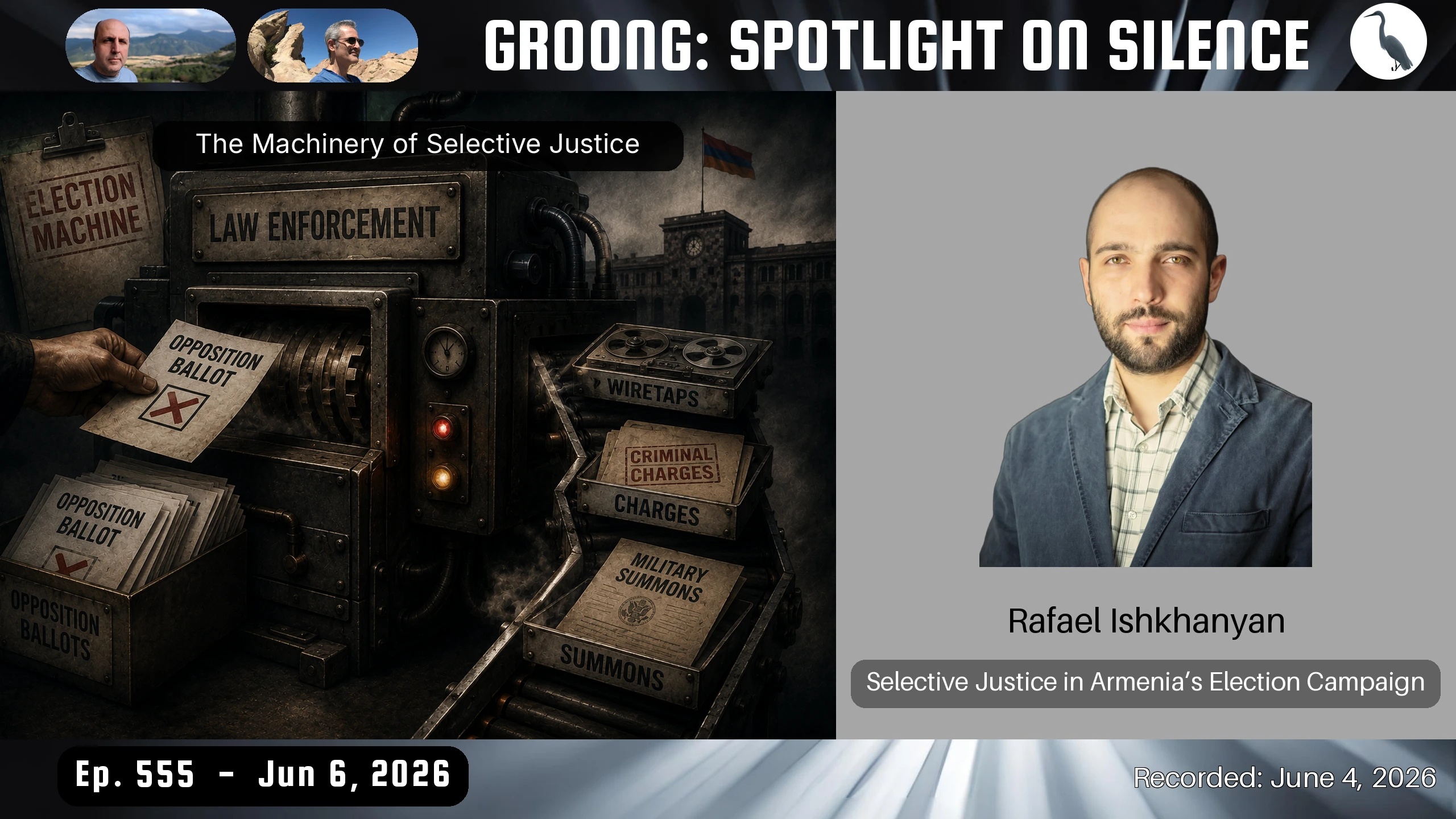
Groong Links:
Guest(s):
Topics:
- Selective law enforcement before elections
- Wiretaps, leaks, and campaign pressure
- Hate speech laws against critics
- Official threats without consequences
- Military summons as political coercion
Episode 556 | Recorded: June 4, 2026
#Armenia #ArmenianElections #HumanRights #PoliticalPersecution #Artsakh #RafaelIshkhanyan #Groong
Show Notes
Summary
In this Spotlight on Silence episode, we speak with Rafael Ishkhanyan of the Armenian Center for Political Rights about selective justice and state pressure ahead of the 2026 Armenian Parliamentary Election. We discuss wiretaps and leaks targeting opposition figures, abuse of hate speech laws against government critics, military service summons used as political coercion, and Pashinyan’s threats against political opponents and Artsakh Armenians.Main Topics Addressed
Selective Law Enforcement: Watching the Opposition, Ignoring the State
- Law enforcement’s apparent focus on opposition-linked wiretaps, leaks, and surveillance
- The use of opposition conversations as campaign material
- The lack of visible urgency when reports concern possible government-side pressure or patronage
- Akanates observer mission allegations involving the Bagratashen customs director, local administrators, and business figures in Tavush and Lori
- Claims that favorable treatment was promised if Civil Contract and Pashinyan secured reelection
- The broader question of whether the campaign is being run through political persuasion or administrative machinery
Investigative Bodies as Campaign Actors
- ACPR’s analysis of the Arthur Osipyan case
- The Investigative Committee’s treatment of Osipyan’s public questioning of Pashinyan as obstruction of an election campaign
- Video evidence cited by ACPR showing that Pashinyan agreed to answer Osipyan’s questions
- Concerns that public statements by investigative bodies may go beyond informing the public
- The use of official narratives to frame critics as criminals before court review
- Public rhetoric targeting Artsakh Armenians and opposition figures
Artsakh Refugees, Prejudice, and Political Targeting
- Artsakh refugees as a vulnerable displaced community
- The loss of homes, security, and normal civic life after the forced displacement from Artsakh
- Pashinyan’s reported use of language such as “pseudo-elites of Karabakh,” “runaways,” and claims that some should have died instead of soldiers
- The repetition of narratives suggesting that “our boys” died while Artsakhtsis ran away
- The political value of vilifying Artsakh Armenians during an election campaign
Hate Speech: Real Abuse, False Enforcement
- ACPR’s argument that Articles 329 and 330 of Armenia’s Criminal Code are being distorted
- Hate speech laws intended to protect vulnerable groups from hatred or calls for violence
- The use of these laws to protect high-ranking officials from harsh political criticism
- The treatment of “political views” as a protected characteristic
- The Hakob Grigoryan case and the April 23, 2026 Court of Cassation ruling
- The concern that criticism of a public official’s conduct is being reframed as hate speech based on a protected characteristic
Pashinyan’s Threats and the Double Standard
- ACPR’s May 19 urgent statement on Pashinyan’s threats against opposition figures
- Pashinyan’s references to Robert Kocharyan, Serzh Sargsyan, Samvel Karapetyan, and Gagik Tsarukyan
- The use of an unverified masked video to link opposition figures to threats
- Reported statements about making opponents kneel, finishing them off, and using severe forceful actions
- The contrast between legal action against opposition activists and the lack of visible legal response to Pashinyan’s own threats
Coercion Beyond the Courtroom: Fear, Duty, and the Vote
- ACPR’s June 4 urgent statement on military service as punishment
- Reports that Armenian citizens arriving from Russia may be served notices for 25-day training camps
- Public statements by government officials about sending voters from Russia to training camps
- Military Police reportedly checking passports at border crossings
- The use of compulsory military training as a possible election tool
- The absence of clear safeguards, rotation, or lottery-based selection for reservists
- The risk that military duty can be used to punish political opponents or deter voter participation
Key Questions Discussed
- What does it say about state institutions when wiretapped opposition conversations become campaign material?
- Has there been any investigation into the Akanates report on alleged administrative-resource abuse?
- Is this an election campaign, or an administrative machine mobilized for political survival?
- Are investigative bodies informing the public, or helping frame critics as criminals during the campaign?
- Are Artsakhtsis a vulnerable group?
- What is the political value of targeting people from Artsakh?
- What are Articles 329 and 330, and how are they being distorted?
- How did hate speech law become a shield for powerful officials?
- What happened in the Hakob Grigoryan case?
- Does the Court of Cassation precedent turn harsh criticism of officials into a detention risk?
- Why are opposition activists detained for crude or hyperbolic speech, while Pashinyan’s direct threats face no visible legal response?
- Are 25-day training camps now being used as an election tool?
- What legal safeguards exist to stop the state from selecting reservists based on political views?
Referenced Articles & Sources
- URGENT STATEMENT: PRIME MINISTER THREATENS POLITICAL OPPONENTS WITH VIOLENT RETALIATION (May 19, 2026)
- “HATE SPEECH” LAWS AS A TOOL OF POLITICAL PERSECUTION (June 3, 2026)
- URGENT STATEMENT: ARMENIAN AUTHORITIES ARE USING MILITARY SERVICE AS PUNISHMENT (June 4, 2026)
- Akanates report on alleged administrative-resource abuse
- Military Police notices at border crossings, Radio Aurora video
- Pink Armenia report on Article 330 and the lack of prosecutions based on sexual orientation and/or gender identity
Wrap-up
Links and Resources
That’s our show, we hope you found it helpful. We invite your feedback and your suggestions, you can find us on most social media and podcast platforms.
Thanks to Laura Osborn for the music on our podcasts.
Guests
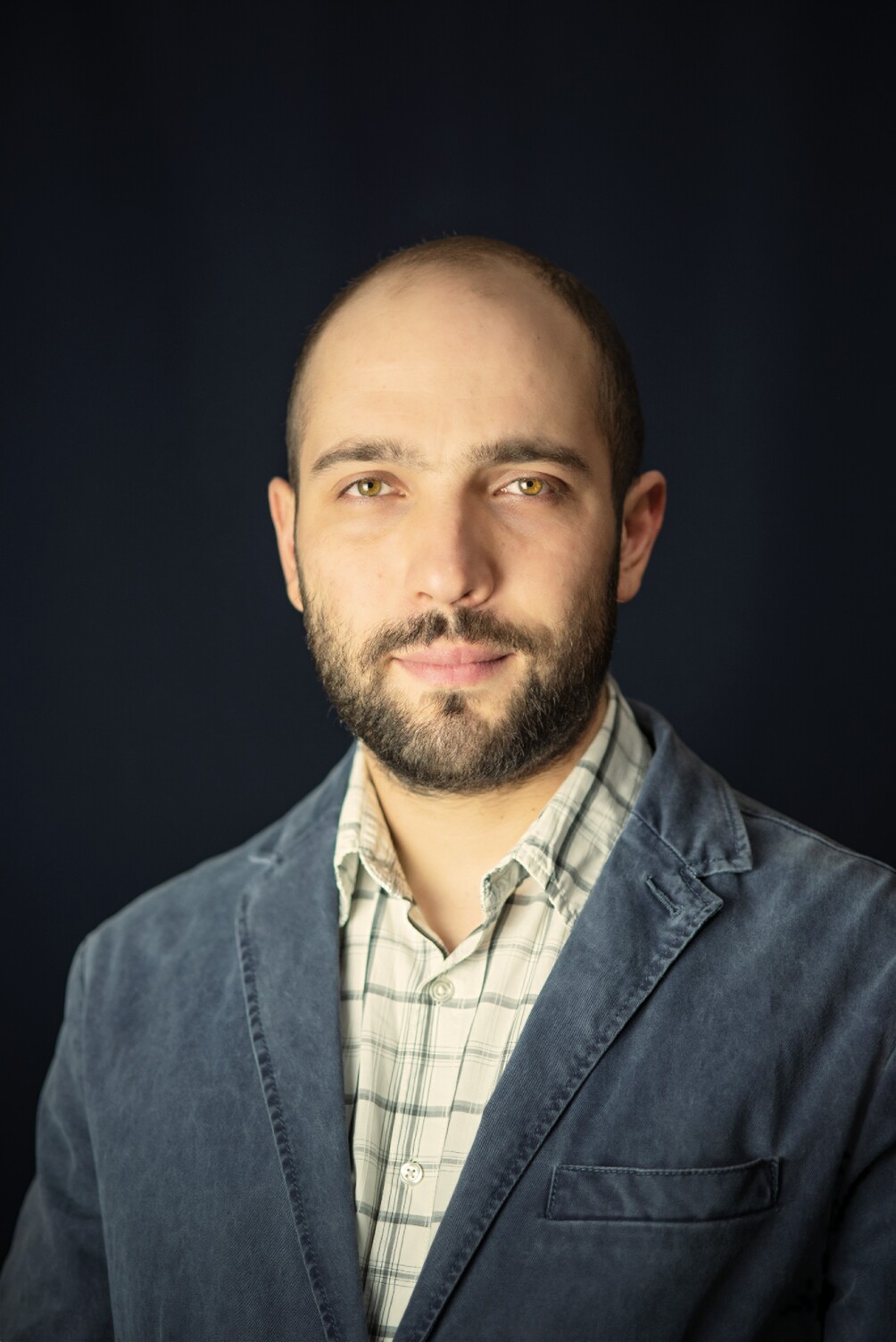
Rafael Ishkhanyan
Rafael Ishkhanyan is a lawyer specializing in human rights, particularly freedom of assembly and expression. He coordinates the monitoring of peaceful assemblies at the Helsinki Committee of Armenia and is a member of the ODIHR Panel of Experts on Freedom of Assembly and Association. In 2023, together with colleagues, he co founded the Armenian Center for Political Rights, a watchdog organization focusing on detecting, responding to, and preventing political persecution and safeguarding political rights.
Hosts
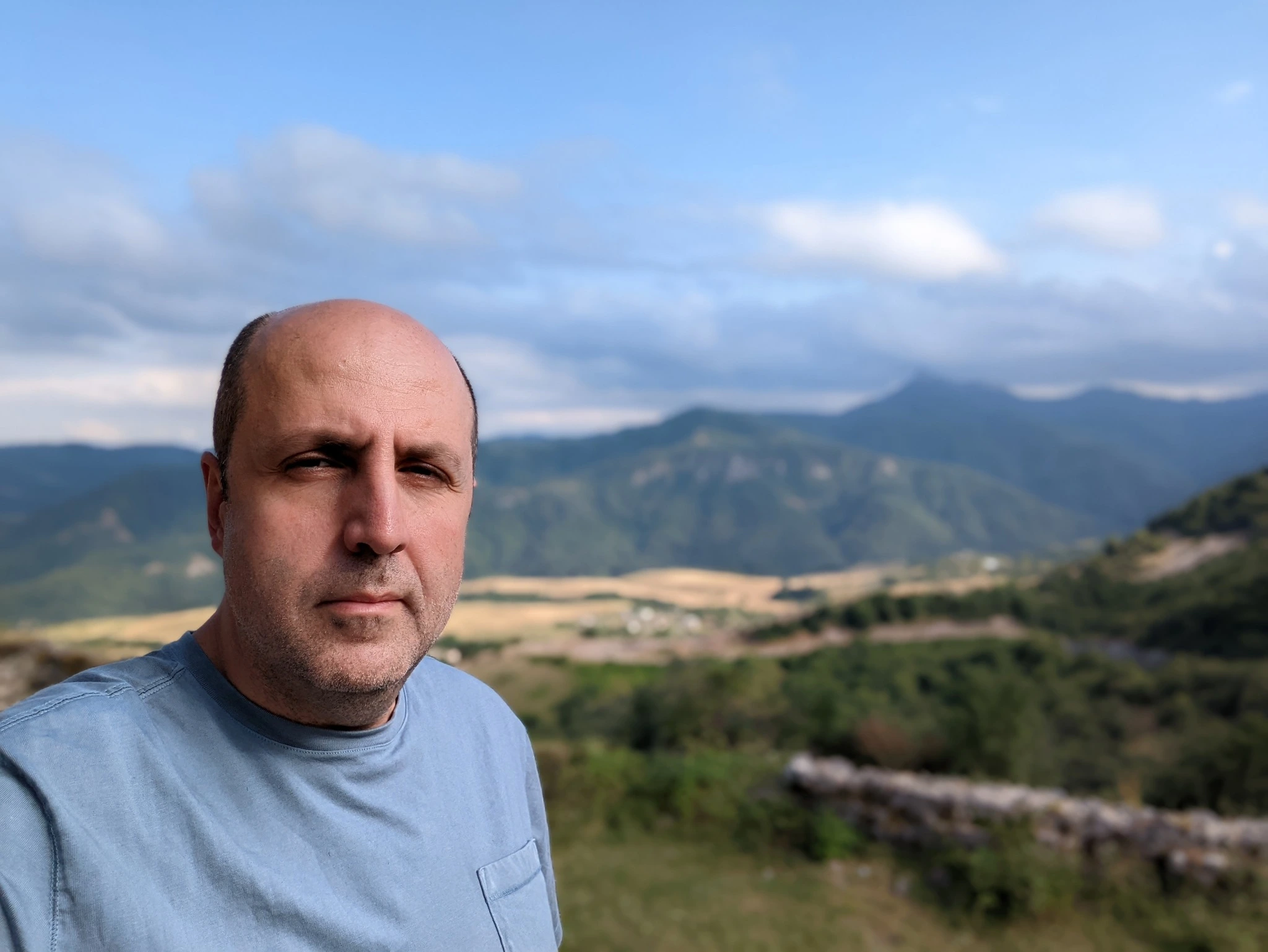
Hovik Manucharyan
Hovik Manucharyan is an information security engineer who moved from Seattle to Armenia in 2022. He co-founded the ANN/Groong podcast in 2020 and has been a contributor to Groong News since the late 1990s.
Disclaimer: The views expressed by Hovik Manucharyan on the ANN/Groong podcast are his own and do not necessarily reflect the opinions of his employer or any other organization.
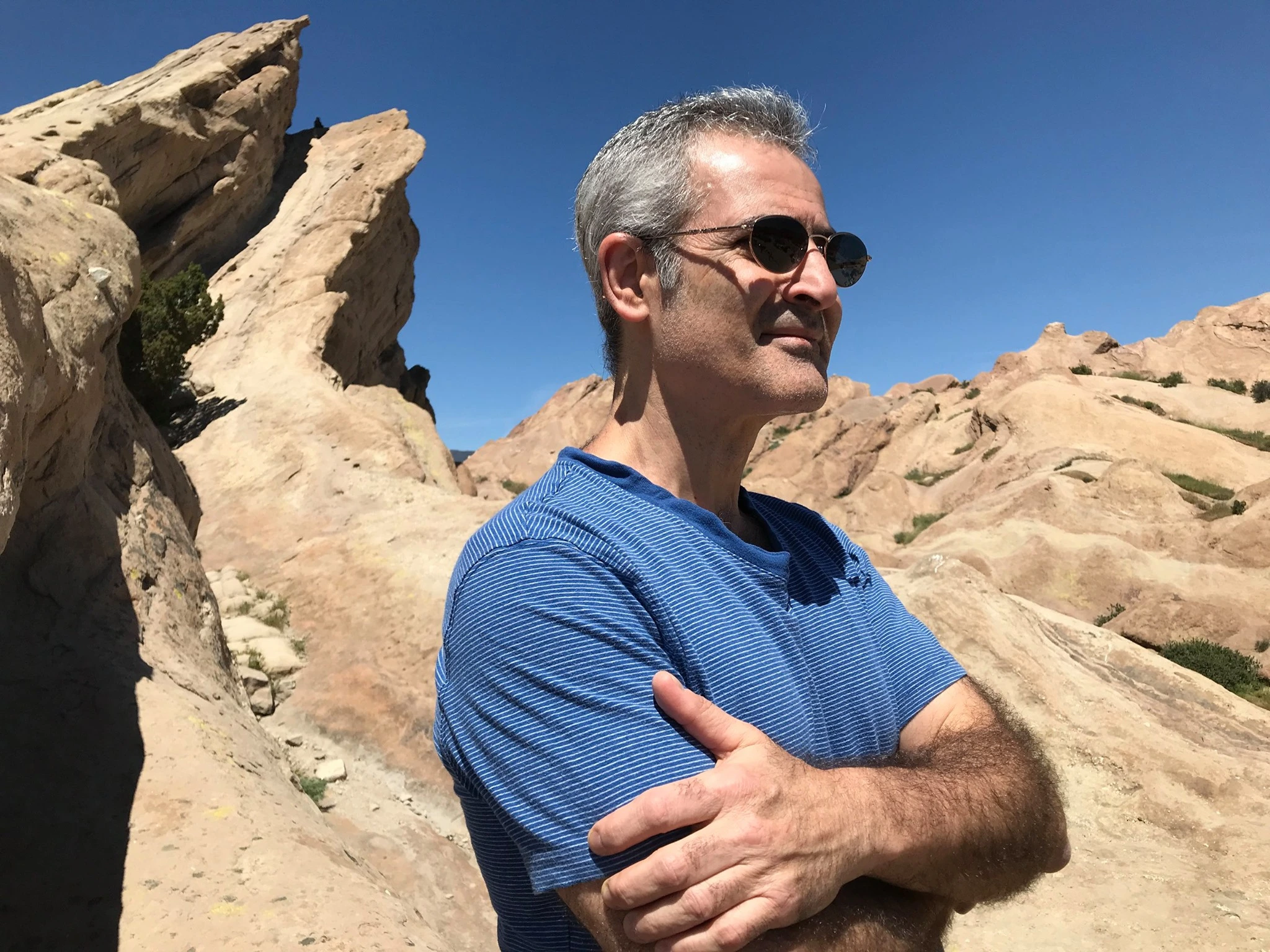
Asbed Bedrossian
Asbed Bedrossian is an IT professional, and for years oversaw the central IT enterprise infrastructure and services at USC. His decades of experience spanned across IT strategy, enterprise architecture, infrastructure, cybersecurity, enterprise applications, data center operations, high performance computing, ITSM, ITPM, and more.
Asbed founded the Armenian News Network Groong circa 1989/1990, and co-founded the ANN/Groong podcast in 2020.