Groong Links:
Guest:
Topics:
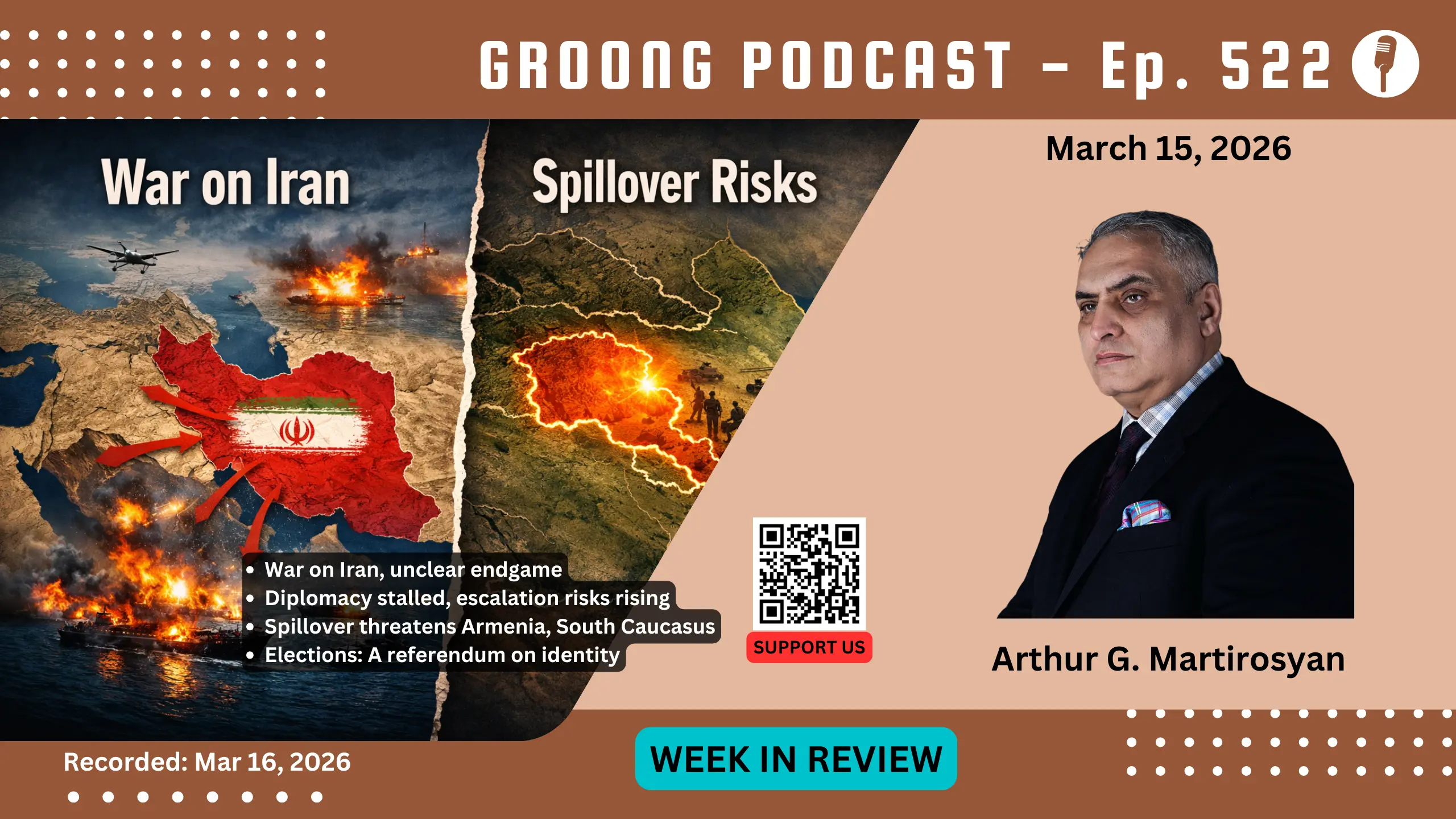
- Iran War
- Effect on Armenia
- June Parliamentary Elections
Episode 522 | Recorded: March 16, 2026
Show Notes
Summary
Arthur Martirosyan examines the ongoing U.S.–Israel war on Iran and its uncertain trajectory, focusing on escalation risks, strategic objectives, and potential diplomatic offramps. The discussion then turns to regional spillover effects, particularly the risks for Armenia amid Iran–Azerbaijan tensions and broader geopolitical shifts. We conclude with an analysis of Armenia’s upcoming parliamentary elections, including the fragmented opposition landscape, concerns about electoral fairness, and contradictions in public opinion reflected in recent polling.
Main Topics Addressed
Iran War: Objectives, Escalation, and Offramps
- The conflict remains unresolved after more than two weeks, with both sides signaling continued escalation rather than compromise
- Limited clarity on U.S. and Israeli end goals and whether their strategies are fully aligned
- Discussion of realistic diplomatic offramps versus continued military pressure
- Escalation risks across multiple domains, including regional expansion and disruption of global energy flows
Regional Spillover and Risks for Armenia
- Iran–Azerbaijan tensions raise the possibility of a broader regional conflict
- Azerbaijan’s potential role as a northern pressure point against Iran
- Turkey’s possible involvement and implications for escalation
- Short-, medium-, and long-term risks facing Armenia under different conflict scenarios
- Strategic implications for regional connectivity projects, including TRIPP
Armenia’s Parliamentary Elections
- Fragmented political landscape with multiple opposition blocs and unclear alignments
- Civil Contract maintaining structural advantages heading into elections
- Questions around whether opposition forces can consolidate effectively
Electoral Integrity and Political Climate
- Concerns over fairness due to pressure on opposition figures and uneven institutional conditions
- Role of turnout and public dissatisfaction in shaping electoral outcomes
- Debate over whether elections can be considered genuinely competitive
Public Opinion and Political Contradictions
- Disconnect between government policy shifts and public sentiment
- Continued public support for Russia despite official reorientation toward the West
- High trust in the Armenian Church despite government pressure
- Civil Contract retaining leading support despite these contradictions
Key Questions Discussed
- Is there a viable diplomatic offramp in the Iran war?
- How far could escalation spread regionally?
- Could Azerbaijan or Turkey become directly involved?
- What are the concrete risks for Armenia under different scenarios?
- Can the Armenian opposition mount an effective challenge?
- Are upcoming elections likely to be free and fair?
- How should contradictory polling data be interpreted?
Thoughts from the Participants
Arthur pointed to Hungary’s upcoming elections as a test case for how external pressure from Brussels may shape outcomes in nominally democratic systems, with possible implications for Armenia.
Hovik argued that the controversy around the Genocide Institute reflects a deeper issue of passivity within Armenian academic circles over recent years, particularly regarding Artsakh.
Asbed highlighted rising costs in the U.S. tied to the Iran war, suggesting that if regime change is the goal of the war, it may instead backfire politically inside the U.S., culminating in Trumpists’ removal from power in 2028.
Referenced Articles & Sources
Wrap-up
Links and Resources
That’s our Week in Review, we hope you found it helpful. We invite your feedback and your suggestions, you can find us on most social media and podcast platforms.
Thanks to Laura Osborn for the music on our podcasts.
Guests

Arthur G. Martirosyan
Arthur G. Martirosyan is a Senior Consultant with CM Partners. In 1994, after graduating from Yale University, he joined Conflict Management Group and Harvard Negotiation Project, and has since worked on conflicts in the former Soviet Union, the Middle East, the Balkans, Africa, and Latin America.
Hosts

Asbed Bedrossian
Asbed Bedrossian is an IT professional, and for years oversaw the central IT enterprise infrastructure and services at USC. His decades of experience spanned across IT strategy, enterprise architecture, infrastructure, cybersecurity, enterprise applications, data center operations, high performance computing, ITSM, ITPM, and more.
Asbed founded the Armenian News Network Groong circa 1989/1990, and co-founded the ANN/Groong podcast in 2020.
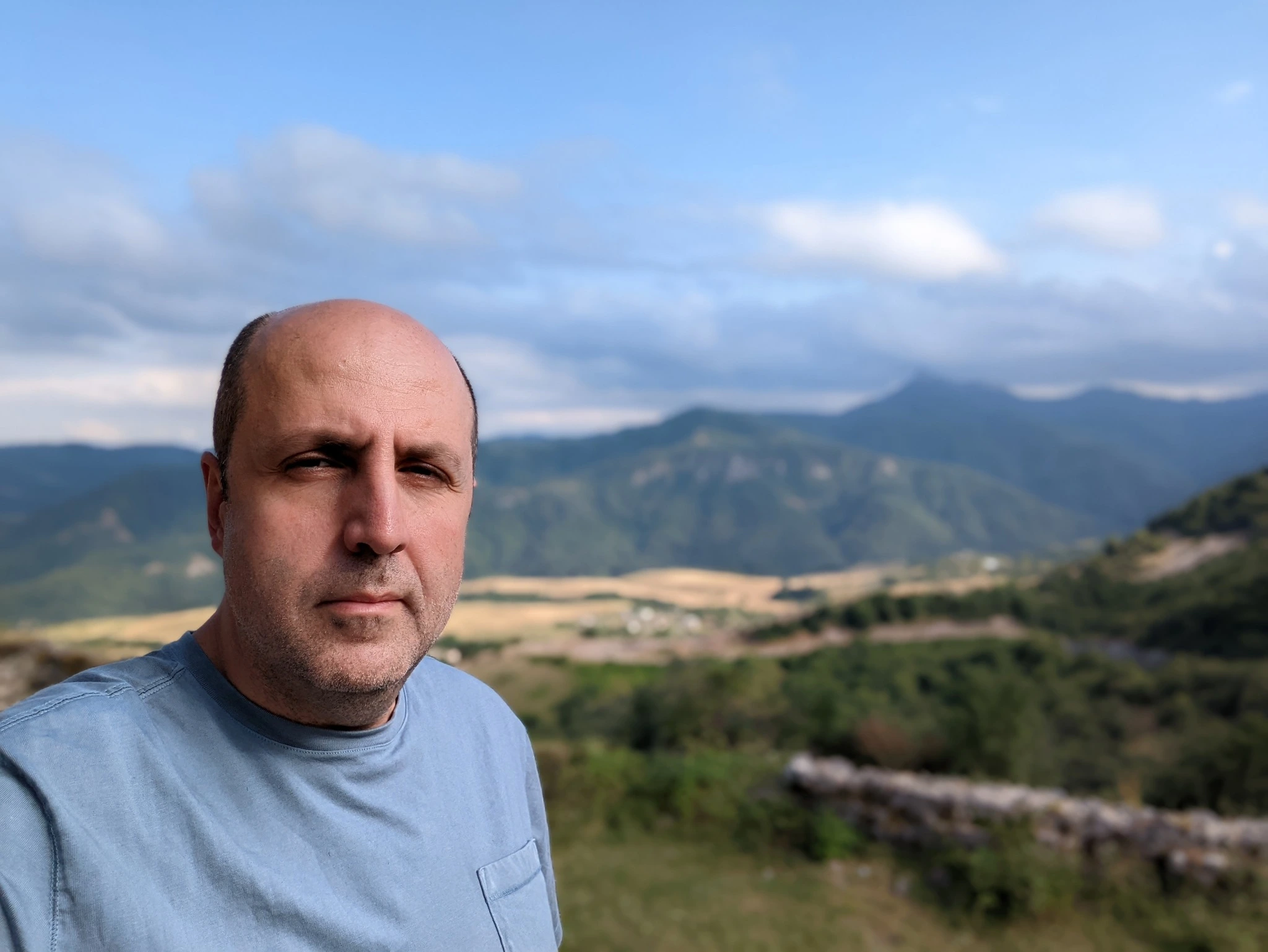
Hovik Manucharyan
Hovik Manucharyan is an information security engineer who moved from Seattle to Armenia in 2022. He co-founded the ANN/Groong podcast in 2020 and has been a contributor to Groong News since the late 1990s.
Disclaimer: The views expressed by Hovik Manucharyan on the ANN/Groong podcast are his own and do not necessarily reflect the opinions of his employer or any other organization.