Groong Links:
Topics:
- Vance visit, protocol and optics
- Tsitsernakaberd tweet, “autocorrect diplomacy”
- TRIPP corridor stake and sovereignty risks
- Nuclear SMR deal, costs and dependency
- Firebird AI project, power and value
- Drones, church silence, Baku charter and prisoners
Episode 517 | Recorded: February 13, 2026
#Groong #Armenia #JDVance #Tsitsernakaberd #TRIPP
Show Notes
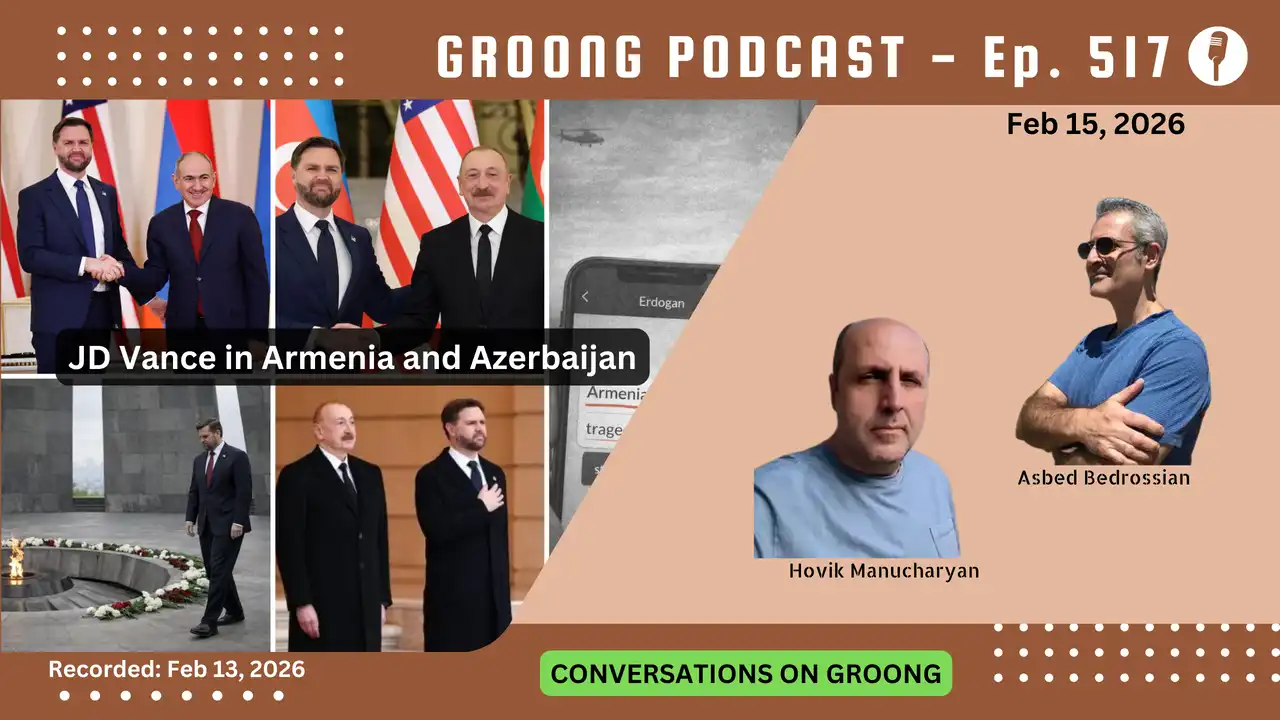
JD Vance’s visit to Armenia became a case study in symbolism, protocol, and leverage. Asbed and Hovik unpack what the trip signaled in Yerevan and Baku, from the Tsitsernakaberd controversy and “autocorrect diplomacy,” to the unanswered details behind TRIPP, the nuclear “peaceful cooperation” announcement, and the Firebird AI factory claims. They also weigh what Vance did not address, including the crackdown on the Armenian Church and the practical limits of US defense sales, then compare the Armenia stop to the Azerbaijan stop and the “Strategic Partnership Charter.”
Main Topics Addressed
Pre-visit context and optics
- Vance’s broader trip optics, security posture, and the surge of military transport flights to Armenia and Azerbaijan (with no clarity on cargo).
- How “historic” the visit was for Armenia versus the region, based on prior high-level US visits to Georgia and Azerbaijan.
Protocol and the Tsitsernakaberd controversy
- Vance’s solo visit to the Genocide Memorial, lack of Armenian official accompaniment, and what that implies about protocol and domestic politics in Yerevan.
- The tweet wording change and the episode’s framing of “autocorrect diplomacy.”
TRIPP and sovereignty risk
- The deal structure as described (long-term majority US stake), and how unanswered terms shape sovereignty, enforceability, and future resale risk.
- Why the corridor’s narrow scope benefits Turkey and Azerbaijan, and what expansions could have made it strategically useful for Armenia.
Small nuclear reactor cooperation
- The $9B “export” confusion, why transparency matters, and how SMRs compare to large reactor options on cost, timelines, and energy strategy.
- Fuel route, uranium sourcing, waste handling, and long-term dependency risks.
Firebird AI factory
- The gap between PR claims and reported financial and operational signals.
- Power requirements, grid realities, and what “value-add” would mean for Armenia.
Defense sales, the Church, elections, and Baku
- V-BAT drones as PR versus strategic utility, especially under wartime import constraints.
- Vance’s silence on jailed clergy and church persecution.
- Vance’s public endorsement framing tied to Armenia’s elections.
- In Baku: the charter signing, public claims about prisoners, and how that contrasts with expectations set in Yerevan.
Estimate on Firebird data center power estimate
GPUs:
50,000
Rack configuration:
72 GPUs per rack
50,000 / 72 ≈ 694 racks
Rack power:
132-140 kW per rack
Compute load:
694 × 132 kW ≈ 91.6 MW
694 × 140 kW ≈ 97.2 MW
Add ~10% non-GPU IT overhead:
≈ 100-107 MW IT load
Apply PUE 1.1-1.3:
Total facility demand ≈ 110-140 MW
Key Questions Discussed
- What did the trip signal about US priorities in Armenia versus Azerbaijan?
- Why was Tsitsernakaberd handled as a quasi-personal stop, and what does that say about Armenian domestic politics and protocol?
- Who can enforce TRIPP terms in a crisis, and what happens if ownership changes hands later?
- Why insist on SMRs, and what is the realistic $/MW and timeline before 2030?
- If Armenia borrows for nuclear and AI projects, what happens to debt and strategic autonomy?
- Can US drone sales matter in a hot war if transit routes run through hostile or constrained neighbors?
- Why did Vance avoid public pressure on the church crackdown despite his “defender of Christians” branding?
- What did Vance actually do in Baku on prisoners, and which prisoners did he mean?
Referenced Articles & Sources
Tsitsernakaberd, Genocide recognition, and protocol optics
Nuclear cooperation and reactor economics
- US and Armenia sign agreement on nuclear energy
- Vance’s “$9B export” figure sparks confusion
- Opposition figure comments on nuclear deal and China offer
- Rosatom VVER-1200 cost reference (Xudabao-3)
- Korea to resume construction of Shin Hanul 3 and 4
Firebird AI factory, data centers, and power draw
Elections, endorsement, and domestic politics
Azerbaijan visit, charter signing, and “prisoners” claims
- Vance and Aliyev sign “Strategic Partnership Charter” (Minval)
- CivilNet clip on Vance and “prisoners” (X)
- Vance claims to have discussed release of prisoners with Aliyev
Wrap-up
That’s our show! We hope you found it useful. Please find us on Social Media and follow us everywhere you get your Armenian news.
Thanks to Laura Osborn for the music on our podcasts.
Hosts

Asbed Bedrossian
Asbed Bedrossian is an IT professional, and for years oversaw the central IT enterprise infrastructure and services at USC. His decades of experience spanned across IT strategy, enterprise architecture, infrastructure, cybersecurity, enterprise applications, data center operations, high performance computing, ITSM, ITPM, and more.
Asbed founded the Armenian News Network Groong circa 1989/1990, and co-founded the ANN/Groong podcast in 2020.
Hovik Manucharyan
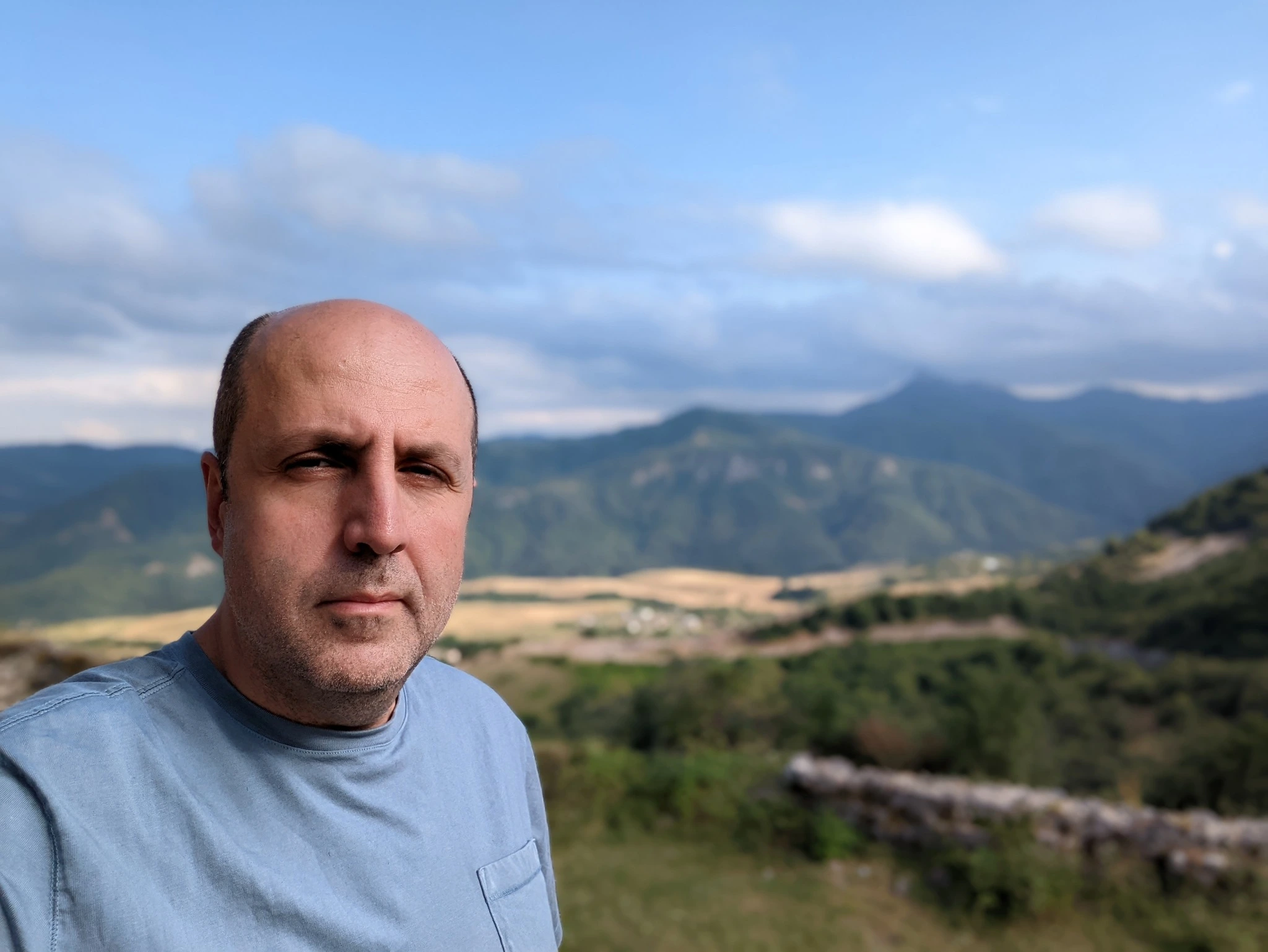
Hovik Manucharyan is an information security engineer who moved from Seattle to Armenia in 2022. He co-founded the ANN/Groong podcast in 2020 and has been a contributor to Groong News since the late 1990s.
Disclaimer: The views expressed by Hovik Manucharyan on the ANN/Groong podcast are his own and do not necessarily reflect the opinions of his employer or any other organization.