Groong Links:
Guest:
Topics:
- Trump 2.0 and the “Donroe Doctrine”
- Rules-Based Disorder?
- Iran vs. the “Big, Beautiful Armada”
- US Cohesion and Midterms
- JD Vance in the South Caucasus
Episode 515 | Recorded: February 6, 2026
Show Notes
Summary
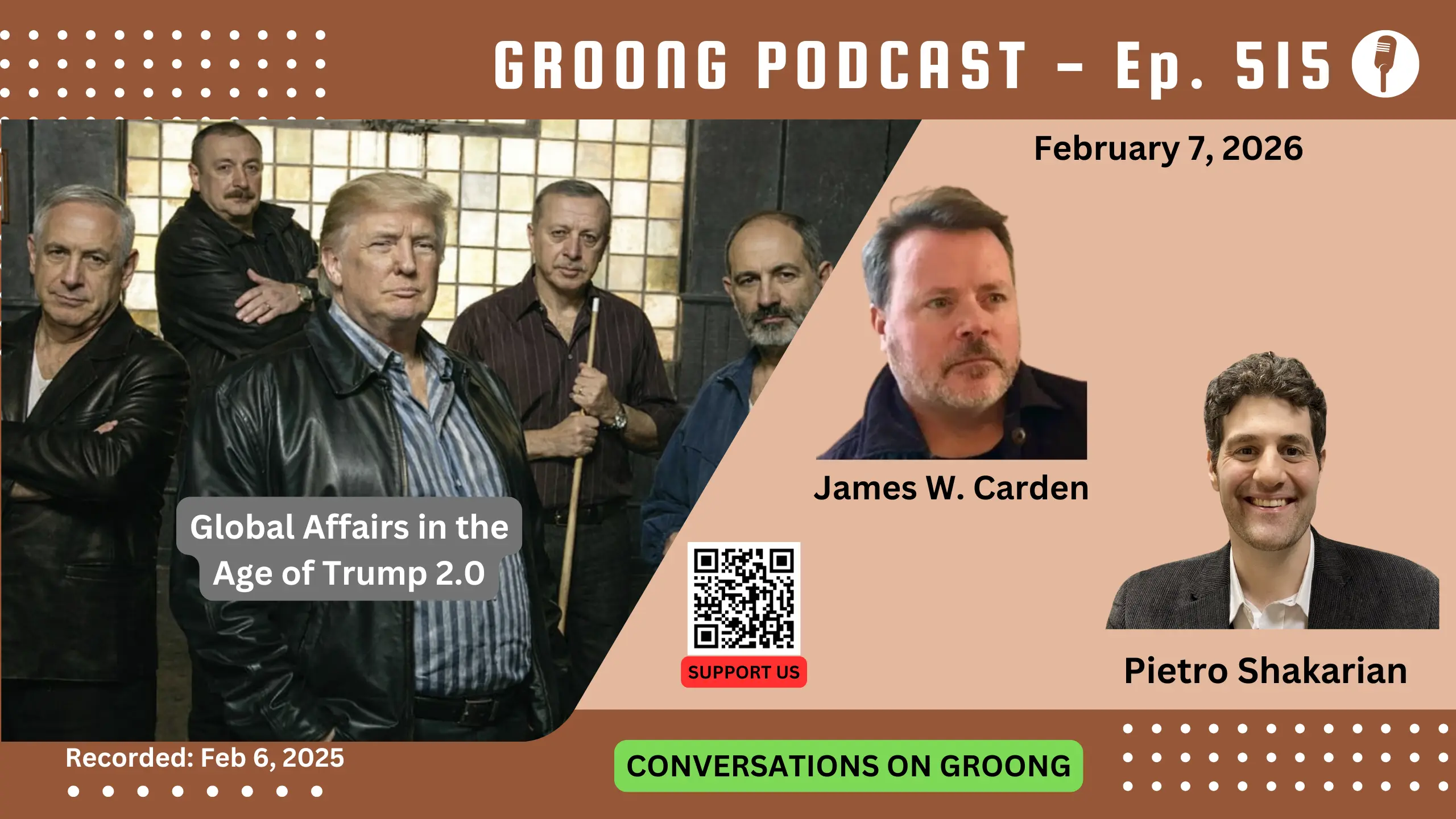
James W.Carden and Pietro A. Shakarian assess Trump 2.0’s “Donroe Doctrine” framing as branding for coercive, deal-driven policy, then widen the lens to the collapse of “rules-based order” language and the rise of pay-to-play influence concepts like Trump’s proposed “Board of Peace.” The conversation turns to Iran, where escalating pressure, shifting demands, and regional signaling raise the risk of conflict and spillover effects for Armenia. The episode closes on JD Vance’s planned Armenia-Azerbaijan trip, how Moscow and Tehran may read it, and how corridor politics (TRIPP) and Armenia’s church-state confrontation shape the stakes.
Main Topics Addressed
- Trump 2.0 foreign policy framing (“Donroe Doctrine”), hemispheric primacy, coercion, and transactional expansion rhetoric
- Great-power signaling and arms control after New START’s expiration
- The erosion of “rules-based order” narratives and Trump’s “Board of Peace” concept
- Iran escalation dynamics, coercive diplomacy versus pretext, and Russia-China signaling
- US domestic cohesion, enforcement politics, and structural versus personality-driven instability
- JD Vance’s Armenia-Azerbaijan visit, corridor pressure (TRIPP), and regional reactions (Russia and Iran)
Key Questions Discussed
- What does the “Donroe Doctrine” label capture, and what does it hide?
- Is the hemisphere-first posture mainly about China, and how does it show up in policy?
- What does New START’s expiration signal, and who benefits from the leverage it creates?
- Was “rules-based order” ever more than a slogan, and what is replacing it?
- Is the “Board of Peace” a serious institution, or influence-for-sale dressed as governance?
- On Iran, are demands structured to produce a deal, or to engineer failure?
- What escalation steps are most plausible, and what could halt them?
- Is US internal turbulence a Trump spike, or an acceleration of long-running system stress?
- Why send JD Vance to Armenia and Azerbaijan now, and what message does it send to Russia and Iran?
- How do TRIPP and Armenia’s church-state confrontation shape the visit’s implications?
Referenced Articles & Sources
- Axios: Tim Scott, Trump, and the Obama “ape” video story
https://www.axios.com/2026/02/06/tim-scott-trump-obama-ape-video - The Realist Review (Substack)
https://therealistreview.substack.com/ - Dr. Pietro Shakarian’s book: Anastas Mikoyan
https://iupress.org/9780253073556/anastas-mikoyan/
Wrap-up
Don’t forget to support us:
That’s our show! We hope you found it useful. Please find us on Social Media and follow us everywhere you get your Armenian news.
Thanks to Laura Osborn for the music on our podcasts.
Guests

James W. Carden
James W. Carden is a columnist and former adviser to the US-Russia Bilateral Presidential Commission at the U.S. Department of State. His articles have appeared in a wide variety of publications including The Nation, The American Conservative, Responsible Statecraft, The National Interest, The Los Angeles Times, and more. His Substack is at The Realist Review.

Pietro Shakarian
Dr. Pietro Shakarian is a historian of Russia and the Soviet Union. He is the author of the book Anastas Mikoyan: An Armenian Reformer in Khrushchev’s Kremlin. Dr. Shakarian’s analyses on Russian and post-Soviet affairs have appeared in The Nation, The Plain Dealer, and various other publications. He was previously a lecturer in history at the American University of Armenia in Yerevan.
Hosts

Asbed Bedrossian
Asbed Bedrossian is an IT professional, and for years oversaw the central IT enterprise infrastructure and services at USC. His decades of experience spanned across IT strategy, enterprise architecture, infrastructure, cybersecurity, enterprise applications, data center operations, high performance computing, ITSM, ITPM, and more.
Asbed founded the Armenian News Network Groong circa 1989/1990, and co-founded the ANN/Groong podcast in 2020.

Hovik Manucharyan
Hovik Manucharyan is an information security engineer who moved from Seattle to Armenia in 2022. He co-founded the ANN/Groong podcast in 2020 and has been a contributor to Groong News since the late 1990s.
Disclaimer: The views expressed by Hovik Manucharyan on the ANN/Groong podcast are his own and do not necessarily reflect the opinions of his employer or any other organization.