Groong Links:
Guest:
Topics:
- Unrest in Iran
- Russia-Iran Partnership
- Solovyov’s Statements
- Trump’s “TRIPP Wire” in the Caucasus
- Release of Armenian hostages
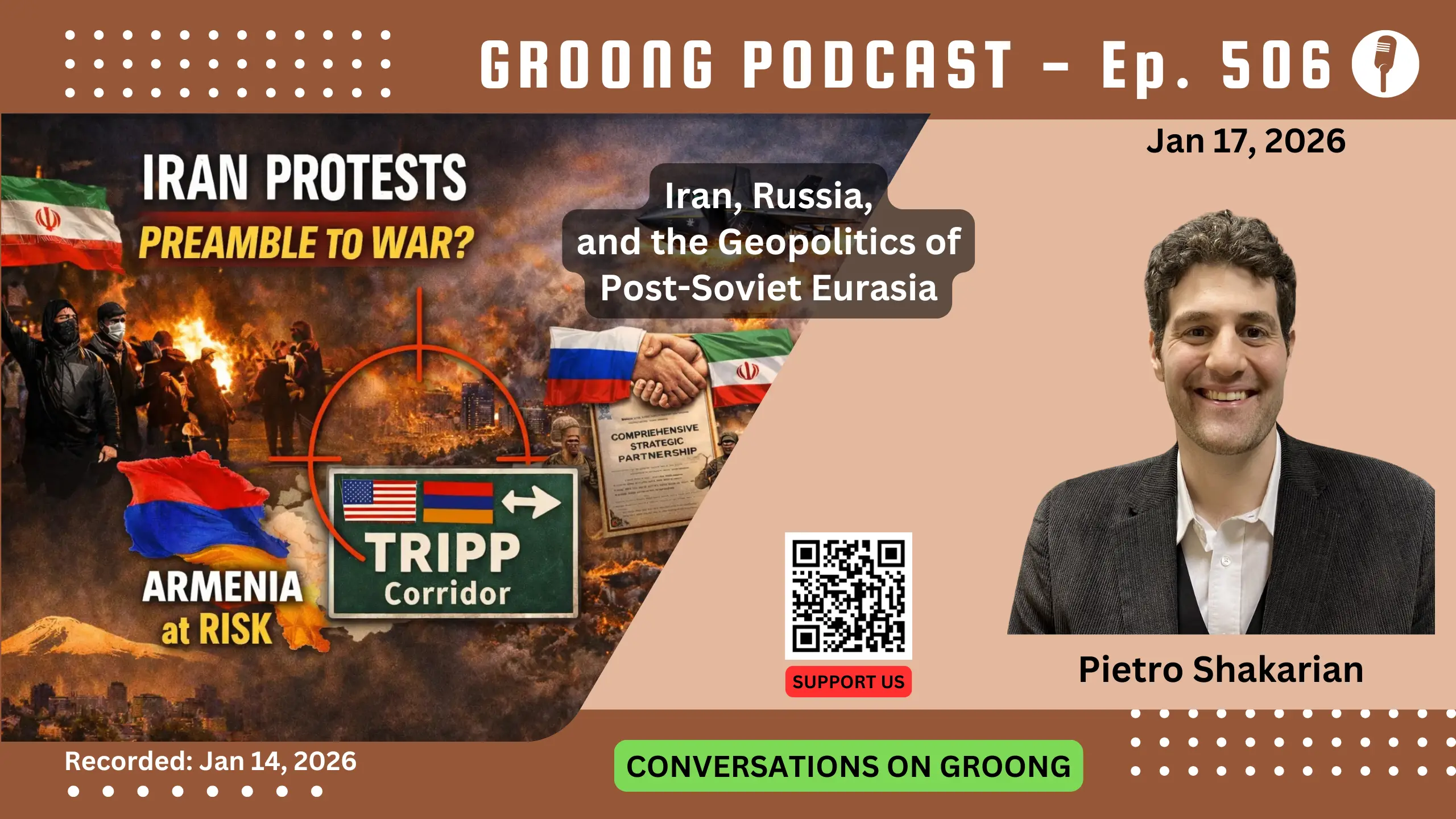
Episode 506 | Recorded on January 14, 2026
Show Notes
Summary
In this Conversations on Groong episode, historian Dr. Pietro Shakarian joins us to look at the riot-level unrest in Iran, Trump’s threats and pressure tactics, and what this could mean for Russia–Iran coordination, Armenia’s security environment, and corridor politics in the South Caucasus, including TRIPP. They also discuss Vladimir Solovyov’s recent comments on Armenia and post-Soviet Eurasia, then close with the release of four Armenian hostages from Azerbaijani captivity and what it may signal.
Main topics addressed
Unrest in Iran
- What is driving the protests and violence, given limited reliable reporting and internet shutdowns
- The roles of sanctions, economic hardship, diaspora messaging, and covert influence narratives
- Trump’s public messaging and threats, and how they change Iran’s threat perception
- Why Tehran may lean more on Russia and China under pressure
Russia–Iran partnership
- How the Comprehensive Strategic Partnership has evolved since it was signed
- Post–June war rebuilding: air defense and missile stockpiles, and the role of suppliers
- How diplomatic coordination (including the Araghchi–Lavrov engagement) fits into the larger trend
- What a destabilized Iran would mean for Eurasian alignments, including BRICS, and for China’s role
Russia’s posture beyond Ukraine and Solovyov’s statements
- Whether Moscow now has more bandwidth for the South Caucasus and Central Asia
- What Russia might do if the US or Israel strikes Iran again, beyond standard statements
- How to interpret Solovyov’s rhetoric on Armenia and post-Soviet Eurasia
- Whether this signals that Moscow’s patience with Pashinyan is fading
Trump’s “TRIPP wire” in the Caucasus
- Iran’s red lines on Armenia’s sovereignty over Syunik, and how an Iran crisis could affect enforcement
- How Iran might read TRIPP’s “implementation framework” and Marco Rubio’s statements
- The impact of protests at the Iranian Embassy in Yerevan on Armenia–Iran relations
- What it means when US figures call on Azerbaijan to “be ready”
- Whether TRIPP pulls Israel deeper into the regional contest, and Armenia’s recent posture toward Israel
- Worst-case implications for Armenia if a joint US–Israeli strike on Iran proves devastating
Release of Armenian hostages
- Azerbaijan’s release of four captives (Viken Euljekjian, Vagif Khachatryan, Gevorg Sujyan, David Davtyan)
- How to assess the move for Armenia and the region
- Whether the timing connects to Iran or TRIPP dynamics
- The status of remaining Armenian captives in Baku
Key questions discussed
- Are Iran’s protests organic, opportunistic, externally curated, or a mix?
- What role do internet shutdowns and information warfare play in shaping perceptions?
- Does unrest push Tehran and Moscow closer, and around which shared threats?
- Which areas of Russia–Iran cooperation become urgent under domestic instability (military-technical, drones, ISR)?
- What would a destabilized Iran mean for the Eurasian balance, including BRICS?
- What role does China play as partner, supplier, or broker?
- If the US or Israel hits Iran, does Russia respond with more than condemnation?
- Do Solovyov’s comments suggest a harder Russian line toward Armenia’s current government?
- Can Iran enforce its South Caucasus red lines while under internal strain?
- How might Iran perceive TRIPP’s rollout and US messaging around it?
- Do protests in front of the Iranian Embassy in Yerevan change Armenia–Iran risk?
- Does TRIPP increase Armenia’s exposure to confrontation with Iran?
- Why did Azerbaijan release four captives now, and what does it signal?
Links & References
- Russo-Iranian Relations Amid the Rise of the Rest (Realist Review, Pietro Shakarian)
- Mossad spurs Iran protests, says agents with demonstrators in Farsi message (The Jerusalem Post)
- Donald Trump Truth Social post (linked in outline) (Truth Social)
- Trita Parsi on Substack (Substack)
- Luke Coffey post (linked in outline) (X)
- Azerbaijan Releases Four Armenian Captives (Hetq)
- Anastas Mikoyan: An Armenian Reformer in Khrushchev’s Kremlin (Indiana University Press)
Wrap-up
Don’t forget to support us:
That’s our show! We hope you found it useful, and you will SHARE OUR SHOWS with your friends on Social Media. That is a great way to support us.
Thanks to Laura Osborn for the music on our podcasts.
Guests
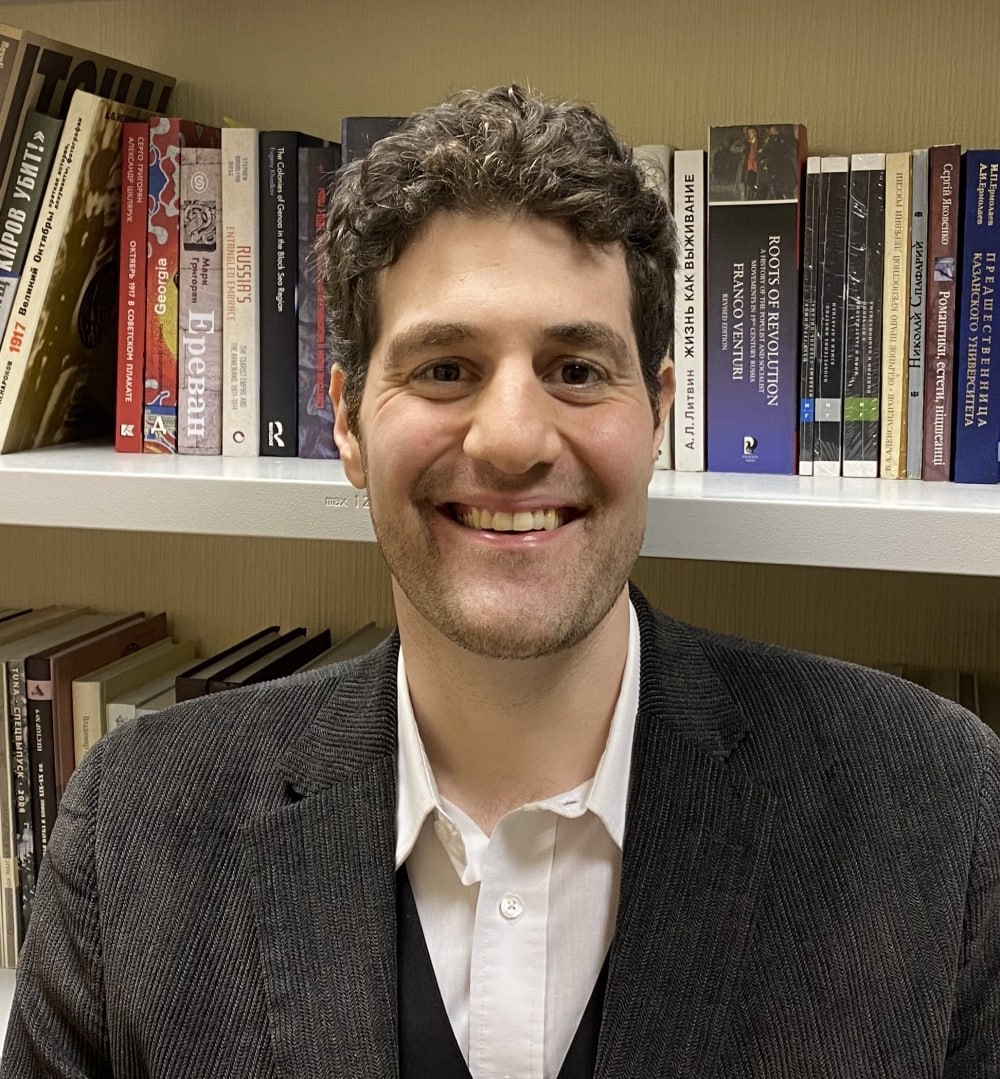
Pietro Shakarian
Dr. Pietro Shakarian is a historian of Russia and the Soviet Union. He is the author of the book Anastas Mikoyan: An Armenian Reformer in Khrushchev’s Kremlin. Dr. Shakarian’s analyses on Russian and post-Soviet affairs have appeared in The Nation, The Plain Dealer, and various other publications. He was previously a lecturer in history at the American University of Armenia in Yerevan.
Hosts
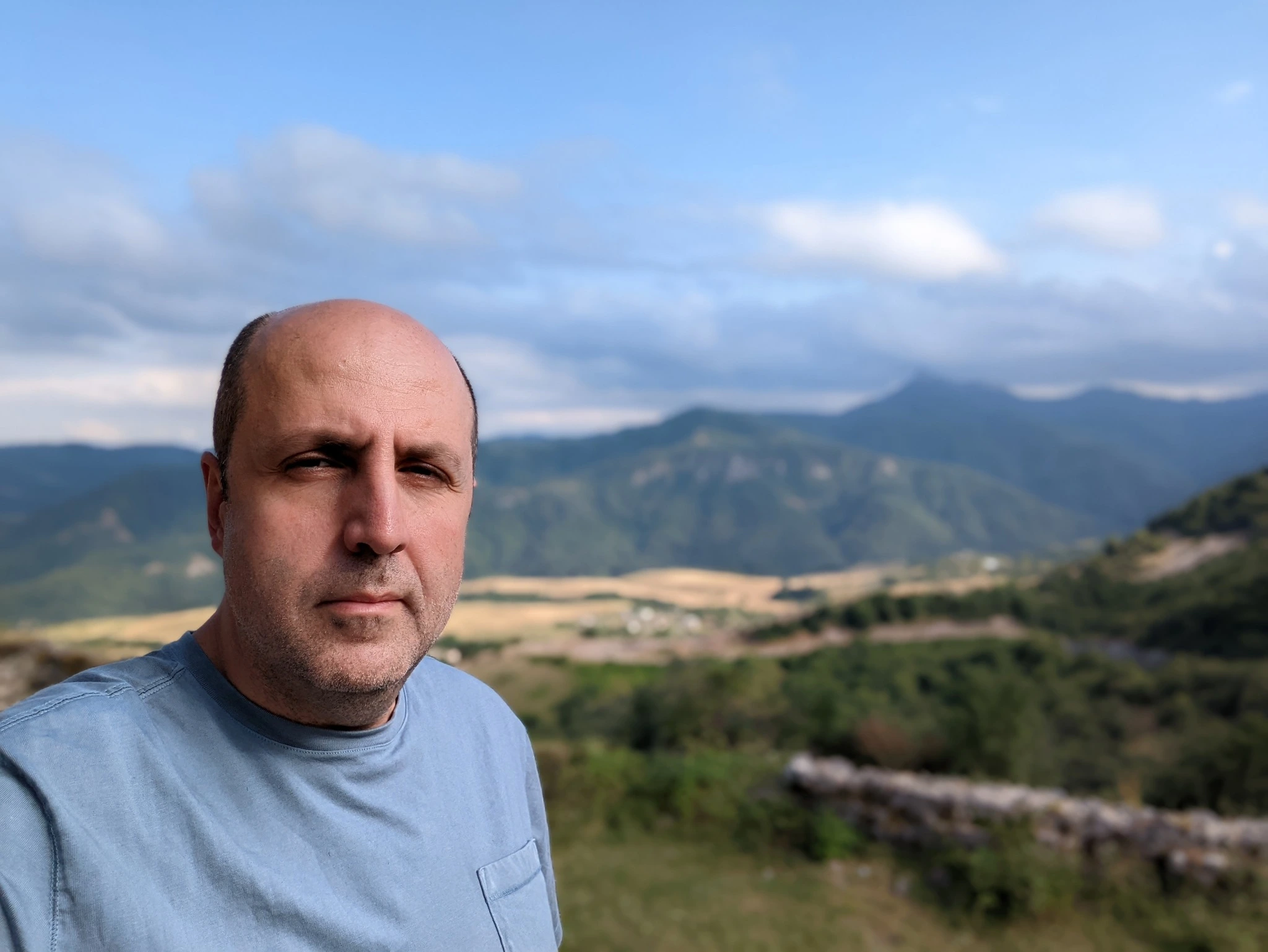
Hovik Manucharyan
Hovik Manucharyan is an information security engineer who moved from Seattle to Armenia in 2022. He co-founded the ANN/Groong podcast in 2020 and has been a contributor to Groong News since the late 1990s.
Disclaimer: The views expressed by Hovik Manucharyan on the ANN/Groong podcast are his own and do not necessarily reflect the opinions of his employer or any other organization.
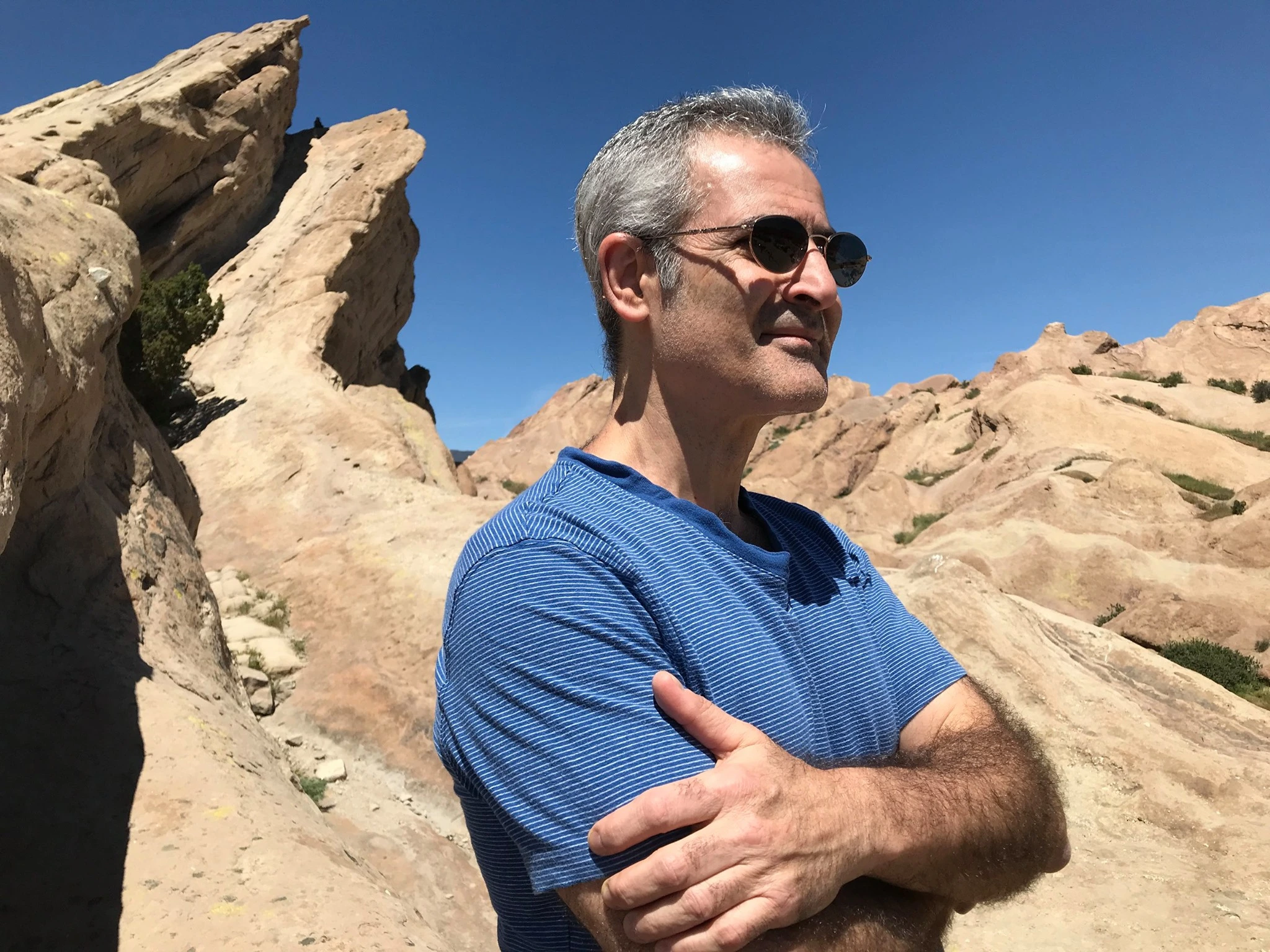
Asbed Bedrossian
Asbed Bedrossian is an IT professional, and for years oversaw the central IT enterprise infrastructure and services at USC. His decades of experience spanned across IT strategy, enterprise architecture, infrastructure, cybersecurity, enterprise applications, data center operations, high performance computing, ITSM, ITPM, and more.
Asbed founded the Armenian News Network Groong circa 1989/1990, and co-founded the ANN/Groong podcast in 2020.