Benyamin Poghosyan - Pashinyan Lies on Decades of Negotiations, 17 Points to an Agreement, 2024 Review and 2025 Outlook | Ep 403 - Dec 29, 2024 [EP403]
Posted on Wednesday, Jan 1, 2025 | Category: Armenia, Azerbaijan, Artsakh, Nagorno Karabakh, Middle East, Israel, Lebanon, Syria, Iran, Turkey, Russia, Armenian Church, Ukraine, Genocide, Geopolitics, China, Georgia, European Union | Series: wir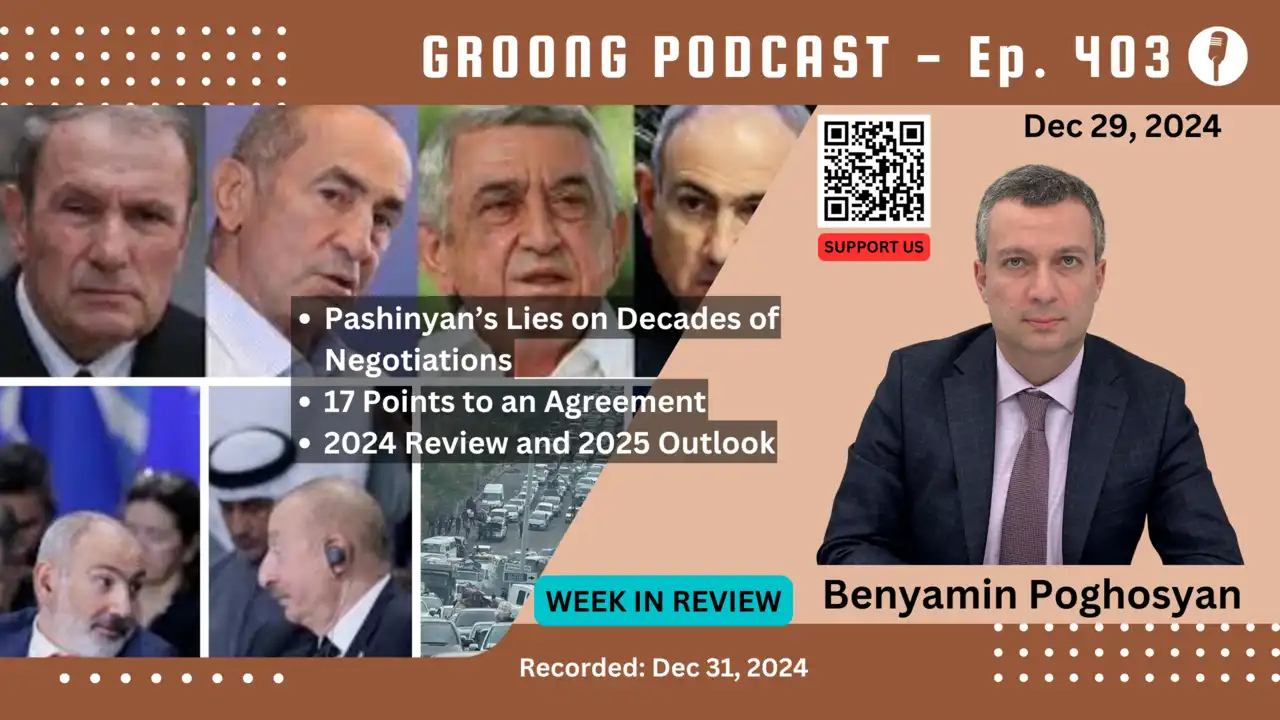
Groong Links:
Guest:
Topics:
- Pashinyanâs Lies on Decades of Negotiations
- 17 Points to an Agreement
- 2024 Review and 2025 Outlook
Episode 403 | Recorded: December 31, 2024
Show Notes
This is the final episode of 2024 for the Armenian News Network, Groong, featuring Dr. Senior Research Fellow at APRI Armenia Benyamin Poghosyan , Chairman of the Center for Political and Economic Strategic Studies. In this Week in Review episode, we delve into a comprehensive discussion of pivotal topics that have defined the past year. These include Nikol Pashinyan ’s controversial claims about past negotiations on Artsakh , the evolving dynamics of Armenia-Azerbaijan relations, and the broader implications of these developments for the region and beyond.
As we close out the year, we also reflect on the most significant events of 2024 and consider what lies ahead in 2025. This engaging episode provides expert insights and thought-provoking analysis, offering listeners a detailed understanding of the current geopolitical landscape.
Topics Covered
- Pashinyan’s claims about decades of negotiations on Artsakh and their historical context
- Ilham Aliyev ’s latest demands, including constitutional changes and their strategic implications
- The dissolution of the OSCE Minsk Group: motivations and consequences for regional diplomacy
- Summary and analysis of the “17 Points to an Agreement” framework and its unresolved issues
- Reflections on the major political, economic, and social stories that shaped 2024
- Key predictions for 2025, focusing on the geopolitical future of Armenia, Azerbaijan, Iran, Turkey, and the broader South Caucasus region
Key Questions Discussed
- Why has Nikol Pashinyan made contentious statements about past negotiations, and what are the broader implications of these assertions for Armenia’s domestic and foreign policy?
- What do Ilham Aliyev’s additional demands indicate about Azerbaijan’s long-term strategy in the region, and how might these demands influence future peace talks?
- How do Russia’s statements on dissolving the OSCE Minsk Group reflect its shifting priorities in the South Caucasus, and what does this mean for Armenia’s alliances?
- What are the unresolved points in the Armenia-Azerbaijan peace agreement framework, and how might they affect the likelihood of a lasting resolution?
- How will regional geopolitics, particularly developments in Iran and Ukraine, shape the landscape of the South Caucasus and beyond in 2025?
- What lessons can be drawn from the political and economic events of 2024 to better anticipate future challenges?
2024 Review and 2025 Predictions
(Segment begins at 40:53)
Asbed Bedrossian
2024 Predictions — Assessment
- Armenian real estate downturn
Predicted a possible significant downturn. This did not occur in 2024, though Asbed noted that underlying risks remain and may materialize in 2025. - Trump election
Initially assessed as 50–50, revised to 75–25 by mid-year. Trump’s election is counted as a successful prediction. - Israel–Gaza war regional expansion
Assigned a low probability to regional escalation. This proved incorrect, as the conflict expanded to Lebanon, Syria, and direct Iran–Israel exchanges, with mass civilian casualties. Asbed still marked partial credit for identifying escalation risk dynamics.
2025 Outlook
- Ukraine war
Likely to wind down or slow, possibly entering negotiations, but not fully resolved. - Palestine / Gaza
Expects continued catastrophe, potential ethnic cleansing, and broad international indifference. Frames this as a defining moral issue of 2025. - Armenia
Does not expect regime collapse. Anticipates continued Western financial support via loans, sustaining the current government amid prolonged insecurity and stagnation.
Benyamin Poghosyan
2024 Predictions — Assessment
- Armenia–Azerbaijan agreement
Initially gave a medium probability that some agreement or statement would be signed, mainly to help Azerbaijan’s image before COP29. Outcome: incorrect. No agreement was signed, and Aliyev rehabilitated his image without concessions. - Ukraine war freeze
Medium probability prediction. Did not occur. - Return of Armenians to Artsakh
Low probability prediction. Now assessed as near zero, both in hindsight and going forward.
Overall assessment: Shifted from cautious optimism early in the year to near-total pessimism by year’s end.
2025 Outlook
- Ukraine
The central global variable: either a ceasefire or continued war, both with major geopolitical consequences. - Iran
Sees Iran as the main regional flashpoint, either through external confrontation (Israel or the US) or internal instability and power transition. - South Caucasus / Armenia–Azerbaijan
Does not expect a peace agreement. Predicts Azerbaijan will focus on the timing, scale, and form of escalation against Armenia.
Hovik Manucharyan
2024 Predictions — Assessment
- Meaningless Armenia–Azerbaijan treaty
Expected a symbolic agreement. This did not happen, though Hovik noted Aliyev ultimately did not need one. - Enclaves
Predicted territorial losses. Assessed as accurate, noting enclaves were effectively handed over. - Pashinyan consolidating power
Predicted increased authoritarian behavior with Western indifference. Marked as fully correct. - Opposition effectiveness
Low probability that the opposition would organize effectively. Remains unfulfilled.
2025 Outlook
- Iran
Aligns with Benyamin’s view. Expects Iran to be the central regional crisis point. - Ukraine
Predicts the war may slow but not end, with conflict displaced into other regions. - Armenia
Sees no positive trajectory without regime change. Views an Azerbaijani attack as a matter of when, not if. Emphasizes morale and internal readiness as Armenia’s only real deterrents.
Overall Takeaways
- 2024
Azerbaijan consolidated gains with minimal cost, Western accountability eroded faster than expected, and pessimistic scenarios materialized more often than optimistic ones. - 2025
No peace dividend expected. Ukraine, Iran, and Azerbaijan’s posture toward Armenia dominate forecasts. Risk and instability increase rather than decline.
Links Referenced During the Show
- Episode 403 on YouTube
- Episode 403 Show Notes
- Related episodes: Episode 300 and Episode 347
Closing Remarks
This episode concludes a remarkable year for the Groong podcast, marking our 103rd show in 2024. Our discussions aim to deliver objective and nuanced perspectives on critical regional and global issues, making this platform an invaluable resource for diplomats, experts, and engaged audiences alike.
We thank our listeners for their continued support and look forward to more impactful conversations in the year ahead. Happy New Year to all, and here’s to a 2025 filled with insightful dialogue and meaningful connections.
Wrap-up
Links and Resources
That’s our Week in Review , we hope you found it helpful. We invite your feedback and your suggestions, you can find us on most social media and podcast platforms.
Thanks to Laura Osborn for the music on our podcasts.
Guests

Benyamin Poghosyan
Dr. Benyamin Poghosyan is a Senior Research Fellow at APRI Armenia , a Yerevan based think tank,and the Chairman of the Center for Political and Economic Strategic Studies. He has served as the vice president for research and head of the Institute for National Strategic Studies at the National Defense Research University in Armenia. Dr. Poghosyan was a Distinguished Research Fellow at the US National Defense University College of International Security Affairs. He is a graduate from the US State Department Study of the US Institutes for Scholars 2012 Program on US National Security Policy Making. He holds a PhD in history and is a graduate from the 2006 Tavitian Program on International Relations at Fletcher School of Law and Diplomacy.
Hosts

Asbed Bedrossian
Asbed Bedrossian is an IT professional, and for years oversaw the central IT enterprise infrastructure and services at USC. His decades of experience spanned across IT strategy, enterprise architecture, infrastructure, cybersecurity, enterprise applications, data center operations, high performance computing, ITSM, ITPM, and more.
Asbed founded the Armenian News Network Groong circa 1989/1990, and co-founded the ANN/Groong podcast in 2020.

Hovik Manucharyan
Hovik Manucharyan is an information security engineer who moved from Seattle to Armenia in 2022. He co-founded the ANN/Groong podcast in 2020 and has been a contributor to Groong News since the late 1990s.
Disclaimer: The views expressed by Hovik Manucharyan on the ANN/Groong podcast are his own and do not necessarily reflect the opinions of his employer or any other organization.